Secret Paths

Like most people, I bumble through each day doing pretty much the same things.  For instance, I work in a generic office park and like to go for a walk at lunch to a cafeteria in a nearby building:
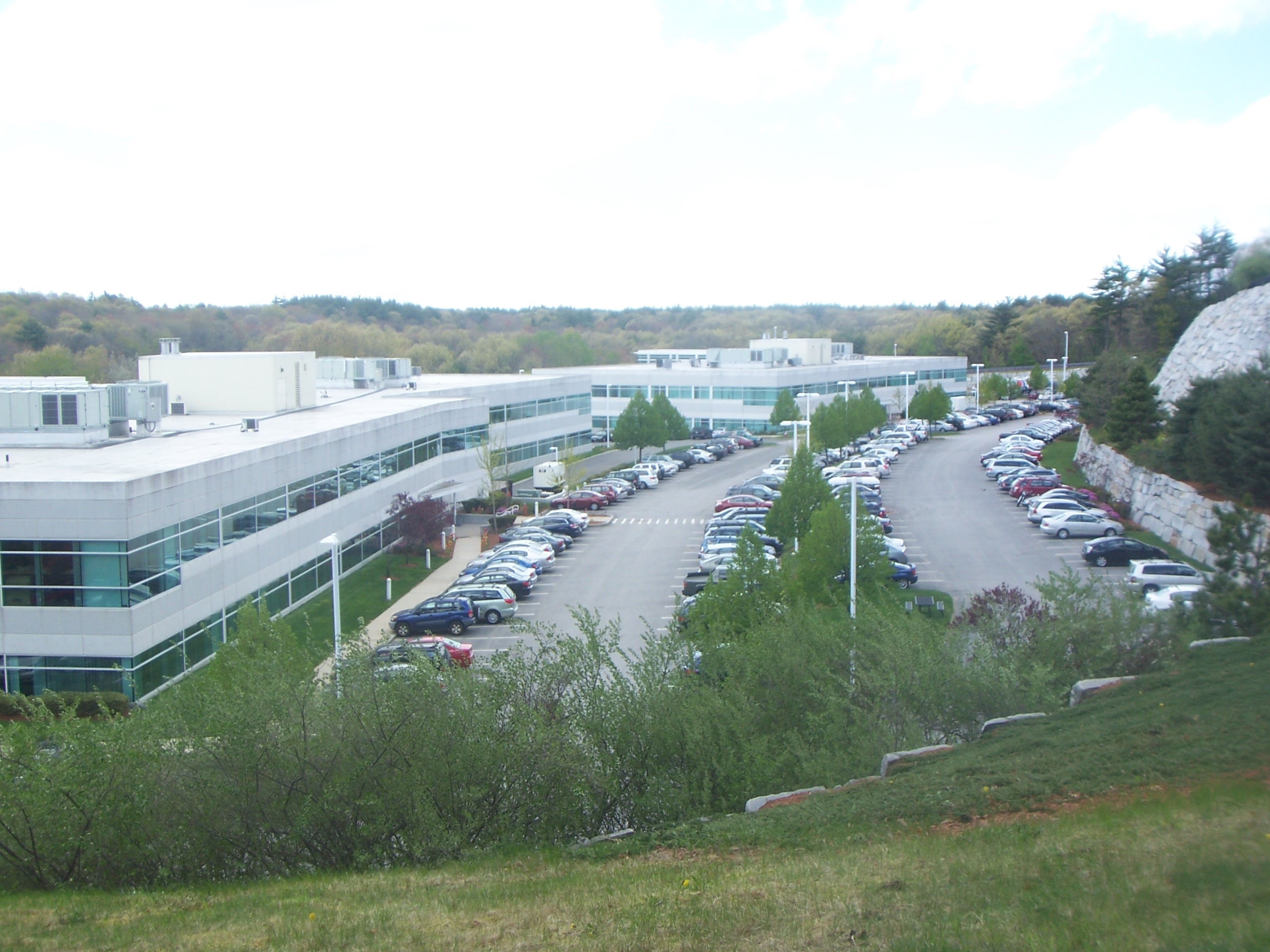
Low buildings with strip windows surrounded by parking lots – the dark Satanic mills of our day

This being the heavily wooded Northeast, the park is surrounded by forest.  One day  I happened to glance over at the fence surrounding the park.  Was that a gap in it?

Entrance to forest path

From the road you could barely see it.  The fence had to stop somewhere, and it looked like there was just brush beyond it.   If you hopped the guard rail and clambered up the mulched slope, though, you could see a path winding down the hill.

So, do you have a meeting to get to immediately after lunch?  Do you need to get back to some task?  Are you a grown-up, whose actions are mainly determined by duty, or are you a temporary child, off the clock for the moment?

I followed the path, of course.  It led down through a light hardwood forest.  It’s light because this was farmland only a century ago:

Remnants of a different age

The woods around here are full of these old stone walls.  18th and 19th century farmers would haul the boulders out of the fields to make them plowable, and pile them up as rough border fences.  They’re actually of some value these days as building materials for suburban walls, since they have nice patterns of lichen growing on them.

A little further on I came across the indestructible relics of our age:

Polyethylene soda bottles – remnants of the current age

They probably washed up here in the spring floods.   It didn’t look like a place where teenagers came to drink and smoke.  Polyethylene never actually degrades – it just breaks into smaller pieces.   The world is now full of the stuff.  There’s going to be a geological stratum of it, the Plastian Era, unless some clever bacterium figures out how to metabolize it.

The path led down to a river:

Upper reaches and marshes of the Shawsheen River

Across it was another office park and a highway.   I’ve worked here for years and had no idea any of this was here.  It’s pretty shallow, but you could canoe it.

So where did this path lead?

Over the hills and far away

I followed it along the bank of the river for about half a mile.  There wasn’t another sign of humanity.   Two deer looked at me and then bounded away.  I saw burrows big enough for foxes.   For a while the path ran along the top of a mound that snaked through the woods.   This is a rather curvy railroad embankment, I thought, then realized it was actually a glacial esker, a ridge formed of sediment from sub-glacial streams.    That’s a remnant of a much earlier age.

The path ended in a road, of course.  You can’t go all that far in eastern Massachusetts before hitting one.  There was yet another office park, and it was time to go back to work.

Back at the office, Google Maps told me that I had discovered part of the Shawsheen River Conservation Area.  The Shawsheen starts a mile or two up from where I came upon it, then meanders its way northeast, ultimately flowing into the Merrimack.    Mills had been built upon it in the 17th century, but now it was hidden away in culverts and pieces of wasted land, like the one I had come upon.   Now visited only by the occasional fisherman or stroller like me, it was little patch of nature among the office parks.   Sometimes, if you keep your eyes open as you bumble through your day, you’ll see something wonderful.

Posted in Uncategorized | Leave a comment

A Failed High-Tech Gamble

Ten miles north of Boston is the National Historic Site of  the Saugus Iron Works, site of the first heavy industry in the country.   It’s a pretty spot, and a great place for a picnic, which my family took advantage of a couple of weeks ago:

Water wheels to drive the blast furnace (foreground) and rolling mill (background)

It’s a reconstruction of the first blast furnace and iron works in the US.  It had its first pour in 1648 and last in 1668.  The site was lost for centuries, until archaeologists uncovered it in the 1950s.  They found the original hammer for the rolling mill (a 500-pound chunk of iron), found the remains of the wooden water wheels, and found the foundations of the brick furnace itself.  Then volunteers found the plans and rebuilt the entire site, re-creating both the mechanisms and the buildings.

I’m sure that most visitors today see it as a charming piece of antique technology, the kind whose workings one can actually see and understand.  You can trace just how the water runs down the spillway, drives the overshot wheel, and turns a crank to pull a bellows or a hammer up and down.

To me, though, it looks like a desperate attempt to build the highest technology of the day by people who were living on the edge of world.   It’s as if the people of McMurdo Station in Antarctica attempted to build a semiconductor fab.

In the 1640s the Massachusetts Bay Colony was barely established.  The main fleet of some 20,000 colonists had only come across in the 1630s.   They had settled the coast of New England, and penetrated a few miles inland along water routes, but were faced with a vast and unknown continent to the west, full of hostile natives.   Plus there were hostile French to the north and hostile Virginians and Spaniards to the south.   Few others had come since then, since England was in the midst of a horrific civil war.  King Charles II and Parliament were at each other’s throats over who was the actual master of England.

The colonists could grow their own food, weave their own clothes and build their own houses.   The key technology they lacked was iron.   Every nail and every axehead had to come from England.    So in 1641 the Puritan leaders of Massachusetts  set up a plan for “the discovery of mines”, and appointed the governor’s son, John Winthrop Jr., to lead it.  He found financing for an iron works in England, and artisans to run it, but picked a bad site in Quincy Mass (now the John Winthrop Jr. Furnace Site) that was too far from the bog iron that would supply the furnace.  Another man, Richard Leader, got money from the same investors and built the site in Saugus starting in 1646.

Saugus was ideal in that it was close to ponds and swamps for the bog iron, surrounded by forests for charcoal (it took an acre a day to feed the furnace), close to lime in Nahant for driving off the slag, and on the navigable Saugus River for transport.   The furnace could produce 8 tons a week when running full out, and you wouldn’t want to move that by wagon.  There’s a good description of the site here.

Its actual operation must have been hellish.   Molten iron dissolves everything, and burns must have been routine.  The cast iron blobs  (“pigs”) were worked into square wrought iron rods by pounding them with an enormous water-driven hammer.   The noise must been crippling.  The Puritans themselves wouldn’t work there – they brought over prisoners of war captured in Cromwell’s Scottish campaigns and had them work off a multi-year indenture.   The hard-drinking, foul-mouthed Scots did not get along with the Puritans, and much of what we know of the operation of the works comes from arrest records.

Although the quality of the iron produced was apparently quite good, the English investors ultimately fired Leader, and his successors didn’t last long either.   The bog iron ran out, the forests were cut down, the Scots high-tailed it out of there, and the English forced fixed prices on the colonial industry and forbade them from selling to anyone else.   It all dissolved in a welter of law suits, as high-tech ventures have from that day to this.

Maybe it was just too early.   There were no other blast furnaces in the US for another 35 years, not until the early 1700s. That’s also about when Abraham Darby figured out how to use coke instead of charcoal in the furnace, strongly cutting its cost.    A better technology had to come along before the provincials could actually master it.   The colonists at McMurdo, stranded there by the Second American Civil War of 2025, will have to wait for the multi-ebeam direct-write-on-wafer semiconductor fab machines to come along before they can start making their own chips.

Posted in Uncategorized | Tagged , | 1 Comment

Hubble and the Triumph of ROI

A few days ago, April 24th, was the 20th anniversary of the launching of the Hubble Space Telescope.  arsTechnica celebrated with a nice article here, from which I will shamelessly lift this famous picture:

"My god, it's full of galaxies!"

This patch of the sky is so tiny that it only contains a few stars from our galaxy, but is packed with galaxies without end.  There’s ten billion light years in a glance.   The total exposure time is a million seconds, done in 800 exposures of about 20 minutes each.

After 20 years of service, the Hubble is the most productive single instrument in the history of science.  That is, more peer-reviewed papers have been written based on its data than any other instrument (~9000 at last count) , and those papers have a significantly higher impact factor (they get cited more often) than typical papers.   Almost 3000 scientists have contributed to those papers, a significant percentage of all the astronomers in the world.   Its biggest discovery is that the Hubble Constant is not – galaxies do not recede as a linear function of distance, but at a more than linear rate.  This is the so-called “dark energy” that no one understands, but are aching to find out.

The Hubble has also been a public relations triumph for NASA and America.  PR is the main justification for NASA’s huge budget, and Hubble has paid off in that regard in a way that the Shuttle and the International Space Station have not.   The Shuttle is ugly and the ISS is purpose-less, but Hubble keeps delivering these gorgeous images.  Yes, its mirror was mis-ground by Perkin-Elmer, but heroic effort by engineers and astronauts saved the mission.  The latest servicing mission was web-cast live, and was fascinating.  There’s now even an IMAX movie about it.

Yet for all that, Hubble is being overtaken by ground-based and balloon-based scopes.   Adaptive optics gives ground-based scopes better angular resolution than Hubble, and with much larger mirrors.  (This technique, by the way, has been the only major result of the 50 years of the Pentagon’s advanced research group, the JASONs.  This is a group of leading civilian scientists that meet each summer to discuss issues of note.  You would think that they would meet in a bunker in Area 51 where the aliens can’t get them, but they like to meet in San Diego so their kids can play  on the beach.)  Balloon-based scopes like the Sunrise and BLAST can see into the ultraviolet and infrared just like Hubble and for vastly less cost.  Right now they can only fly for a few days at a time, but once they start using solar-powered robot planes (E.g. HELIOS), they’ll be able to orbit Antarctica for the six months of daylight.  Building such planes are expensive, and they might cost as much as TEN MILLION DOLLARS, as Dr. Evil would say, but that’s chump change by space standards.  This paper compares the number of papers in Nature that came out each of the major scopes in the period 1991 to 1998, and finds that Hubble leads the pack, but not by much.

You see this over and over again in engineering.  Someone tries something really out of the mainstream, in the hope of exploiting some big natural advantage, and they get ultimately crushed because so many people are working on the standard approach that they can’t compete.  RISC vs the x86 architecture is a good example.   Reduced Instruction Set Computing looked like a naturally better way to design faster computers, but it ultimately failed.  Intel and AMD could put so much talent into speeding up the hideous x86 instruction set that RISC ultimately had little performance advantage.  Worse, it had a huge disadvantage in the lack of software.   There was a big return-on-investment of speeding up the computer that was on everyone’s desk, and not a great ROI in forcing everyone to re-do their software for only a 2X speedup.

Putting a big telescope in space was a vastly expensive project, in the $5 billion to $10 billion range depending on how you price the Shuttle service missions.  Yes we love the images it has returned, and admire the craft of the project itself, but the science itself could probably have been done for a lot less.    A lot of ingenuity applied to a lot of cheap scopes will give a better scientific return than a lot of money spent on a big showcase project like Hubble.

Posted in Uncategorized | Tagged | 1 Comment

Out of Body Experiences

In one of those Hollywood coincidences, two recent movies, “Avatar” and “Surrogates” made use of the idea of remote-controlled bodies.   In “Surrogates”, people had robot bodies that were so much better than real ones that no one went out in public in the flesh any more.  Their robots were so much stronger and better-looking than they were  (E.g. Bruce Willis once again has hair!) that people preferred them.   They would lie on couches at home plugged into some kind of neural control system and walk their perfect selves around.

Bruce Willis zoning out in “Surrogates”

In “Avatar”, people use vat-grown bodies to walk around on an alien world.  The air is poisonous and the natives are hostile, so this is the only way to move about freely.   There too people lie on a couch to control their remote bodies.

The ideas are similar but the usages are not.  “Surrogates” uses its robots to make literal the behavioral masks that people wear in society.   Instead of having to learn to smile and make small talk, you let your robot be your persona.   That’s intriguing, but they didn’t do much with it.  The robots are mainly used to jump over cars and get shot in big chase scenes.  The surrogates are ultimately considered to be evil for some reason and are all destroyed.   Personally, I think it would be great to not have to risk your one and only body in some risky occupation like Willis’s policeman, but movies are much more conservative than SF fans.

In “Avatar”, the bodies are a way to literally see through another’s eyes, to empathize with people who are completely foreign.   They don’t live or think the way we do, and unfortunately they have something we want.  It becomes all the more important, then, to understand their perspective before they get steamrolled by modernity.

Anyway, these two movies got me wondering what would actually be involved in these neural controllers.   They would have to interface to our nervous systems somehow.  How much data would actually have to be sent and received?  What’s the bandwidth of the human IO system?

It turns out that no one knows.   That is, I was unable to find any reference that listed basic things like how many nerve fibers run from the spinal cord to the muscles and sensory organs.    The best I was able to find was this paper, “Measurements and mapping of 282,420 nerve fibers in the S1–5 nerve roots” from 2009, that described the nerves that run from the 5 sacral vertebrae, the ones at the very end.  The researchers had dissected several cadavers, taken pictures of the spinal cords, and counted them.   By hand!  They found ~280,000 nerve fibers total, of which the majority were sensory, followed by motor, and then “parasympathetic”, which control organs.

There are 31 pairs of spinal cord nerves total, one for each vertebra.

The other spinal nerves are unlikely to have similar numbers (E.g. the hands are likely to have far more nerves than the legs and feet), but I can’t find any references for them.  If they also had ~60K fibers/nerve, the whole spinal cord would have ~1.7M fibers.

The nerves that run directly from the brain to various parts of the skull are better understood, and are listed here.  There are 12 pairs of cranial nerves, of which the optic is by far the largest, with 1.2 million fibers to each eye.  The auditory only has 30,000, 40X fewer.   A high-quality video stream, such as the one from a Blu-ray player, needs 20 Mbits/sec (compressed, not raw pixels), while a high-quality compressed audio stream needs 200 to 500 Kbits/sec, so the 40X about jibes.

So let’s call it 1.2 * 2 + something ~= 3M fibers for cranial nerves.  With another 1.7M for the spine, we’ll round it up to 5M nerve fibers total that connect you to the outside world.  At what bit rate do these nerves run?  This study from U Penn in 2006 looked at the data rate in guinea pig optical nerves, and found that they averaged ~10 bits/second.   If that’s true for all fibers, that would mean that your total bandwidth is only ~50 Mbits/sec.  That’s about what a good wireless link can do.

So if you were floating in a tank inside the Matrix (and who’s to say you aren’t?), it would only take a medium-speed Ethernet to fool you into thinking you were in the real world.   The evil Matrix robots would have to spread that Ethernet into 5M fibers, most of which are only a micron across, but we’ll wave our hands vigorously and say “micro-machined silicon neural interface chips” and “superconducting quantum interference device magnetometers”, and leave it at that.

Of course, there are easier ways to take you out of your body.  Movies do it all the time.  You forget about the taste of the stale popcorn and the way your feet stick to the floor, and are lost in the story.   Digital cinema data rates are about 100 Mbits/second (again, that’s compressed with JPEG 2000, not raw), so that’s not far off of what it take to simulate everything.   The latest films double the data rate again for 3D, although it’s possible to share info between the two views.   That’s not easy, but it’s worth it if it lets theaters raise the price a couple of bucks, and so raise their margins from almost zero to something respectable.

However, there is a way to leave your body at a far lower data rate.  The technique takes a lot of practice, and usually has to be learned in childhood.   Many people, maybe even most, never got comfortable with it.  It can be physically damaging if done to excess, but it’s crucial for certain professions.

I’m referring, of course, to reading.   A typical novel contains about 100K words  (10 Mbit) of text, and takes maybe 3 hours (10K seconds) to read, for a data rate of 1000 bits/second.   Once immersed in it your own brain will create all the other sensations.   Your memory will provide smells, touches, sights, and sounds.   Your predictive and pattern-matching faculties (OK, call it your imagination) will invent the feeling of sailing with Long John Silver or playing quidditch.   It turns the brain against the body and disconnects it from the world.    No wonder some think it’s dangerous!

Posted in Uncategorized | Tagged , | Leave a comment

Amping up the SF in “Avatar”

The last post noted how Avatar’s director and writer, James Cameron, left off a key piece of info that would have explained a lot of mysteries in the movie – that unobtanium was a room-temperature superconductor.  We’re still left with a fairly straightforward and somewhat old-fashioned story, at least compared to what literary SF has been doing.  Io9.com noted how much Avatar resembles Poul Anderson’s novella “Call Me Joe”, and that dates from 1957.

So how can we bring “Avatar” into the 21st century in SFnal terms?  Another commenter on io9 (sorry, can’t find reference) noted how oddly human the Na’vi are:

neytiri pose_800

Surprisingly sexy, maybe sinisterly sexy, for a creature from an utterly different evolutionary path.

All the other life on Pandora appears to have 6 limbs, but the Na’vi only have 4.   The others have vents in the their chests for breathing; the Na’vi have mouths.  The others have two neural links on their skulls, and they look like fronds; they have one and it looks like braided hair.  They’re sentient, but don’t appear to have fire or domesticated animals.

So they look human, too human.  By the time of the movie, the world-brain of Pandora, Eywa, has had hundreds of years to watch TV broadcasts emitted from Earth.  It could see that homo sapiens was headed its way, and would have been readying its response.  The Na’vi were lemurs swinging through the forest two hundred years ago, but now they’re humanoid tool users, just like the approaching enemy.  They’re suspiciously attractive, as if Eywa was trying to make creatures that would appeal to and maybe seduce the invaders.

After all, the galaxy is old.  Technological alien races could have swung through the Alpha Centauri system every few million years.  Eywa would have seen their like before.   As in Bruce Sterling’s seminal story, “Swarm”, Eywa could have evolved the Na’vi as a counter-measure to this familiar threat.

It seemed to work.  All the humans who worked closely with the Na’vi loved them, even though they were blood-thirsty xenophobes with the cultural sophistication of a second grade playground.  Several betrayed their own species for the sake of the Na’vi.   They actually let themselves be scanned by Eywa, thinking that they would become Na’vi.  Now it has access to everything that the marine Jake and the scientist Dr. Augustine knows.  Talk of an espionage coup!  Mata Hari had nothing on Neytiri.

By the end of the movie the humans have abandoned their planet-side base.  The remaining humans will be quickly scanned, and then Na’vi will set to work reverse-engineering all the human weaponry.  The human ships in orbit won’t be safe for long.

Will the Na’vi start building their own fleet of matter-antimatter starships to attack Earth?  They live near a gas giant – they have immense energy resources at their disposal.  Will the AI who is the actual power behind Evil Corp find a way to counter Eywa’s plan?  The scale of these movies could expand a lot.

Posted in Uncategorized | Tagged , | 3 Comments

Fixing the SF in “Avatar”

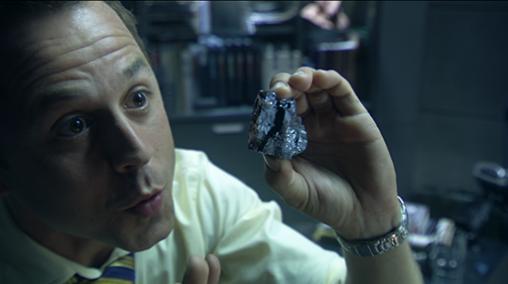
One of the bizarre things about the “Avatar” movie was that no explanation was ever given for why Evil Corp wanted to plunder the Edenic moon Pandora.  They were supposed to be after some mineral with a joke name, unobtanium, but they never said what it was.

The sleazoid exec going on about this mysterious rock

Even more bizarrely, this didn’t seem to bother anyone in the audience, or at least didn’t bother them enough for them to tell their friends to avoid a movie with a huge plot hole in the middle.   Maybe people have gotten so used to MacGuffins in action movies that they don’t care any more.   Let’s just get to the spectacle as quickly as possible before these 3D glasses give us migraines.

It turns out, though, that there actually is an interesting back-story around unobtanium – it’s supposed to be a room-temperature superconductor.  This would in fact be hugely valuable stuff (although nothing is valuable enough to ship across interstellar space).  Not only can you build perfect power lines with it, but you can build perfect magnets, magnets strong enough to run fusion reactors.   In the movie backgrounder site, Pandorapedia, they claim that it’s critical to building  the matter-antimatter starship drives that allow human beings to get to Pandora in the first place.

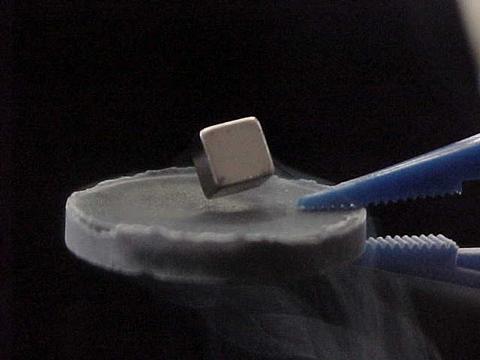
It also explains Pandora’s floating mountains.   If a magnet is placed above a superconductor, any motion in it will induce a current in the superconductor that exactly repels the magnet:

A magnet floating above a disk of liquid-nitrogen cooled superconductor

It’s called the Meissner Effect, and is one of those places where quantum effects show their bizarre nature at a macroscopic scale.

So if Pandora’s mountains contained iron ore, they could conceivably float above a crust that was a superconductor.   The electromagnetic effects of this would be wild, and would explain the disruption of radio in the “Flux Vortex”.

It might even explain another plot problem in the movie.  The Na’vi can see that humans are powerful and dangerous, yet refuse to consider moving away from their Home Tree habitat.  Why didn’t they just cut a deal?  Evil Corp would be happy to pay them off with the Pandoran equivalents of whiskey and guns.   That’s how most of the encounters between the West and aborigines turned out – they traded instead of fought.

But the whole ecosystem of Pandora was supposed to be linked into a vast nervous system.  Superconductors would make fine nerve fibers.  It wouldn’t be an accident that there was a lot of unobtanium under the Home Tree – that was the tree’s brain.  The Na’vi couldn’t move because mining unobtanium would kill a piece of their god.

This kind of background information is actually pretty cool.   I had no idea that any of it was in there, and it would have improved the movie, at least for me.  The only reference to superconductivity was a floating magnet on the desk of the Evil Corp manager, and  I thought that was just an office tchotchke.    It wouldn’t have taken much to drop it in – just a couple of lines here and there, and it apparently was in an early version of the script.

Still, Cameron decided to drop it, and two hundred million movie-goers didn’t seem to miss it.  Maybe he’ll put it into the upcoming DVD release.

Posted in Uncategorized | Tagged , | 1 Comment

The Awesome, Yet Easily Controlled, Power of Nature

io9.com recently posted a nice set of pictures here, of Niagara Falls being shut off for maintenance  in 1969 by the Army Corps of Engineers.  Here’s what they looked like from Prospect Point when off:

The Falls when dry, looking from American side

And here’s what they look like when on:

Standard postcard view

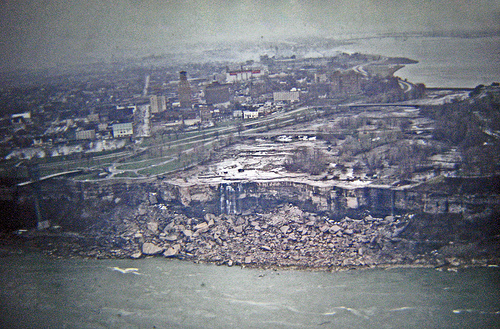
The pix originally came from Rob Glasson’s Flickr Photostream.  The Corps was worried about erosion on the rock face, and also wanted to remove some talus at the bottom of the cliffs.   They closed off the flow with a dam about a half mile upstream:

Aerial view of the shut-off of Niagara

The talus apparently appeared in a rockslide in 1954.  The Corps decided not to actually remove it – too expensive, and perhaps bad for the cliff face.  They also kept the bed watered to prevent it from drying out and cracking.  The extra water went over the Horseshoe Falls on the Canadian side.

They kept if off for six months, from June to November 1969.   They clearly weren’t thinking of the tourist business, or else they would have waited until autumn.

They may have been more worried about the hydroelectric business.  At present there’s a total of 4.4 GW of generating capacity on both sides of the river.  That’s 1% of the total consumption of the United States!  At 10 cents a kWh, that represents $10 million a day.

The US part of the project is mainly at the Robert Moses Niagara Project, which is a 2.4 GW dam/pumped-storage facility in Lewiston NY, and is run by the New York Power Authority.  Their annual budget shows that it runs at about 70% capacity, producing 1.7 GW on average, totaling 15 TWh a year.   The whole NYPA had revenue of $2.8B in 2008, and a big part of it must have been from this.  They like to run their generators at night when the flow over the Falls is less important to tourists, and use the power to pump water up into a holding lake.  They then drive the generators from the lake during the day instead of from the river.  The electricity is worth more then, and the Falls flow is preserved.  Clever!  That trick is probably worth hundreds of millions a year.

Anyway, it’s nice to think that this awe-inspiring, overwhelming spectacle is now a carefully preserved artifact, a kind of Nature’s Grandeur theme park.  The Falls could be reduced to a trickle to feed the insatiable demand for cheap power, but they’ve kept it flowing out of atavistic respect.  When the day comes that people care more for artificial spectacles than natural ones, and care more about CO2 levels than the tacky hotel business, the Falls will be gone.

Posted in Uncategorized | Tagged , | Leave a comment

Bike MPG

It being officially spring (albeit with so much rain that even the ducks get depressed), I broke out the bike and bopped around a bit.  There’s a nice rail trail near me (the Minuteman Bikeway) that covers about 2/3 of the way to work, so I often commute that way in the summer.  Google’s new bike map option actually showed me a route I didn’t know about, thus showing how AI is creeping into our lives.  It won’t be long  before the Googleplex figures out the nuclear launch codes, so it’s a good thing they’re officially not evil.

It’s about a ten-mile bike ride as compared to a twelve-mile commute by car.  Is that worth it in greenhouse terms?  The car drive takes about half a gallon of gas, or about 60 Mjoules.  Bike riding is said to take about 400 Kcalories/hour, and the ride takes 45 minutes, so that’s 300 Kcalories, or 1.3 Mjoules.  That’s 45X less energy!  Bikes rule!  In straight energy terms 300 Kcalories is the energy in about 1/100 of a gallon of gas, so on my 10 mile ride I’m effectively getting 1000 miles/gallon.  Beat that Toyota!

This isn’t too surprising when you consider that my car weighs about 15X what my bike and I weigh.  It goes about 3X faster on average (40 mph vs 13), so 15X * 3X = 45X the power needed.  That’s suspiciously close, actually.

Unfortunately, it takes fossil fuel to make food.   I haven’t seen a clear breakdown of where it goes, but most of the claims refer to this study by Prof David Pimentel of Cornell.  The claim is that it takes  7 to 10 calories of fossil fuel to produce each calorie of food.   Each of the major steps – fertilize, harvest, package, ship, and refrigerate – takes its share, with fertilizer being the largest piece.   Growing organically and buying locally helps, but it’s still going to be a few calories in per calorie out.

So those 300 Kcal of bike effort really represent more like 2000 Kcal of gasoline.  That drops my effective mpg from 1000 down to ~150.  Still pretty good, but within striking distance of a Lovins-style hypercar.

So maybe this:

A recumbent bicycle from Bike-E

My own bike, from the sadly defunct Bike-E company

Will ultimately lose to this:

IDEA hypercar from Bright Automotive

IDEA hypercar from Bright Automotive (concept)

Posted in Uncategorized | Tagged | Leave a comment

Spacy music from an actual space pioneer

There was an interesting article in the Boston Globe today, “Symphony in J Flat” , about a local clarinetist, Amy Advocat, who is learning a strange new tuning, the Bohlen-Pierce scale.  This is a scale where every octave is 3 times the frequency of the one below instead of 2 times as in the standard tuning.  Instead of 12 intervals in the octave, there are 13 in the “tritave”.  The ratios of chords are 5/3 and 7/3 instead of 3/2 and 4/3.   It has an eerie sound, but not as discordant as you might think.

There’s a conference, The Bohlen-Pierce Symposium, going on about it right now in Boston.  It can be played on synthesizers, of course, but people are now building real instruments for it.  The clarinet is particularly suitable because it has odd-numbered harmonics already.

The Wikipedia article is incomprehensible, but is does mention a bit about the inventors.   What’s odd is that they weren’t musicians – they were engineers, and microwave communication engineers at that.  And they came upon this idea independently!

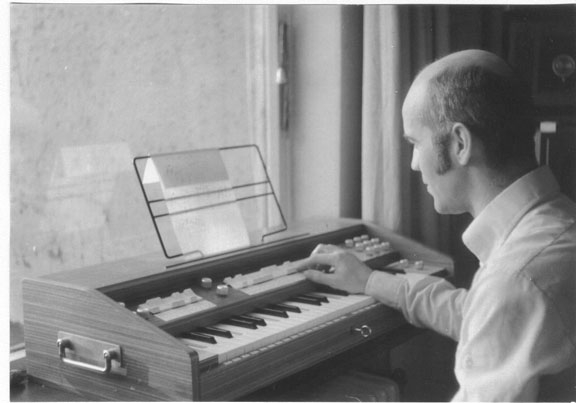
Heinz Bohlen at organ in 73

Heinz Bohlen working on a synthesizer in ’73.  Note the odd pattern of black keys

Heinz Bohlen worked on klystrons in Germany and only started fooling around with the math behind tunings when some friends asked him to help with their recordings.

John R Pierce

John R Pierce in full 60s NASA nerd mode

John R Pierce (1910-2002) came up with the same scheme about 6 years later, only to discover that Bohlen had done it first.  He’s actually a significant figure in electrical engineering – he headed the group that developed the transistor at Bell Labs (and in fact named it) and was crucial in putting up the first telecom satellites.  He even wrote science fiction under the name “J. J. Coupling”,  which is a term in quantum mechanics having something to do with electron interactions.  He sold stories to Hugo Gernsback in the 30s and non-fiction articles to John W. Campbell at Astounding (later Analog) in the 40s and 50s.  When he retired from Caltech, he joined the computer music lab at Stanford, CCRMA, where he discovered this scale.

Oh, and he was also an expert glider pilot, and he and his wife threw terrific parties at their house in Palo Alto.  So there he is: bon vivant, musician, author, teacher, manager, space pioneer.  Some people’s careers make you despair of your own.

Posted in Uncategorized | Leave a comment

Another local industry – political ambition

So I was looking at lists of presidential candidates from recent elections, and was struck by the number of candidates from my small and somewhat out-of-the-way state, Massachusetts.  It looks as though MA is tied with New York and California for total number of people who have run for president since WW II – they each have 8.  Here are the candiates from the top few states, with primary winners in italics, and election winners in bold:

  • 8 – MA – JFK (’60), Henry Cabot Lodge (’64), Robert Kennedy (’68), Teddy Kennedy (’80), Dukakis (’88), Paul Tsongas (’92), Kerry (’04), Mitt Romney (’08)
  • 8 – CA – Earl Warren (’48,’52), Nixon (’60, ’68), Reagan (’68,’80,’84), Jerry Brown (’76, ’80, ’92), Alan Cranston (’84), Bob Dornan (’96), Pete Wilson (’96), Duncan Hunter (’08)
  • 8 – NY – Dewey (’48), Averell Harriman (’52), Rockefeller (’60, ’64, ’68), John Lindsey (’72), Shirley Chisholm (’72),  Steve Forbes (’96),  Hilary (’08), Giuliani (’08)
  • 7 – IL – Stevenson (’52,’56), Phil Crane (’80), John Anderson (’80), Jesse Jackson (’84), Paul Simon (’88), Carol Moseley Brown (’04), Obama (’08)
  • 6 – TX – Johnson (’56,’60,’64), Lloyd Bentsen (’76), John Connally (’80), George H. W. Bush (’80, ’88), Phil Gramm (’96), George W. Bush (’00, ’04)
  • 4 – OH – Robert Taft (’48,’52), John Glenn (’84), John Kasich (’00), Dennis Kucinich (’04,’08)
  • 3 – MN – Harold Stassen (’48 on), Humphrey (’60, ’68), Mondale (’84)

There have been ~110 candidates for the Democratic and Republican parties in the 16 elections since 1948, and a half dozen independents who have made a mark.   Texas has had the most actual presidents with 3, and Texas and Massachusetts have had the most election candidates with 3 each.

Massachusetts has 1/5 the population of New York and California, and yet has had as many people ambitious for the Oval Office as they do.  What’s in the water up here?  Part of it is all those Kennedys, but even without them the state would have put up much more than its share of candidates.

Maybe part of it is the activist nature of politics here.  People are pretty engaged in politics – it’s the local blood sport.   They can be merciless about it too, like forcing acting governor Jane Swift to sleep on her brother’s couch in 2001 when the Legislature wouldn’t grant her a housing allowance.  Historically Mass has been among the most progressive states – it freed its slaves while the Revolution was still going on – and it still leads the nation in a number of policies like charter schools, universal health care, gay marriage, and decriminalizing possession of marijuana.  Maybe there’s just more government done here than in most places.

Posted in Uncategorized | Tagged | Leave a comment