The Obsolescence of White Nationalism

I was sitting in a conference room the other day, meeting with a company that wanted to supply a component for a new chip we’re working on.  These days most chips are assembled from big pieces from other firms.   It’s the only way to handle the hundreds of millions of transistors that go onto a $10 chip.

I was looking around the room.   Here was our internal expert on this kind of hardware, a Chinese-American.   Here was our expert on this software, from Eastern Europe.   The senior person from the presenting company was a tall, thin Dutch guy, and his US application engineer was a brusque Israeli.   East Coast sales were handled by a genial Boston Irishman.   I was the only WASP there, and I’m a first generation American myself.

When I started my career it wasn’t like this.   A significant number of people I worked with then had been born nearby.  Those were days when ten people could build a competitive chip, and would design every transistor on it.  It still takes about ten people to do a chip, but they won’t ever touch a transistor, or even do much logic design.  They can’t possibly, if they want to finish in their lifetimes.

So we use larger and larger blocks, that have to come from a wider and wider range of sources.   There’s a wider range of skills involved too, from physics at the process level to system experience with software tools. The talent to do this has to come from a wider and wider pool as well.  Thus the range of backgrounds in even this one meeting.  Even the country with the largest and oldest electronics industry in the world , the US, can’t develop  chips by itself.

If you’re in tech, you’re familiar with this.   Globalism is taken completely for granted, and is an obvious necessity.   Not so for a lot of people.  They seem to think that Harley Davidsons can be made entirely in America.  The Brexiters thought that their small island could manage a modern industrial economy, and they’re finding that they can’t even manage the negotiations with the EU.  Worse still are the people who think that an all-white country can work, that letting in only certain people like, say, Slovenian models (to pick a random example)  is enough to sustain a country.

They’re bigots, and they’re obsolete.   It hasn’t worked that way for decades.   Look at the poor Russians — their one technical success, rocketry, has been running on old tech for so long that it’s both failing (E.g. the recent Soyuz abort and upper stage launch failures) and getting surpassed (E.g. Vector, SpaceX and Blue Origin).  They aren’t part of the worldwide slosh of ideas and talent, and they’re getting left behind.    If it can happen to a country as full of determined and brilliant people as theirs, it can happen to anyone.
Posted in Uncategorized | Tagged , | Leave a comment

Immigration and the Nobel Science Prizes

It’s hard to take the current Administration’s stance on immigration seriously.   Their policies are deliberately cruel, as in family separations, and clearly motivated by bigotry.  In response, people have pointed to the 80 million US immigrants and their huge contributions to the country.   This includes the ancestors of many of the people in the Administration itself, such as the president’s grandparents and wives.

But let me do a quantitative take on this.   The most prestigious prizes in the world are the Nobel science prizes, those in Physics, Chemistry, and Physiology or Medicine.   These even outweigh the other Nobels: Peace, Literature, and the new Economics.   The Peace choices are often terrible, like Kissinger and Obama; Economics is not as important a field as the others; and the Literature awards are usually obscure.   But the science Nobels have been for consistently important work for over a century, and are about the only technical prizes anyone knows about.

[Irresistible side story: Brian Schmidt was visiting his grandmother in Fargo  North Dakota, when was stopped by the TSA in the airport.  They saw a solid black disk in the X-ray of his carry-on.  “Sir, what’s this?” they asked.  “A half pound of gold.”  “Where did you get it?”  “It was given to me by the King of Sweden.” “Oh really?”  “Yes, for discovering the acceleration of the expansion of the universe.”  Physics award, 2011.  “Yeah?  So why are you in Fargo?”]

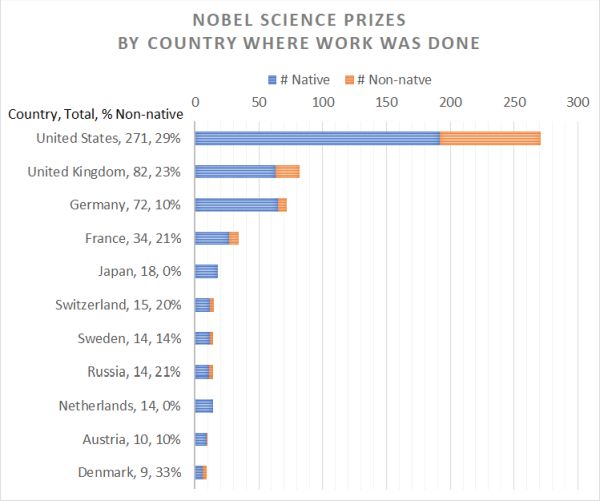
So how has immigration contributed to winning science Nobels?   For each laureate, we can identify the country where their work was done and whether the laureate is a native of that country or was born elsewhere.   For the top ten work countries, the split between native and immigrant looks like this:

The data comes from this List of Nobel Laureates by Country, but each laureate was only given one country where the work was done.   The full list and charts are in this spreadsheet: Science Nobel Prizes and Countries.

There have been 609 Prizes awarded to individuals between 1904 and 2017 inclusive.  Three people have won two: Marie Curie, John Bardeen, and Frederick Sanger. 32 countries in total have gotten Prizes for work done there.  Switzerland appears to get the most per capita, followed by Sweden and Denmark.

The US dominates the list with 271 of them, 45% of the total.  This isn’t just because the US has a much larger population than the others.  It only got 26 prizes before 1950, but then Congress poured money into the NSF, NIH, and other Big Science programs, and it won 245 more, 54% of that total.  That’s still true in the 21st century – the US has 77 out of 142 since 2000, which is still 54%.  Only 2 native Americans have done their work elsewhere.

What’s even more striking is that 79 of the US prizes come from immigrants.  More immigrants have won Nobels for work done in the US than for any entire country, except the UK.  The UK has 82 and Germany 72.

So where did those immigrants come from?

                            Birth Countries for US Laureates
Region Country Number each
Europe (41)
Germany 14
Italy 6
Austria 5
Hungary 3
Netherlands, Poland, Norway 2
Czech Republic, Ireland, Romania, Spain, Switzerland, France, Lithuania 1
Anglosphere (16)
Canada 8
United Kingdom 6
Australia, New Zealand 1
Other (22)
China 6
Japan 4
India 3
Russia, Ukraine, Mexico, Israel, South Africa, Taiwan, Turkey, Egypt, Korea 1

Looking more closely at the European immigrants, we find that 18 out of 41 of them, about half, were driven out by mid-20th century persecution by Nazis, and by Italian and Spanish fascists.  16 of those were driven out by anti-Semitism, and 2 were not, Max Delbruck and Severo Ochoa. Europe’s loss was the US’s gain.

Immigrants from the Anglosphere would have had a much easier time transitioning.  But Canada in particular lost a lot of talent – it lost 8 people to the US while only getting 9 itself, and 4 of those were also immigrants.  More native Canadians have won Nobels in the US than in Canada itself.

Immigrants from other parts of the world would have had difficulty getting into the US before the 1960s, when immigration rules were greatly relaxed.   Notice what a range of countries they come from, many of which would be considered undesirable.

The current Administration is explicitly denying entry to those fleeing persecution, and trying to eliminate immigration from non-white parts of the world.  If it had kept out the 22 from the Other parts of the world, and the 18 that were fleeing European persecution, that’s 40 of the world’s leading scientists.  Fleeing and non-white immigrants have won more Nobels for the US than any whole country has won, except the UK and Germany.  That’s more than all of France.  The Administration’s anti-immigration policies will damage US science even at this very top level.

Posted in Uncategorized | Tagged , | 1 Comment

SF Inventors

Unlike other groups that I’ve written about (Beautiful Inventors, Political Inventors, Criminal Inventors and Movie Inventors), science fiction authors are known for their interest in technology.   You would think, then, that a lot of them would have made real-life contributions, but I haven’t actually found that many.  Here are a few of interest:

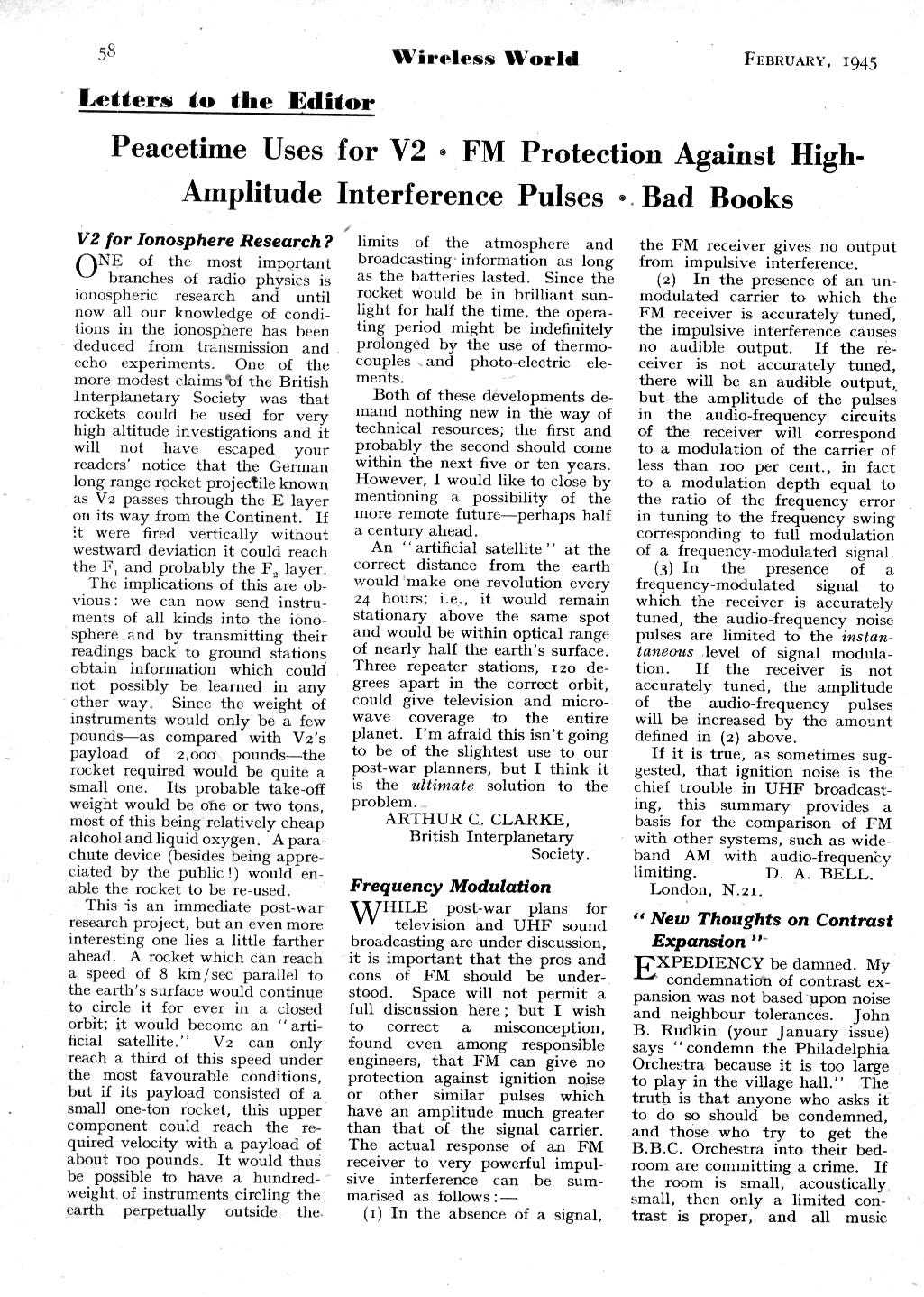
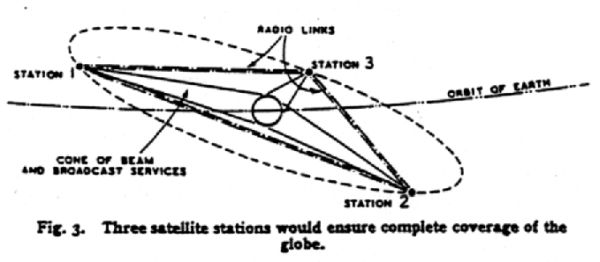
Arthur C. Clarke is the probably the best known SF inventor, and that’s because he came up with the best use for spacecraft – geosynchronous communication satellites.   Its first mention is here, in a letter in the Feb 1945 issue of Wireless World, and he gave it a full write-up in the Oct 1945 issue:

Click for article

People had talked vaguely about communication satellites before, but he figured out the right way to do it.   The idea of orbiting anything was pretty far-fetched in 1945, much less what to do when you were up there.  Clarke thought that it would be 50 years before such a service could be built, but it took only 19 – Syncom 3 launched in 1964.   There are about 530 operational satellites in GEO now, about 30% of the total.  Satellite comm overall is a $200 billion industry today, which is about 2/3 of all space activity.   Not bad for a radio technician!  Clarke never made a dime off of the idea, but it was worth immortal fame.

James Cameron – In between making some of the biggest movies of all time, like Titanic and Avatar, and some of the best SF movies, like The Abyss and The Terminator and Aliens,  Cameron has found time to get two patents and one design patent:

  1. 5,189,512 (1993) Helmet Integrated Display System – a scheme of projecting a video image into both eyes of a cameraman so that they appear at a virtual distance
  2. 4,996,938 (1991) Apparatus for propelling a user in an underwater environment These were both with his younger brother Michael, who has also been in the Industry as a stuntman and actor.
  3. D783522S1 (2017) Solar Power ArrangementImage result for cameron solar sunflower -2015He likes solar power, but admits that the panels are ugly.  He designed these tracking solar sunflowers for his wife’s school, MUSE, and five of them supply most of the school’s needs.  When they came out in 2015 he said that he would open-source the plans, but hasn’t yet.   He does appear to be a busy guy.
Cameron and a partner, Vincent Pace, were also key to the revival of 3D movies, largely through their Fusion Camera System.  This split a single optical path into two stereoscopic ones with a variable distance between them, and allowed for the capture of both 2D and 3D simultaneously.   Plus, of course, he has been deeply involved in deep sea diving, using one of his own submersibles to visit the bottom of the Marianas Trench.   It’s not clear if he sleeps.

Gene Wolfe – has written brilliant outré fantasy such as The Book of the New Sun, the best long novel of the 1980s.  But his day job in the 1960s was as a mechanical engineer at Proctor and Gamble, and that’s where he worked on  Pringles potato chips.   In a 1998 interview with Lawrence Person he said:

GW: I developed it [Pringles]. I did not invent it. That was done by a German gentlemen whose name I’ve forgotten for years. I developed the machine that cooks them. He had invented the basic idea, how to make the potato dough, pressing it between two forms, more or less as in a wrap-around, immersing them in hot cooking oil, and so forth and so on. And we were then called in, I was in the engineering development division, and asked to develop mass production equipment to make these chips. And we divided the task into the dough making/dough rolling portion, which was done by Len Hooper, and the cooking portion, which was done by me, and then the pickoff and salting portion, which was done by someone else, and then the can filling/can sealing portion which was done by a man who was almost driven insane by the program. Because he would develop a machine, and he would have it almost ready to go, and they would say “Oh, instead of 300 cans a minute, make it 500 cans a minute.” And so he would have to throw out a bunch of stuff, and develop the new machine, and when he got that one about ready, they’d say “make it 700 cans a minute.” And they almost put him in a mental hospital. He took his job very seriously and he just about flipped out.

Pringles are everywhere – I’ve seen them lining the shelves of Central Asian convenience stores.  Maybe that’s because one can make 700 cans a minute. Wolfe was also the robotics editor at Plant Engineering magazine in the 1970s before switching to writing full-time.   How Pringles and manufacturing robots got him to think about far-future medievalist societies is mysterious.

Neal Stephenson – and four others received US patent 9,037,478 in 2015 for “Substance Allocation System and Method for Ingestible Product Preparation System and Method”.   It’s  written in impenetrable patent-ese, but appears to be a machine that will mix a dose of a drug like aspirin into a something like a smoothie. It was assigned to Elwha, a patent troll outfit started by Nathan Myrvold, formerly CTO of Microsoft. Stephenson appears to have gotten several patents associated with this, and Myrvold is on some of them.  This may be an attempt to lock up the concept of a personalized food fabricator.

Stephenson is also into western martial arts, and tried to develop a sword-fighting video game called CLANG.   It would have had a sword-like motion controller and use actual fighting styles.  He raised half a million for it on Kickstarter here. , but that doesn’t go all that far for a real game, and it never shipped.

He now has the title Chief Futurist at Magic Leap, a secretive augmented reality company with some new display scheme.  They too are having trouble getting anything out, but he is more concerned with what the best use of this tech is.  That sounds more up a writer’s alley than getting embedded controllers to work in swords and food makers.

Let me finally briefly mention some people who really do have tech day jobs:

  • Robert L Forward – inventor of the StarWisp interstellar craft concept and interesting solar sails, and author of the notable novel Dragon’s Egg, about life on a neutron star.
  • Geoff Landis – actual NASA researcher on the Mars rover missions and advanced propulsion concepts, and Hugo and Nebula award winning short story writer.
  • David Brinholder of US7124372B2 “Interactive communication between a plurality of users”, and notable author of the Uplift trilogy.
  • Leo Szilard – discoverer of the fission chain reaction, which he actually patented in Britain in 1934 as GB 630726. In 1961 he published a book of SF short stories, The Voice of the Dolphin, where the title story is about how dolphins use scientists as fronts to save the world.

These are all I could find!   I’m sure there are more, but perhaps writing invention and mechanical invention are very different skills.  One or the other can certainly occupy all your time!

Posted in Uncategorized | Tagged , | Leave a comment

Mad Science #4: Geo-Engineering With Nukes

Nuclear devices, what are they good for?  Almost nothing, it turns out.   They’re close to useless as weapons, since the goal of war is domination, not destruction.  The nuclear powers have been in dozens of wars since 1945, and have never come all that close to using them.   They make too much of a mess and cause too much auxiliary trouble.

So there must be something else that one could do with this expensive tech.   The Soviets sure tried.  They had a huge program called Nuclear Explosions for the National Economy, which did 156 tests between 1965 and 1989.  They tried fracturing rock for oil and gas only to find that it became radioactive.   They tried to create underground caverns for the storage of oil and gas, and for nuclear waste itself, but the caverns were unstable. They used nukes to blow out gas well fires, which actually does work but contaminates the field.

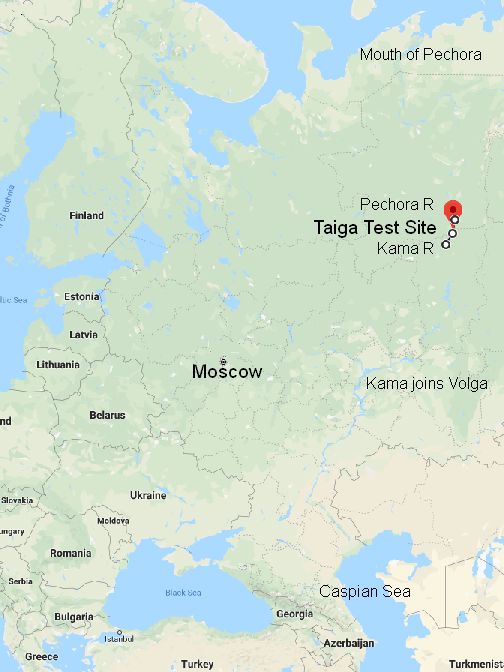
But the most interesting usage was for mega-scale civil engineering, projects that could affect the planet’s balance.   The one that actually got started was the Taiga Project of 1971, an attempt to dig a canal between the Kama and the Pechora rivers.  The result is still there:

The 600 x 400m crater left by the three Taiga Tests.  Photo taken from a paper on its current radioactivity. Click for source

The Pechora flows into the Arctic Ocean, while the Kama joins the Volga and then flows into the Caspian Sea.    There is lots of irrigation around the Volga that could use more water, and the Caspian itself is land-locked, and so in danger of drying up.  The Pechora is a major river, with 1/4 of the discharge of the Mississippi at its mouth, and 1/2 of the volume of the Volga itself.  Rather than waste all that water on the useless Arctic ocean, why not send it south?

Pechora-Kama Canal Map

The land between the rivers is relatively flat, and has long been used as a portage.  A canal had been proposed back in the 1930s, but to move serious amounts of water a really big channel would be needed, and it couldn’t have locks.   The total distance was about 100 km, but the southern 40 km was flat enough that it could be dug by conventional means.  The northernmost 60 km had a range of hills of up to 60 m high, so that’s what needed the nukes.  They would use them to excavate down about 80 m to make a channel with a cross-sectional area of 2000 m2.   That would be 20 m deep and 100 m wide if rectangular, but it would actually be more like a triangle.

A researcher at Lawrence Livermore National Laboratories, Milo Nordyke, did an analysis of the project in 1979: Estimates of the Nuclear Design Requirement for the Pechora-Kama Canal Project.  Nordyke had been involved in the US peaceful nuke program, Operation Plowshare, as in beating swords into.  It showed rather un-American timidity and only set off 27 tests between 1961 and 1973, but was stopped by quite American local opposition.

The canal looked quite feasible to Nordyke, but would need at least 250 devices, of up to 150 kilotons each.   The actual test used three devices of 15 kT each.   They used very small fission igniters, of only 0.3 kT each, to reduce the amount of fission products.  They were set off 150 m underground, also to keep the radiation down.

That failed.  The 2009 study mentioned in the top picture found that the radiation around the lake peaked at almost 1000 times the background.  It included lots of radioactive isotopes like Cesium-137, Cobalt-60, and Americium-241.  The site is surrounded by a fence, but people fish in it anyway.

Great.  Just this small test has contaminated the area, although it appears to be far from any settlements.   It’s not as bad as the Polygon in Kazahkstan, an 18,000 km2 area that was permanently poisoned by 456 Soviet nuclear tests, but it’s still bad.

What really puts this in the Mad category, though, is the overall size of the project – 250 bombs.   This was in 1971, when people already knew quite a lot about contamination.   The water flowing through the canal would have poisoned a good fraction of Russia’s agricultural land via irrigation.   All of the peaceful tests had the same problem – more radiation got out than expected.  Even small tests caused trouble, so setting off hundreds of them was ridiculous.

Yet the project had an unexpectedly positive side-effect – it drove DARPA to start research into climate modeling.   Sharon Weinberger discovered this as part of  her history of DARPA, The Imagineers of War.  She writes about it in Chain Reaction – How a Soviet A-bomb Test Led the US Into Climate Science.  The Soviets had been talking about re-routing rivers for a long time, and then in 1971 they actually started doing it.  The head of DARPA at the time, Stephen Lukasik, had the entirely proper reaction: “Holy shit, this is dangerous!”

If fresh water stops flowing into the Arctic, what effect does that have on global climate?  The planet’s ocean currents are not just driven by temperature differences, but also by density changes due to salinity.  That’s why people are so worried today about fresh meltwater from Greenland shutting down the Gulf Stream.  If the Arctic Ocean becomes more saline, what happens?

No one knew.  Lukasik assigned a young Air Force meteorologist, John Perry, to find out.  He got $4 million to distribute to studies of paleo-climates and computer modeling.  That became a lifeline for the Illiac IV, the first big multi-processor supercomputer, and kicked off lots of climate projects.    In 1976 it was taken over by NOAA and the NSF, and morphed into the current US federal climate program.

So a terrible but typical bit of Soviet hubris prompted a research program into what has become the major environmental issue of the age!  I hope the irradiated fishermen of the Taiga Atomic Lake don’t mind.


Posted in Uncategorized | Tagged , | 1 Comment

Who Is the Most Corrupt US Businessman?

Paul Waldman of the Washington Post was recently writing about the raid on the office of Donald Trump’s fixer, Michael Cohen, which is likely to uncover lots of shady dealings.  Waldman wrote “He [Trump] may well be the single most corrupt major business figure in the United States of America.”

That sounds like a challenge!   Can we find a US business figure even more corrupt than Trump?   There are a lot of unpopular businessmen that I could include here, like the Koch brothers and the Coors family, but they’re unpopular more because of their heinous politics rather than outright crimes.  So here are some sleazier candidates, in alphabetical order:

Sheldon Adelson – casino magnate.  He has been credibly accused of bribing Chinese officials to set up casinos in Macau, and of running prostitution rings out of them.   He also bought a great deal of attention from the GOP (he was Trump’s largest single contributor), including the planned move of the US embassy from Tel Aviv to Jerusalem.  This is a clear disaster for the US, getting it far more deeply into the hole that Israel is digging for itself.  On the other hand, running hookers is not as bad as actually harassing women, as Trump  has.

Richard DeVos – co-founder of Amway, the world’s largest multi-level marketing  (MLM) company.  The less polite name is pyramid scheme.  They claim to have 3 million “independent business operators”.  Hardly any of them make any money, but they pay commissions to their “upline” recruiters.   They’re also encouraged to buy sales materials from their uplines, which can be a large part of their profit.  DeVos himself is worth $8B.  He got in on MLM right from its beginning by selling Nutrilite health supplements from the California Vitamin company in 1949.  It had pioneered MLM in 1945, and he later bought it.  The FDA shut that down as false advertising, but they branched out to a lot of other products, hardly any of which are distinctive.  His daughter-in-law Betsy DeVos is now Secretary of Education, probably for her GOP contributions and efforts to undermine public schools in Michigan.  Trump is likely to have followed DeVos’s lead when setting up Trump University, but he only ripped off a small fraction of the people that DeVos has.

Robert Durst – heir to a real-estate fortune, and now on trial for murder in California.  He’s accused of killing a friend, Susan Berman, and is also suspected in the death of his wife, a neighbor, and three teenage girls.   He was the subject of a six-part HBO documentary, The Jinx, and appears to have confessed on camera when he didn’t think the mike was on.  This is way worse than anything Trump has done, but Durst does not appear to actually be a businessman – his brother Douglas runs the empire.

Bernard Madoff – runner of the largest Ponzi scheme in history with a peak claimed value of $64B in 2008, when he confessed.   Investors chipped in about $20B, and about $11B has been returned by the liquidators, so the total real loss is about $10B.  The assets of Madoff and his family were sold off long ago, and were nowhere near that amount, so someone still did very well out of all this.  It’s probably overseas banks that will just seize the abandoned accounts.  Still, victims who invested less than $1M with him got full restitution, so the main losses were with already rich people.

Angelo Mozilo – CEO of Countrywide Financial when it was a major contributor to the sub-prime mortgage catastrophe.  At its peak in 2006 it issued 17% of all the mortgages in the country.  Most of them had adjustable rates and no documentation.  That meant they couldn’t be backed up by the US housing guarantors Fannie Mae and Freddie Mac, so they were bundled together into mortgage securities and used as collateral on derivatives.  When housing prices fell in 2007 and the rates were reset, massive numbers started defaulting, and the dominoes toppled.  The company collapsed in late 2007 and was bought for nothing by Bank of America in 2008.    While Mozilo was engineering all of this, he was cashing out his own stock for about $300M.   The SEC later charged him with bank fraud, and he had to return about $50M.  Boo hoo.  At least he can never work in a public company again.

Compared to these people, Trump comes off as a piker.  Sure, he’s ripped off a lot of contractors and investors, but that’s more in the several hundred million range rather than many billions.  Sure, he’s made a fair amount of money in fees for managing things badly and in laundering oligarch money via real estate, but that’s also more in the several hundred million range.  Yes, he has embarrassed and humiliated dozens of women, including his wives past and present, but hasn’t actually injured anyone, as far as we know.

No, Trump’s opportunity to do big damage is right now.  He has already harmed Puerto Rico by botching the cleanup from Hurricane Maria, and has enabled the brutal Saudi war in Yemen, which has killed tens of thousands.  As a businessman, he didn’t have the opportunity to harm as many people as those listed above, but as president, he can far exceed them.  He’ll be the biggest yet!


Posted in Uncategorized | Tagged | Leave a comment

Google Is Getting Creepy

Facebook has always been creepy, of course, with its reliance on selling your personality to advertisers.  People are shocked, shocked, that this would be used for political ends by Cambridge Analytica and other manipulators, but that’s basic to what they do.

But Google has been getting creepier too with time, and not just because they also try to infer your preferences from your search choices.   They’re also using the new tech of machine learning to do creepy things.

I saw this directly at a talk last month by  Olivier Temam of Google Paris called “A Shift Towards Edge Machine-Learning Processing”.    This was at ISSCC 2018, and the slides are here  and abstract here.  The talk started by describing the recent successes of machine learning, and those are impressive and uncontroversial.   It has now gotten quite good at difficult tasks like language translation and image recognition, even of things like cancer cells.  The rest was about how to do machine learning on small systems, ones that could go into gadgets, instead of having to communicate with huge servers in distant buildings.   These need interesting hardware techniques to run fast and at low power, and are now the subject of massive research efforts.

But they’re getting applied to hackle-raising things.   Temam talked about occupancy detection for offices, where a camera tries to count the number of people in a room in order to control the temperature and ventilation.   They want to do the counting in the camera itself for “privacy reasons”, so that the whole video stream does not get uploaded to some server.   But who would believe that it isn’t being uploaded?   Or that the camera isn’t looking at you or your screen to monitor what you’re doing?  This kind of counting can be done much more easily and cheaply with an infrared sensor, with no such privacy concerns.

Then there’s Google Clips, a new camera they’ve developed that can run their machine learning package:It uses a brilliant new chip called the Movidius Myriad 2, now owned by Intel, that can do huge amounts of work at low power.  It has 16 GB of internal storage, but links wirelessly to your phone to upload everything.

So do they have it cleaning up pictures, allowing you to get the best shot no matter what the lighting?   No, they want it to take the video, not you.  They got a team of professional photographers to work with a crew of babies and pets.   They captured the entire video stream from their cameras, and looked at when the pros actually pressed the shutter button to capture a clip.  Then they set their neural nets to work on the stream, trying to determine just what the cutest moments were.   Should it capture when the baby is facing you?  The net detects a large round blob in the middle of the image.   When it’s smiling?  When it’s raising its arms in glee?   When it’s rolling over?  The net doesn’t care – it’s just trying to predict when the professional would push the button.  It knows when the actual push happened, and adjusts the synaptic weights on all of the filters it runs on the images to generate features that map to cuteness.

As Elon Musk said “This doesn’t even *seem* innocent.”  This widget is watching and judging your baby constantly.   It’s assuming that you’re too busy or stupid to film your own baby.  God knows what it actually does with the video, but somewhere a Facebook type is thinking about how to monetize your baby videos.

OK, but creepier still is their AIY camera kit:This contains a lens, image sensor, button, and a cardboard box for the body.  You supply a Raspberry Pi processing board, and load their software onto it.   The demo is, and I’m not kidding, a joyfulness detector.   You point it at someone’s face, and it gives you a measure of how joyful their expression is.  An LED turns yellow for joy and blue for sad, just like the emotions in the Pixar “Inside Out” movie.    “And if your joy score exceeds 85%, an 8-bit sound will play. Cool!”  That’s one reaction, but not the one I would have.

This is still all kind of minor, though.   Where this attitude starts to matter is in their self-driving cars.  For the last ten years they’ve been saying how wonderful it will be when driving is taken away from fallible humans.   30,000 people a year are killed on the road in the US!   If you’re skeptical about this, you’re some Luddite delaying the self-driving millenium, and costing thousands of lives in the meantime.  Cars shouldn’t even have steering wheels!   Trust the machine!   Put your lives in our hands!

I would believe more of this if Google (now spun off into Waymo) were actually selling car safety systems.  They’ve spent billions on this by now, but haven’t offered a single product.  Real car companies are steadily adding safety features: blind spot detection, back-up collision alerts, and automatic forward braking.  I have them on my 2017 Chevy Volt, since they really do make a difference in accident rates.  I find the braking to be annoying, to be honest, since the alert goes off constantly in harmless situations, and every few months it applies the brakes when it shouldn’t.  But Google isn’t doing any of this.

I think the reason is money.   The Volt’s collision detector is based on a camera built by an Israeli company called Mobileye:

A Mobileye camera and processor, usually built into the back of the rear view mirror

They were acquired by Intel in 2017 for $15B, but in 2016 they sold about 6 million systems for $400 million.   That’s terrific for a small company, but chump change to Google.  Even if they sold ten times as many systems, 60 million a year, enough for 75% of the cars built each year, that’s still only $4 billion.  Google makes over a $100 billion a year.

No, serious money in self-driving cars only comes when they can sell car-when-you-want-it subscriptions.  Charge $500 per month, and have one car handle four or five subscribers, since each one only uses it for an hour or two a day.  Now you’re making $25K / car / year.   Run a million of those and it’s $25 billion.   When the tech really works, run 10 million of them, and you’re making $250 billion.

That’s what this is about, not safety.  It’s certainly what Uber is going for, since they’re presently losing money on every ride.  Actually doing full autonomous driving (called Level 5) is an enormously difficult problem because the driving environment is really ill-defined.   Just because Google’s Alpha Go program can beat a human champion doesn’t mean it handle situations without fixed rules.  No one cares if it makes a bad Go move, but people care a lot when your software kills someone.  The current accident rate in the US is about one fatality per hundred million miles, or several million hours.  It’s extraordinary hubris to think that computers can do this a lot better, and that hubris is going to kill people.

Posted in Uncategorized | Tagged | Leave a comment

Who Are the Best-Selling SF Authors?

There doesn’t seem to be a direct way to answer this.   Book sales data appears to be kept very private between authors and publishers, probably for the same reason that you never tell anyone your income.  In any case, books are a highly durable product and can last for centuries, so knowing modern sales figures wouldn’t say much about how many books were sold long ago.

But maybe we can answer this a different way.  The website LibraryThing lets you keep a catalog of your own library online.  It currently has 2.2M members, and 122M works cataloged, representing 11.7M unique titles.  I use it myself.   It can show the number of works held by its members by author.   This can tell us how popular authors are, at least among these bibliophilic and technophilic users.   They’re far from a random sample of readers, but they’re probably more similar to you, if you’re reading this blog post.

The most popular author by this standard is J. K. Rowling, who has 625,782 works in the collection as of this writing.  That’s 0.5% of all the books listed!   For other authors, let’s express their popularity as a percentage of hers, rather than by somewhat meaningless raw copy counts.   The webpages also show which individual book has the most copies, so let’s also look at whether that book dominates the author’s total.  It even shows the total number of works held, although that can include a lot of really minor stuff.

I sampled a lot of authors in this spreadsheet: LibraryThing Author Statistics.  Many of them write in multiple genres, but I assigned them to the genre of their biggest book. I did make an exception for Ursula K. Le Guin, because I’m a fan.   Below is how it looks for the top 20 SF authors.  Click on the link to see the author’s full list on LibraryThing:

AuthorLived% of Rowling copiesBook with Most Copies% of author’s total# works
Isaac Asimov 1920 –199229.6%Foundation7.6%1901
Orson Scott Card1951–23.8%Ender’s Game20.8%340
Anne McCaffrey 1926 –201123.7%Dragonflight4.1%262
Kurt Vonnegut 1922 –200722.2%Slaughter house-Five23.7%227
George Orwell 1903 –195021.4%198443.3%266
Douglas Adams 1952 –200121.4%The Hitchhiker’s Guide to the Galaxy20.9%110
Robert A. Heinlein 1907 –198820.2%Starship Troopers7.1%341
Margaret Atwood1939–19.0%The Handmaid’s Tale22.7%187
Ray Bradbury 1920 –201216.2%Fahrenheit 45135.6%803
Ursula K. Le Guin 1929 –201814.9%A Wizard of Earthsea10.8%397
Philip K. Dick 1928 –198214.7%Do Androids Dream of Electric Sheep?14.1%525
Frank Herbert 1920 –198613.4%Dune31.0%178
Arthur C. Clarke 1917 –200813.4%2001: A Space Odyssey10.7%482
Neal Stephenson1959–13.0%Snow Crash18.5%70
Larry Niven1938–11.0%Ringworld10.1%299
Aldous Huxley 1894 –196310.6%Brave New World59.1%234
William Gibson 1948–10.6%Neuromancer25.8%51
Iain M. Banks 1954 –201310.2%Consider Phlebas7.8%54
H. G. Wells 1866 –19469.8%The Time Machine19.7%898

Asimov wins! And he’s not just known for Foundation. And there are an enormous number of works under his name, 1901, which is unsurprising given that he wrote over 500 full books.  The authors with the most works are him, Wells, Bradbury, Dick, and Le Guin, who all had long, productive careers.

Orson Scott Card and Ann McCaffrey come in at #2 and #3, which higher than I would have expected.  Likewise Heinlein at #6 and Clarke at #12 are lower.  I’m pleased that Iain M. Banks made it onto the list, and if you added in his non-SF work (published as just Iain Banks), that would add another 3%.

Orwell, Bradbury and Huxley are mainly known for one work, but those works are major.  McCaffrey, Heinlein, and Asimov had the lowest percentages for their biggest book, showing what diverse output they had.

There are only a few living authors (although we just lost Le Guin!), and only three women, so this represents an older view of the field.  This might well be an older audience, one that has had time to build up enough of a library to want to catalog.

For comparison, let’s look at the top 10 genre authors:

AuthorLived% of Rowling copiesBook with Most Copies% of author’s total# works
J. K. Rowling1965–100.0%Harry Potter and the Philosopher’s Stone14.9%177
Stephen King 1947–77.6%The Gunslinger3.3%664
Terry Pratchett 1948 –201561.1%Good Omens6.3%312
J. R. R. Tolkien 1892 –197348.3%The Hobbit21.5%620
C. S. Lewis 1898 –196346.1%The Lion, the Witch and the Wardrobe10.1%618
Neil Gaiman1960–45.9%American Gods9.1%575
Stephenie Meyer1973–28.2%Twilight26.1%72
Dan Brown 1964–23.8%The Da Vinci Code38.3%35
Dean Koontz1945–22.7%Odd Thomas4.2%342
Mercedes Lackey1950–21.3%Arrows of the Queen2.3%295
George R. R. Martin1948–21.0%A Game of Thrones21.4%494

Fantasy sells a lot more than SF!  Six authors here are bigger than Asimov, including the youngster Neil Gaiman.  The youngest author in both these lists is Stephenie Meyer, followed by Rowling.

Are you dismayed that fantasy and SF seem to dominate people’s collections?   Don’t worry – classic authors do very well too:

AuthorLived% of Rowling copiesBook with Most Copies% of author’s total# works
William Shakespeare 1564 –161640.8%The Complete Works of William Shakespeare9.0%4336
Agatha Christie 1890 –197636.8%And Then There Were None5.2%1502
Jane Austen 1775 –181730.6%Pride and Prejudice29.8%705
Charles Dickens 1812 –187029.3%Great Expectations14.2%1841
Mark Twain 1835 –191019.2%Adventures of Huckleberry Finn24.2%2040
Ernest Hemingway 1899 –196117.4%The Old Man and The Sea19.3%501
Fyodor Dostoevsky 1821 –188116.6%Crime and Punishment29.8%952
Gabriel Garcia Marquez 1927 –201415.0%One Hundred Years of Solitude35.1%289
Arthur Conan Doyle 1859 –193014.4%The Hound of the Baskervilles10.0%2350
F. Scott Fitzgerald 1896 –194014.1%The Great Gatsby58.0%425

Big Bill is way up there, and blows away those lightweights with 4336 works.  Even the foreign language authors Dostoevsky and Marquez rate highly in terms of number of copies.

Is this a fair measure overall?  It’s certainly not a measure of overall influence – Austen and Dickens are clearly more important authors than Rowling or King.   It’s probably not a good measure of actual unit sales either, but that only matters to investors in publishing houses.  Maybe it’s best thought of as a sense of what people who care about books have actually read.    You’ve probably heard of all of these authors.   If not, give them a try!

Posted in Uncategorized | Tagged , | Leave a comment

“2001” Was Completely Wrong

This year marks the 50th anniversary of the best SF movie ever made, 2001: A Space Odyssey.  I actually saw it when it first came out, and have seen it many times since then.  I think I’ve also read everything by Clarke and seen everything of Kubrick’s.

Yet what strikes me these days is how far off the movie is on, well, everything:

  • The prime use of intelligence is not murder.  The opening scene has the monolith uplifting a hairy hominid, who promptly starts using tools to kill his enemies.  Yet the distinctive characteristic of homo sapiens is not violence, but cooperation.  We live in vast social groups, and achieve enormous wealth because of trade.  Chimpanzees are actually much more violent than people.   Note that the famous jump cut from the flying bone to the flying orbital nuclear weapon was already wrong in 1968:

Watch: 4 Things All Great Edits Have in Common

Nope

The Outer Space Treaty had already banned nukes in spaces in 1967. It was easily passed because having nukes outside of one’s immediate control is a really terrible idea.   Having a dark view of human history is not rare, of course, and this movie was made not long after the worst war ever, but it’s still not right.

  • None of the space tech happened, and none of it will for the foreseeable future.  There was an orbital space plane, the Shuttle, but it was a disaster from the start.   Rotating a space station for gravity means that far more mass is needed for structural support, at enormous expense, and you’ll have pieces flying off. Moon bases aren’t in the cards because there’s nothing to do up there.   Nuclear rockets have all been cancelled because of safety issues.  Manned space flight in general is fading – the last space tourist was nine years ago, and many fewer individuals are flying now.  (see The Human Population of Space).
  • We’re not close to HAL’s general artificial intelligence.   More and more specific human abilities are now able to be done by machine, from image and speech recognition to language translation, but those are isolated programs.  Machines don’t make their own way in the world.   They don’t have their own will for just the reason shown in the movie – they’ll then do what we do NOT want.  AI programs are expensive industrial software, not children.   They better damn well do the right thing or else their programmers will all be fired.

Why does all this matter?   Because 2001 was as good as it gets for SF.  It hit most of the field’s tropes – aliens, space, robots – and did it as well as anyone could do in 1968.  No sound in space, no dogfights in vacuum, no whizzing past nebulae.  It took on big themes like technology and evolution, and what transcendence looks like.   It still has that core feeling of SF, of alienation and wonder, but its future just never happened.

Posted in Uncategorized | Tagged | Leave a comment

Mad Science #3: Land Mine Follies

Two stories of mad science this time about this vicious class of weapons, and one about how they ought to be done:

Radioactive Nazi Land Mines

Like Mad Science #1, the first story comes from Atomic Adventures (2017) by James Mahaffey.   Ordinary land mines have steel or aluminum cases, and so can be found by metal detectors.  These work by inducing a current in the object with a changing magnetic field, and then picking up the object’s field.  To defeat that, you can make the mine out of something non-conductive, and the Nazis actually built 11 million mines with glass shells.  These had the added ‘feature’ of riddling people with glass shards, which are hard to see on X-rays.

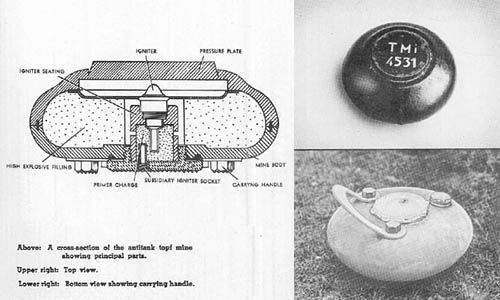
But you don’t just want to hide mines – you want  to be able to find them yourself.  So the Nazis came up with another idea – make them radioactive.   They can then be detected with Geiger counters.   In 1944/45 they built a class of anti-tank mines called Topfmines which were painted with a material called ‘tarnsand’.   No one seems to know quite what this was, but it appears to be tailings from uranium mining.   The mine’s case was made of pressed wood pulp, and it contained 6 kg of TNT.  It had a pressure plate on the top and a trigger that responded to 150 kg of pressure.  That’s heavier than a person (at least in those days), but would be set off by a vehicle.

topf_mine
Topfmine Radioactive Anti-tank Mine – credit http://www.lonesentry.com/ordnance/topf-mine-antitank-mine.html  Bottom right image shows the bottom of the mine and its carrying handle

They then mounted a Geiger counter called the Stuttgart 43 on a long pole and attached it to the front of tanks. It could pick up this mine long before they drove over it.

The Allies never caught onto this.   About 800,000 were made in 1944 and 45.   They were probably laid in France and Poland to stop Allied advances, and many may still be there, along with so much other unexploded ordnance.  The casings would degrade over time, and the charges would also deteriorate, but the radioactivity would last forever.  They’re just another memento of Nazi occupation.

British Nuclear Land Mines, Heated by Chickens

One expects craziness from Nazis, but an even madder project came from the British.   They started developing their own nuclear weapons in the 1950s after the US cut off research cooperation due to spying scandals.  Their first bomb was called Blue Danube, and went into production in 1956.   This was a huge implosion device, weighing about 5 tons, with about a 10 kiloton yield.   That’s a hard thing to move by bomber, so they thought about other applications for the same design.   They hit upon using it as a land mine on the plains of Northern Germany.   If the Cold War turned hot, and thousands of Soviet tanks rolled out from East Germany to attack the West, these would be set off by timers or miles-long wires for remote detonators.   The project was called Blue Peacock and two were actually built:

That Time the British Developed a Chicken Heated Nuclear Bomb
Blue Peacock Nuclear Land Mine in the collection of the UK Atomic Weapons Establishment (AWE, awe.co.uk).  Click for AWE article by curator

Yes, turning Germany into a radioactive wasteland just to block tanks was a deeply terrible idea.  But, they reasoned, it would be even worse if it didn’t work.   These bombs were just sitting there in the cold ground.  How could they be sure that the timers and detonators wouldn’t freeze up in the winter?  They considered swathing them in glass fiber pillows, but then hit on a much better idea – put a crate of chickens inside.  Their body heat would amount to about 10 watts per chicken.  Keep them from pecking at the wiring, give them some feed and water, and they would be fine, at least until they were vaporized.

This was discovered on April 1st, 2004, when the program was declassified after 50 years.  April 1st, eh?   But no, it wasn’t a prank – there were archival drawings of just where the coop would go.  Wasn’t that rather cruel to the chickens?   Well, when setting off an atomic bomb, the health of chickens is low on one’s priority list.

Although ten of them were proposed to be built, the whole program was cancelled in 1958 when they came to their senses.  However, the US did go on to build nuclear land mines, the Medium Atomic Demolition Munition, and deployed them between 1961 and 1989 in Europe, South Korea, and possibly even the Golan Heights.

Modern Mine Replacements

Land mines are horrible anyway, and injure many thousands of people a year, often children playing in abandoned fields.   Most countries are banning them under the auspices of the Ottawa Land Mine Treaty.  Unfortunately, the major military powers – the US, Russia, China, and India – have refused to sign.  In spite of spending trillions on their militaries, they still like this cheap and dangerous weapon, even though it injures their own people.

But if there have to be minefields, let’s at least make them safer.  A friend of mine suggested that instead of strewing a field with explosives, strew it with sensors.  When they detect a person or vehicle crossing a restricted area, signal an automated mortar.  It drops a shell on the detected position within a couple of seconds.   The signals are encrypted to prevent spoofing, and the sensors disable themselves if disturbed.  The whole thing can be disabled if your own troops are entering the area, and shut down when the front changes position.  This is just what DARPA was trying to do with its Smart Dust program in the late 1990s.

Given the progress in Internet-of-Things electronics, this could well be cheaper than minefields!  These sensors could cost pennies.   Maybe then this weapon class can be eliminated everywhere.

Posted in Uncategorized | Tagged , | 1 Comment

Is STEM Recruitment Working?

The technical world, that of math, science, and engineering, has been trying for decades to get more young people interested in it.   It collectively sponsors TV programs, high school contests, and scholarships.   Politicians are constantly touting the benefits of STEM careers, as are companies.

So has all this encouragement had an effect?   To check, let’s look to see if more people are entering the fields, as defined by getting bachelor’s degrees in them.  This should be a better guide than graduate degrees, because those are often not economic, and are heavily affected by how many foreign students come.  Let’s also derate by the number of people in the age group, to make sure it’s not some population shift.  The Census tracks population in five-year groupings, so let’s pick ages 20-24, which covers the usual age for  for when people get bachelor’s degrees. The number of people in that range has varied from 16M in 1969, up to 22M at the peak of the Boomers in 1983, down to 18M in 1997, and back up to 23M in 2015.

The National Center for Educational Statistics, a division of the NSF, tracks the number of degrees here: WebCASPAR database.  I’ve massaged all the data into this spreadsheet –  STEM Recruitment As Measured by Bachelor Degrees – but let me put the charts here with some description. So, first, engineering:

I’m including Computer Science under engineering, because science is the study of nature, not machinery.   CS is much the most popular degree, but interest in it varies a lot.  It peaked in 2003, when people got into it during the Dot-Com Bubble in the late 90s, crashed in the Great Recession, and is still not back to peak levels.

Mech E was stable for decades, but recently is on the rise, probably because of robotics. The TV shows Mythbusters and Junkyard Wars may also be helpful, since those stress mechanical invention above all other kinds of engineering.

EE peaked in the 80s, and has been on a long, slow decline since, although there’s a recent small up-tick.  EE is a capital-intensive field these days, unlike most of its history, and so recruitment is down.

Civil is pretty constant, as are Industrial and Aerospace, but Chemical is doing well.

Other is a catch-all for many categories, and is doing very well.   Its major categories are Biochemical, Biomedical, Mechatronic, Naval and Ocean Engineering, Nuclear, and Systems.  The data doesn’t break this down, but I would expect that the bio-oriented and the robot-oriented ones have big increases.

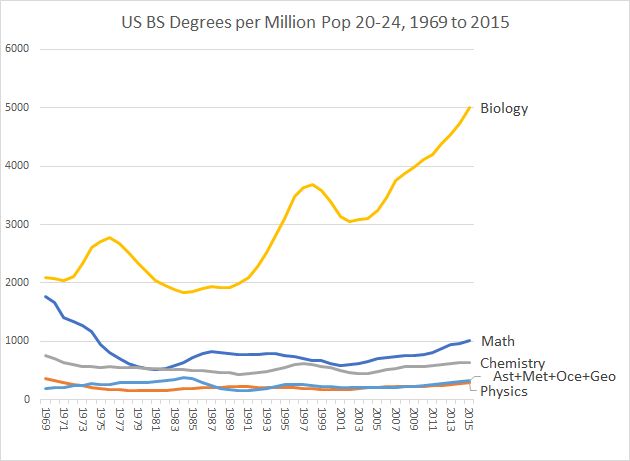
Now let’s look at math and the major sciences:

Biology utterly rules, and is doing great.  About twice as many people get bachelors in biology as in CS.  In fact, there are more biologists than all engineering fields combined.  This is partly because Bio is an entry degree for medicine, and partly because Bio really is the dominant field of scientific research these days.

Math is actually down from its level in the 1960s, but is on a slow rise these days.   CS probably took away the more practically-oriented math people in the 1970s.

Chemistry, physics, and the natural sciences (Astronomy, Meteorology, Oceanography, and Geology) are all stagnant.

The above are the so-called hard sciences, a term I dislike, but they’re the ones that concern the natural world.  The ones that concern the human world are more popular:

Psychology and Sociology are just fundamentally more interesting to us humans than fields that deal with abstract forces or invisible molecules.  I think we’re on a threshold in these fields of being able to truly model what’s happening in them, which should lead to breakthroughs at least as big as those of 19th century physics and 20th century chemistry.   Like those, they can also be used for ill, as I mentioned in Weaponized Psychology Helped Elect Trump  and in When Modeling Goes Bad – “Weapons of Math Destruction” .  But understanding is always key to progress, and these fields are moving fast.

Medical Sciences is on an upswing as part of medicine in general, but Anthropology seems constant, perhaps because too much of the world is inter-connected.  Linguistics as actually on a good upswing but can’t be seen at this scale.

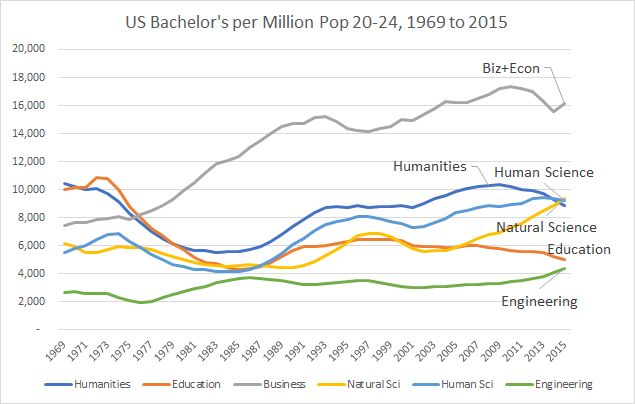
Finally, let’s look at how STEM fields compare to the trends in degrees as a whole:

The large fields that are growing are Business (unsurprising as the country becomes more mercantile), Natural Science (largely Biology), and Human Science (largely Psychology).  Engineering is on a slight rise (largely CS), and Humanities and Education are flat.  The big changes happened in the 1980s, when Humanities and Education were displaced by Business, probably as opportunities for women grew.

So what can we say overall?   It doesn’t really look that good for STEM.   Biology and CS are up, but they’re volatile.   Other STEM fields are largely flat or only slowly growing.  My own field, EE, is actually declining.  STEM promoters are almost certainly not trying to increase the number of Psychology majors, but that’s doing very well.   Maybe this promotion has a minor effect compared to people’s inherent interest in fields and the career prospects for it.


Posted in Uncategorized | Tagged , | Leave a comment