Insects of Doom

One of the pleasures of my field is to find a technical paper written in the driest passive-voice-only larded-with-acronyms style on a subject that is astonishingly, gruesomely science-fictional.  Last month’s issue of the Journal of Solid State Circuits had such a paper:  “A Pulsed UWB Receiver SoC for Insect Motion Control” by D. Daly et al of MIT, U. Arizona, and U. Washington.   In brief, they have designed a chip that is small enough and light enough that it can be wired onto the back of a moth to turn it into a cyborgized spy or weapon.  The chip receives radio commands and drives tiny wires that are plugged into the moth’s wing muscles:
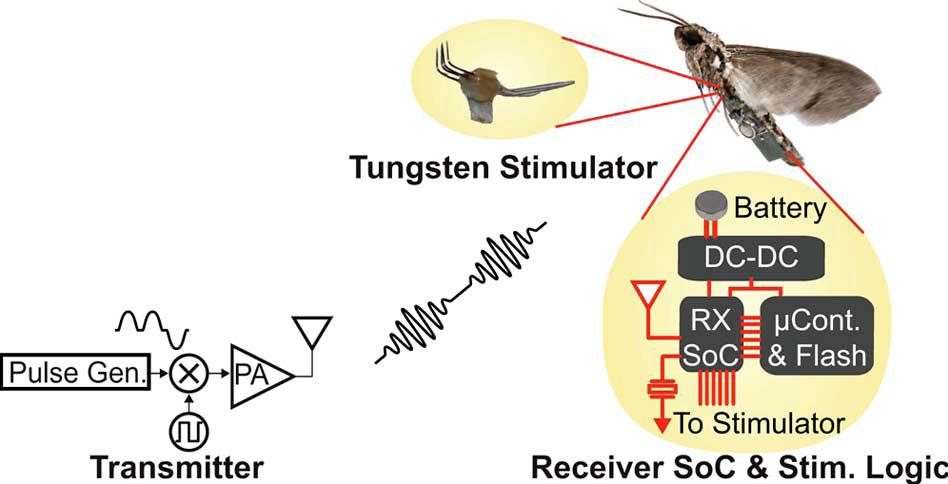
A diagram showing the radio system for a remote-control moth

Insects don’t just look like machines any more

The block labeled Rx SoC (that’s Receiver System-on-a-Chip) is the subject of the paper.   The “Tungsten Stimulator” is the wires that go into the moth’s muscles,  the “DC-DC” block turns the voltage from the battery into a suitable voltage for the chip, the triangle is the radio antenna, the  “uCont. & Flash” is a micro-controller chip with flash memory storage of program parameters,  and the little rectangle is a crystal that supplies a clock frequency.

The thrust of the paper is how they were able to build a radio of such low power and high bandwidth that it’s able to run off of a battery small enough to be carried by a moth.  The whole system only weighs 1.0 grams, but this species of hawkmoth only weighs 2.5 grams, and it was apparently a real challenge just to attach the thing.  The receiver can run at up to 16 Mbits/sec, which is a decent rate for a laptop WiFi connection, but only draws a few milliwatts, the kind of power a watch battery can put out.

Yes, you ask, but why?   The answer can only be a bone-chilling laugh.  Well, that and it’s getting DARPA funding.  And it uses an interesting new modulation technique called ultra-wideband (UWB) which is much easier to integrate onto a chip than other kinds of radio.   That means that small, low-power radios can be built much more cheaply and therefore used in a much wider range of applications than the expensive multi-component types now found in cellphones.

OK, you say, speaking more slowly and distinctly, but why do they want to put remote controls on insects?   Beats me.  Here’s all they say about it:

“Scientists and engineers have been fascinated by cybernetic organisms, or cyborgs, that fuse artificial and natural systems. Cyborgs enable harnessing biological systems that have been honed by evolutionary forces over millennia.  An emerging cyborg application is hybrid-insect flight control, where electronics and microelectromechanical systems (MEMS) devices are placed on and within insects to alter flight direction. Compared to existing micro- and nano-airvehicles used by the military and other government agencies, insects are appealing because they are small, can travel significant distances, and can carry relatively large payloads. Such a hybrid-insect system would take the best qualities of biology: energy storage, efficient flight control, highly adapted sensing—and combine them with the best qualitiesof electronics: low weight, small size, deterministic control, and interfacing with computation.

Well that’s phrased carefully.   One is free to imagine anything:  moths doing suicide runs on enemy light bulbs, moths dropping anthrax into terrorist soup,  or crowds of moths clogging tank barrels.   Once manufacturing scales up, you could have  vast clouds of radio-controlled locusts devouring an enemy’s crops.  Once you can put a transmitter on the chip as well as a receiver, you could use it as an, ahem, bug.

Sorry.  The real reason, of course, is that the only way to get research money out of Republicans is to claim that it has some military application.  Cheap, low-power radios would be a great thing to have all by itself, and if the only way to get Uncle Sam to cough up is to pair it with some men-who-stare-at-goats class of project, then so be it.

Update 2/9/2010: The MIT professor who did this study, Anantha Chandrakasan, happens to be at a conference I’m attending.  I asked him why DARPA wanted to control insects and his answer was “That’s above my pay grade.”  He was interested in the radio design, and a grad student got a nice thesis out of it.  The biology part was someone else’s responsibility.

Update 6/26/2017: The above professor has just been made Dean of Engineering at MIT!  He has done a lot of great work on chips, so this is well-deserved, but maybe some three-letter agency interested in cyborg insects also likes him.
Posted in Uncategorized | Leave a comment

Take that, Eichmann

94-year old Holocaust survivor, Yitta Schwartz, leaves 2500 descendants:

http://www.recordonline.com/apps/pbcs.dll/article?AID=/20100104/NEWS/100109926

She had 17 children herself, and 170 grandchildren.  By my reckoning, each of her grandchildren would have an average of 13.7 descendants, and apparently they have grandchildren themselves.  It hardly seems possible.  The Guinness world record as of 2002 was 824, from one Samuel Mast who died in 1992 at age 96 in the US.

She was living at Kiryas Joel, a Hasidic community in lower New York. Wikipedia says that it has the lowest median age (15 years), highest concentration of Hungarians (19%) and the highest poverty rate (2/3) of any community in the nation.  The 2500 number is probably apocryphal, but is kind of awe-inspiring.

Posted in Uncategorized | Tagged | 1 Comment

How Many Citizens Are There?

As noted in the last post, more than half of all Americans who ever lived are alive now.  The percentage isn’t as dramatic in other countries because they haven’t had the 100X increase in population over the last 200 years that the US has, but the percentage is likely to be high there too.

But I think there’s another effect at work that magnifies the impact that  modern culture has on the natural world even more.  Not only are there are a lot more people these days, but a higher percentage of them are active agents.   They’re out on their own, with their own domiciles and jobs.  They’re citizens, and that means they’re burning up the planet faster than ever.

To try to see this effect, I looked at what percentage of the population actually votes.  I could also look at the proportion in the workforce, or the size of households, but this data goes back farther.

If you can’t vote, you’re not really a participant in society.  You’re a child, or mentally incapacitated, or an illegal immigrant, or have forfeited your rights in some way.  You may be an agent, but your activities are constrained by law or by your dependency.

So here’s what it looks like for the North Atlantic Anglophone world:

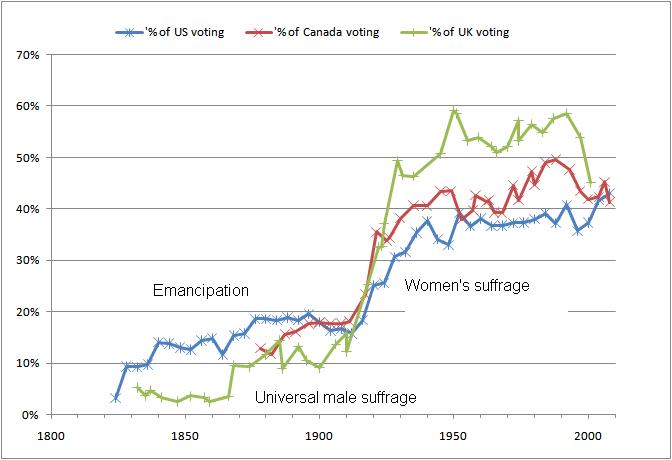
Percentage of population that votes

About half of modern people are citizens - < 20% of Victorians were

The US data is for presidential elections; Canada and the UK are for Parliament.   All three countries had elections before the first dates shown here, but didn’t record the popular votes.  The UK and US had surprisingly low rates in the early 19th century – just a few percent.   The big jump happened in the 1920s when all three countries granted women the right to vote.  The rate more than doubled, so apparently everyone was encouraged to participate.   Perhaps more men were egged on by their wives.

The rate has been fairly flat for the last 60 years, in spite of the repeal of Jim Crow laws in the southern US, and lowering the voting age to 18.  Perhaps these are balanced by higher proportions of immigrants or felons.  The US proportion of voters is significantly below the others, for reasons that would be worth understanding by those who value the Republic.

Posted in Uncategorized | Tagged | Leave a comment

How Many Americans Have There Been?

In a previous post I noted the claim that 7% of all human beings who ever lived are alive today.  I’m not happy with that statistic.  It’s hard to measure population today, much less in pre-industrial times, and essentially impossible in Paleolithic times.

Yet the total number born is really sensitive to how many people were alive in the 200,000 years since homo sapiens arose.   Say that there was a static population of 10,000,000 people, who each lived for 40 years.  Then there would have to be a birth rate of 250,000 people a year, making 50 billion over 200,000 years.    But if there were only 1,000,000 people, with an average life span of 30 years (perhaps more realistic), then the prehistoric number born drops to 6.7 billion.

And that’s not even getting into things like the Toba Catastrophe, which may have almost exterminated the species 70,000 years ago, when a giant volcanic eruption on Sumatra cooled the climate for decades.  Humanity may have dropped to a few thousand people, probably in Africa.  We are suspiciously genetically similar, much more so than, say, chimpanzees, which indicates that we have a small number of ancestors in the fairly recent past.

Anyway, let’s try for something that has better data – what fraction of all Americans are alive today?  As best as I can tell, here’s how the country has grown from 1790 to 2010:

Chart of the number of Americans over time

About 55% of all Americans who ever lived are alive today

The country has grown from about 3 million at the time of the revolution to about 300 million today.  If you add up all the people born in the last 220 years, plus the number who have immigrated in that time, you get 545 million of which 472M were born here and 73M immigrated.  So a little over half (55%) of all the Americans who have ever lived are alive now.

These numbers themselves are dicey.  They come from the US Census, but they only really measured population in the 19th century, not number of births or number of immigrants.   I took birth rate estimates to find the number of births, and likewise immigration estimates.  Those get clearly rougher as you go back further, since no one was registering all the births that happened at home, and people could come into the country regularly without papers. Births and immigration were counted in the 20th century, and those numbers are so much bigger than the earlier ones that it probably doesn’t affect the total.

Why does this 55% number matter?  I’d say that it’s rather interesting by itself, but it also shows how strong an effect we have on the land today compared to previous times.   The US has been around for quite a long time, longer than maybe a dozen other nations, but the massive impact of people upon the landscape is happening right now.

That’s true of the world as a whole too.  We’re now actually changing the composition of the atmosphere, exploiting most of the fresh water, and using most of the arable land.   It’s happening now because right now is when the most people are living.

Posted in Uncategorized | Tagged | 40 Comments

Stupid date tricks

Yes, it’s cheap, yes it’s obvious, and yes it’s meaningless, but I can’t resist noting that today’s date, 01/11/10, is both binary and a palindrome, at least when written in the North American, non-Y2K-compliant style.    The next one is Nov 11, 2011, and that’s it for this century!

Posted in Uncategorized | Leave a comment

Feeling the force

So here’s an interesting idea – making the gas pedal push back when you get too close to the car in front or should shift for fuel economy:

Active pedal picture

Active Pedal from Continental AG

Full description here at Green Car Advisor.  They claim that when people can feel when it’s best to shift, they can improve mileage by 5 to 10%.

Even a small improvement like that easily justifies the extra cost of an active pedal. Say that this is an optimized diesel that gets 40 mpg and gets driven for 120K miles before getting junked. It’ll burn 3000 gallons of gas during its life. At $3 a gallon that’s $9000. A 5% saving is $450. If the car maker has a 50% margin on features (which is what everybody slaps on to their products), then they would buy the pedal for $225. For that much you can put an Atom processor and a camera into the thing.

I’ve driven cars with little lights that blink at the shift point, and they are pretty annoying.   Anything that flashes forces you to take your eyes off the road, and when it’s a flash that you intend to ignore anyway, it’s not long before you break out the black tape.  I could see that a tactile feedback loop like this could soon become unconscious, leaving you free to be irked by the news on the radio.

I wonder if something like this could be done with the steering wheel too.   That might be better for a lane departure warning than a buzzer.   You could even simulate  road feel while still having an active suspension.   You could feel what the road is like without actually getting bounced all over.    It’d be nice if cars just nudged you instead of beeping or flashing.

Posted in Uncategorized | Leave a comment

The algorithmic complexity of snow shoveling

Another storm, another clearing of the driveway.  I don’t mind it all that much, at least this early in the season, since snow brightens everything.    It’d be entirely fine if you didn’t have to drive on filthy slush.   I’ve seen Russian kids going to school on snowy paths with 18″ skis strapped to their boots, and envied them.

But the trouble with shoveling is that every time an inch of snow falls it has to be lifted above the N inches that are already there.   Shoveling gets harder and harder as the piles accumulate.  I remember that the Blizzard of ’78 was particularly bad because there had already been a 22″ snowfall a few days before, so when another 26″ fell there was no place to put the stuff.

In computer science terms this would be called an O (N^2) problem, because the work increases as the square of N, not just as N.  It’s like sorting a list by comparing every element to every other element – as the size N of the list increases, the time increases as N^2.

So what to do?  There are a couple of approaches:

  • O (1) – Do nothing.  Wait for it to melt.  The Washington DC approach.
  • O (N) – Do the same thing no matter how much snow there is.  This is the snow blower principle – just throw it all up high enough and it’ll get over whatever piles are already there.
  • O (N log N) – As the piles get higher, make them wider.  That is, move the snow farther away from where you’re shoveling.  This is the principle of the mighty Wovel, which my brother gave me for Christmas one year:
  • a snow shovel with a huge wheel in the middle

    Wovel in action, though not by me

    You push down on it to raise the shovel, and then jerk it back to add to a pile.  The nice thing is that you can transport the snow easily to a new pile when one gets too tall.   It can’t lift things more than about two feet, though, which isn’t all that high.

  • O (N^2) – Get depressed as winter proceeds.

As you can tell, my mind wanders when I’m doing this.

Posted in Uncategorized | 1 Comment

Life is long, history short

So I was reading Alan Furst’s new novel “The Spies of Warsaw” when I was struck by a particular passage.   A typical Furst protagonist, the world-weary French Colonel Mercier, is attending a grand reception in Warsaw with a typical Furst heroine, the luscious and mysterious Anna Szarbeck.  It’s 1937, and war is coming. She’s chatting with various strangers:

“So, you’re with the League of Nations.”  The woman was in her seventies, Anna thought; her husband, with grand white cavalry mustaches, at least in his eighties.  “Such a hopeful notion, my dear, really.  A league, of nations!  How far we’ve come, in this dreadful world.  My husband here, the general, was the late-life son of a colonel in the Hussars.  In 1852 that was. A great hero, my husband’s father, he fought in the Battle of Leipzig and was decorated for bravery – we still have the medal.”

“At Leipzig, really.”

“That’s right, my dear, with Napoleon.”

The Battle of Leipzig was in 1813, and was the largest battle in Europe before WW I, involving 600K troops.  If the husband’s father was 21 then, he would have been 60 in 1852, when the general was born.  That’s old for a father, but not terribly old.  Of every 100,000 births, between 20 to 100 are to men of that age.  If the general himself had had a child at 60 in 1912, that child would be 97 today.  Again, old, but not unheard of. Adjust those ages a little bit, and a man who had a son at 70 who himself had a child at 70 would have a grandchild who would now be 76.

So a person living today could have a grandfather who fought in the Napoleonic Wars.  It only takes three lifetimes to cover the modern era.   Three lifetimes to go from sailing ships to robots on Mars.   Three lifetimes to cover the Industrial Revolution, the rise of democracy, the 10X explosion in world population.

But then, all of human history is short, maybe 5000 years.  My own lifetime covers 1% of that, and I’m just some guy.  It would only take 100 lives like mine to cover it all.  You too have probably personally experienced a significant percentage of all of history.

How can that be?  Maybe because of that population explosion.   The total number of people who have ever lived is somewhere around 100 billion.  There are almost 7 billion of us right now.   If you ever lived, there’s a 7% chance that you’re alive right now.

Update 9/4/17: A case has been found of the above!  The site Mental Floss noted in 2012 that President John Tyler has two living grandsons.  Tyler was born in 1790, and was president from 1841 to 1845.  He was a captain of a militia company in the War of 1812, which counts as a spinoff of the Napoleonic wars, but saw no action.  He had a son, Lyon Gardiner Tyler in 1853, at age 63 by his second wife.   Lyon then fathered Lyon Gardiner Tyler Jr. in 1924, and Harrison Ruffin Tyler in 1928 when he was 71 and 75, again by a much younger second wife.   Both are apparently still alive at ages 93 and 89.  Harrison is still in the family home in Virginia.  That’s three generations covering 227 years!   Neither Lyon Jr or Harrison have second wives, so their family’s extremely long generations stop with them.

Posted in Uncategorized | Tagged | 3 Comments

Are SF writers Lettuce or Whiskey?

Alexander Jablokov lists on his blog “Five reasons writers don’t improve with age”.   It’s a depressing thought for an SF writer like him, although he’s one of note, but is it true?   Are writers more like lettuce, best when picked fresh off the field, or whiskey, aged for decades in their cellars?

We can have personal opinions about whether the later books from a writer are better than the earlier ones, but there is a more general criterion in the form of book awards.  Let’s look at the Hugos for best novel, and see how old the writers were when they won them, and for how long they had been writing at that point:

Chart of Age of authors when they won a Hugo

Authors tend to win after 20 or so years of writing

The youngest winner was Roger Zelazny at age 29 for “This Immortal”, the oldest were Vinge, Clarke, and Asimov at 63, and the average age is 45.  The shortest interval from first-published-work to award was again Zelazny at 4 years, while the longest was Asimov at 44 for “Foundation’s Edge”.  No surprise there – Zelazny burst on the scene like a nova, and Asimov was a star for generations.  The average time from start to award was 17 years.  Quite a few people had late starts – having first published in their mid-30s – and still won.   I would say that the author who changed the most from his early work to his winning novel was Frederick Pohl, whose 1978 “Gateway”, written when he was 61, is quite different from his famous 50s satires like “The Space Merchants”.

Overall, then, it looks like writers do improve with age, at least up to 20 years or so into their careers.   Those careers are pretty long compared to a lot of fields.  Joe Haldeman once remarked that when he in college, he thought seriously about going pro in baseball.  Instead he went to Vietnam, got blown up, and became a writer.  He was in his early 30s when “The Forever War” came out, and was considered a promising young writer.  As a baseball player he would have thinking about retirement.  22 years later he won again for “The Forever Peace”, a book quite different in style but playing with the same themes.  Imagine being a star baseball player in your 50s!

Now I’m curious about the distribution for other fields like music or drama, but that’ll have to wait for other entries.

Posted in Uncategorized | Tagged , | 2 Comments

Living in the Anthroposphere

So I was planting tulip bulbs a few weeks ago when it occurred to me – this is the first time in weeks that I’ve touched something not man-made.  Almost everything in our day-to-day environs is an artifact.  Our clothes – woven from some fiber.  Our tools – stamped or cast from metal or plastic.    Our food – bred to meet our needs.  A carrot is as much made as a hammer.   Seafood is an exception, but less and less of that is caught in the wild.   Dogs are pretty much an artifact; cats are less so.  Furniture, cars, books – even our water is purified before we touch it.

In gardening you touch actual dirt, made by plants and eathworms and microbes.   Dirt is why everything else in our lives is man-made – actual nature is unhealthy.   Plants and animals really don’t want to be touched.  They’ll discourage it with thorns and teeth.  The bacteria that do want to get into us are doing so for reasons we don’t encourage.  We like our surfaces to be sterile and dead instead of alive and infectious.

This isn’t a particularly modern condition.  People have worn shoes and used hoes for a long time.  Humanity has been steadily separating itself from direct contact with the natural world for millenia.   You live longer that way.   It may seem limiting and sheltered to be wrapping ourselves in a cocoon of our own stuff, but it’s protective too.

Posted in Uncategorized | 1 Comment