The Modern Alexandria?

What modern city would match Hypatia‘s Alexandria?  Not in the sense of being filled with murderous mobs, of course, but in terms of being a main repository of knowledge.

Continue reading

Posted in Uncategorized | Tagged , , | 2 Comments

More on Agora and Hypatia

The movie Agora mentioned in the previous post got me interested in the actual Hypatia, so I picked up “Hypatia of Alexandria, Mathematician and Martyr” by Michael B. Deakin (2007).

Portrait by Elbert Hubbard, 1908

It discusses the little that is actually known about her, and goes into some depth on what her mathematical contributions were.  The author is an Honorary Research Member of the School of Mathematical Science at Monash University, which is near Melbourne Australia.   He taught there from 1973 until his retirement in 2003, and got his doctorate from the University of Chicago in 1966.

According to Deakin, Hypatia was the leading mathematician in the world in 400 CE.  This, unfortunately, was because she was the leading mathematician in Alexandria.  Nothing was happening at that time in Athens, the other major center of learning in the Roman world, and China and India were in down phases.    So it may seem a limited honor, but it’s a rare one.  One could say that Marie Curie was the world’s leading chemist in 1910, but no other female mathematicians since Hypatia’s time could really claim to be the best in the world.

Continue reading

Posted in Uncategorized | Tagged , | 3 Comments

Two Recent Science Movies You Probably Didn’t Get To See

… unless you live in an ultra-blue city.  They are Creation, about what made Darwin finish “On the Origin of Species”, and Agora, about the tragic end of the one of the last great intellectuals of the Classical era, Hypatia of Alexandria.

According to Variety, Creation opened on 1/22/2010 in the US, played at a peak of 9 theaters and had a cumulative box office of $340,000.  Agora opened on 5/21/2010, peaked at 6 theaters and did hardly better at $577,000.

Continue reading

Posted in Uncategorized | Tagged , | 2 Comments

The Population of Other Hostile Places

In the last post I calculated that the current population of outer space was about five, if you added up all the person-years spent up there.  What about other difficult places to live?

Under the Ocean

This was another of those 50s skiffy dreams – that there would soon be cities under the sea as Humanity’s Manifest Destiny took it into every corner of the earth.  It wasn’t clear why people would be living there when there is so much room in, say, North Dakota, but that was the vision.

Today there are only two regularly used underwater habitats: the NOAA Aquarius Reef Base and the Jules Undersea Lodge.  Here’s the Aquarius base:

The Aquarius Reef Base

It’s about 50 feet down in a coral reef off the Florida Keys.  It has bunks for 6, and teams can go for 10 days at a time.  It’s actually about the same size as the Mir space station (350 m^3), although zero-gee lets one use a lot more of the volume.   The base allows researchers to spend 6 times as much time on the reef than if they had to dive from the surface.  In 2010 it’ll be occupied for about 81 days, so if there are 6 people there at a time, that’s 1.3 person-years.  Given that it’s stuck in one place on this reef, it’s scientific value is limited.

It costs ~$1.5 million a year to run, so that’s about ~$1M/person-year.   A tourist trip to the ISS space station costs $20M for 7 days, so that’s about $1B/person-year, 1000X more.  It’s nice to have fresh air only 50 feet away!

The Jules Undersea Hotel is somewhat cheaper: $500/person/day, or $200K/person-year.  It’s in only 20 feet of water, though, and looks a bit sad with its 70s decor:

Common area of lodge – Yes, they even have a VCR

It’s immediately off a dock, and there’s a gift shop!   It’s not exactly the New Frontier.

Real undersea work is already almost entirely done with waldos, as witness the work in capping the BP Deepwater Horizon spill.  There were up to 12 Remotely-Operated-Vehicles down by the well head at a time.  The ROVs seemed to do about as well as manned deep-water submersibles, and didn’t have to spend hours going up and down.  Having real people near these operations is so dangerous and expensive that I doubt we’ll ever see real undersea habitats.

Antarctica

Here’s another place that would kill you quite quickly if you went outside in what you’re wearing right now.   It would take maybe 15 minutes instead of the 2 minutes to drown at Aquarius (and 30 seconds on the ISS), but nevertheless there are a lot of people there doing a huge range of things. The CIA factbook says that there are about 4400 people there in the summer, and 1100 in winter.  At the South Pole itself there are about 200 in summer and 50 in winter:
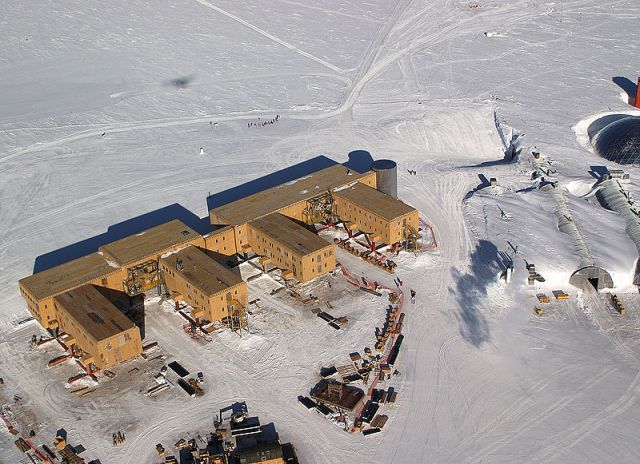
Current Amundsen-Scott South Pole Station, with old dome to the right

The whole building is up on stilts and is designed to direct the wind to scour the snow from underneath it.   The previous bases kept getting buried, but for this one they’ll just jack it up as the snow rises.

The US National Science Foundation spends about $350M a year on Antarctic research, which covers 1200 people in the summer and 300 in the winter.  That comes to about $500K / person-year, so Antarctica is even cheaper than the shallows of the Florida Keys.

High Altitude

The highest manned structure that I could find is the University of Tokyo Atacama Observatory (TAO) in northern Chile, at 5640 m (18,400 feet). (No, there are higher bases!  See at bottom)
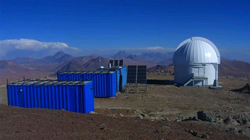
Dome for 1 meter scope, shipping containers for electronics

It’s placed so high to maximize infrared observing.  There’s only a 1m scope there now, but a 6.5 m is coming soon.  Power comes from a photovoltaic array at the base of the mountain and a high-temperature superconducting cable.

The site is designed to be remotely operated.  There doesn’t appear to be any place for people to live.  The atmospheric pressure there is about half that at sea level.  Even the construction workers may have gone up for only the day.  5640 m is getting close to the danger zone of 6000 m, which is considered the limit for living for more than a couple of days.  At some point the astronomers are going to start using pressurized cabins in their efforts to get clearer and clearer views, but that hasn’t happened yet.

There have apparently been miner’s camps at 5300 m, and the gold-mining town of La Rinconada, Peru (population 30,000) is at 5100 m.

Thousands of people do climb 8800 m Mt. Everest every year, so if they each spent a day up there, that would count as several person-years at the lower edge of the stratosphere.

Great Depth

The world’s deepest mine is the TauTona Gold Mine in northeast South Africa at 3900 m.  The temperature at the bottom is 60 degrees C (140 deg F), and so it needs to be air-conditioned.  5600 people work in it, and it has 800 km of tunnels.  It only takes an hour to travel up and down, so the miners probably only spend one shift down at a time rather than staying down for months.  The air pressure at the bottom would be 1.5 atmospheres.   It sounds like a hellish place, and it kills about 5 miners a year.   It produced about $120M in gold last year, though, and so will be running for the foreseeable future.

The main permanently manned underground structures are military bunkers, of which the most famous and probably largest is Cheyenne Mountain, 600 m deep in Wyoming.   It used to be the command center of the horrific American ICBM system, but that time of history is thankfully past.  The much reduced missile operations are now run from nearby Peterson Air Force base, and Cheyenne is kept on “warm standby”.

Overall

It’s kind of striking where people don’t live.  Cities under the sea? Better done with robots.  In the sky?  More robots.  Deep in the earth?  Only if you fear nuclear attack.  The worst place that people seem drawn to is Antarctica.  Given its spectacular scenery, I’d like to see it myself!

Update  9/20/10: I found a much higher place where people live: the forward Indian army outposts on the Siachen Glacier in the Karakoram Mountains.   Specific positions are highly classified because of the ongoing Siachen Conflict, but the highest admitted is a helipad at 6400 m (21,000 feet) (!).  The area has been fought over for decades by India and Pakistan.  Thousands have been killed, mainly by hypoxia, hypothermia, and avalanches, but active shelling goes on to this day.  The struggle is over some 900 km2 of uninhabitable wasteland, and so is a matter of profound national importance.  There’s occasional talk of withdrawal, but then some other atrocity occurs.  I say they should put some cameras and remotely-operated machine guns up there and let the robots fight it out.  A vivid description of the conflict from Outside magazine is here.  Here is a Pakistani base at Sher:
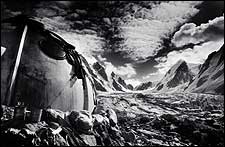
Fiberglass igloo hut at 6000m, surrounded by garbage and grandeur


Posted in Uncategorized | Tagged , , | 1 Comment

The Population of Space

The SF writer Charlie Stross recently wrote on his blog about the absurdity of self-sufficient space colonies (“Insufficient Data”).  He noted that it takes an extraordinary number of people to maintain a technological civilization, because even the most common artifacts embody a vast range of skills.  There are tens of millions of lines of software in every modern car, and a huge variety of individual mechanisms.  He thought that maintaining even the current level of technology would probably need at least 100 million people.   It’s impossible to estimate such a thing of course, but worth noting that the 10 to 20 million people in North Korea and Cuba have great trouble supporting a modern economy.  100M is not a big percentage of the Earth’s population of 7 billion, but it’s hard to imagine plunking that many people down on the Moon or Mars.

But this made me wonder – what is the actual population of outer space today?   The quick answer is zero, since there are no permanent residents of space.  But what is it if you add up all the person-years of the transient visitors?  There have been continuously occupied space stations since the early 90s, so there’s been someone overhead for a quite a while now.  As far as my Google-fu can tell, no one seems to have added this up.

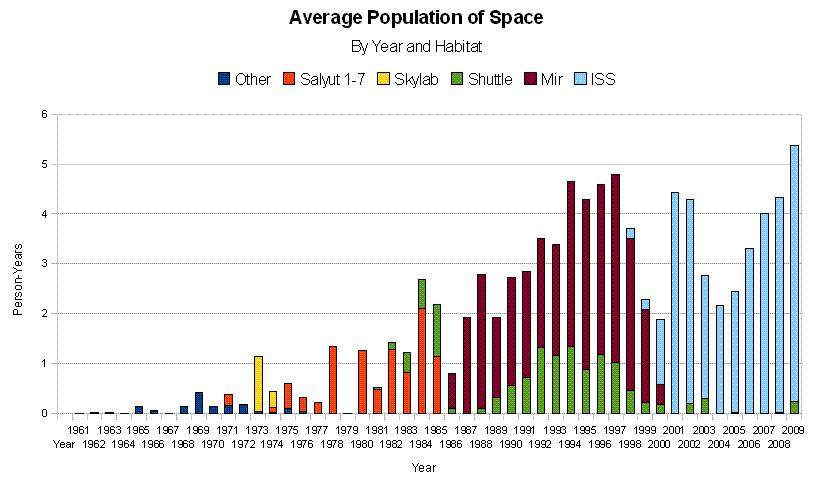
I did find a list of all manned space missions here, thanks to the efforts of Robert A. Braeunig.  I turned that into a list of all the people who had ever visited space, and calculated how much time they had each spent there, and where they had lived (E.g. on the Shuttle, on the Mir station, etc.). The results are shown below (please click for a larger view):

Average Population of Space, by Year and Habitat

The habitats are:

  • Salyut 1-7: a series of small stations put up by the Soviets
  • Skylab: a big station put up with one of the last Saturn 5s and occupied jointly by the US and USSR.
  • Shuttle: Missions by one of the 5 US Space Shuttles.  In the 2000s the Shuttle has been almost entirely used for building the ISS, so I’ve counted  those flights in the ISS category
  • Mir: A large station put up by the Soviets and occupied for 14 years
  • ISS: The International Space Station, a gigantic station with contributions from the US, Russia, EU, Japan, and Canada.  It’s now the most expensive single structure ever built, with cost estimates ranging from 35 to 150 billion dollars.
  • Other: all the other various launches.   These have all been done by the US or Russia, except for 2 by China in 2003 and 2005, and 3 suborbital flights by Scaled Composites Inc. in 2004.

While I’m at it, let me throw out some of the other statistics I learned:

  • Total number of manned flights: 289
  • Total number of visitors to space (counting repeats): 1262
  • Total number of individuals: 520
  • Max number of flights: 7 by Jerry Ross and Franklin Chang-Diaz
  • Max total time in space: 2.2 years by Sergei Krikalyov
  • Number of people killed in space: 17 (Soyuz-1, Soyuz-11, Challenger, Columbia)
  • Number of space tourists (people who paid their own way): 7 (Charles Simonyi has been twice, thanks to Microsoft stock)

So the full answer to “What is the population of space?” is “About five”, at least as of 2009.  Future growth will come from the full occupation of the ISS, which can handle up to 6 people at a time, and the launch next year of a small Chinese station, Tiangong 1.

The population of space has bounced up and down a lot, but the  growth since 1980 is about 4% per year.  At that rate we’ll have 100 million people in space in about 470 years, about the era of Star Trek.  That’s way beyond the the disasters we see now!  Space colonization will not save humanity.

Posted in Uncategorized | Tagged , , , , | 2 Comments

The Dangerous Isaac Newton

Here’s an image – the world’s greatest scientist is in a grubby London dive, talking to lowlifes.   Candles flicker on the table between them, and the air is close and foul.  He’s interrogating them closely, sometimes smiling and handing over a payment for information, and sometimes threatening them with Newgate Gaol. He’s a lean man of middle age and ordinary dress.  The most striking thing about him are his eyes.  It’s a gaze that cracked The System of the World, and now it’s directed at a web of crime that is undermining the nation.

Continue reading

Posted in Uncategorized | Tagged | Leave a comment

Rejected by the American Legal System

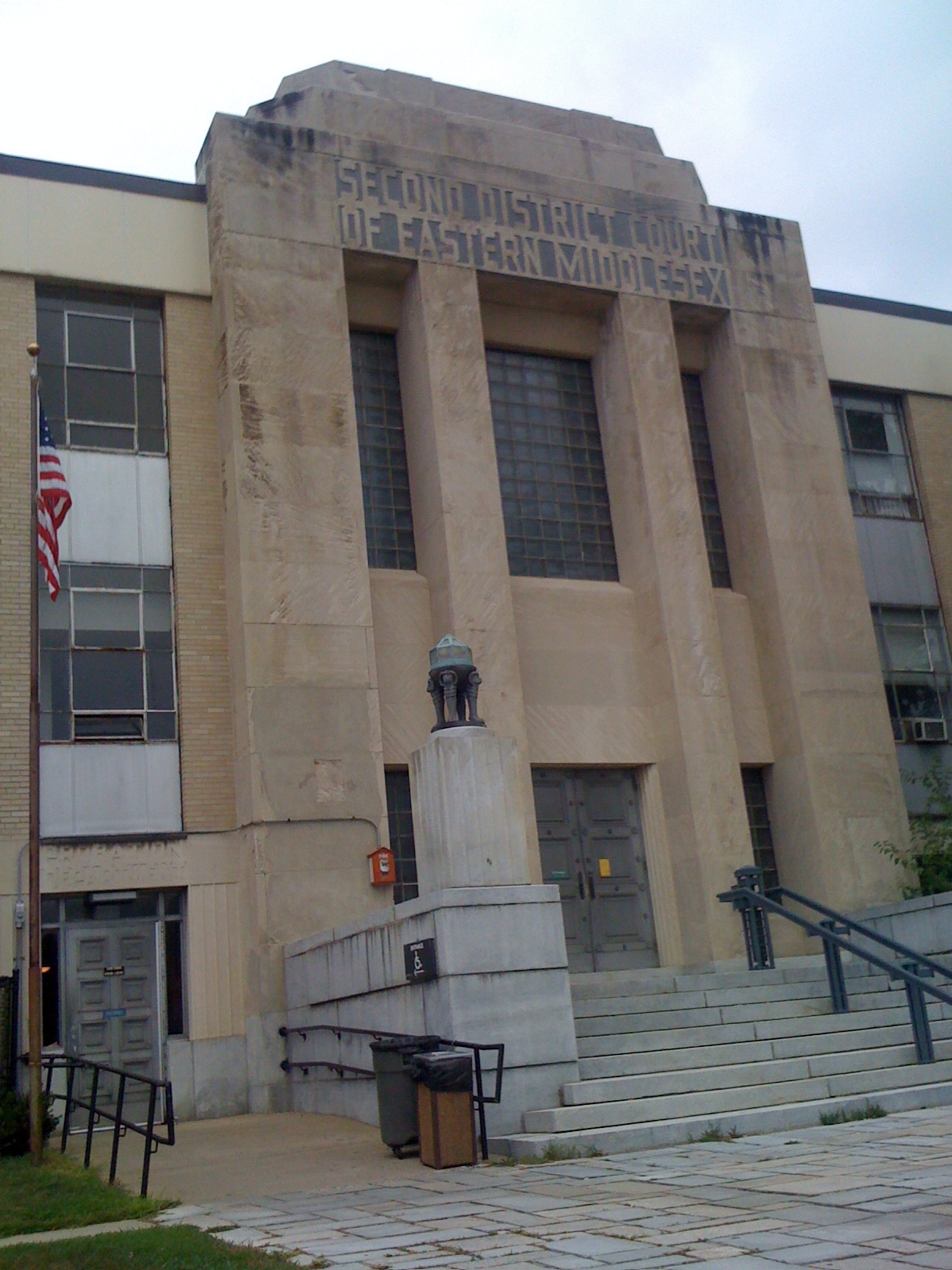
… for jury duty.  Geez.  I got a series of ominous notices over the last couple of months telling me to appear at the district courthouse:

Waltham District Courthouse – grand in 1938, but now not so much

So I appear at 8 AM per request.  This being an important civic duty, I wear a tie.   My 14 fellow jurors are in T-shirts and shorts, perhaps because it’s 90 degrees and 90% humidity outside.  One guy is in a lime-green shirt with a cartoon character sprawled on it saying “I’m not drunk, I’m just wicked tired from drinking all night”.

We hang out until 11, when the judge appears and thanks us effusively for showing up.   He had already resolved four cases that morning, but one was determined to go in front of a jury.   The others chickened out.   We filed into the courtroom and he introduced the defendant, a young guy up on a DUI, then the lawyers and the witnesses.  He then asked if any of us knew any of these people or had been affected by drunken driving.  About half the people raised their hands, including the guy in the green shirt.

The judge then interviewed each of them individually, grilling Green Shirt especially hard.  I could only catch a little of what he was saying, but it was something about “Do you feel that your judgment would be affected by what you’ve experienced?”  Eventually they all returned to their seats, and the clerk starts choosing jurors.  Green Shirt gets impaneled first.  The judge had not been amused.

They pick seven jurors (six regular and one alternate), and then a couple are excused.  The clerk called “Juror 15!”  and I stood and went to the jury box.  Some invisible sign passed among the lawyers and the clerk said “Juror 15, please return to your seat.”

Rejected!   How come Green Shirt gets to sit in judgment on a fellow citizen and I don’t?  Was it the tie?  Maybe they thought I was a Mormon.  I did say on the juror questionnaire that a lot of my family was involved in medicine, or maybe it was being an engineer.

After being dismissed, I went back to the courtroom to hear about the case.  The morning was shot anyway.  The defendant had driven off the road at 1 AM and crashed into a fence on a snowy night, even though it was an all-wheel-drive SUV.  When the state trooper showed up, he said “Honestly, I may have had a few beers.”  He could not recite the alphabet in order from F to Q.  The trooper took him back to the station, where his blood alcohol level was measured at 0.14%.  And that was over an hour after the accident!  0.08% is the legal limit in Mass.

The only defense his attorney (or more likely, his dad’s attorney) offered was “The state has not proven that my client was intoxicated at the time of the accident.”  What, he started drinking after he crashed his car?  Then this guy really does not belong on the road. He did have a witness there, a woman who came from Wisconsin to testify on the accuracy of breathalyzer tests.

I couldn’t stay to the end, but I think the verdict would have been pretty clear.  The guy’s dad must have figured that since no one was hurt, the state wouldn’t pursue a DUI all the way up to a jury trial.  A bad call.  The jurors in my pool were not happy to be there, and probably squashed him flat. The judge said beforehand that he only oversaw 30 jury trials a year, even though hundreds of cases came up before him.   I hope his other cases weren’t as lame as this one!

Posted in Uncategorized | Tagged | 1 Comment

Disasters vs Development

Here in the Northeast US it’s been a damn hot summer.   In Boston  last month the average maximum was 85.8 deg F, 3.5 deg higher than the average from 1971 to 2000, and we had several heat records.

We dealt with it mainly by complaining,  our usual response to weather, but also by going to the beach more and turning up the fans and AC.  People were annoyed, but no one died.

Unlike in Russia.

Continue reading

Posted in Uncategorized | Tagged | Leave a comment

Plating the Planet With PV

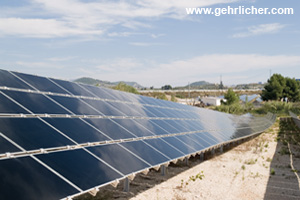
A 5 MW FirstSolar system in Bullas Spain

So I see from this report from GreenTech Media that the worldwide production of photovoltaic (PV) cells is due to pass 10 GW this year.   That’s a kind of random milestone, but to put it in perspective, that’s about 2 GW worth of baseload power, like that from nuclear plants.  Nukes run about 90% of the time at their peak output (called the capacity factor), while solar cells only do that 20% of the time (25% in the desert).   2 GW is about 2 nuclear plants worth, or about the average output of the turbines at Niagara Falls.   Also, that’s 2 nuclear plants more than have been built in the last 30 years in the US.

“Silly tree-hugger” I hear someone mutter.  “There are over a hundred nuclear plants in the US alone.  It’ll take 50 years at that rate to replace even those plants, never mind the other 80% of US power generation.”  Yes, but it’s not the 2 GW number that’s interesting – it’s the growth curve.   Production has grown from 170 MW in 2000 to 10 GW in 2010 at a compound rate of 50% per year.   That’s a doubling about every 18 months – a nice match to Moore’s Law for semiconductors.

So at that rate how long would it take to get enough PV power to run the country?   The US draws an average of about 400 GW, so at 20% utilization we’d need 2000 GW of cells.  We’ll ignore storage for the moment.   That’s 200X the world production this year, or ~8 doublings.  At 18 months per doubling, that’s only 12 years.

Isn’t compound growth staggering?   Surely that can’t be right.   How expensive would that be?   Well, First Solar is selling thin-film CdTe panels right now for $0.85 per watt.   The rule of thumb in manufacturing is that every doubling of production leads to a 10% reduction in cost, so:

cost after N doublings = base_cost * (0.9)^N = $0.85 * (0.9)^N = $0.37/W

So building 2000 GW of solar panels would cost ~$700 billion.   That’s less than what the US has already spent on the Iraq/Afghan occupations.  Instead of killing a million people, the US could have gotten rid of fossil fuel power production.   For that matter, the US just spent $700 billion to bail out Wall Street.  It spends ~$500 billion a year just on oil.

How big would such a system be?  Looking at First Solar again, a 70W panel occupies 0.72 m2 (4′ x 2′) and weights 12 kg (25 lbs).   That would cost ~$25 at $0.37/W.  That’s only about 5X as expensive as asphalt roofing shingles.  2000 GW’s worth would need 20,000 km^2 of panels, a region about 100 miles on a side.

The green square is a 100x100 mile solar farm in the Mojave, enough to power the US

Well, that’s a lot.  But consider that the US produces about 2,000 km^2 of plywood a year.  (More exactly, the USDA Forest Service Forest Products Laboratory says that the US produced ~20 billion ft2 of 3/8″ equivalent plywood in 2005).   If the solar industry could produce panels like plywood, they could fill the country’s needs in 10 years.

Multiply by 5 for the whole world, or by 10 when China and India come up to reasonable living standards.  Either way, it’s not infeasible.

And solar PV is actually about the most expensive form of renewable energy.  Concentrating solar thermal is much cheaper, has a higher capacity factor because it can track the sun, and can store its energy in big underground steam tanks.

Wind is cheaper still.   World production of wind will probably hit 50 GW this year, and it too has a higher capacity factor, more like 30%.  In Europe they’ve been building more wind than natural gas plants for the last couple of years.  Kansas and Texas are getting covered in towers.

I take comfort in this at a time when there’s constant bad news about energy.  First it was the horrible Massey coal mine deaths, then the BP disaster in the Gulf.  Behind that is the looming threat of Peak Oil, and behind that the vast catastrophe of global warming.  It’s one wave after another, with a tsunami on the horizon.

Yet we can and are getting past this.   Replacing the fossil fuel infrastructure looks daunting, but modern industrialism has awesome production capabilities when it gets going.   It looks like it would take a lot of money and a lot of stuff, but it’s not a lot compared to quite ordinary businesses.

Posted in Uncategorized | Tagged , | 1 Comment

One Catastrophe and One Annoyance

A few weeks ago there were two serious industrial accidents –  the BP Deepwater Horizon oil spill in the Gulf of Mexico on 4/20/2010 and the MWRA water main break in Boston on 5/1/2010:

Broken 21″ oil pipe 5000′ down in the Gulf of Mexico

Broken 120″ water pipe in Weston MA

At first sight, the Boston break was more serious.  It was actually a 1000X larger break – it dumped 300 million gallons of water a day into the Charles River (which doubled its flow!) compared to the 300 thousand gallons of oil a day from the BP spill.  It directly affected the water supply for two million people.   In a matter of hours the word went out to the entire area – the tapwater was not safe to drink and had to be boiled or chlorinated.  How many people would be sickened by contaminated supplies?  There was still water supplies for toilets and fire hydrants, but how long would it last?

The BP spill initially looked like a problem for just BP.   Spills like this happen every several years.   The pictures of the burning oil rig were surreal and apocalyptic – many noted how they looked like something from an SF movie.  11 people were reported dead, but (sad to say) that statistic doesn’t have much impact in the context of big accidents.  Everyone expected that BP would shut off the flow and then pay out a couple billion in damages, and that would be that.

Yet the Boston break was fixed in just two days, and the boil-water order was lifted in four.  No one was sickened and no one died.  People were irked at having to dash out and get bottled water (although boiling was cheaper and more convenient), but many were actually energized by the emergency, the way they are when a good blizzard comes in.

The BP spill is still not capped after six weeks of desperate effort.  There are now tens of millions of gallons of poisonous glop floating around in the Gulf, killing the wildlife, ruining the fishing, and destroying the shoreline.  BP is looking at hundreds of billions in damages, and probably bankruptcy.   Americans are once again looking like helpless incompetents, as they did after Katrina.  There isn’t going to be a clean beach left in the northern Gulf.  Whole species of marine life could be exterminated.

So what’s the difference between the two accidents?  In a word, backup.   The Boston water main had a giant valve just upstream from it that could shut off the break:

Now that’s a faucet

That let them clear the water from around the break so that guys could get in to fix it.  That was heroic work – two welders were in the pit around the pipe for 18 hours to attach a new collar around the break.  It turns out that the company that built the pipe, Barletta Construction, happened to have a spare collar in their yard – more backup.  It turns out that the Massachusetts Water Resource Authority (MWRA) actually gamed out a situation like this in 2006 and knew how to bring new water supplies on-line from local lakes – still more backup.  They’ve even been fixing up an old pipe, the Hultman Aqueduct, for use as a redundant supply.  It’s not due to open for another four years, but after that even this minimal disruption can be avoided.  Their full report is  here.

BP did have backup on their well – a so-called blowout preventer:

A large, complex set of valves for controlling the pressure in an oil well

There’s a good discussion of how this works here.  In summary, a driller has to be careful when digging into an oil or gas reservoir to maintain the pressure on the well itself or else the 1000s of PSI pressure difference between the well and the surrounding rock will make the fluid shoot out like, well, a gusher.  The blowout preventer allows them to regulate the pressure by controlling the flow of mud and oil/gas in and out of the well.

But it didn’t work.  It’s in pieces on the bottom of the Gulf along with the riser pipe and the rig itself.  It’s not clear why it failed, but it doesn’t seem to have been well-maintained.  Without it, there’s no control at all of the flow.  BP has to work around an active pipe under a mile of water with wreckage everywhere.

I can’t comment on whether they’ve done all they can on the capping or the containment of the spill, but it sure looks like they have every incentive to do so.   They’re faced with a catastrophe.   If they’d had more backup on the sea floor, on the riser pipe, and on the rig itself, they might be in the MWRA’s position, of having a bad problem that was quickly solved, instead of having a disaster that’s almost impossible to solve.

Posted in Uncategorized | Tagged | 1 Comment