The Last Factory

My town of Arlington Massachusetts was first settled in 1635.  Its first factory was a water-powered grist mill built just two years later by a Captain George Cooke.  Its last factory, an ice cream plant, is just being torn down now:

The Arlington Brigham's HQ and Ice Cream Factory. The refrigerators were on the back of the second floor.

Brigham’s was a local ice cream chain and manufacturer.  It was founded by Edward Brigham in 1914, and went bankrupt in July 2008.  It sold its recipes to a large local dairy company, H. P. Hood, and its 28 stores to a private equity firm.   The ice cream is still made under its name, but now it’s made by Friendly’s, another local chain, in its plant near Springfield MA.  Brigham’s vanilla is still a favorite among my family, and in fact has been the most popular flavor in the Boston area.  In its peak year Brigham’s made 1.3 million cases of ice cream and had 120 stores.

The building itself was a hundred years old.  It’s only two blocks from where Captain Cooke’s original mill was.  It’s due to be replaced by a five-story 116-unit apartment complex.  The factory had 40 people when it closed, and they were all laid off.  Those 40 were the last factory workers in Arlington, a town of 40,000.

Clinton and Louis Schwamb at their Arlington Mill in 1905

After almost 400 years of manufacturing, the only factory left is a museum, the Old Schwamb Mill.   The Schwamb brothers imported a unique German wood-working jig in 1864 that allowed them to carve oval picture frames.  They sold 100,000 of them in 1866.  The pieces of the frame were assembled as a board, and then an oval molding was cut by a huge belt-driven, water-powered lathe. Their family ran the Mill until 1969, when a trust took it over.  The 150-year-old equipment still works, and it gets used for classes and special projects.   It was used to make a set of 75 oval frames out of the wood of the Washington Elm, which was supposedly the tree that Washington stood under when he took command of the Continental Army on the Cambridge Common in 1775.

Arlington is now an inner suburb of the Boston metropolitan area.    It’s completely filled in with houses and apartment buildings, and doesn’t even have a mall or office park.   Even if you wanted to build a factory here, there’s no place to put it.  There’s no mystery as to why manufacturing left – both land and labor are expensive here, and the neighbors complain if you run a lot of trucks in and out.  Light industries like ice cream and picture frames aren’t even competitive with other parts of Massachusetts.  That’s why I think this Brigham’s plant will be the last factory here, at least until the survivors of some apocalypse settle here to rebuild civilization.

So this isn’t a moral drama, like the outsourcing tragedies of the Rust Belt.  The usual stories don’t apply, the ones about  about oligarchic greed (from the left), or slackers allergic to real work (from the right), or foreign tyrants using slave labor to steal jobs (from both sides).   It’s just a natural evolution of a community.  Arlington used to be mainly farms, then it was mainly factories, and now it’s mainly houses.   Someday it’ll probably all be park, when we all tele-commute from low-environmental-impact arcologies.   Actually, that’s pretty much what the new apartment complex on the property will be.

We keep the old economies around out of nostalgia.  That’s what the Old Schwamb Mill is.  There’s also a vegetable farm, Busa Farm, on the Arlington / Lexington town line, that’s being converted to community supported agriculture out of nostalgia for farming.  Maybe someday there will be museums of suburban houses, where people will marvel at the space wasted on cars and the way people had to shovel snow and mow grass by hand instead of letting the robots do it.

I may be the only one nostalgic about plants like ice cream factories.   People who were actually there probably didn’t like it, since it was probably cold work with a lot of lifting.   Still, it was work that added tangible value to things, value you could actually taste in this case, and that’s no longer common.   We’ll miss that too when the AIs take over all the current post-industrial jobs.
Posted in Uncategorized | Tagged , | 2 Comments

Rural High Tech

I’ve been vacationing with the family at a camp in western Maine owned by some friends of ours.  It’s in the foothills of the White Mountains and is fairly rugged, with deep forests and lots of pretty lakes.  It’s scenic, but like most of rural America, the area around it is pretty poor.  There’s a veneer of money from tourism, but the only other local businesses are lumbering and granite quarrying.   I happened to be in a local bookstore when a kid went up to the guy at the register and asked  “Do you need any help around the store?”

“Sorry,” the guy replied, “I used to have some people but now have to do most things myself.  I might have something next summer.”

“I’ll be gone by then,” the kid replied, and then went over to browse the manga shelf.  Who can blame him?  If he’s going off to college, there’ll be nothing to bring him back.  It’s a familiar story all over the country.

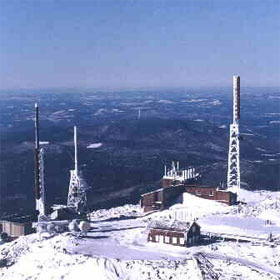
Shively antennas being tested on Mt. Washington NH, site of the country's worst weather.

I was surprised, then, to drive past a large building in Bridgeton ME with a big sign reading “Howell Laboratories” and “Shively Laboratories”.  What kind of labs would be out here?   Some Googling revealed that Shively Labs builds radio antennas and filters for commercial FM broadcasters.  Their specialty appears to be in tuning a transmitting antenna to get an optimal coverage pattern for its area.  They sell all over the world.   Their founder, Ed Shively, started the company here in 1963, after working on circularly polarized antennas at RCA.

He sold the company in 1980 to Howell Labs, and they now share the same facility.   Howell builds water-handling equipment for the Navy.   They have a pretty wide range of products, including moisture meters, dehydrators, anti-fouling equipment, and potable water generators.   They’re about 50 years old, and started with their own gear, but now appear to license the base technology from German and Italian firms.  The two companies together look to have about 50 employees.

This is pretty sophisticated stuff for backwoods Maine.  How has the company survived here?   For two reasons that I can see:

  1. They’re a defense contractor.  They talk about their expertise in managing Navy contracts, and building and documenting things to Navy specifications.   That’s an odd kind of intellectual property, but a real one.   Although Bridgeton isn’t on the sea, the Bath Iron Works are only 90 minutes away, and they’ve been building Navy ships for 130 years.     Once the Navy has decided they like your gear, they’ll use it for decades.
  2. They’re employee-owned.   That means that employees get to vote on major company issues like relocation, although they don’t have a say in things like board votes.   In the US there are big tax advantages for a company to set aside money in a trust for employee shares.   The employees don’t actually own the stock until they leave or retire, so they don’t get direct control of the company, but they do get a say in how things are run.   If Howell were owned by investors, they probably would have moved to San Diego long ago, but Howell employees have no interest in that.  Employee Share Ownership Plans (ESOPs) actually seem to do pretty well as retirement vehicles, giving more money than pensions or 401Ks, and with similar diversification of assets.    It’s as if democracy actually works as an organizing principle in America.

I can’t tell how these labs wound up here in the first place.  It could be just that their founders loved the area.  That’s easy to understand, if you like fresh air, big views, and some space around you.  You just have to have a high tolerance for snow.  That’s not common these days, but if you have it, you can do 21st century work in a 19th century setting.

Posted in Uncategorized | Tagged | 2 Comments

Reading Criminal Authors

So I was in a bookstore browsing the new non-fiction when I came across “The Rational Optimist” by Matt Ridley.  The cover blurb was intriguing:

For two hundred years the pessimists have dominated public discourse, insisting that things will soon be getting much worse. But in fact, life is getting better—and at an accelerating rate. Food availability, income, and life span are up; disease, child mortality, and violence are down all across the globe. Africa is following Asia out of poverty; the Internet, the mobile phone, and container shipping are enriching people’s lives as never before.

In his bold and bracing exploration into how human culture evolves positively through exchange and specialization, bestselling author Matt Ridley does more than describe how things are getting better. He explains why. An astute, refreshing, and revelatory work that covers the entire sweep of human history—from the Stone Age to the Internet—The Rational Optimist will change your way of thinking about the world for the better.

I pretty much agree with this.  Life is getting better for most people, and for the same reason as described here: people are accumulating more and more knowledge about how to do more and more complex things.  The wider one’s field of interaction becomes, the more good ideas you find, and the better off everyone is.  You can be Whiggish about this and claim that it’s due to strong property rights and the Invisible Hand, but the overall direction of progress is clear.

But that name, Ridley, rang an alarm bell.   Where had I heard that?  The author bio was brief:

Matt Ridley is the author of several award-winning books, including Genome, The Agile Gene, and The Red Queen, which have sold more than 800,000 copies in twenty-seven languages worldwide. He lives in England.

I had heard of “The Red Queen” is some biology context, but that wasn’t it.  There was a little more bio stuff inside the back cover, but it sounded unobjectionable.

Fortunately I had one of those instruments of human progress in my pocket: a phone with a browser that could reach Wikipedia.  It turns out that Ridley is not mainly a science journalist – he was the chairman of Northern Rock Bank when it collapsed in mid-2007.   During his chairmanship, the bank had gone heavily into securitization of mortgages, the practice of selling bonds based on pools of mortgages of varying quality, the now infamous Collateralized Debt Obligations or CDOs.   The same practice later destroyed a slew of American banks and finance companies, and brought on the Great Recession in September 2008.

Ridley resigned his position in October 2007 after questions were raised in Parliament about his performance.   Eventually the Bank of England took it over, wiping out the shareholders.  The bank started its road to ruin in 1997 when it converted from a mutual building society owned by its members (somewhat like a US credit union) to a stock-issuing corporation.  Ridley was in charge from 2004 to 2007, its most reckless period.   His father, the 4th Viscount Ridley, was a senior exec at the bank, and Ridley himself has been involved with it since the 90s.  He has also been a strident libertarian columnist and a climate change skeptic.

OK, so Wikipedia just saved me $15.  The fact that he didn’t mention any of this in the bio clinched it.  Yet I was still troubled.  Is it right to dismiss someone’s arguments because of their personal behavior?  I remember having this argument with a friend when Ted Kaczynski, the Unabomber, was captured.  His Manifesto was all over the Internet, and my friend had found it quite interesting.   There were a lot of good points there, he thought.  “But how can you take it seriously when its author went around murdering entirely random people?” I asked.   “The arguments are made on their own, independent of the author,” he replied.

He was right, strictly speaking, but wrong with regard to my own learning pattern.  I have neither time nor ability to fully evaluate ideas that are being presented to me.  The presenter could be leaving out crucial counter-arguments or over-emphasizing favorable data or just flat-out lying.  I can catch obvious cases of this, but if the subject is at all deep, I’m not going to catch them all.  If I bother to read something at all, it has to be with a certain level of trust in the source.  If the source has done something outrageous, then it’s not worth my time to think about what they say.

To take another example, Henry Kissinger knows an enormous amount about foreign relations, and has written extensively on it.  Yet he also betrayed his country by conducting secret negotiations with the South Vietnamese before the election of Richard Nixon in 1968.  Is it worth reading his thoughts on Soviet-Chinese relations?  I’d say no.

Does this lead to excessive filtering of ideas?  Yes, if I were an active participant in the subject.   In that case I ought to know the dodges that partisans use and be able to account for them.  But most of what I read is as an interested citizen.  It’s hard enough to make time just to learn something, never mind pass judgment on it.     There may be a case for techno-optimism about the ills that beset us, but a financial criminal like Ridley is not a source to be trusted.


Posted in Uncategorized | Tagged | 1 Comment

The Robot Population of Deep Space

In 1978 I heard Carl Sagan speak at MIT.   The two most important space probes ever, Voyager 1 and 2, had just launched the year before, and  Sagan had been deeply involved with them.  It was his idea to do the Golden Voyager Records , the gold-plated phonograph disks that held hundreds of sounds of the Earth.  He said in his lecture (quoting from memory):

Right now is the golden age of planetary astronomy.  Twenty years ago we weren’t able to do anything but look up at them through an ocean of air.  Twenty years from now they’ll be fully explored.   This is the time to get involved.

That’s pretty direct advice from a professor to students!  Unfortunately, the timing of it was bad.   The Voyagers were the last gasp of the Apollo-era US space programs.   There were two more US launches in 1978, of the Pioneer Venus probes, and then nothing until the Galileo Jupiter orbiter in 1989, an 11 year gap.

The main problem was Shuttle cost overruns.   It was already in trouble in the late 70s, and it only got worse.   That sucked up most of NASA’s money.  When Reagan was elected in 1980, his administration also had little use for space science.   Those people wouldn’t vote for him anyway.  He preferred to spend space money on the Pentagon, which would both scare the Reds and give tens of billions to his campaign contributors.

In Stephen J. Pyne’s recent book, “Voyager: Exploration, Space, and the Third Great Age of Discovery”, he also believes that the Voyagers were a never-to-be-exceeded peak of space exploration.   He thinks that there was a huge exploration phase in the 20th century, starting in the 50s with the explorations of Antarctica and the seafloor,  culminating in Voyager, and declining since.   He compares it to what he calls the First Great Age of exploration, the discovery of the route to India and the New World between 1450 and 1550, and the Second Great Age from 1750 to 1850, the age of Cook, Humboldt, and Darwin.  His comparisons seem rather forced, but it’s clear that the exploratory impulse has waxed and waned over the centuries.

And it does actually look as if the US space program is in deep trouble.  The Shuttle just retired, and nothing is replacing it.   The most productive scientific instrument of all time, the Hubble, is nearing the end of its operational life, and its replacement, the James Webb Space Telescope, is close to being cancelled.

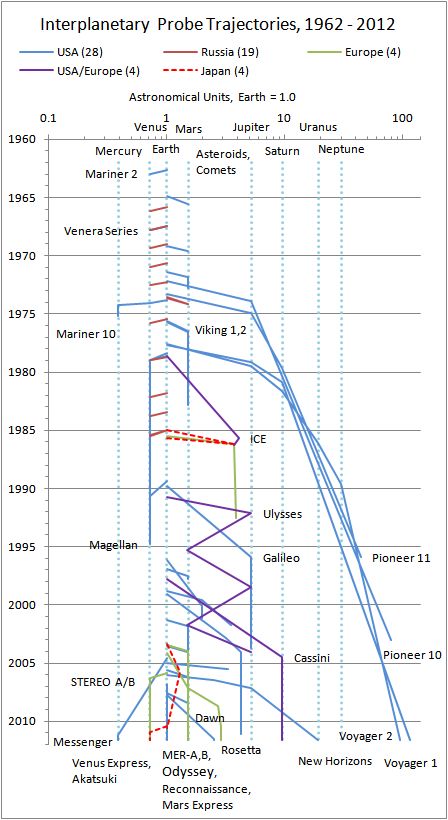
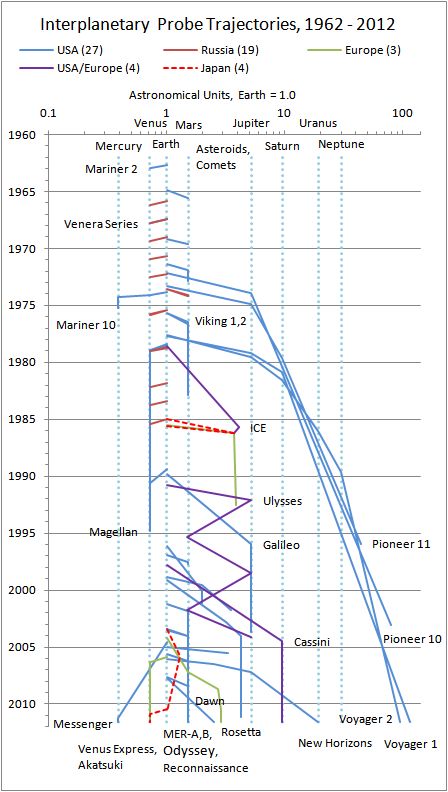
So I decided to look for myself at how space science activity has increased and decreased over the 50-odd years of the Space Age.   How many robots have been operating in deep space by year?  I took this List of Interplanetary Voyages  and plotted where and when the 59 successful probes have flown:


The 80s really were a sparse time, with just some Russian probes to Venus and two Japanese probes to the asteroids.  Then things picked up in the late 90s, and really got active in the Zips.    Right now there are 15 active deep space probes:

  • Messenger – a Mercury orbiter.  It’s hard to get that deep into the Sun’s gravity well, and it took six years and four gravity assists from Venus and Mercury to do it.
  • Venus Express – a Venus orbiter.
  • Akatsuki – another Venus orbiter.  It failed its initial injection into Venus orbit, but will try again in 2016.
  • Juno – a Jupiter orbiter, launched in August 2011, and due to arrive at Jupiter in 2016 after a gravity assist from Earth in 2013.
  • STEREO A and B – two solar observatories that precede and follow the Earth in its orbit.
  • MER-B – the Opportunity rover on Mars.  Its twin, the Spirit Rover, stopped responding in 2010.
  • Mars Odyssey, an orbiter
  • Mars Express, an orbiter
  • Mars Reconnaissance, an orbiter
  • Dawn, an asteroid probe currently orbiting Vesta, and due to move on to Ceres
  • Rosetta, a comet orbiter.  It’s due to land a sub-probe on 67P/Churyumov–Gerasimenko in 2014.
  • Cassini, a Saturn orbiter.  It also dropped the Huygens probe into Titan in 2005.
  • New Horizons, which will fly by Pluto in 2015
  • Voyager 2, in interstellar cruise mode after visiting Jupiter, Saturn, Uranus, and Neptune.   By 2020 it’s thermoelectric power supply will be so far down that all instruments will have to be shut off, and by 2025 it will no longer be able to transmit.  It’s now at 96 AU, over 3X the distance to Pluto.
  • Voyager 1, also in cruise mode, and it too will be dead by 2025.  Notice how these two probes are now so far out that they’re hard to plot even on a log scale.  It’s now at 117 AU, almost 4X the distance to Pluto.

So there’s actually a lot going on.  In fact, it’s one of the most active times for planetary science yet, with Messenger and Dawn achieving their orbits just this year.  Another NASA mission is due to launch this year the Curiosity Mars rover.  The ESA and Russia are also planning Mars missions soon.  The Chinese have put two probes in orbit around the Moon, and are also looking at Mars in 2013.

So it looks to me as though Pyne’s Third Age of Exploration is going pretty strong.    Sagan had it wrong – there’s plenty still to be discovered about the solar system 33 years after his lecture.  That would have delighted him, actually.   A student who had heeded his advice in 1978 would have had a tough first 15 years, but would have plenty to do today.

Update 9/24/11 : Added the recently launched Juno Jupiter probe and removed MER-A, the Mars Spirit Rover.

Update 11/22/11: Added Mars Express and STEREO A&B

Posted in Uncategorized | Tagged , | 5 Comments

Another Front in the IP Wars

Shannon Wren mug shot from arrest on 9/16/2010

So here’s a juicy story: a company in Florida, VisionTech Components, was charged last September with selling counterfeit Chinese chips to US military suppliers.    It doesn’t get more politically fraught than that.  The CEO of the company, Shannon Wren, was a apparently a well-known figure in drag-racing circles – he was the first to drive a Mustang at more than 200 mph.  He also had a clothing store, Reborn Couture, that sold biker apparel and staged bikini contests.  It has a typically garish MySpace page, but the page hasn’t been updated since his arrest.

The indictment claimed that he bought 60,000 chips from suppliers in Hong Kong and China for $400,000,  changed their markings, and sold them for $16M.    When arrested, Wren had a Ferrari, a Rolls, a Mercedes, and an RV.  The chip biz was treating him pretty well.

Shannon Wren (left) in happier times, at an event at Reborn Couture

I wonder if he got into chip distribution through his racing.   All modern cars are electronically controlled, and the controller chips can be old and obscure.  It’s common in the semiconductor industry to only manufacture parts for a few years and then abandon them.   I’ve done this myself.   It’s painful to let go of your old projects, but they become more trouble to support than they’re worth. The remaining stocks are bought up by distributors, and anyone who needs them then has to pay a big markup.

The VisionTech web site is down, but I looked in the Wayback Machine to see what kind of parts they offered.    It mentioned the Motorola MC68000P10, a  10 MHz 16/32-bit microprocessor introduced in 1981, and the Texas Instruments TMS34010FNL-40, a 5 MHz 32b graphics processor from 1986.  These were hopelessly obsolete in 5 years time, never mind 30, but if you had to have one, you had to go to people like VisionTech.   Military electronics stays in use for decades, so they often have to pay through the nose for archaic parts.

A Moto MC68000P10. A USB stick has more processing power.

So this is a legit business, although its customers don’t like the way they get gouged.  What wasn’t legit was to claim that parts were military-grade (meaning they run from -55 C° to 125 C°) instead of commercial (0 to 70 C°).  Nor was it legit to claim that they had “Certificates of Conformance” as to how they had been handled when VisionTech didn’t even have a quality engineer.  Finally, it wasn’t legit to claim the parts were made by TI or National or Cypress instead of by unlicensed Chinese firms.

It’s the unlicensed IP part that drew the wrath of the US government down upon this poor schlub.  The DoJ has set up an Intellectual Property Task Force devoted to hunting down just these kind of cases.   They talk a great deal about how dangerous these parts could be, how they could fail in combat situations, and might even contain back-doors and viruses that could disable US equipment.  The US knows all about that ever since it put the Stuxnet worm into the Siemens controllers of Iranian uranium centrifuges.

[Digression: a friend of mine noted that a lot of Siemens execs were in trouble over a bribery scandal in the late 2000s, which was just about the time when the US and Israel could have been pressuring them to insert this worm into their gear.   If they did let foreign spies put dangerous code into their equipment, they deserve much harsher penalties than that for bribery.]

Safety and security are valid concerns, but they aren’t the rationale for this DoJ task force.  Their main business seems to be catching DVD and software pirates.   Just as the movie studios and record companies are trying to draft the DoJ into prosecuting people they don’t like, the semiconductor industry is doing the same.

Yet I’m actually surprised that there’s any money in counterfeiting chips.   The old ones are fairly easy to duplicate, but there’s also not much demand for them.    Maybe they stole the chip design for some piece of high-volume military hardware like a landmine or an anti-aircraft shell, and these sales are just gravy.  It could also be that these Chinese firms really did have old supplies of chips from the original manufacturers that they picked up with some astute bargain-hunting.  VisionTech just changed the temperature grade on them to make them more valuable.   The DoJ could just be making an example of VisionTech as a shot across the bow for any other Chinese firm that might be thinking of cheaping out on a license.

Whatever the reason, they had VisionTech dead to rights.  They arrested Wren and his assistant Stephanie McCloskey in September, and McCloskey pled guilty in November.  She forfeited the $160K that she had made at VisionTech, and agreed to testify.   Wren was brought in for a drug test in January as a condition for a pre-trial release, but was caught using a “home-made prothesis” when giving the urine sample.  His lawyers said “he has difficulty urinating in front of adult males due to an incident that occurred in his youth”.  Could be, or he could have had another reason.  The judge released him anyway, but made him take weekly drug tests.

Then, on May 26th, he was found dead in his house.   There has been no word as to the cause of death, but he was only 42.    He was looking at some real prison time.  They had seized all his cars.  People across the Web were calling him a traitor.  Suicide is a distinct possibility.  There’s been no mention of a homicide investigation.   If he was part of a much bigger scheme, someone might have wanted to rub him out, but it would have been way late to do that.  The DoJ already has all his records and can get his assistant to testify against anyone else.

Or maybe he just had a bad heart.   Here was a guy who liked fast cars and bikini contests, and who came across an easy and lucrative scam.     He could have gotten crunched behind the wheel of his Mustang, but instead he got crunched by slow-motion maneuvering  between the US and China.   When the elephants are trampling about, the mice should stay in their holes.

Posted in Uncategorized | 2 Comments

The End of the Shuttle and the Start of Nothing

The launch I saw in 1992, with the contrail twisted by the wind and petering out to nothing.

So last Friday I watched the liftoff of the last Space Shuttle on the NASA feed in my office.  I saw it for real once in 1992, when I went down to Florida just for the show.  I had just quit a company after a especially painful project cancellation, and needed something to cheer me up.  It worked.   Even though I was ten miles away, the roar was deafening.   It lit up the whole landscape.  It was out of sight in minutes.   It was awesome to see something that big go that fast.

But now it’s done for.   It held on for far longer than I expected.   Even in ’92 I thought that I had better see it while it was still flying.  The Challenger explosion in 1986 had already shut it down for almost three years, and it was clear that it would not provide the routine, cheap access to space that it had promised.

So it’s not a tragedy that it has finished.   Its only remaining job was to lift supplies to the ISS, and that can be done more cheaply and safely by Russian expendables.   The Hubble won’t need servicing again, and no other scopes really need to be serviced by humans.  The low orbit required for servicing was a handicap anyway.

No, the tragedy is that nothing has improved upon it.    There have been a lot of attempts – E.g. Constellation, VentureStar , and DC-X – but little has come of them.   The reasons don’t seem to be technical.  DC-X and VentureStar were both radical designs: single-stage-to-orbit reusable ships.  They were high-risk but high-payoff, and NASA didn’t believe in them.  So they turned to Constellation, which was a low-risk incremental design that re-used the Shuttle solid-rocket boosters and main engines, and the Apollo return capsule.    Obama cancelled it for being over-budget and boring.

I don’t think that was the problem.  The real problem is that US leadership no longer believes that the country needs to do something technically flashy to show that it’s the leader of the world.    That was the original purpose of the space program.   The Soviet Union was just a distant, frozen country with weird politics until it put up Sputnik.  That showed up the US as fat, slow and complacent.   If communism could produce orbital rockets even when starting from way behind on every technical and industrial measure, then maybe there was something to it.

So the US swung into action, and aimed for the one space record that they thought they could win – first to the Moon.  The Soviet Union actually won everything else: first satellite in orbit, first person in orbit, first probe to the Moon, Venus, and Mars, and first space station.    The US got its victory, declared the race over, and lost interest.   Its two big later space achievements, the Shuttle and Voyager, came out of left-over momentum from Apollo, and had hardly any follow-ons.

The same pattern appears in other areas.    The last really tall building put up the US was the Sears Tower (now the Willis Tower), built in Chicago in 1974, and it’s half the height of the Burj Khalifa in Dubai.   The world’s most important physics experiment is the Large Hadron Collider in Europe, not the Superconducting Super Collider in Texas, which was cancelled in 1993.   The last really big bridge built in the country was the Verrazano-Narrows Bridge of 1964, and it’s now 9th in terms of span.

You might say, “But we have Google and Amazon! That’s the technology of today.”  Maybe those were hard to build in the late 90s, but they weren’t hard for long.  They’re big now more because of returns-to-scale rather than because of technical leadership.   They have lots of competition, and can be overturned as easily as Facebook overturned MySpace.

You might also say “Manned spaceflight was always ridiculous given how much cheaper robots are, and how much better scientific return they have.”  Driving around on Mars with Spirit and Opportunity really was extraordinary, although it didn’t have the heavy metal thrill of a rocket launch.  Still, that stuff is only cheap compared to the Shuttle.  Those are billion-dollar science programs.    That’s several years of research by a thousand people in Antarctica, on problems that are of critical importance, like climate change and ocean biology.   They only get done at all as riders on NASA bills, and will disappear if manned spaceflight does.

Finally, you might say “Who cares about these contests?  All this ‘Mine is bigger than yours’ stuff is puerile.”  Sure, granted, but  I’ll also note that the US’s  reputation is in tatters after losing New Orleans to Katrina, and losing the wars in Iraq and Afghanistan.   All its expensive tech has failed to defeat thugs with AK-47s.    The country could use a clear, decent win on something, anything.

But that’s not how it looks to play out.  The country hasn’t really exerted itself to demonstrate technical leadership on anything for a long time.  That’s why I don’t think it’s going to replace the Shuttle.    The manned space program will limp along for a few years with re-purposed boosters like the Delta IV and fly-by-night operations like SpaceX, but there isn’t the will to do more.   Putting people in space was always mainly about PR, and they’re not interested in that any more.

Posted in Uncategorized | Tagged , | 1 Comment

Print Your House

Houses assembled like Ikea furniture.  The little dash marks are slots and tabs that hold it all together.

One of the other talks at MIT’s Technology Day was by Lawrence Sass, an associate professor of architecture at MIT.   He’s been looking at how to get computers directly involved with constructing buildings.   As a test case, he built a New Orleans-style shotgun house entirely out of NC-cut sheets of plywood, as seen to the right.  It was part of a big exhibit at the Museum of Modern Art in New York in 2008 called Home Delivery.  There’s a video of the project here.

He started by photographing a lot of classic houses in New Orleans.  They all have the same basic structure, but vary the front porches.   He turned the photos into 3D models, and then into volumetric renderings of each element like the walls and floors.  He came up with a scheme for building up the elements out of ribs of plywood, and covering them with sheets:

The ribs have small tabs that fit into slots on the sheets of the flooring and walls.

Everything is slotted together instead of being nailed or screwed.  Sass says that the friction bond is actually stronger.

The plywood was cut by big computer-controlled routers made by ShopBot of North Carolina.  These are like the old pen plotters, but hold a router bit that can move in X and Y over a 4×8 sheet of plywood.  They can also move in Z for cutting shallow channels.  It took 18 days to cut the 7000 pieces into 10 pallets worth of plywood.

A ShopBot PRSAlpha CNC Router

A router like this one can cut 600″ per minute in X and Y.  They make models from industrial sizes down to 24″x32″ desktops.  They also make 5-axis models that can tilt the router bit.  That allows them to cut detail into the sides of objects instead of just the top.  Their founder, Ted Hall, is a prof of neuroscience at Duke, who got into this by being frustrated at the amount of time it took to cut the sheets he needed for building plywood boats.

Sass in the middle, and his students Smithwick and Michaud. Judging by his forearms, Michaud has done construction before.

Anyway, once the pallets were delivered to MoMa, it took about a month for two of Sass’s students to fit all the pieces into place.  They used rubber mallets and the occasional crowbar for extra persuasion.   They only found 5 errors in the cutting!  That’s a low bug rate.

But does this approach really make any sense?   I don’t think it actually takes a month to frame a house.   This structure doesn’t even have roofing or siding.   The framing is only a small part of the work in a modern house compared to the wiring, plumbing, drywall, and painting.  The rib structure of the walls would make it hard to insulate, although it should be good for preventing the spread of fires.

I would say that the detail work is a better use of this NC stuff.  The standardized structure of a house is an already solved problem.  Doing all the fiddly variations that people would want to individualize their houses is the place where the complete flexibility of the NC router can shine.   It can easily handle all the gingerbread seen on that porch.  Modern architecture got away from that kind of fine detail when the Italian craftsmen who carved it in 19th century New York and Boston got too old and too expensive, but maybe NC can bring it  back.

Posted in Uncategorized | Tagged | 2 Comments

“The oceans are dissolved information”

Said the MIT professor Sallie Chisholm as she spoke to an audience of alumni at MIT’s Technology Day last Saturday.  She was not talking about a nanotech infestation that was turning the seas into computronium. Well, actually, she was.   It was natural nanotech,  the bacterium Prochlorococcus, the smallest and most abundant photosynthetic organism known.  There are 100,000 of them in a milliliter of seawater, and maybe 10^27 of them on earth.  They have generated about 20% of the oxygen in the atmosphere.  They live in the top 200m of the ocean, the sunlit zone, and are found from the poles to the equator.

Prochlorococcus, the creatures that actually run the earth. Copyright 2003, Chisholm Lab

They appear to be a vast super-organism.   There is huge genetic diversity among the individual cells.   There are only 2000 genes in all its DNA, but 800 of them vary from cell to cell.   The variations allow them to adapt to different levels to sunlight, and of temperature, and of nutrient availability.   The variations are transmitted from cell to cell by viruses.   There are millions of these viruses per milliliter of seawater, and they float from cell to cell like chemical nerve impulses.

They’re the bottom of the food chain.  Zooplankton eat them, and krill eat the zooplankton, and whales and Japanese and everything else eat the krill.   They’re a kind of blue-green algae and have been here for billions of years.

Yet here’s the thing – they were only discovered in 1985.   They’re so small that they went right through the filters before that.  Prof. Chisholm was one of their discoverers, actually, due to a new flow cytometry technique she had developed, a means of counting cells in a stream of water.   People had seen the chlorophyll in them before that, but thought it was due to the breaking open of larger cells.  They also weren’t seen in cultures because they don’t happen to like to grow in Petri dishes.

And it’s only been in the last five years that they’ve been able to measure their genetic diversity.  There are instruments now that can sequence the DNA in individual cells.    They’ve done 11 strains so far, and 3 of the viruses that infect them.

So this major component of the Earth’s ecosystem wasn’t even known until recently, and is only now coming to be studied.   There are now stations off Bermuda and Hawaii measuring their population.   “Visiting them is one of the benefits of being in this field,” said Chisholm, but then added “although the stations are there because the prochlorococcus like warm water.” Uh-huh.  Better there than the McMurdo or the Barrow stations.

“All nice and interesting,” you might think, “but how can money be made off of them?”  Through a scheme called  iron fertilization.   This is a means of reducing global warming by causing blooms of phytoplankton with iron particles.   Iron is a key nutrient for these creatures, and is unavailable in a lot of the ocean.   Proponents estimate that one tonne of iron can prompt enough phytoplankton growth to suck out 80,000 tonnes of CO2.   It could be a profitable venture if it’s used to get carbon capture credits from the Europeans.

Yet Chisholm knows how little she knows about all this, and so is a skeptic.  She notes that if the plankton sink down and get eaten by something else, they could create anoxic zones in the deep sea.  The death and decay of those predators could release methane and nitrogen oxides, which are much worse greenhouse gases than CO2.   “Today’s solutions are tomorrow’s problems,” she says.  “If you want less CO2, don’t produce it in the first place.”

Her talk at MIT isn’t yet available on their video site, but there’s an earlier one here: The Invisible Forest – Microbes in the Sea.  She’s a funny, if gawky, speaker. She thinks microbes in general have gotten a bad rap because of disease, and as proof brought a collection of plush toy microbes from giantmicrobes.com.  “Look at this – ebola, rhinovirus, and the flu!  Where are the good microbes that live inside us?”  So one of her grad students modified a round green one to be Prochlorococcus.   Here’s the tiny little bio-machine on which we all depend.   Wouldn’t it be nice to know how they worked?

Posted in Uncategorized | Tagged | 1 Comment

The Big Dig Is Ugly

“It doesn’t matter how much it costs, so long as it looks cheap,” goes the old line about government contracts.  So what does the most expensive civil engineering project in US history look like?

I-93 North on the ramp from the Sumner Tunnel

Randomly patched pavement.  Fluorescent light fixtures from a hardware store that are unevenly aligned.  Concrete ceiling panels, already black with soot.  They were originally supposed to be metal panels, which would have been lighter and easier to clean.  The concrete ones, though, were somewhat cheaper, at least until one of them fell off and killed someone, when they turned out not to be  cheap at all.

It makes for a depressing drive.  Yet there is one attractive feature of the project, the Zakim Bunker Hill cable-stayed bridge:

The Leonard P. Zakim Bunker Hill Bridge. It’s kind of nice that it was named for someone who wasn’t a military hero or a sports hero or a writer or even a politician, but it’s also kind of baffling.

It was a late addition to project, put in when all other schemes for getting traffic across the Charles River had failed.   It looks great from the side, and impressive when you’re heading south on it towards the city.

Yet even here the Dig’s designers managed to screw up.   When you’re traveling north you rise up from the darkness of the tunnel into daylight, and the bridge appears before you.  It could have been a great Ah! moment, but instead you get this:

What would you rather see – the open sky and a soaring bridge, or a big green sign?

There’s an old trick in architecture where the entryway to a building is low and cramped.   You walk in, almost having to bow your head, and then come up a short stairway into a large, well-lit space.    It gives a little lift to your heart every time you enter.   It was probably wired into us by evolution when our mammalian ancestors first crawled up out of their burrows.  Frank Lloyd Wright used it in his famous Robie House in Chicago.

The Dig’s designers, though, decided that you just had to be told that the Tobin Bridge exit was coming up right there and then.   They couldn’t move that sign a hundred yards forward or back, and so ruined the best view in the project.

So, yes, the Dig saved Boston from terminal congestion.   Yes, it cuts the time to and from the airport in half.  Yes, it got rid of an even uglier structure, the elevated Central Artery.   Yes, it reconnected the North End with the rest of the city and opened a pleasant park right next to downtown.

Yet it itself is ugly, and I think it was designed to be that way.   Spending a little more money to make it look decent would have been too much of a reminder of its $16B cost.    There couldn’t be even a hint of sinful extravagance in this Puritan city.   It had to be built, and it had to cost a lot, but it couldn’t look like it did.

Posted in Uncategorized | Tagged | Leave a comment

You’ll Never Fly, But Your Robot Can

Werner Herzog’s terrific new movie about the Grotte Chauvet, the “Cave of Forgotten Dreams”, has a striking opening shot. You’re looking at rows of grape vines in a vineyard in France, and start to walk down one of its aisles.  As you come close to some trees at the end, you start to rise into the air.  “Nice crane work”, you think, if you’ve been watching movies for too long.  Then the camera rises up some more, and actually goes over the trees.  Beyond them is a river with a magnificent natural stone arch across it.  The camera flies along and right underneath it:

Pont D'Arc, ~70 mi NNW of Marseilles

You think “That is the bravest helicopter pilot I’ve ever seen.  How on earth did he take off from that vineyard?  Was the camera dangling below on some kind of mount?”

No, it’s an example of one of the niftiest new devices of recent years – a  multi-rotor electric helicopter:

About four feet across, and folds up into a travel case

They’re also known as Micro Air Vehicles, or MAVs.  This one is built by British Technical Films. It can loft single or stereo HD video cameras with on-board recording. The cameras have gyros to stabilize them separately from the copter itself, so the copter can bank while keeping them still. It sends a video feed back to the controller so the shots can be accurately framed. The rotors make a fair amount of noise, but not enough to disturb the tigers being filmed here:

More videos, including one of the camera descending through an oak tree, can be found here.  Footage from them has a wonderful floating feel, like being a soap bubble blown on the breeze.   Herzog must have loved the contrast between the free flight of the copter and the cramped and dark interior of the Chauvet Cave.  It’s not until the very end of the movie, when it descends into someone’s hands, that you realize how this footage was done.   I think it’s the first use of such a vehicle in a 3D movie, and perhaps one of the first uses period.  It’s some of the most advanced technology in the most technically advanced art form, and Herzog used it in a movie about the oldest art known:

All apparently done by one artist. The horse at the bottom is whinnying.

The paintings in the Cave date back to 32,000 years BP, and copters like this can only have been built in the last couple of years.

They’re made possible by light high-power light lithium polymer batteries, by light low-power electronics, and by vast amounts of open-source software.    They’ve advanced to the point where they can be offered as toys, such as the AR.Drone quadrotor from Parrot:

For $300 you get four motors/props, two cameras, an ultrasound altimeter, and a Wifi video link to your iPhone controller!    Sadly, the main use for it seems to be for augmented reality aerial duels, but that’s consumer tech for you.

The video links on these aren’t very good yet, but that’ll improve.  Soon you’ll be able to have stereo cameras on them feeding a fast video link to a set of stereo goggles.  It’ll let you fly.   You’ll be able to  float within a forest canopy, or through the buildings of a city, or among the clouds.   People may be somewhat afraid of these rather insectoid robots, and annoyed by the noise and possible use by Peeping Toms, but they could be as liberating as that opening shot.

Posted in Uncategorized | 2 Comments