Steampunk vs Apple-ism

I had no idea how big steampunk has gotten.  There was a gathering of them in Waltham this last weekend at the Watch City Festival, and 17,000 people showed up.  I took the kids there on a beautiful Saturday afternoon, and there were people in costume everywhere:

Most of the men were in top hats and brass goggles, since you never know when you’ll need to do an emergency dirigible liftoff.  The women were in big skirts and corsets, lending an air of kink to the proceedings.

The festival was centered on the Charles River Museum of Industry, which is full of the old machinery beloved by these neo-Victorians.  The museum is in the shell of the first integrated textile mill in the country, built in 1814.  It was so successful that it kick-started to the Industrial Revolution in the US.  It was based on British machinery, reverse-engineered by the great Paul Moody.  As usual, though, his VC backer, Francis Cabot Lowell, was the one who got a city named after him, while Moody only got a street.

The city of Waltham is quite enthusiastic about the festival, since it has few other attractions for visitors.    It’s a nice way for them to take pride in their industrial history.  They’re still a hub for high-tech; I had my first real engineering job here, building pre-PC microcomputers in the old Waltham Watch factory building, and my last company has an office here now.  It’s a bit run-down in general, though, so they’re glad to have such a big crowd show up.  Just as Civil War battlefields get fans out to reenact the period in blue and butternut, Waltham gets Heyday of Industry fans here in parasols and jewel-encrusted ray guns.

In looking around at this crowd, I’m struck by what a revolt this is against the Apple minimalist aesthetic.  Here’s what they think a PC should look like:

By ModVic, credit Amy Galante

Not Less Is More, but More is More. Everything is made individually, and by hand, instead of in million-unit lots by robots and Chinese serfs. Everyone follows their own taste instead of that dictated by Fearless Leader Jobs. Apple won’t even let you load your own software onto their devices, much less reconfigure it in brass and crystal. Appleoids may dress in simple clothing of solid colors, but the punks prefer hats and hand-embroidered vests.

My own taste leans towards the Apple side, but I appreciate what the steampunks are doing here.  No more of this barren white and silver future, where we all huddle over screens inhaling caffeine.   We want a baroque future of strange lands and airships and absinthe.    We don’t want smartphones, we want gauntlets with aetheric links and built-in heat rays.  We want to dress like men and women instead of androgynous corporate cogs.  We want to look up and out at the sky and sea instead of down at our tablets.

Yes, I can see it, and I can see why all the steampunks here were young.  They don’t like the world we Boomers have made, and are looking backwards for a better one.

Posted in Uncategorized | Tagged , | 2 Comments

The Persistence of Beautiful Things

The Cambridge Science Festival was held last week in Cambridge MA, and the kids and I got to go to two of its events.  The first was Rocket Day in Danehy Park, where they got to tape fins onto two-liter soda bottles, fill them half up with water,  pump them to 70 PSI from a CO2 tank, and shoot them hundreds of feet into the air.   Entirely satisfying!  Fortunately, the park was big enough that we didn’t hit any of the soccer games.

The second was a tour of the Harvard-Smithsonian Center for Astrophysics.   This is a complex of buildings about a mile from Harvard Yard.  The kids got to make star charts, see how high they could jump on the Moon, and play with the fun Microsoft tool WorldWide Telescope, which lets you zoom in to the highest resolution images of the planets and stars.  The highlight, though, was seeing the Great Refractor:

The 1847 15″ Great Refractor at the Center for Astrophysics, and Leo

It was the largest telescope in the country when built, and the largest refractor  in the world.  Here is the President’s Report of 1847 boasting of its accomplishments in seeing the 8th moon of Saturn and the 2nd of Neptune, but bemoaning the fact that its enormous cost of $36,000 was still not covered, and the Observer still not paid.  They petitioned Congress to avoid paying $800 of import duty on it, but to no avail.  There’s a full description of it and its history here.

The Observatory was out in farmland at that time, on the highest point in Cambridge.  Now it’s in the middle of a dense city.  The Refractor had to cease operations in 1912, when the electric street light got too much for it.   They did get 65 years of use out of it, though, mainly for photometry.

Yet it has now been sitting unused in the most prime real estate in Massachusetts for 100 years.    The dome doesn’t close reliably, so they haven’t even been able to use it much for public star-gazing.    Why keep such a huge and useless thing around?

Because it’s beautiful.   The brass gears twinkle, and the mahogany tube gleams.  It’s mounted on a huge pier of solid, cool granite.   There’s an observing chair mounted on rails next to it, that can move around it and up and down as the heavens turn.  It’s covered in red velvet, and lets you look right into the eyepiece.   Even visiting it in the day time gives one a thrill, and it must be magnificent to actually use it at night.

That thrill is what has preserved it for a hundred years.   Think of the vast number of machines that you have used in your life: the old cars, the old appliances, the old computers.  They’re all in landfills now, or ground up for recycling.   We hold on to very little.  I only own two things from my grandfathers: a wooden-handled screwdriver that still fits the palm perfectly, and a drafting set.  The set was made in Germany in the 1920s, and still has the compasses and the dividers, the holders for pencil leads and the nibs for ink wells.   It’s such a piece of perfect organization that you want to draw something grand and geometric with it.

Walk into any major museum and you’ll see pieces of painted cloth that are hundreds of years old, and pieces of stone that are thousands.   I’ve seen Japanese swords with perfect finishes from 1200 CE; imagine keeping a piece of steel entirely away from water for 800 years.

Whatever a thing’s original purpose was – a sword to chop off peasant heads, a portrait to flatter a rich merchant, a drafting kit to draw tractor parts, or a piece of glass to find new moons – doesn’t matter.  What matters is what feelings it stirs in people of the present.  Give something appeal and it’ll be preserved.  What gets saved is what’s beautiful.

Posted in Uncategorized | Tagged | Leave a comment

A Prank That Looks Too Natural

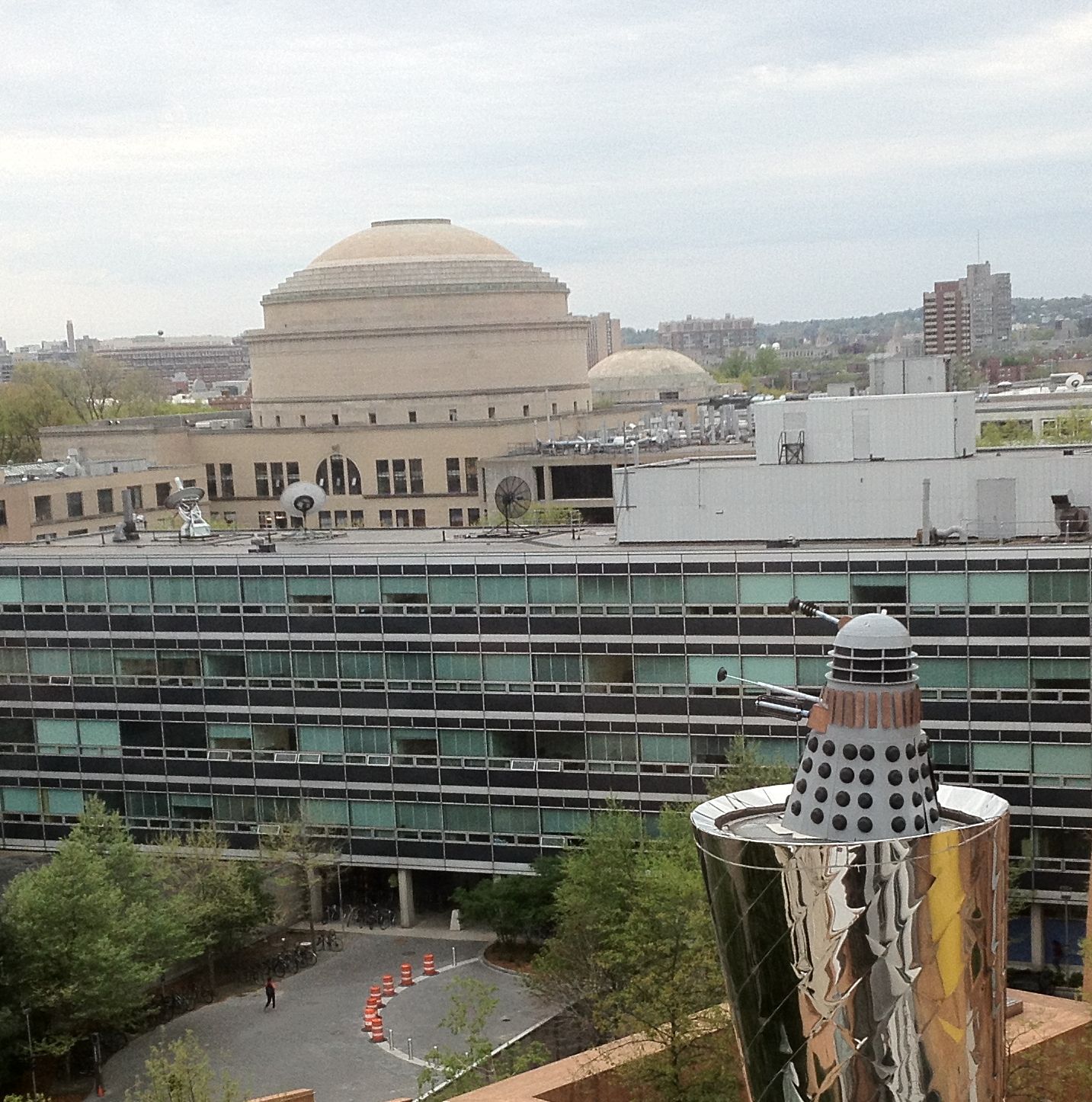
So I was at a rather dull seminar at MIT when I happened to gaze out the 8th floor window of the Stata building:

Yes, that’s a Dalek triumphantly shaking its blasters at the MIT sky line.  The silver column it’s sitting on is not a custom-made dais for a race of evil galactic mutants – it’s part of the Gehry-designed building.  It’s been up for nine days now, according to the Hack Gallery, but doesn’t seem to have drawn a lot of attention.

Perhaps evil mutants and odd Frank Gehry buildings are a natural combination, or perhaps there are so many strange things on the rooftops of MIT that few have noticed.  I was too far away to hear if it was crying “Exterminate!” or  maybe it’s just waiting for Doctor Who.  The TARDIS has been sighted here recently, so perhaps the Doctor is curious about this quaint school of ancient and primitive technology.

Posted in Uncategorized | Tagged , | 1 Comment

Why Was Heinlein So Wrong?

Virginia and Bob Heinlein in 1950, probably on the set of "Destination Moon"

The eclectic blog Lists of Note recently published a list of predictions that the SF writer Robert Heinlein made in 1952 for what the year 2000 would be like.  Here they are, with my comments in red for wrong and green for right:

(Source: Galaxy magazine, Feb 1952)

So let’s have a few free-swinging predictions about the future. Some will be wrong – but cautious predictions are sure to be wrong.

1. Interplanetary travel is waiting at your front door — C.O.D. It’s yours when you pay for it. Nope.

2. Contraception and control of disease is revising relations between the sexes to an extent that will change our entire social and economic structure.  Yep.

3. The most important military fact of this century is that there is no way to repel an attack from outer space.  Nope.

4. It is utterly impossible that the United States will start a “preventive war.” We will fight when attacked, either directly or in a territory we have guaranteed to defend. Wow, no.

5. In fifteen years the housing shortage will be solved by a “breakthrough” into new technologies which will make every house now standing as obsolete as privies. Nope.

6. We’ll all be getting a little hungry by and by. Nope.

7. The cult of the phony in art will disappear. So-called “modern art” will be discussed only by psychiatrists. Nope.

8. Freud will be classed as a pre-scientific, intuitive pioneer and psychoanalysis will be replaced by a growing, changing “operational psychology” based on measurement and prediction. Sort of.

9. Cancer, the common cold, and tooth decay will all be conquered; the revolutionary new problem in medical research will be to accomplish “regeneration,” i.e., to enable a man to grow a new leg, rather than fit him with an artificial limb. Nope.

10. By the end of this century mankind will have explored this solar system, and the first ship intended to reach the nearest star will be a-building. Nope.

11. Your personal telephone will be small enough to carry in your handbag. Your house telephone will record messages, answer simple inquiries, and transmit vision. Yep.

12. Intelligent life will be found on Mars. Nope.

13. A thousand miles an hour at a cent a mile will be commonplace; short hauls will be made in evacuated subways at extreme speed. Nope.

14. A major objective of applied physics will be to control gravity. Nope.

15. We will not achieve a “World State” in the predictable future. Nevertheless, Communism will vanish from this planet. Mostly, depending on what you call China.

16. Increasing mobility will disenfranchise a majority of the population. About 1990 a constitutional amendment will do away with state lines while retaining the semblance. Nope.

17. All aircraft will be controlled by a giant radar net run on a continent-wide basis by a multiple electronic “brain.” More or less.

18. Fish and yeast will become our principal sources of proteins. Beef will be a luxury; lamb and mutton will disappear. Nope.

19. Mankind will not destroy itself, nor will “Civilization” be destroyed. Yep.

Here are things we won’t get soon, if ever:

— Travel through time Yep.
— Travel faster than the speed of light Yep.
— “Radio” transmission of matter. Yep.
— Manlike robots with manlike reactions Yep.
— Laboratory creation of life Nope, already done.
— Real understanding of what “thought” is and how it is related to matter. Nope, pretty close now.
— Scientific proof of personal survival after death. Yep.
— Nor a permanent end to war. Yep.

Heinlein’s predictions about impossibilities were a lot closer than his possibles!   He broke Arthur C. Clarke’s 1st Law: “When a distinguished but elderly scientist states that something is possible, he is almost certainly right. When he states that something is impossible, he is very probably wrong.”

Still,  the hit rate here is obviously very low.  How could such a bright and imaginative guy could get so many things wrong?  Sure, prediction is notoriously difficult, but he was really off by a lot.

I think it was because he was extrapolating from the changes he saw around him, but he happened to live in a time of unsustainably high technological change. In his lifetime (1907 to 1988) he saw flight go from biplanes to interplanetary rockets. Imagining that “the first ship intended to reach the nearest star will be a-building.” would be a natural step. He had seen air travel become commoditized, so he thought space travel would too. He had seen polio and TB beaten, so he expected cancer to be beaten soon as well.

In fact, the changes that so impressed him largely stopped in the 70s. Changes in transportation stopped because the energies needed were too high – SSTs and manned spaceflight are too expensive. Medical progress slowed way down because antibiotics and vaccines only beat the easy problems. Social progress actually went backwards – the ERA was defeated, and the provision of health care and education are a bit worse than in his day, at least in the US. The major technical problems of his day – like AI, fusion power, and missile defense – are still not solved, and we’re not all that close. He lived in a time when everything was changing fast, but it slowed down a lot soon after.

That’s part of why he’s fun to read even now.  All his characters are so energetic!  They’re all excited about the bright future.   Life is visibly improving for them, in a way that it isn’t really for us.

Posted in Uncategorized | Tagged | 7 Comments

Robotics for Profit and Fun

Last week Kiva Systems, a maker of robots for distribution warehouses, was bought by Amazon for $775M in cash.  It’s the biggest deal ever in robotics.  They were founded in 2003, and last year had sales of about $100M.  Their main backer was Bain Venture Capital, so this will be another chunk of change for Mitt Romney.  I’ve been following them for a while because they have what seems like a simple but great idea – have robots do most of the work in distribution warehouses.  They carry shelves of products to tables where human workers can then pack them into boxes.   No more running up and down endless aisles trying to find the one widget someone has ordered – just have the robot get the whole thing.  People are actually far better than robots at handling parts of myriad sizes and fragility, so bring the box to them and let them move the part into its shipping container.  Here’s a video from IEEE Spectrum showing the system:

One of the cool features is how they get these little robots to raise a 1000-pound shelf.  There’s a big screw jack on top of each one.  It drives under the shelf, raises the jack with a separate motor, and then when it’s touching the bottom, it spins itself in a circle to keep the screw stationary while it moves upwards.  The screw is the most difficult part of the system and was (as of 2008) actually made in Massachusetts.

Amazon itself has not been using this system.  They used people, working under frequently hellish conditions.  This report from the Morning Call newspaper in Pennsylvania talks about how they would keep an ambulance standing by for when people fainted from heat exhaustion.  It was cheaper than air-conditioning a big warehouse, I guess.  They refused to improve ventilation by opening the loading bay doors for fear of theft.  Typical one percenters. With Kiva’s scheme, though, they can leave the warehouse hot or cold and just condition the area where the people are.  Kiva might be worth it to them just to stave off the inevitable lawsuits, or worse still, unionization. Now that Amazon controls this tech, they’re also likely to deny it to other online retailers, further cementing their monopoly.

Kiva was founded by Mick Mountz (CEO) and Peter Wurman (CTO), who were roommates as undergrad Mech E’s at MIT in the mid-80s.    Mountas went off to Apple and Motorola, and then had his dot-com baptism by fire while being logistics manager for WebVan, an online grocery deliverer.  Wurman got a doctorate at U Mich and became an associate prof at NC State, while working at Kiva on the side. The third major figure is Raffaello D’Andrea, formerly at Cornell and now a professor at ETH Zurich.  While at Cornell he taught robots how to play soccer, which turned out to be crucial to keeping them from crashing into one another.

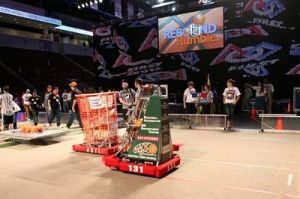
FIRST Boston 2012 contestants in the Rebound Rumble. Photo by Christina Rizer

Who knew that something as frivolous as robot soccer could have such big applications?  The people who run the FIRST robot competition, that’s who.  The local playoff was held last Sunday at the Agganis Arena at Boston University, and  I took my seven-year-old son to see it.   High school teams from all over the Northeast came, and even ones from Israel and Turkey.  Each team had six weeks to build a machine that could snarf up basketballs and shoot them into hoops at varying heights.  At the end of each match the robots had to drive up on a seesaw and balance there.  Two teams would compete, with three bots on each side from separate teams.   Some would specialize in blocking, others in gathering balls for their side, and others in shooting, so there was a lot of strategy involved.  They were usually driven by remote control, but had to shoot autonomously for the first few seconds of the round.

They gave stats on the national competition, and California, as you might expect, had the most teams with 195. However, Michigan had 193 teams with only 1/3 of CA’s population.  They know where manufacturing is going.  The highest per-capita number was Minnesota with 154 teams in a state of only 5M people.

Half the arena was blocked off for a prep area, and the other half for the playing court.  The arena seats in that half were almost full!  Every team had at least their own T-shirt, and some had real costumes.  Many brought cheering sections from their high schools.  There were a lot of booths outside for local tech firms to show off their stuff.   Boston has become something of a center for robotics, largely because of Rodney Brooks of MIT and his firm iRobot.  That’s why Kiva wound up here instead of in the Valley.  iRobot, by the way, just won a big contract for nuclear power plant inspection, thanks to the good publicity they got by helping out with the Fukushima disaster.

There was pounding music and two manic cheerleaders announcing the teams and giving commentary.   Everyone cheered at great plays and groaned when one of the robots fell over.    Some of the teams had their own dance moves, which they would show off before a round.  Nerds are so much cooler now than in my day!  And if Kiva is any indication, there’s a bright future in this stuff.

Posted in Uncategorized | Tagged | Leave a comment

Unsuspended Disbelief in “Hunger Games”

What on earth am I doing here?

In the Oath of the Slan that every trufan must secretly swear, there’s a clause that says you must go and see any movie that’s even vaguely science fiction.  You don’t have to do the sequels – one Transformers is enough – but you have to support the genre by seeing at least the first one.  Comic books and fantasies, fortunately, don’t count.  Sometimes you lose, as with the lame ending of “Source Code”, and sometimes you win big, as with the evocative and compelling “Monsters”.

Thus I found myself at “Hunger Games” this weekend.  Thus I found myself baffled and dismayed.   I just didn’t get it, and am therefore dismayed by its popularity.  It’s already likely to be the biggest movie of the year.  I’m clearly clueless with respect to my fellow movie-goers.

My problem was with the premise – how does kidnapping and murdering children help maintain an oppressive empire?  The movie claims that the decadent rulers of Panem stage gladiatorial games using forcibly seized teenagers  in order to somehow keep the provinces from revolting.  Wouldn’t that enrage the subject peoples?  It actually does in one scene, but wouldn’t that be the case every single time?  The whole movie hinges on this – there’s no story otherwise – and it makes no sense at all.

If you’re an evil overlord, then of course you take someone out every now and then and shoot them.   You make sure, though, that they’ve disobeyed you in some way.  If you do it completely at random, like here, then no one has any reason to obey.   It’s clear to them that it doesn’t matter if they submit or not; they’ll get it either way.  They’ll blow up your expensive high-speed railroads, garrotte your under-armored riot police, and use smuggled RPGs to take down your hovercraft.  That’s just what a certain pugnacious mountain people are doing to the American Empire right now.

If you’re a smart evil overlord, you’ll take your subjects’ children hostage.  That’s what the shogun did to the daimyos, and what the Romans did to the Greeks (E.g. Polybius).  It was for the children’s education and protection, of course.   They get to live amidst the splendors of the capital, and be protected by the emperor’s very own guards.  All the time.  So, sure, you would seize the provincials’ children.  But if you kill them, especially in a public and humiliating way like here, you’ll just guarantee their enmity.

I also have to say that as a parent I really hate seeing children get hurt in movies.  It’s the cheapest dramatic effect known, after kicking dogs.   We almost walked out of “Slumdog Millionaire” when the boy was about to be blinded by the beggar.   When I saw the spunky little girl here, I knew she was in for it, just as it was obvious that the most vicious and blondest teens would get it in the most disfiguring way.

Now, I can understand why this book has been so popular among teens.  They’re already disposed to think that grownups are against them.  They see “Fear Factor” and MMA bouts.  Maybe they’ve seen the other sports-as-gladiatorial-spectacle movies like “Rollerball” or “The Running Man” or “Battle Royale”.  They like the tough and resourceful heroine Katniss, who appears to be as handy with a bow as Artemis, but not quite as committed to virginity.  She’s played by the striking Jennifer Lawrence, who actually looks like a young woman instead of a hollow-cheeked model.

But why are adults going to see this?  Maybe people just don’t care about premises.  “Avatar” also had a huge hole at its center – what was this unobtainium rock that they were so desperate to mine? – and that didn’t bother anyone.   You sit in the dark and pretend that you’re not looking at colored lights on a screen, and get swept away by the story.   Or, like me, you get hung up on a rock when you wonder about how this future society would actually work.

Posted in Uncategorized | Tagged | Leave a comment

Keurig Dumps Inventor, Builds Millions of Junk Coffee Makers

Keurig single-cup coffee makers are the most unreliable appliances I’ve ever owned.  My most recent machine failed after only three weeks, and thus this rant.  I’ve owned several of them, and used many more at work, but they never seem to last more than a year.  There’s actually a class-action lawsuit proceeding against them, claiming: (a) false advertising in their performance and durability, (b) that they brew less than the advertised amount, and (c) that these bugs force the use of more K-Cups.

There appear to be several problems:

  • The needle that punches up into the cup gets clogged.  It can be cleaned out with a paper clip if you have a good eye.
  • A vapor lock occurs in the water feed line from the reservoir to the pump.  If you close off the little white overflow pipe at the top of the reservoir and brew another cup, that sometimes clears it.
  • The internal micro-controller gets hung.  It can be rebooted by unplugging the brewer and plugging it in again

I’ve clearly fiddled with these way too much.  These problems seem fairly easy to fix, so something appears to be wrong at Keurig Central Engineering.  These also aren’t the only issues that they’ve been slow to fix.  In the late 2000s the machines routinely made a loud clattering noise as the internal reservoir was filled, and that turned out to simply be defective pumps.

John Sylvan, from his user page on Quirky.com

So maybe their problem is that they kicked out the actual inventor of the machines, John Sylvan.  The Boston Globe had an article about him and Keurig  last fall  – The Buzz Machine.   He founded Keurig (excellence in Danish) with a partner, Peter Dragone, in 1992.  They tried a lot of different ideas in their apartments, and did their own taste testing. Sylvan actually found himself in the ER with caffeine poisoning after drinking 30 cups a day.  By 1997 they had a working machine, and had raised $1M from venture capitalists.  Sylvan didn’t like being told what to do, though, and was shoved out of the company for a relatively small amount, $50,000.   Dragone was kicked out too, but kept stock.   By the mid 2000s Keurig was starting to take off, and one of their investors, Green Mountain Coffee of Vermont, bought out the 65% of the company that they didn’t own for about $100M.   In fiscal 2011 (ending Sep 24, 2011), total sales at Keurig were $2.6 billion, of which brewers were $520 million.  The brewers are actually sold at a loss to encourage K-Cup sales, which might be why they’re so crummy – they’ve cut every corner on manufacturing them.

Sylvan and Dragone’s original patent (# 5,325,765, Beverage Filter Cartridge) was granted in 1994, and expires this year.  Sylvan hasn’t patented anything since his Keurig days, but the Globe article says he’s working on a solar heating and cooling unit.  He also appears to have designed a nice interlocking trivet scheme at Quirky.

He seems more amused than bitter about his experience, which is the right attitude.   He could have been like Robert Kearns, the inventor of intermittent windshield wipers and the protagonist of the movie “Flash of Genius”.  He came up with a quite minor idea – using a transistor RC oscillator to drive a wiper – and then wasted the rest of his life suing people he thought had stolen it.    You just have to let that stuff go.

I can speak about this with some experience.  After I left one company, my work was adopted by another and they sold about 20 million chips using it.  I didn’t get anything out of that, but I was still pleased.  It’s so rare that something actually takes off that it’s a thrill when it happens.   Although it pains your ego to say it, the success of something is due to a lot of people’s work, and not just your brilliant idea.

Anyway, I’ve kept using these Keurig K-Cups because they really do brew good coffee, and really are a convenience.  Maybe when the patents are gone someone else will find a way to build a decent brewer.

Posted in Uncategorized | Tagged , | 61 Comments

Political Inventors

There’s a great deal of talk in the political world these days about improving STEM education – Science, Technology, Engineering, and Mathematics.   I’m not sure how Technology is different from Engineering, but it does improve the acronym.    The US apparently needs more STEMans to  Compete In the Knowledge Economy of Tomorrow.   So it might be fair to ask how many politicians have actually taken part in this wonderful new form of work.   Let’s get specific and ask – what politicians have actually held patents?

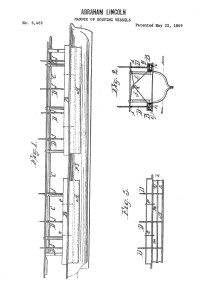
Lincoln’s patent, #6469 from 1849

The first answer is a quite gratifying one – the greatest American president, Abraham Lincoln, actually held a patent, although he’s the only president to do so.   It’s #6469, “Buoying Vessels Over Shoals”, and was granted in 1849.   By that time there had only been about 17,000 patents issued (they started re-numbering them in 1836 after a fire destroyed the records of the first 10,000)  so getting one was a fairly big deal.  These days there are about 1000  granted per day.   The scheme was to have expandable buoyancy chambers to lift steamboats over sandbars or other obstructions.  Lincoln got the idea after being stuck in exactly that situation.  He whittled a model of it out of wood (a requirement for patenting in those days), and the model is still in the Smithsonian.  It didn’t actually work – the chambers added enough weight to make the boat more likely to run aground – but was still a nice idea.

But that was 160 years ago.  How about politician inventors in the present day?  I looked through this list of scientists and engineers in Congress from the start of the Obama administration, and of these 30 people, found 3 who actually hold patents:

Steven Chu – Secretary of Energy (2009-present)

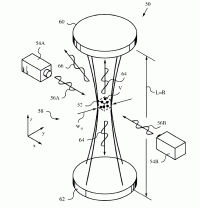
#6,684,645 Chu’s cooling scheme

And Nobel laureate!  He won in 1997 for a means of cooling atoms to extremely low temperatures by Doppler cooling.  This is where you shine a laser on a gas of cold atoms and tune the laser to just below their absorption frequency.  If the atoms move towards the laser, its frequency looks higher, and the atoms absorb photons and slow down.  You can get them down to within 150 millionths of a degree above absolute zero this way.   He received 6 patents for aspects of this (6,684,645, 5,528,028, 5,512,745, 5,338,930, 5,274,232, 5,274,231) between 1993 and 2004, and 3 others (5,079,169, 7,013,739, 4,742,224) for other physics-related schemes.  As head of the DoE he has not, sadly, been able to do much about the primary energy issue of our era, global warming, but it hasn’t been for lack of trying.

Rush Holt – D-12 New Jersey (1998-present)

#4,249,518 Holt’s Solar Pond

Has a PhD in physics from NYU, and was assistant head of the Princeton Plasma Physics Laboratory in the 90s.  He’s the only Quaker in Congress, and actually worked on arms control in the 80s.  Given the disastrous wars the US has undertaken in the last 10 years, we could have used some more Quakers.  His patent is from 1979: #4,249,518, “Method for maintaining a correct density gradient in a non-convecting solar pond”, and is a nice scheme for collecting solar energy on vast scale.  You expose a pond to sunlight, but keep lighter fresh water on top, and heavier salt water on the bottom.  This suppresses convection because the warm salty water on the bottom doesn’t lose enough density to rise.  The water gets hotter and hotter on the bottom, and doesn’t rise to lose heat to the air on top.  It gets piped off to evaporate, and fresh water is condensed from it.   Solar ponds seem to have been used a fair amount, but don’t get a big enough temperature difference to be an efficient heat engine.

Jerry McNerney – D-11 California (2006-present)

#7,351,033 McNerney’s wind load management algorithm

Has a PhD in mathematics from the University of New Mexico.  From the 80s up until his election he worked on various kinds of wind energy, ending up as CEO of a wind turbine startup,  HAWT Power, which seems to be no more.  His patent is from 2008: 7,351,033, “Wind turbine load control method”.  It describes an algorithm for changing the pitch on the blades of a windmill so that it can rotate at maximum speed in light winds but reduce the load in high winds to avoid damaging the mill.   It looks useful, but like most software patents seems on the obvious side.

Still, there’s a huge lawsuit going on right now between the US company American Superconductor and the Chinese wind turbine maker Sinovel over the theft by Sinovel of AMSC’s turbine control software.   An Austrian employee has actually confessed to the theft, but it’s being tried in a Chinese court, which dismissed the first round.   AMSC has lost hundreds of millions in sales over this, so doing this control right must be worth a lot.

Anyway, 3 patent holders out of the 535 members of Congress and ~30 members of the Cabinet doesn’t seem like very much.  For a country that prides itself on innovation and claims to want to boost it, it doesn’t seem to be selecting innovators as leaders.

Posted in Uncategorized | Tagged , , | 4 Comments

Every Thing Can Be Improved

Well, maybe not everything can be improved, but every thing can be.  “Surely not,” you think.  “Some things are so old and worked over that nothing more can be done with them.”

Well, how about a garbage can?  Is there a simpler manufactured object?   Fold a sheet of steel into an open box and weld the seams, or squirt low-density polyethylene into a mold, and you’re done.    But BigBelly Solar realized that garbage cans are not meant to hold trash – they’re meant to hold trash until someone picks it up.   For public trash cans, what matters is the cost of the pickup, not that of the can itself.  So they’ve come out with a can that monitors its fullness level and radios the DPW when it needs attention.   That can cut the number of pickups by 2/3, saving a vast amount.

SmartBelly solar-powered wireless trash can

The can includes a 6W solar panel, an ultrasonic sensor of the trash level, and a GPRS radio for signalling.  It ties into a software system that collects data from all the cans in a neighborhood and plans garbage truck routes.  This complements their main line of BigBelly compacting cans. They can hold up to 5X more than a regular can because they have a solar-powered compacting blade.  And they’re made in the USA!

“But that’s just exploiting the progress in electronics,” you scoff.  “Anything can have a wireless node on it these days.   The bell rings, you salivate, and give a gizmo an IP address.  The chips probably cost less than the can does.”

OK, lets try something simpler – push lawnmowers.   The first one was patented in England in 1830, and the current form of reel mower comes from the late 19th century.  It uses a helical set of blades turned by a gear train off the main wheels to squeeze the grass between the blades and a rear cutting bar.

Standard reel mower on left, new Fiskars on right, Frances for scale

The problem with it is that the blades scrape across the cutting bar, which dulls them.  That makes them harder to push, requires them to be sharpened at least once per season, and causes the grass to not be clipped as neatly, which looks worse and harms the grass itself.

So someone at Fiskars devised the StaySharp Max Reel Mower, which has a much more stable positioning of the cutting bar versus the reel, and so doesn’t scrape.  They claim it only needs to be sharpened every 7 years.  It also has a catcher that throws the grass forward instead of all over your feet, and a chain drive for extra torque when hitting twigs.  I find it much easier to push, and it gives a nice clean cut, although it is a bit heavier.  It comes in their signature orange so you can show off to your neighbors.

“That’s just better materials,” you continue to scoff.  “And Chinese labor to assemble a more complex machine.”

Wovel Snow Wolf, Leo for scale

You’re a tough crowd. Let’s go with something simpler still, a snow shovel.  Here’s the latest model from the Connecticut-based Wovel Corp, the Snow Wolf.  I actually own the previous version, which is heavier and doesn’t fold up.  Even in the extremely narrow field of wheeled snow shovels, improvements are possible!  You push the snow along with the big blade, and then push down on the handles to flip it up onto a pile.   You can clear a big driveway with it far faster than with an ordinary shovel, and with much less back stress.

“But you couldn’t build a wheel like that 20 years ago,” you complain.  “It needs stronger plastics and better injection molding to make something that large.”

OK, that brings me to the most astonishing improvement yet – a faster way to tie shoelaces:

You form a loop with each hand and pull them through each other.  Click on the graphic for full diagrams.   The creator is one Ian Fieggen, an Australian programmer and web designer.  One problem with the method is that you don’t have a spare finger to hold the bottom knot tight while you’re tying the top one, but it really is faster than the standard approach.   This is what the Internet was invented for.

So people are out there improving centuries-old mechanisms like lawnmowers, and millennia-old techniques like shoelace-tying.  What makes you think your problems are insurmountable?

Posted in Uncategorized | Tagged | Leave a comment

What I Wanted To Be When I Grew Up

Actual photograph of the engineers Alfred Kunen and Milton Minneman looking at an ion rocket engine. Ad for Republic Aviation from Aviation Week, 1959

Well, this isn’t literally what I wanted to be, since I wasn’t reading magazines like this in 1959, or at all, actually. But this sense of the mysterious and awesome work that was happening right now in labs all over the country was something that very much informed my childhood in the 60s.    A picture like this would have been a painting  in any earlier decade, but by then it was a photograph.  I could be one of those Men in Black, peering at a device which would fly people to Mars.   Note how they included a shot of the entirely mundane office building where the work happened.  It was actually a recruiting ad, so they wanted to reassure people that this was a real job.

This image came from “Another Science Fiction – Advertising the Space Race 1957 – 1962” (2010) by Megan Prelinger, which was a birthday gift from my brother.  Prelinger is also the keeper of the fascinating Prelinger Library in San Francisco, an open-stack private library meant to encourage the finding of connections.  She has dug through old aviation magazines and found a treasure trove of space imagery.  The whole country was in a post-Sputnik dream of the Final Frontier.  All these images from the id of science fiction popped up in corporate advertising.  There was a huge push on to develop ICBMs for the Cold War, and they sweetened the job descriptions with the promise of space exploration.  You wouldn’t be contributing to the fiery destruction of civilization – you would be pushing humanity out to the stars.

This particular picture is touting a research project into one flavor of ion thruster rockets.  These use an ionized gas driven by electrical and magnetic fields to get a lot of momentum change from very little fuel.    They’ve been used on 7 space missions so far, including the Dawn mission to Vesta and Ceres, and the Hayabusa asteroid sample return mission.

Prelinger describe this engine  like so:

The pinch plasma engine was an initiative of Republic Aviation, sponsored in part by the navy and the air force.  In pinch plasma propulsion, a neutral mix of ions and electrons is suspended in a gas.  Plasma propulsion “utilizes the magnetic acceleration of a plasma to eject particles from a space vehicle.”  The result is propulsion with low thrust and high specific impulse.  The “pinch” chamber confines the gas as well as the electrical current that is released into the gas by an electrical charge.  The charge ionizes and heats the gas, creating a shock wave and pressure buildup inside the “pinch” chamber, which ejects the gas at 1.8 pounds of thrust.

The patent describing this scheme is 3,091,079 “Propulsion Engine with Electromagnetic Means To Produce Propellant Acceleration”.  Unfortunately, current work in ion thrusters doesn’t appear to have gone this route.  Almost all of the projects described in the book came to nothing, largely because Apollo sucked away the research money for anything exotic in space.

Of the people in the picture, Alfred Kunen doesn’t appear to have left a trace on the Internet, except for the above patent and a previous one for an air conditioning scheme.

Minneman holding his 6th degree, from Alyson Bryant/Gazette.net

Milton Minneman is still around at age 87.  He only retired from the DoD in 2004 at age 80, and has just gotten his 6th college degree, a master’s in IT.   Here‘s an article about him in the Maryland Gazette.  The article mentions that he worked on troop transport, but some Googling revealed that he was involved with earth-penetrating nuclear weapons.    This was a particular interest of Dick Cheney and Donald Rumsfeld, who wanted to use them to get at deeply buried Iranian and North Korean bunkers.

Maybe that’s what happens to the dreams of wannabe wizards.  You start out wanting to fly to Mars and end up doing crazed Strangelove-ian military projects.    That’s where the money is.   There was only money for flying to Mars as a side-effect of the Cold-War-driven Space Race.  Once that race was won with Apollo, the space dreams evaporated.

Or rather, the absurd space dreams evaporated.   As I’ve written about before, there is lots of genuine space science being done today.    Ion engines are really in use.   Today’s wizards don’t wear black suits and narrow ties, but they’re doing work just as amazing.

Posted in Uncategorized | 2 Comments