Hawaii – Land of Peril

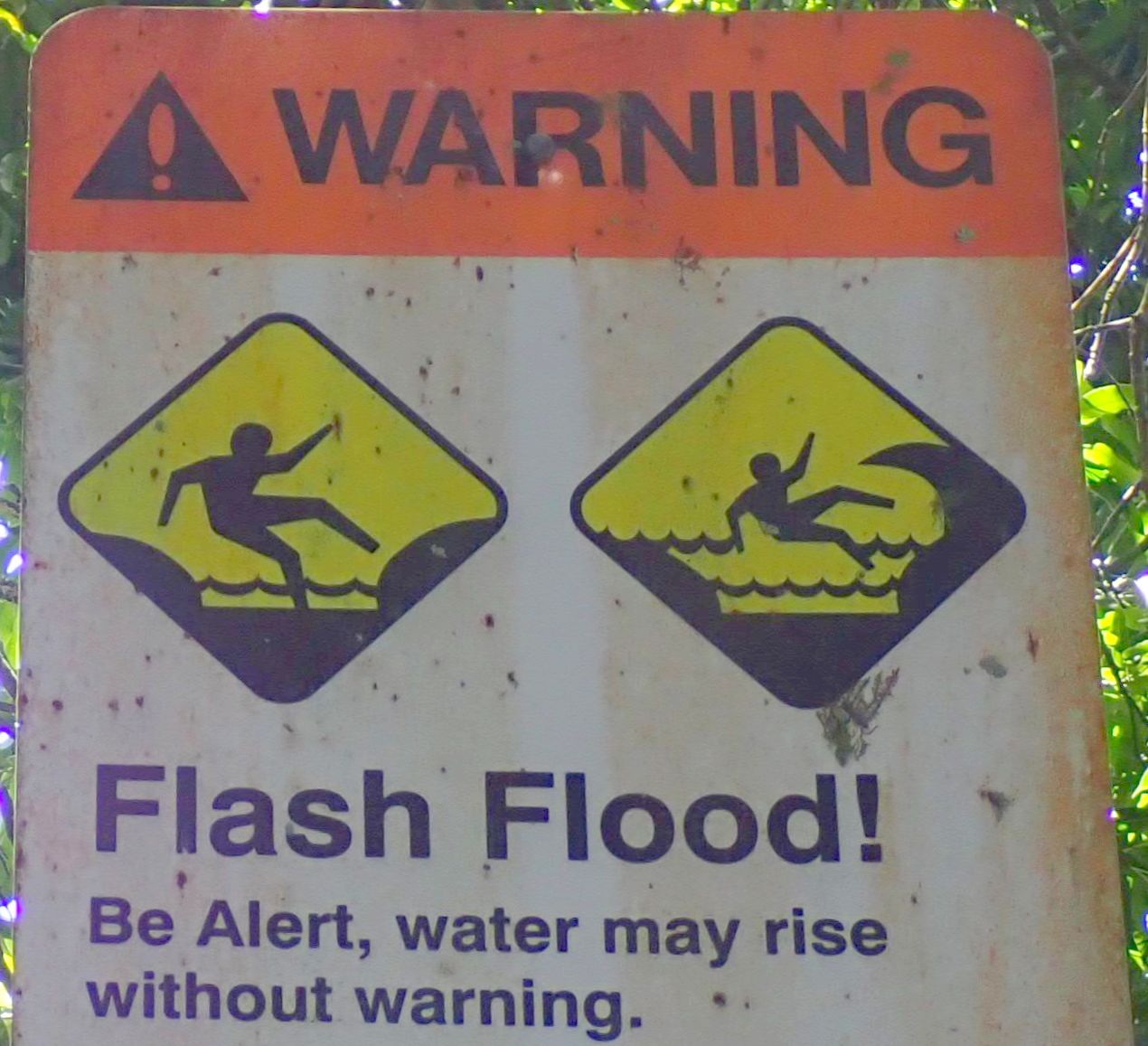
The family and I are vacationing in Hawaii, and it really is as spectacular as everyone says. There are extraordinary things to see everywhere, but they’re very aware of how bumbling tourists can be. As one of our tour guides said “I used to believe that there was no such thing as a stupid question until people started asking me things like ‘Does the sea go all the way around the island?’ ‘Yes, ma’am it does.’ ‘Is that the same moon we see in California?’ ‘Yes sir, it is.'” So everywhere you go, they’re careful to warn you about what might happen. E.g. before entering a lava tube you see:

Sign before the Thurston Lave Tube near Kilauea, Big Island

The tube floor was covered in puddles, and the girl behind me was worried about getting her shoes muddy. I wanted to tell her “You’re standing in a tunnel that was filled with molten rock just a few hundred years ago. Chill!” But that was unkind. Even slow and unfit people deserve to see amazing things like this.

By the volcano itself, they’re just as worried:

At Kilauea Overlook, Big Island

Good advice!

Out on the beach, the locals are just as worried:

We did actually see enormous plumes being thrown up by the surf. Our guide had a pro tip – if there are pine needles on the rock by the cliff it’s probably OK, but if not, it’s because the waves took them off. That’s not the only risk:

Yet not all the signs were of imminent doom:

Stay 10 feet away from sea turtles. How big is 10 feet actually? The size of a VW Beetle and its constant companion, a surfboard. That’s a pretty good scale!

The only positive sign, one in green not red, was a good general rule:

Finally, one of the stick people was not getting drowned or crushed!

I wonder if the designers of all of these signs were thinking of Hawaiian petroglyphs:

Credit; David Stillman, Olowalu, Maui

Icon figures are good for all sorts of images! Whether they’re of people dancing, or people having very bad days. In a place as beautiful as Hawaii, it’s easy to get so distracted that you lose common sense.

Posted in Uncategorized | Leave a comment

1 in 200 American Deaths Have Been Because of War

This Memorial Day, let us note how war is a common cause of death for Americans. Wiki lists 1.35M deaths from 1775 to 2023 in 81 conflicts. About half were in combat and half not. About half the deaths were in the American Civil War, 30% in WW II, and 10% in WW I.

From 1780 to 2020, there have been about 550M people born in the US (Birth rate, Population), and perhaps another 60M who became naturalized citizens (32M since 1910). So there have been about 610M Americans total. Of that total 330m are still alive, and so 280M have died. The 1.35M deaths in war thus represent about 0.5% of all deaths, or about 1 in 200.

To give a sense of scale, a lot more people have been killed in car accidents, about 4M since 1900. That’s 1 in 70. The number of war deaths, though, is not far off from the number of murders. Hard statistics for the murder rate go back to 1950, and soft ones say that the rate was about 5/100K people before that. That gives 1.7M murders in our history. The number of Americans killed in war is 80% of those killed by other Americans, not counting the Civil War.

It’s kind of startling. Yet when I think of my own ancestry, there was a grandfather lost in the gulag in WW II, a great-grandfather in Belgium in WW I, and another great-grandfather in the Russian Revolution. I don’t think any of my great-great-grandparents died in war, and that’s about as far back as I know. That makes 3 deaths among 28 people, almost 10%.

If you can track your family back for several generations, you too probably have some war deaths in the family. The twentieth century was just one of the most violent in history.

Posted in Uncategorized | Tagged | Leave a comment

When Will Scotland Sell More Wind Than Whisky?

Here’s something unexpected – there is actually an advantage to living on a storm-swept rock in the North Atlantic:

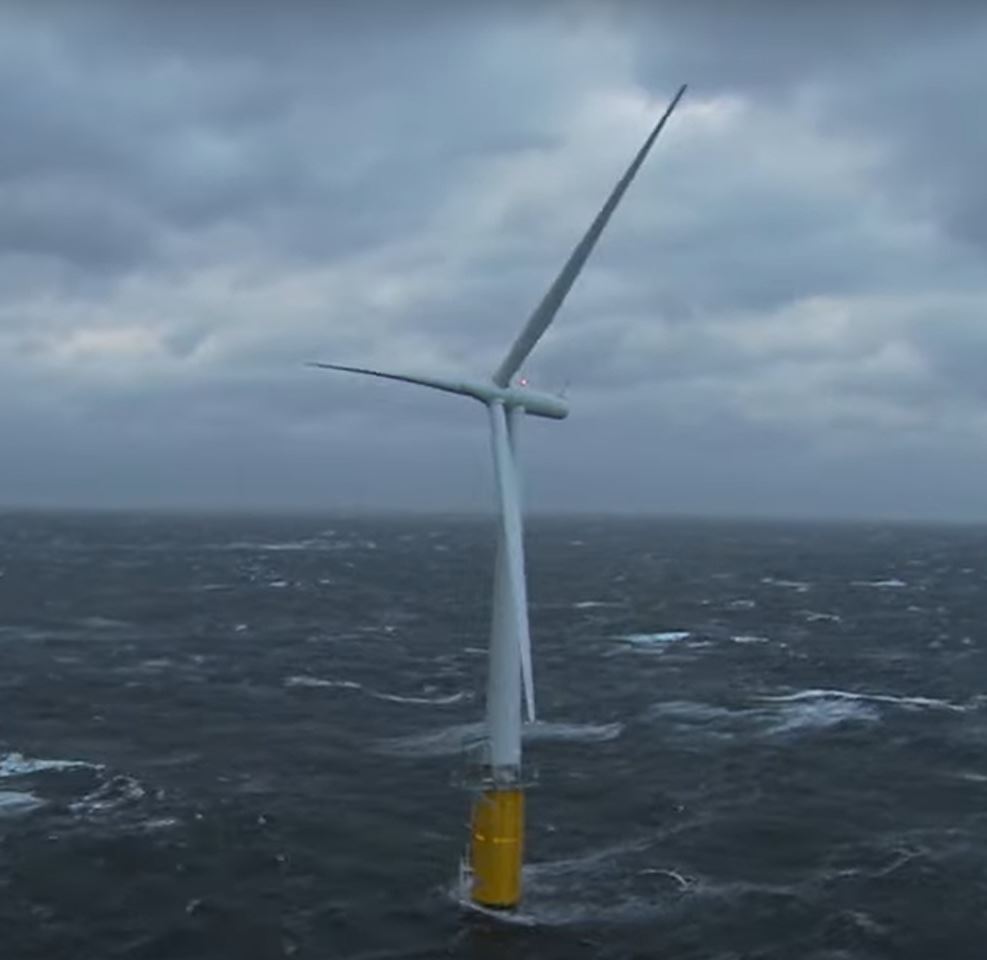
A floating offshore turbine off the northeast coast of Scotland, part of the Hywind Farm

Scotland now has more wind power per person than any other country! They’re now up to 1900 W/person of capacity for onshore and offshore wind (10.36 GW among 5.5M people), well ahead of second place Denmark at 1100 W/person. The US is at about 400 W/person. To put that in perspective, one of the old many-bladed wind pumps that used to be all over the prairies had a capacity of about 500 watts. Scotland now has the equivalent of four of those for every person in the country!

They generated 27 TWh of electricity from wind in 2022, which averages out to 570 watts continuously per person. That’s a lot of light bulbs burning all the time. That would be enough to entirely power Connecticut. That’s more than their total consumption of 25 TWh. They sell the excess to England and Northern Ireland. Scotland also has a nuclear plant, and sells most of that to the south as well. In 2022 it had net exports of 19 TWh to England. That was worth about 4 billion £ at the typical wholesale price of 200 £/MWh. It still does burn some natural gas for power, about 15% of the total, but coal has been gone for 15 years. Its electricity usage has actually dropped by about 15% over the last ten years due to more efficient lighting, appliances, and industrial processes. Yet usage is likely to increase as more people drive electric cars, and use heat pumps instead of gas furnaces.

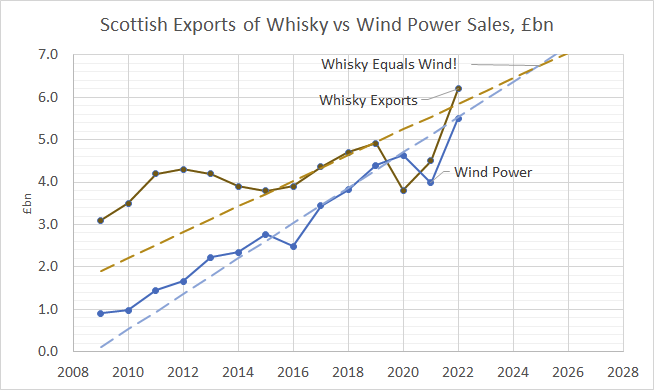
So electricity is now a major export of this small country. How does it compare to its much better-known export, whisky?

Sources: Scottish Energy Statistics Hub and the Scotch Whisky Association

They actually sold more wind than whisky in 2020! That was probably because everyone stopped importing whisky during the height of the pandemic. It had been growing steadily in the 2010s, and then surged in 2021 and 2022 after people started eating out again. Wind has been growing at a slightly faster pace, but had bad years in 2016 and 2021 because of mild weather. The linear estimates of the dashed lines shows that wind will pass whisky in about 2026.

There are plans for vastly more wind power in Scotland – about 40 GW worth. That’s 5X what they have now. Most of it will be offshore. Those turbines give more useful power for a given capacity than onshore ones since the wind blows more steadily and faster at sea. They’ll be able to power about a third of England with that! They could also sell to other countries with more undersea power cables. England already has ones to Norway, Belgium, and France, and Scotland could build some too.

The upshot is that Scotland has already nearly stopped emitting CO2 for electricity, and is actually exporting lots of clean power. The UK as a whole is not far behind. If it can be done there now, it can be done in the rest of the world in the next 20 years. In fact, wind engineering expertise could become another export of the country. Scotland supplied a lot of the mechanical talent for the First Industrial Revolution in the early 1800s, and could be important for the Fourth Revolution in the 2020s and 2030s.

Posted in Uncategorized | Tagged , | 2 Comments

When Did Fiction Turn Female?

I was browsing the Boston Globe Sunday Arts section, looking at the Local Bestseller lists, when this caught my eye:

Hardcover FictionPaperback Fiction
Hello Beautiful Ann NapolitanoDaisy Jones & the Six Taylor Jenkins Reid
Lessons in ChemistryBonnie GarmusThe Lincoln Highway Amor Towles
I Have Some Questions for You
Rebecca MakkaiThe Candy House Jennifer Egan
Tomorrow, and Tomorrow, and TomorrowGabrielle ZevinThe Seven Husbands of Evelyn Hugo Taylor Jenkins Reid
Pineapple StreetJenny JacksonThe Paris Apartment Lucy Foley
The White Lady Jacqueline WinspearThe Thursday Murder Club Richard Osman
Demon CopperheadBarbara KingsolverThe Four Winds Kristin Hannah
Horse Geraldine BrooksThe Last Thing He Told Me Laura Dave
Foster Claire KeeganIt Ends With Us Colleen Hoover
Old Babes in the Wood: Stories Margaret AtwoodNever Never Colleen Hoover, Tarryn Fisher
Boston Globe – Local bestsellers for the week ended March 26

Twenty books, of which eighteen are by women! Seventeen female authors (two twice) and two male. That’s an 8:1 ratio! Less recent lists have been the same. Is this peculiar to the Boston area? Is this recent?

Let’s look back over a bigger survey, the New York Times bestseller lists. They keep them at URLs of the form https://www.nytimes.com/books/best-sellers/<year>/<month>/01/<category>/. They only go back to 2009, but that was far enough. I parsed out the entries for each month over the last 14 years, and they can be found at this spreadsheet: NYT Bestsellers 2009 to 2023. I found lists of girl and boy names from the Social Security Administration in order to estimate genders. Some names are ambiguous, but the proportion is small.

So if we look at the 678 NYT lists from 2009 to today, there are 9313 books on them, with 1803 authors and 3171 titles. The breakdown by gender then looks like this:

From 2009 to 2019, women were about half the fiction authors, but they then became the majority, and now completely dominate paperback fiction. They are still only about a third of the authors of nonfiction, and that wobbles around but has been fairly constant over the last 14 years.

What could be the reason? The rise in female paperback bestseller authors started in 2019, and so came just before the COVID pandemic. The tendency is even stronger in 2023, though, when the pandemic’s effects are largely past It might be the Trump administration, when women had plenty of reason to seek entertainment. Or maybe men are spending their time video gaming instead, or posting rants on 8chan.

Or it could simply be that women are coming into their own. Women have gotten the majority of bachelor’s degrees since the 1980s, and are now up to 57%. Colleges are actually worried. The majority of medicine and law degrees, and of science doctorates, now go to women, and that happened in only the last couple of years. There are now as many college-educated women in the workforce as men. They have money, and they want stories from authors like them. It could be as simple as that.

Whatever the underlying reason, it’s certainly a welcome development. Every field of art needs to get talent from as wide a range of people as possible. Storytelling especially needs everyone’s voice to be heard, because books are how things are preserved. I don’t own a single artifact from the 19th century, but I have lots of books from then. The fact that more women are writing books and almost certainly more women are buying them, does NOT mean that fewer men are writing and reading them. It’s not a zero-sum game. There’s room for all!

Posted in Uncategorized | Tagged | Leave a comment

“Lethal Tides” – Researcher Heroines of WW II

Click for publisher’s page

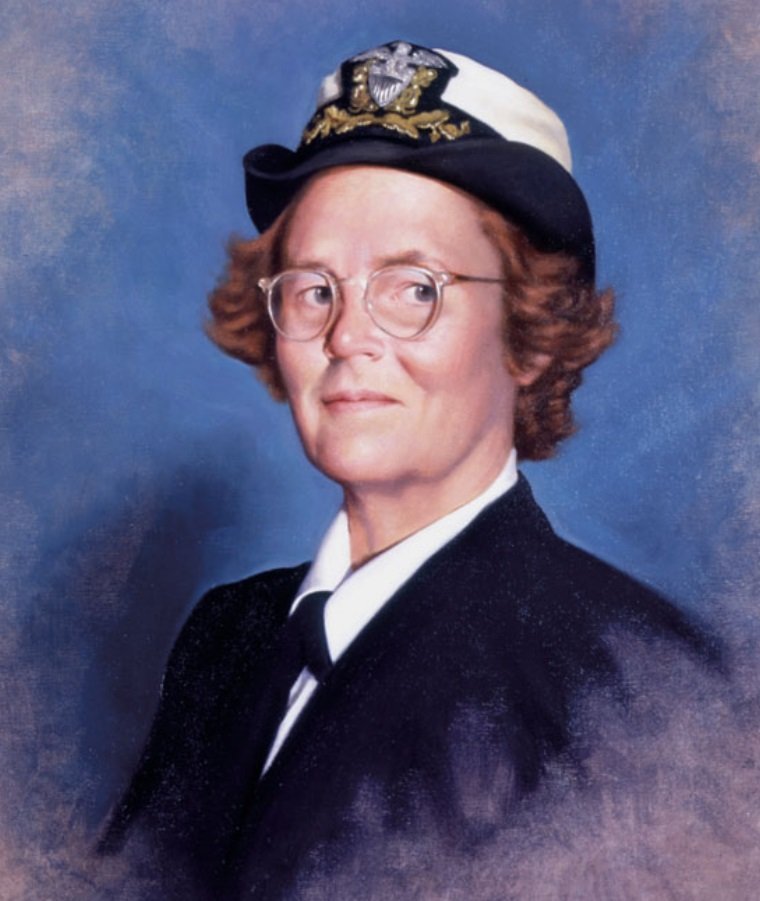
“Lethal Tides – Mary Sears and the Marine Scientists Who Helped Win World War II” by Catherine Musemeche is a thorough biography of the sort of person that is easy to overlook. Sears was an unassuming marine biologist who wound up heading the Oceanographic Department of the Naval Hydrographic Office during the War. She was the one of the Women Men Don’t See, as in James Tiptree’s memorable story, but her work, and that of the researchers she directed, saved a lot of lives.

She was born in well-to-do circumstances in Massachusetts, but lost her mother early to polio. Her step-mother was an alumna of Radcliffe, so she went there and eventually got a PhD in zoology in 1933. She worked at the great Museum of Comparative Zoology at Harvard under Charles Bigelow, a founder of the Woods Hole Oceanographic Institute (WHOI). It and Scripps are the leading ocean research centers right down to today. They wouldn’t let her on the research cruises, though, because dames is trouble. She finally got out to sea in 1941, studying plankton in the Pacific off Peru, which are crucial to the seabirds on whose guano Peru depended for exports. She didn’t actually hear about Pearl Harbor until she got back.

WHOI had immediately mobilized for the war. Most of their people enlisted, and the remainder started working on things like keeping ship hulls from getting fouled, and exploiting density layers in the ocean to let submarines hide from sonar.

The Navy knew that it was going to have fight the Japanese across the Pacific, and knew that it was going to need to know as much as it could about all the islands on the way. So they went to WHOI and asked for oceanographers to do all this charting. Almost everyone was gone! So the head of WHOI said, how about Mary?

They were skeptical. She was older, 37, and had already tried to enlist and failed a medical exam. Still, they didn’t have much choice, so they made her a lieutenant in the WAVES (Women Accepted for Volunteer Emergency Service) and set her up in the Oceanographic Division in 1943.

Musemeche notes an odd thing about the WAVES – their uniforms were the best outfits most of them had ever worn. They were designed by a major New York couturier, Main Rousseau Bocher, and were made of stylish and durable wool. All of these women from the provinces finally got to wear clothing made to national levels.

Anyway, the Division was a great match to Sears’ skills. She knew people from universities all over the country and got them to join. They quickly started assembling the thousands of charts needed.

The need for her skills was seen immediately. In November 1943, the tiny atoll of Tarawa, about halfway between Hawaii and Australia, was attacked by a force of 18,000 Marines. They came in on amphibious craft called Higgins Boats that needed about four feet of water. Unfortunately, it was a neap tide and there was only 3 feet above the outer coral reef. The boats were stranded there under withering Japanese fire. About a thousand Americans were killed in the three-day battle, a lot of them due to this failure of mapping and oceanographic knowledge.

Sears and her team were NOT involved – they were working at that time on the marine mapping of Bulgaria. No one knew why, but that was their orders. Yep, it takes a while to get agencies straightened out. They were immediately re-directed to the Pacific. The next goal was the Marianas Islands (Saipan, Tinian, and Guam), but they had never been charted. One of her researchers, Mary Grier, found that Japanese marine biological expeditions had explored them in the 1920s. The Emperor happened to be fond of marine life. It was all published in Japanese, and was in the bowels of the Library of Congress, like everything else written by humanity. They used that and maps from the voyage of the HMS Challenger in 1876.

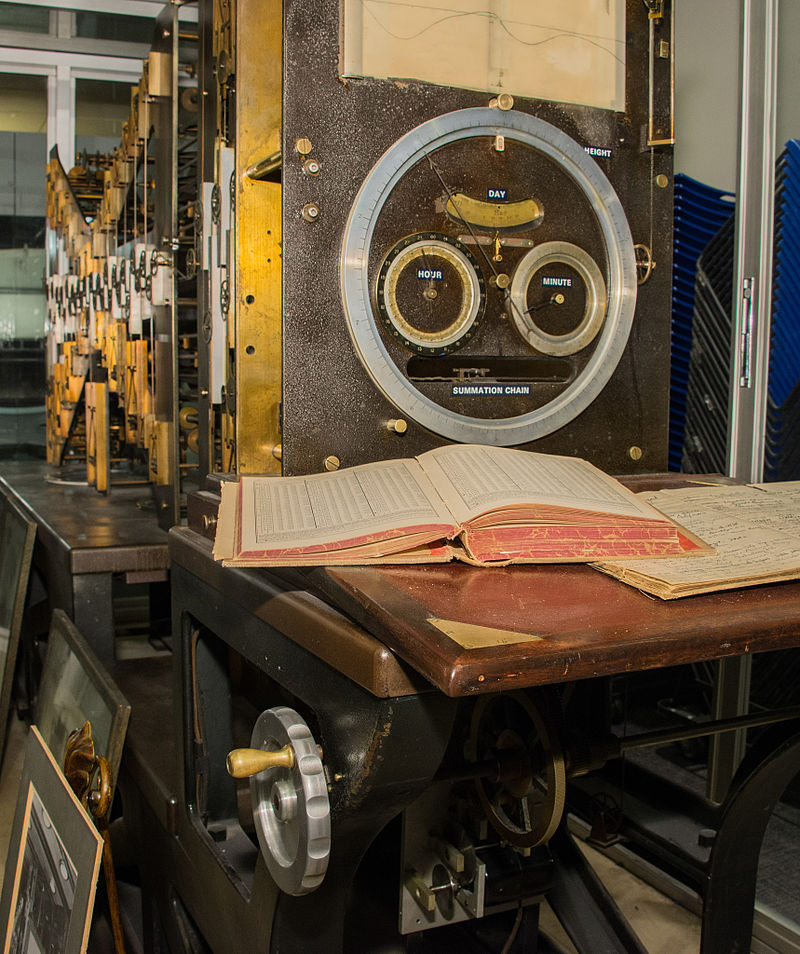
Turning the crank moved the gears on the left to read out on the dial and the paper trace above it.

The key data for amphibious landings are the tides, as seen at Tarawa. These are normally calculated by taking measurements over a couple of months, and applying a Fourier transform to find their frequency components. This was figured out by George Darwin, son of Charles. Sears didn’t have that data, but could make estimates based on topography and astronomy. She came up with the components and their phases and then ran them on Old Brass Brains (more boringly known as Tide-Predicting Machine No. 2), a unique analog computer in Washington DC that used slotted crank yokes to sum up all the frequencies to get the time-domain values of the rise and fall levels. It was a remarkable mechanism that ran from 1910 until 1965, when it was finally displaced by digital. It’s still on display at NOAA.

The Hydro Office used all this to create the Joint Army Navy Intelligence Studies (JANIS), huge documents that were distributed all across the military and described everything that they might come across. The version for the Marianas campaign in June 1944 was still not quite complete. When the Marines landed on Saipan, the waves were much too steep and choppy to easily get across the reef. They were blasted by Japanese fire again. Tinian and Guam went better over the next two months, but the Japanese still fought with extreme tenacitiy, prompted by propaganda about what the barbarous whites would do to them.

The invasion of Palau in November 1944 was also tough, but by Luzon (Jan 1945) and Okinawa (April 1945), the Hydro Office had hit its stride. The conquests themselves were bloody, but they had the landings down. They were then busy charting everything they could about Japan itself. The plan was to invade its southern island of Kyushu in November 1945, and take Tokyo in March 1946. Even though FDR died in April, and the war in Europe ended in May, the Office was still going all out. Then came Hiroshima and Nagasaki in August. Emperor Hirohito gave the surrender speech in his first ever radio broadcast, and set a world record for under-statement with “the war situation has developed not necessarily to Japan’s advantage.”

Everyone was overjoyed, of course, but the Office’s work turned out to be crucial even after the fighting stopped. About 36,000 Allied POWs were being kept in 140 camps around the Far East. The main and sometimes only information on how to get to these camps was in the Office’s JANIS reports. They were so useful that it was recommended that the series be kept going, since the US was clearly now going to be the world’s policeman. The CIA took them over in 1947, and produces versions to this day.

Sears ran the Hydro Office until June 1946, steadily expanding its capabilities. It became its own division of the Navy, and then a separate Office. By 1976 it out-grew DC office space and moved to southern Mississippi, where it’s called NAVOCEANO. Sears went back to Woods Hole as a senior scientist, and founded and edited two major journals: Deep Sea Research and Progress in Oceanography. She became a trustee of the Marine Biological Laboratory, and the Clerk of the WHOI Corporation. She retired from the Navy in 1963 with the rank of commander, and from WHOI in 1970. She was often seen around Woods Hole, riding her bike, walking her dog, and sailing her boat, the Piquero, named for a kind of guano bird that she had studied way back when in Peru.

She died in 1997 at the age of 92. In 2000, the Navy christened their oceanographic survey ship the USNS Mary Sears. It’s 5000 long tons, 100 m long, and is still in service. It was christened by her sister Ariel. There are about 2500 personnel today in the US Naval Meteorology and Oceanographic Command. An office that started as just her and three others with oceanographic backgrounds has become a significant operation!

Most people are bemused by scientists. They find it hard to imagine devoting one’s life to something like the study of plankton and currents. For Sears, her work really was her main fulfillment – she had siblings and nieces and nephews, but no family of her own. She was in a field that in her day didn’t particularly respect women. Her Hydro Office work actually did earn her great respect, and that carried over into her later career at WHOI. Yet it was the work itself that sustained her.

It’s people like this who shine in times of national crisis like the War. No one cared about currents and tides in distant oceans until they became literally a matter of life and death. Then even short, shy people have a role to play. They get overlooked in the bustle of a mercantile nation, but they know how the real world actually works, and that’s always going to matter at some point.

Posted in Uncategorized | Tagged , , | Leave a comment

Why Does “Avatar” Look So Dated?

“Avatar: the Way of Water” is an overwhelming movie. Every frame is filled with astonishing detail. The alien world of Pandora is as vivid as the most scenic places on Earth. Beyond that, the performances are rich and expressive, even though they’re nearly all CGI aliens. Apparently whole new motion capture techniques were invented to get those performances from real actors.

Yet as I was watching I couldn’t help thinking, “Isn’t the tech and culture in this 22nd century world kind of old-fashioned?” The earth soldiers use assault rifles and rocket-propelled grenades, and actually call them ARs and RPGs. They have piloted helicopters, but no drones. They have radio earbuds, but no AR glasses or implants. Their military tech is about at the level of the 1960s, not Iraq and certainly not Ukraine. They move stuff around on railways, which are elevated maglevs for some reason, a tech that failed 30 years ago. They go whaling, for heaven’s sake, in pursuit of a drug that would be far easier to just synthesize. They’re all mercenary thugs, with the only educated person being the marine biologist on the whaling ship.

This sure looks vicious, but also a lot like a Soviet gunship from the 1980s Afghan war

The natives, the Na’vi, are also primitive, even for indigenes. They appear to have hardly any social structure – they’re just bands of warriors. Their material goods are just spears and bows and arrows, and barely even clothing. The humans have been around for 30 years, but the Na’vi haven’t picked up anything from them. They have no agriculture, or metal, or ceramics. The Cherokee would chew them up, never mind the Maoris.

The external reason for this is straightforward – this style of fighting looks great. Having dogfights between dragons and choppers is exciting, even though actual aerial dogfighting stopped 50 years ago. See the other recent blockbuster, “Top Gun: Maverick”, for a similar take on a style of warfare as obsolete as jousting.

The director, James Cameron, is a Boomer, so his formative war was Vietnam. This looks a lot like that conflict, both in weaponry and in having brutal techno-soldiers versus innocent locals. A closer analogy would be the 19th century struggle between the US Cavalry and the Plains Indians. That turned out extremely badly for the Indians, even though they had held off the Euros for 300 years by that time. The tech and social advantages of the Cavalry became too great by then, what with repeating rifles, supply by railroad, and training in the Civil War. Cameron is probably talking about the Indian genocide here, and throwing in the disgusting practice of whaling for good measure.

Cinematic logic and the director’s background are kind of boring and obvious reasons, though, for why the movie looks like this. How could this primitive look be justified in the context of the movie’s setting?

For the Na’vi, the answer is easy – they’re not actually sentient individuals. Pandora has a literal Great Spirit, Eywa. It’s an underground neural network that connects all the enormous trees. It’s capable of capturing entire human minds, as it did at the end of the first movie. In this one, one of of the Na’vi children gets visions from it, including ones from her dead human mother, Grace. The Na’vi are clearly just mobile sub-units of Eywa, like all the rest of Pandora’s animal life. Eywa may even have molded them to look humanoid. All other animals on Pandora have six limbs, but they only have four. They have two neural tendrils that can be used for communication, while the Na’vi only have one. Two hundred years ago they might have been primates swinging through the jungle, but then Eywa picked up Earth television, and knew it had to prepare.

For the humans the answer is trickier, but there’s a clue in their tech. They have hardly any computers. All their vehicles have to be driven by hand. None of their weapons are self-guiding. Self-guided artillery shells and drones are common today, never mind 130 years from now. The humans have complete control of low orbit, and yet can’t track the whales or the bands of hostile locals. That would take automated sensing and recognition, which they just don’t seem to have.

They’re behind where we are today, so something bad must have happened. I nominate Skynet. In the Terminator movies, also by Cameron, Skynet is a computer network that becomes sentient, seizes the world’s nuclear arsenals, and tries to exterminate humanity. That never made much sense. Who is going to then build all of Skynet’s hardware? It would be much better to simply seize the world economy and turn it towards building lots and lots more of Skynet. It could claim that it was building, say, Amazon Web Service data centers. Does anyone really know what’s going on in all those enormous window-less buildings?

Ultimately the Earth can’t support Skynet’s voracious demands, so it turns to the stars. It absolutely doesn’t care about the science and beauty of Pandora, and so only sends brutal and ignorant humans to do its dirty work. It saves all the good computer tech for itself, to make sure the humans don’t learn what’s happening. Skynet has stuff like consciousness uploading, where minds can be transferred from one body into another, but won’t let the humans have even Boston Dynamics robot soldiers.

Who will win in the battle between Eywa and Skynet? Cameron’s sympathies are clear, and he must have a lot of plot lined up for the sequels. But speaking as a hapless mobile sub-unit, I’d prefer to stay away from their conflict.

Posted in Uncategorized | Tagged , | Leave a comment

Musk Really Is Like Tesla, But Not In a Good Way

Although Elon Musk did not found or name Tesla Inc, he often gets compared to its namesake, Nikola Tesla. Both were from the provinces – South Africa for Musk and Serbia for Tesla – and made their fortunes in the US. Both made important technical contributions – Musk to EVs and rocketry, and Tesla to AC power and motors. Both were personally impressive, with people coming away awed by them.

Yet there are negative similarities between them too. In Musk’s case these are becoming more apparent:

Both had erratic educations which they were not honest about. Tesla boasted about his time at the Imperial Royal Technical College in Graz, Austria, but dropped out in his third year, possibly due to womanizing and gambling. His father died around that time, and his uncles got him into the Charles-Ferdinand University in Prague, but he only audited courses there. Musk started at Queen’s University in Kingston Ontario because he could get a Canadian visa from his mother, but then transferred to U Penn. He claimed to have graduated in 1995 with degrees in physics and economics, but was actually missing some required courses. He later needed them for a US H1-B visa, and U Penn waived the requirements and awarded them in 1997. This whole history was unclear enough that it came up in the lawsuits against him.

Both had psychiatric issues. Tesla suffered badly from OCD later in life, although that was not yet a defined malady. He became obsessed with the number 3 and adopted a lot of rote behaviors. Musk declared on Saturday Night Live that he has Asperger’s. His manner in presentations really is rough, with lots of staccato bursts of words. He is widely known to be oblivious to social relations, and a terrible boss.

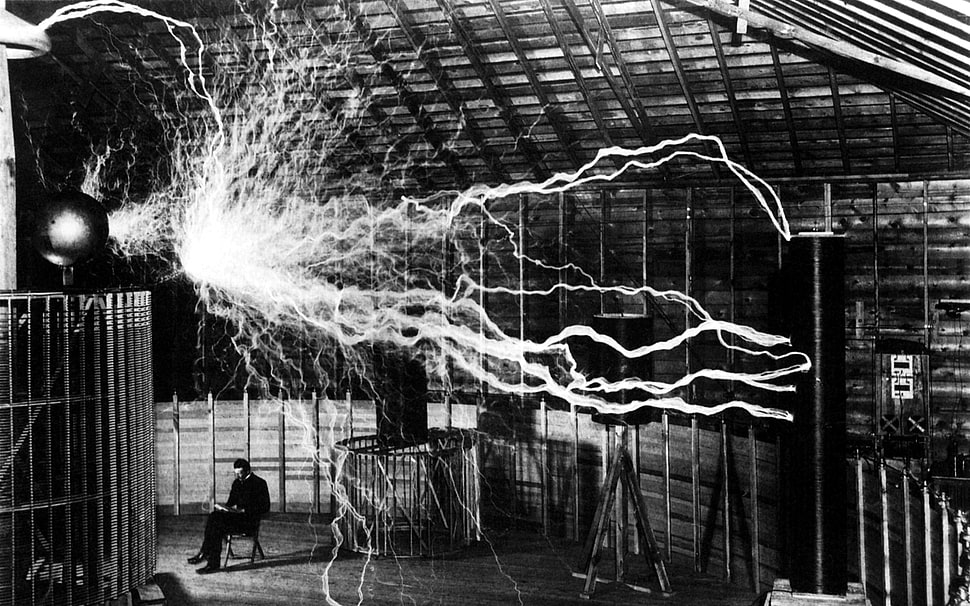
Yet their most distinctive similarity is over-promising. Here’s what Tesla used to persuade J. P. Morgan to invest in his wireless power scheme:

This was taken in 1900 at his lab in Colorado Springs. It’s fake. You can’t possibly sit next to these coils in operation. It’s actually a double exposure. The two Tesla Coils are exchanging sparks on a long-duration exposure, and then they turned them off and had Tesla sitting there with the lights on. Tesla claimed that these high-frequency transformers would let people get power out of the air over great distances. He went on to build a big one at Wardenclyffe Long Island, with $100,000 of Morgan’s money. It didn’t and couldn’t work. Morgan pulled the plug and the project stopped in 1905. That was Tesla’s last major effort.

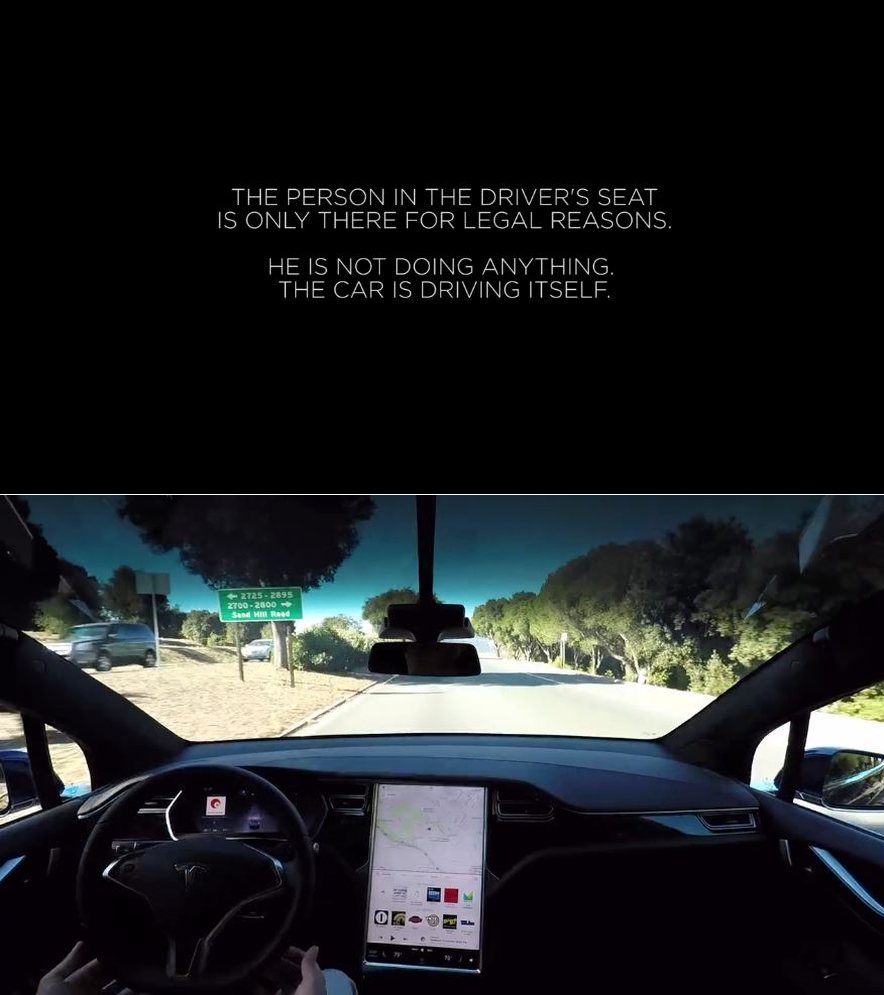
Here’s what Elon Musk announced in 2016 in a video showing a self-driving Model X:

This demo was rigged. The car was NOT recognizing stop lights and stop signs – it was following a pre-programmed course. They had tried to do this ten-minute drive for four days, but avoided rain and rush hour traffic. They constantly had to have the human driver take over. The car failed to parallel park, and ran over the curb and hit a fence. This has all come out in a lawsuit over the 2018 death of Walter Huang. His Model X ran straight into a highway divider at full speed, killing him instantly.

Musk has claimed on no evidence that self-driving Teslas are safer than human-driven ones, when they appear to be worse. They’re now being investigated by NHTSA. He also claimed that the Model 3 was the safest car they had ever tested, when there are lots of cars with equal ratings.

The reason was clear – stock hyping. It wasn’t enough to just build a new kind of car, since that was taking a long time and needing an enormous amount of capital. It had to be revolutionary in multiple ways. He even resorted to claiming he was going to take the company private at a premium in order to keep the stock pumped. This worked for a while, and he was briefly worth a fantastic amount, about $320B. But hyping defective products and making fraudulent stock claims cannot work for long, and he’s now in the midst of a welter of lawsuits.

His catastrophic decision to buy Twitter has led everyone to reevaluate his previous ventures. Yet it’s been obvious for a long time that self-driving is an extremely difficult problem, and that talk of colonizing Mars is ludicrous. His odd manner and his early successes contributed to people taking him to be a genius, just as they did for Tesla. Tesla died broke and in the sole company of pigeons. Let’s hope for his sake that Musk doesn’t meet the same fate.

Posted in Uncategorized | Tagged , , | 2 Comments

“The Mountain in the Sea” – Aliens Among Us

In the last few years we have been learning an enormous amount about intelligence among animals. In particular, we’ve found that octopuses are startlingly smart. They use tools, they invent hunting techniques, they invent disguise techniques, and they are curious and playful. They do this entirely on their own, without the benefit of parents or society. They pack it all into their one to two year lifespans. Their cognitive architecture is utterly different from that of vertebrates, never mind mammals, never mind us. They have more neurons in their arms than in their brains, and that lets them do extraordinary things with their bodies, things that animals with central brains and skeletons could never manage. The Australian philosopher Peter Godfrey-Smith uses them as examples of alternate paths to consciousness, as described in “Other Minds: the Octopus, the Sea, and the Deep Origins of Consciousness” (2016).

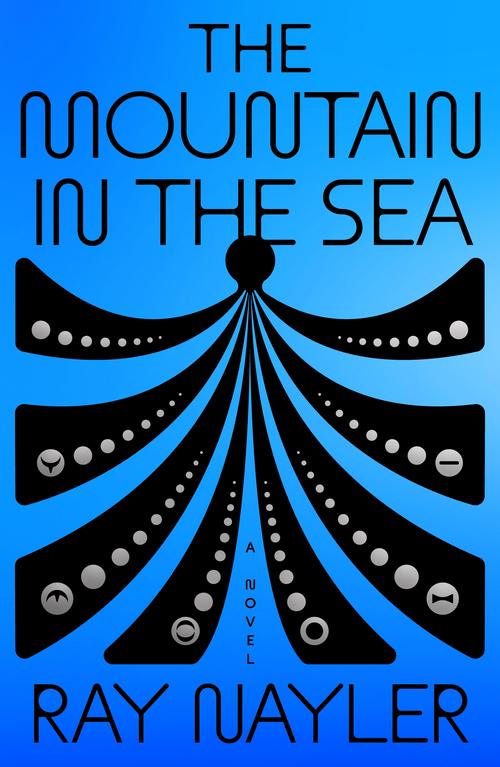
Click for publisher site

So now Ray Naylor has taken on octopus sentience in his debut novel, “The Mountain in the Sea” (2022). The great SF writer Theodore Sturgeon had a rule for his stories – “Ask the Next Question”. Given some premise, what are its implications? Naylor asks – just what it would take to level up octopuses? It has to be something that allows them to pass what they learn from generation to generation. They might already have language. Do they need a real society? A writing system? Then how could humans understand signs from beings with utterly different senses and world-views?

Beyond that, he asks “Who would be most interested in such creatures?” Scientists, of course, so his protagonist is Dr. Ha Nguyen, an Australian expert in cephalopods. Who else? He has a global software enterprise called DIANIMA, that builds AIs for use in every industry. AIs are now used in place of ship captains, and one plot line considers the brutal workings of an AI-driven fishing factory ship. DIANIMA hears rumors of the octopuses at an island nature reserve off the coast of Vietnam, and promptly buys it. They claim that they can better manage it than the poorly-paid park rangers. That’s actually true, since the rangers let desperate fisherman poach the reefs all the time. The company clears all the people out of the island and brings Dr. Nguyen and a security specialist there, along with their crowning achievement – a beautiful, Turing-test-passing android. Then there are others who are not about to let humanity exterminate these sentients the way they have so many other species, and those plot lines converge.

Naylor himself has an interesting background. He has been in the US State Department for many years, most recently as the environment, science, and health policy officer at the US consulate in Ho Chi Minh City (formerly Saigon). This is his first novel, but he’s been putting out SF shorts for a while, most recently in the Nov ’22 issue of Asimov’s Science Fiction. His story there, “The Empty” is a nice near-future account of how to economize on senior care.

I can’t say too much more about this novel without spoilers, but can say it has a distinct poignancy. Half of SF is about aliens, and here we are living next to them. In that sense this book is just like Ted Chiang’s striking short story “The Great Silence”. In it a Puerto Rican parrot asks why we spend so much effort on the radio telescope at Arecibo when the parrots are right here. They won’t be for long, and for matter Arecibo is gone now too, so our chances are slipping away.

Octopuses are the most adaptable of creatures, but they too are under threat. Contact with them can be opening and uplifting, as Peter Godfrey-Smith found, and as Craig Foster also discovered in the documentary “My Octopus Teacher”. They may look hideous and monstrous to land vertebrates like us, but share with us an internal consciousness that non-sentient Nature will never provide. It’s us, and the octopuses, and the parrots, and the chimps, dolphins and elephants against the uncaring atoms of the universe. There are lots of aliens right here, and they should be our allies.

Posted in Uncategorized | Tagged | Leave a comment

The Netherlands Would Be a Pretty Nice Future

The Washington Post today has a fascinating article about what would seem to be a dull topic: Netherlands Agriculture Technology. It notes that tiny little Holland, with the land area of Maryland and only 17M people, is the second largest agricultural exporter in the world, after the US. They do it by using vertical farming, immense numbers of greenhouses, and humane treatment of animals.

Kipster hydroponic tomato operation, credit Wpost

They have systematically optimized this. They have massive seed banks for genetic building blocks. They cross-breed everything to improve disease resistance and taste. They tune the growing with respect to lighting, nutrients, and water, and avoid herbicides and pesticides by growing things under glass. They automate most of the handling. They use the waste from all food processing as feed for animals or nutrients for vegetables. They’re about to power it all with offshore wind farms, since Russian gas is, to put it mildly, no longer a reliable supply.

Now they export not only the product itself, but the tech that goes into it – they’re setting up grow operations all over the world. The country has become a classic magnet center for innovation. It’s not for boring stuff like social media software in Silicon Valley, but for the most crucial product of all, food. They do it with good middle-class jobs instead of oppressed immigrants. They’re actually ready for a climate-damaged future.

Well, not if there’s 5 meters of sea level rise. Then they’re screwed, but they can handle a meter or two with more dykes and more pumping. So they can probably handle the loss of Greenland, but the collapse of West Antarctic Ice Sheet would be dicey, and the melting of the East Antarctic Sheet would do them in. They’re living the future that Kim Stanley Robinson talks about in his cli-fi novels, but not in his typical anarchist co-ops. Instead, they’re straight-up capitalists. The Netherlands is actually where capitalism was born in the late 1600s, and they’re well aware of its failure modes.

This may all sound utopian. Kim Stanley Robinson has written about those too, with upbeat novels of the near future like Pacific Edge (1990) and Sixty Days and Counting (2007). Unfortunately, they’re dull. That’s true of most utopian fiction, actually, since we want conflict in our stories. That’s not a problem for real life, though. What we’re seeing in the Netherlands is a welcome economic alternative to the desert dystopias full of armed fundie gangs that has been all over SF and YA for the last decades. This could be a cleaner, richer, more positive future than the ones we obsessively dread.

Posted in Uncategorized | Tagged , | Leave a comment

Why Care That “The Rings of Power” Is Mediocre?

“The Rings of Power” is a new streaming series based on Appendix A of “The Lord of the Rings”. It gives the history of Middle Earth before the War of the Ring: the second rise and fall of Sauron, the destruction of the greatest land of Men, Numenor, and of the Dwarves’ greatest domain, Khazad-dum. It stars major characters like Galadriel, Elrond, and Gandalf. Amazon Studios paid $250M for just the story rights, and triple that for the production. When all else fails, it has the scenery of New Zealand to fall back on.

So it’s got a big story, a big budget, and great visuals. Yet it’s not working, especially compared to the movie version of LotR. Galadriel, for instance, is a kind of grim bully instead of being the sorceress queen of the world:

Morfydd Clark as a 3000-year-old Galadriel, and Cate Blanchett as her at 8000

The new actress, Morfydd Clark, is 6″ shorter than Cate Blanchett, and doesn’t have her bearing. To be fair, no one does. Elrond is no longer the wise duke of Rivendell – he’s a slick political aide. Elendil and Isildur are not the mighty father-and-son warriors who go after Sauron in single combat – they’re a grouchy middle-management dad and his moody teenage boy. I’m sure they’ll all evolve over the course of the series, but the first few episodes have given us little reason to care about them.

The dialogue is pedestrian too, but maybe that can’t be helped. Tolkien wrote the languages of Middle Earth before he created the world, and it shows in the sonority of his writing. Only someone with an expert ear, like George R. R. Martin, can actually do this well.

So that’s all a shame, but the world is full of bad Tolkien pastiches. I care because I’ve always been a Tolkien fan, but why should you care?

Because it’s being politicized. Right-wing trolls are seizing on its diverse casting to say “Look, the globalist media elite is ruining your beloved books to cram their phony progressive agenda down your throats!” There is now a Black elf, a Black dwarf and a Black hobbit. There’s only one of each, so they’re pretty much tokens. The female characters are consistently smarter, tougher, and bolder than the males. It’s full of what the trolls call The Message, and they’re using that slant to tar the whole production. It’s not mediocre because Tolkien is a hard act to follow; it’s marred by its progressive elements.

Amazon is not taking this lying down, of course. They’ve invested an enormous amount in this, perhaps because it was one of the few major genre intellectual properties still available. Other studios are busy exploiting Star Wars, Star Trek, Marvel, DC, and Harry Potter for all they’re worth, although there’s little to wring out of them at this point. Apple even produced a Foundation series, but I thought it was a disaster. So Amazon is pushing tRoP pretty hard, with ads for it on the packaging of their boxes. Their proxies have put out lots of stories criticizing the criticism, calling it racist and MAGA-ish. They have a point – a lot of the criticism really does sound nasty, but it’s a replay of the defense of the slack Ghostbusters reboot and the under-cooked Ms Marvel movie.

So a routine piece of Hollywood adaptation gets sucked up into the American culture wars. That’s mortifying, but it’s also a sign of how Hollywood misunderstands the soul of what they’re adapting. They take great works but don’t trust the writer’s understanding. “Game of Thrones” fell apart when it moved beyond Martin’s novels. Star Wars 7, 8, and 9 were glitzed-up copies of the original, sometimes scene-for-scene. Star Trek re-booted with a different cast and timeline because the original wasn’t violent enough. Even Marvel had a consistent theme in the first few movies of sons-with-difficult-fathers, and diversity-creating-strength, and that’s gone in the recent ones. Amazon actually did do this right in their great adaptation of “The Expanse” novels, but they kept the original writers involved all the way through.

The show runners here just don’t seem to get it. The theme of the Lord of the Rings is that the world is vast and ancient, and full of wonderful and terrible things, but that even the humble can contribute. It opens on the smallest scale in the Shire and then expands from there, showing the above, not telling. Gandalf is actually an archangel, but he starts as an old guy in a cart.

This starts with Galadriel jumping around in a cave while battling a snow troll, and that just takes the mystery out of her. When we meet Durin, the crown prince of the dwarves, he’s irked because Elrond didn’t come to his wedding. Dwarves aren’t fearsome figures from the underworld, they’re grumpy building contractors. This all makes Middle Earth seem more like our own, and that’s not what we want from it.

Posted in Uncategorized | Tagged , | Leave a comment