Obscure Creators of the World #3 – Jack Ryan

And now for something completely different! Jack Ryan did not create fundamental innovations like Federico Faggin and the self-aligned FET, or Robert Dennard and the DRAM. He did not have a long, successful career with a strong and supportive family. He did get involved in massive lawsuits. He did throw infamous Hollywood parties full of drugs and starlets. He did come to a bad end. Yet he also created things that have brought more direct pleasure to more people than either of my previous Obscure Creators. He’s the inventor of the Mattel toys Barbie, Chatty Cathy and Hot Wheels!
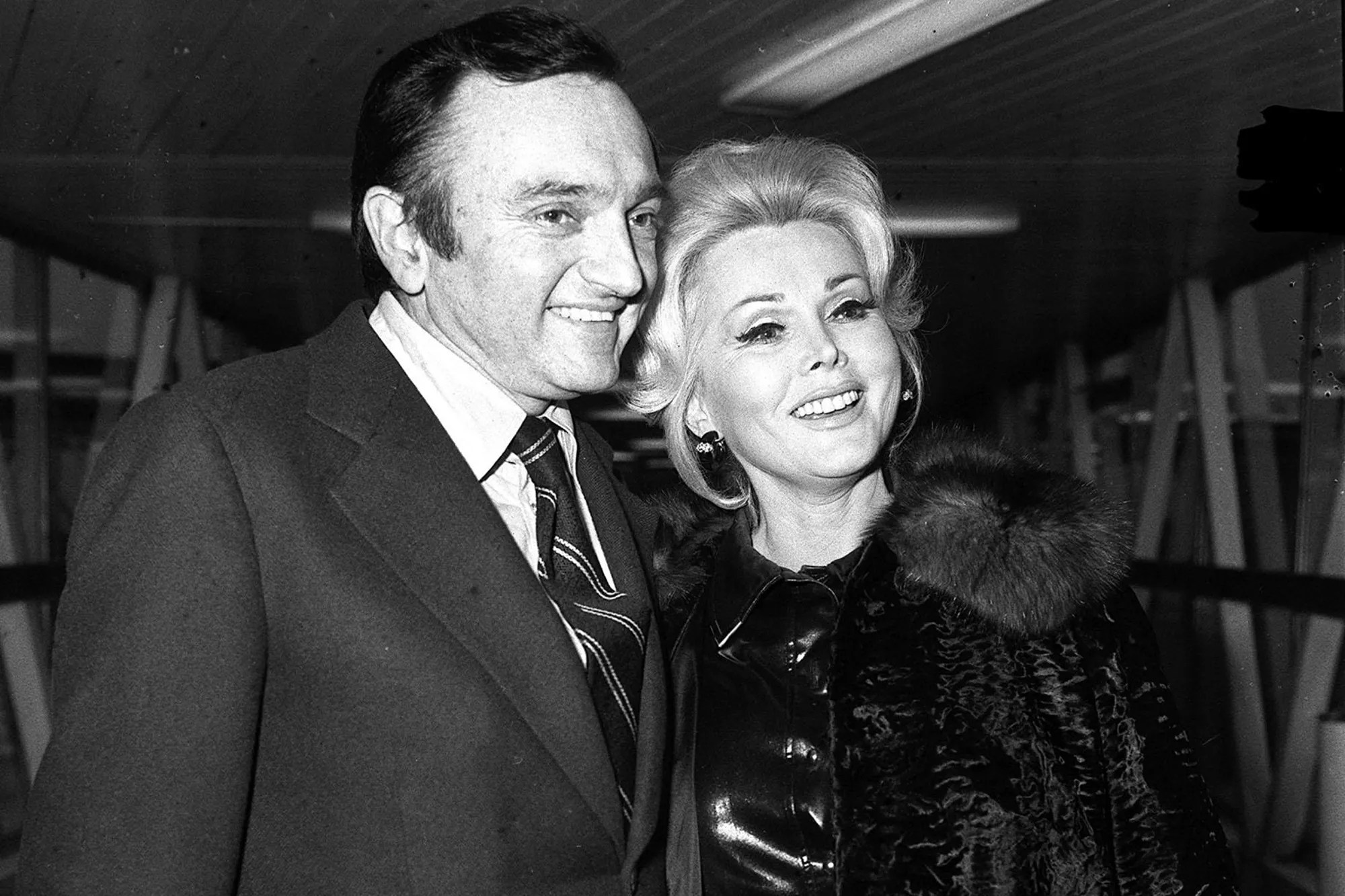
Jack Ryan and Zsa Zsa Gabor, the second of his five wives, in 1975. He was the sixth of hers.

Not that Mattel will admit that, but more on that later.

He was born in 1926 to a well-to-do family in New York. His father was a builder, and he was a tinkerer all through his teens. He graduated from Yale in 1948 with a degree in electrical engineering, and then moved to the Boston area to work at Raytheon. They were just starting up with radar-guided missiles, and he worked on the Sparrow III air-to-air missile and the Hawk surface-to-air. These are still in use after many upgrades. Yet Cold War work was depressing, as was gray New England. He was sent on business trips to sunny, relaxed southern California and loved it. In 1955 he quit Raytheon and moved his whole family there.

He had already met Ruth and Elliot Handler, the founders of Mattel. They had just had their first success, a toy called the Burp Gun, which they promoted through an exclusive and expensive deal on the Disney Mickey Mouse Club TV show. They pioneered TV sponsorship, but it took all their cash. It was a big risk, but they sold a million of them in the first year. Ryan wanted to work with them, but knew they had no money. Instead, he negotiated a deal where he got 1.5% of the gross on all the toys he designed for them. They were delighted – they got this obviously talented guy for free.

Both Ryan and Ruth Handler first wanted to do a better doll. He had seen how girls played with paper dolls instead of the expensive ones on their shelves because “they had dopey figures.” Ruth had just been on a vacation in Germany, and saw just what she was after, a curvy doll called Bild-Lili. It was based on a racy cartoon, Lili, in the German magazine Bild. She brought one back and that became their model:

Bild-Lili Hong Kong clone (RomitaGirl67) and first edition brunette Barbie (1959)

Different eyebrows, but same figure. Ryan designed the mold and the internal armature. He even got a patent for it!
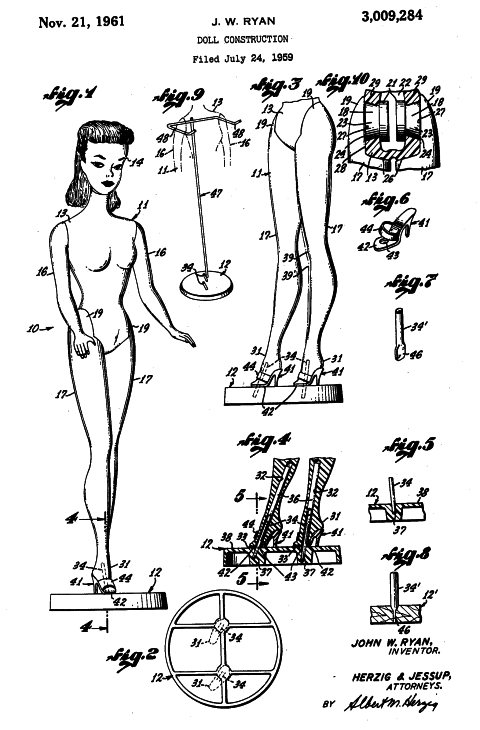
US 3,009,284 “Doll Construction”, filed 1959, granted 1961, assigned John W Ryan

He received about 215 patents all told between 1959 and 1980, with most going to Mattel, some to him personally like the above, and others to the Ideal Toy Corporation. Almost all were for toys, but he also devised a coffee cup that would keep beverages at a constant temperature (probably using a phase change of sodium acetate), and a camera that could develop its own film.

Barbie was a huge success right away, and is to the present day. Part of that is her shape, part is her articulation (which was much more natural than other dolls), and part her houses, all of which Ryan designed. I don’t think he did her clothes, but that’s a big part of the appeal too.

However, Ruth Handler claimed complete credit for Barbie in her 1994 memoir “Dream Doll”. She said that the doll was named after her daughter Barbara, but Ryan’s wife was a Barbara too, and she looked a lot more like this. The portrait of Handler in the recent “Barbie” movie is complete corporate spin – she was a tough-as-nails business-woman and somewhat crooked, and not at all the lovable nana seen there. Handler’s own taste was prim and conservative, while Ryan’s was completely wild, so he was far more likely to devise a sexy toy. That said, he did chicken out just before the doll went into production, and filed the nipples off of the mold.

He soon followed that up with Chatty Cathy, a doll that could speak up to 11 phrases. It was not electronic – it had a tiny phonograph record holding the sound. The pull string would wind a coil, and a needle would drop onto the record. It was attached to a paper cone for amplification, just like the great horns of the original phonographs. It’s a brilliant design and was used by all talking toys up until it could be done even more cheaply by chips in the 1980s.

Even though he was never an employee of Mattel, he was their head of R&D. Not only did he do the mechanical design of the toys, he studied how children interacted with them. That’s because he was a real engineer, not just a tinkerer, and that means being systematic. He set up play areas with prototypes and had psychologists evaluate them. This became another reason for Mattel’s success.

His biggest hit after Barbie was Hot Wheels. Elliot Handler had looked with envy at the success of the English Matchbox cars. He wanted to do the same but using snazzier SoCal hot rod designs. Harry Bradley was hired out of Chevrolet to design the shells and paint jobs, while Ryan did the mechanicals.

Bradley had caught polio at age 14, which paralyzed him from the waist down. Perhaps unsurprisingly, he spent his whole career designing ultra-cool ways to get around, including the Oscar Meyer Wienermobile and the Dodge Deora.

Original Hot Wheels designs and tracks. The Dodge Deora is on the left.

Unlike Matchbox, Ryan put plastic wheels on the cars with a little give for traction, needle bearings for smooth motion, and a suspension. He also came out with the orange track system that let kids build raceways, and they even had a battery-powered accelerator that would shove the cars along. The result was that the cars totally zoomed. This too was an instant hit, and is still everywhere. Like his wife, Elliot Handler later claimed credit for them, and relegated Ryan to the role of technician.

Mattel sold six billion Hot Wheels cars in their first 50 years, from 1968 to 2018. When my son was small he had dozens of them, and he gave them all personalities. He would line them up on the edge of the bathtub and tell stories about them. Maybe that wasn’t so different from Barbie after all.

So in the 1960s, Ryan was making a 1.5% royalty on toys that was selling for hundreds of millions. A million bucks a year barely gets you into the 1% these days, but was serious money back then. It all went to his head. He bought an enormous mansion in Bel Air which he called The Castle:

He hired Hollywood set designers to rebuild it as a literal castle, but with plywood and sheetrock. He never actually finished it because that would be no fun. The first floor became an enormous banquet room paneled in black fur. He would hold Tom Jones feasts there, where everything had to be eaten with your hands, and you couldn’t even use napkins – you had to lick your neighbor’s fingers clean.

The master bedroom had mirrors everywhere. One time he was lying in bed there with Gwen Florea, the tall, voluptuous redhead who was the voice of the first talking Barbie. She later related that he had said “You know something kid? I should cut a hole in the ceiling so that when I make love I can look up and see the sun and the moon. Wouldn’t that be just delightful?” Yes, the Sixties.

You can hear a lot more about this in Jerry Oppenheimer’s savage take on the rise of Mattel, “Toy Monster” (2009), and in his daughter’s Ann’s accounts in Dream House – the Real Story of Jack Ryan. Ann and his other daughter Diane remember him with great fondness, but they saw a lot less of him after their mother gave up on him in 1971. His strict Catholic father had died by then, and they were finally free to divorce.

Other things started going wrong in the 70s. The Handlers disapproved of his lifestyle, thinking it damaged the brand, and resented the royalties. They set up an alternate R&D division to take work away from him, and hired a demanding ex-military guy to run it. It was a disaster for both sides. The company started losing money, and the Handlers hid the losses using various financial tricks. The SEC found out about it, and they were forced to resign from the company in 1975.

They first stiffed Ryan on his royalties. He sued them for $24 million, and they simply stalled. He had burned up most of his money by then, and the legal bills were huge. He had to sell the Castle for a pittance. He went through several more wives, including Gabor. He was owed money on about 200 products he had done for them, and they had him under deposition for 200 days over three years. They finally settled in 1980 for $10 million, but only after he had had a heart attack and needed a quintuple bypass.

He was still inventing in the 1980s, and had settled down somewhat, when the final blow came. He had a stroke in 1989 that robbed him of speech and left him paralyzed down his right side. All he could do was lie in bed and watch TV. His last wife, Magda, found him on the floor of their bedroom in 1991 with a gun in his hand. He had written “I love you” on their mirror and then pulled the trigger. He was 64.

Did the libertine lifestyle of LA do him in? Maybe, but probably not. He had always been manic-depressive, and rather sex-crazed. Even if he had stayed in the staid Northeast, he would have had mistresses on the side. He would probably have drunk himself to death, as so many of his class do, and that’s just as hard an end as cocaine.

What LA did permit was to let his imagination run wild. With that much money he could do anything he wanted, and people would be amused instead of appalled. A lot of what he did was frivolous, and some was self-destructive, but Mattel, and kids everywhere, benefited when his ideas became concrete.

Posted in Uncategorized | Tagged , | 2 Comments

A Better Heat Pump Scheme: Networked Geothermal

A lot of the green energy transition is already well underway. PV solar and wind are already cheaper than gas, and electric vehicles are at near cost parity with ICE and much more fun to drive. Major countries like Germany and the UK already get more than half of their electricity from non-fossil sources. The emissions from advanced economies actually dropped by 4.5% from 2022 to 2023, and are down to 1990 levels, according to the IEA: CO2 Emissions in 2023. They burn less coal than they did in 1900.

The next biggest emission wedge to convert is heating and cooling, and there the answer is clear – heat pumps. These exchange heat between the inside of a building and an exterior heat reservoir, and can heat or cool. There are two main types: air-source and geothermal. The air-source heat pumps are basically reversible air conditioners. They can make hot outside air cold or vice-versa. They then move it into the house through a fluid and then to air ducts. They need big outside fans and so can be noisy, and don’t work that well in cold winters, when they have to raise the outside temperature by 30 or 40C.

It’s better to use a heat reservoir with a more constant temperature, like the ground. This is geothermal. Water pipes are either run deep into the ground in a U-shaped well, or are buried under a backyard. The ground is at a constant year-round temperature of 13C in Massachusetts, and so works well for heating and cooling all year round. The big issue is getting that big run of pipe in somewhere, since that’s expensive.

Here’s where networked geothermal comes in:

Still from heet.org’s Youtube video

Instead of having a pipe for each building, have a system for a whole street managed by a utility. Each place maintains its own heat pump, just as they now do for a gas furnace, but a central authority handles the wells and the piping. The system expands smoothly as more buildings are added. This has lots of advantages over individual wells or air-sources:

  • The cost of the wells is amortized over lots of customers. A single well costs tens of thousands.
  • The pumps use a reservoir close to the building temperature, and so get very high seasonal coefficients of performance (SCOP). That’s the ratio of heat energy out to electrical energy in over a whole year. An air-source pump might get 3.0, but geothermals get more than 5. This means less electricity cost for everyone, and less strain on the grid. ISO New England says that electricity demand in its region has dropped by about 20% over the last 20 years as more efficient lighting is used, manufacturing improves and more residential solar panels are put in, but they expect it to rise by 20% as more heat pumps and EVs are used. Better SCOPs will help.
  • The plumbing is no longer a one-off project, but is installed and maintained regularly by experts, which also lowers costs and speeds conversion.
  • The system can be sized for the average over a number of buildings, rather than having to meet the peak of one. Yet another cost savings.
  • The system can be handled by the gas utility, and so can convert over smoothly as gas heat is retired. This is a big political advantage, since there is no longer a big incumbent resisting the new scheme. It benefits union labor too!

The scheme is being promoted by a Massachusetts group, the Home Energy Efficiency Team, heet.org. They maintain a Gas to Geo Wiki with info about every aspect of the plans. The first gas-utility-backed trial started in 2022 in Framingham MA with this route:

Eversource Networked Geothermal Project

The loop is about a mile long and is buried 5 feet deep. It uses 8″ plastic pipes with thick walls. It will cover 36 buildings with 24 residential (apartments and houses) and 12 commercial. The in-house installation of the heat pumps is due to finish this summer of 2024. The main boreholes are in a parking lot in the middle.

The people participating will all get huge breaks on their heating bills. There are already big rebates available: $15K from MA and $8700 US. Since the average MA geothermal install is $44k, this can cut the cost by more half.

So this sounds like a win for everyone! The utility and unions get future work, the customers get clean and quiet heating and cooling that doesn’t smell from leaks or occasionally explode, and the planet gets less emissions. I hope this comes to our neighborhood soon!

Posted in Uncategorized | Tagged , | 5 Comments

Innovations of the Big Dig 3 – Scheme-Z => Zakim Bridge, Conclusion

Here’s the last of the major innovations described in the WGBH podcast, The Big Dig, along with my take on how it all turned out.

Along with the straight construction challenges of the Dig, described in the previous posts, Fred Salvucci had a geometric challenge at the north end of the Central Artery tunnel. The road there had to rise up to connect with the elevated decks of I-93 going north, with Rt 1 heading east towards the Tobin Bridge, with Storrow Drive heading west along the south bank of the Charles, and also somehow get across the Charles without wrecking it and the Orange Line subway that ran nearby. People would need to drive on all these connections at speed with minimal merging, something that had caused thousands of accidents on the old artery. 

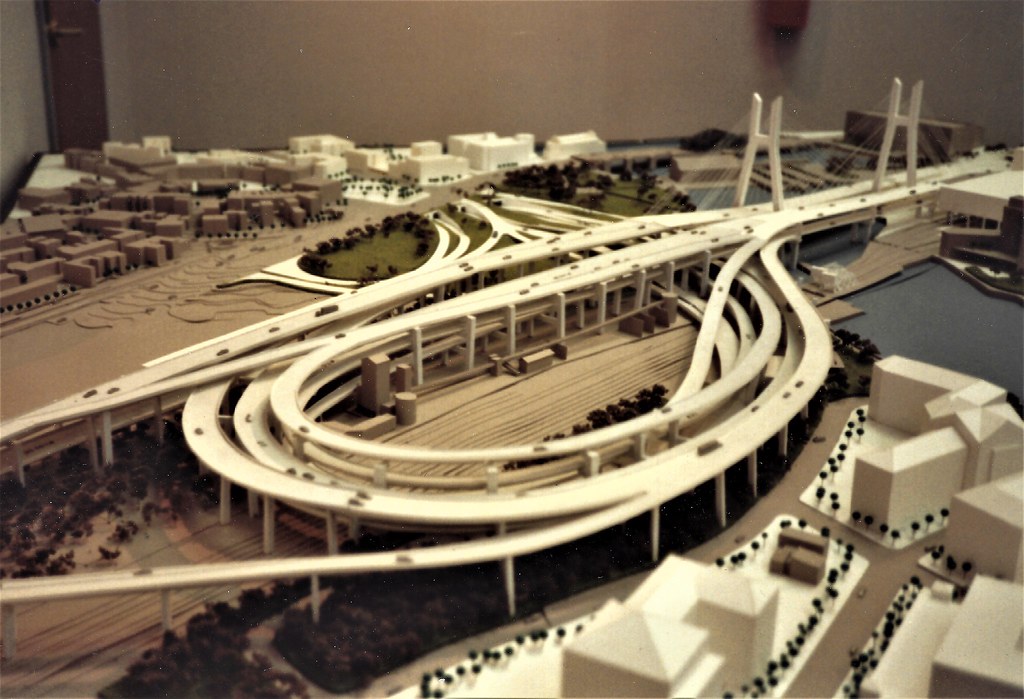
His team worked through 31 different plans for how to hook up all these roads, and finally settled on the 26th, Scheme Z. This almost killed the entire project. It was a huge mass of multi-level road decks, rising over a hundred feet into the air:

Model in MassDOT office, 1990, credit Charlie_MTA

This is looking southeast from Cambridge, with the Charles River in the upper right. The two towers support a bridge that would rise up out of the tunnel, and then all the connections would be those loops on the Cambridge side. It would have added as many lane-miles as depressing the Artery removed! Everyone really, really hated it. 

Yet Salvucci stood by it through the storm of criticism. By 1990 he had been working on the Dig for about 15 years. He and the governor, Michael Dukakis, had gotten the project through all the state-level blockages, and then through federal approval. With Tip O’Neill’s help, they even got it through a veto by Ronald Reagan. 

[Aside: what is it with Republicans and public works projects? The only one who backed them was Eisenhower with the Interstate Highway system, and he justified that in military terms. Herbert Hoover actually hated the famous dam that bears his name because it displaces private power utilities in LA. That was a sly dig by FDR. Nixon, Reagan, both Bushes and Trump built nothing of note. Manhattan has been jammed for the last decade because then GOP NJ governor Chris Christie refused to allow a new tunnel to be built to it under the Hudson.] 

Scheme Z was the last major piece to work out, and to Salvucci’s mind it was the best solution. All those lightweights who were just then starting to pay attention to this vast effort had no idea of what really needed to be done.

1990, though, was his last year on the project. Dukakis had already been governor for 12 years and didn’t run again. He was replaced by the Republican Bill Weld. That meant that Salvucci was replaced as well as Secretary of Transportation. The new administration knew that the Dig had to carry on, but wanted nothing to do with the Scheme Z controversy. They cast about for new designers and had the fortune to find two brilliant ones, Christian Menn, a world-famous Swiss bridge designer, and the young Miguel Rosales, born in Guatemala and trained at MIT:

Christian Menn (1927-2018) and Miguel Rosales (1961-)

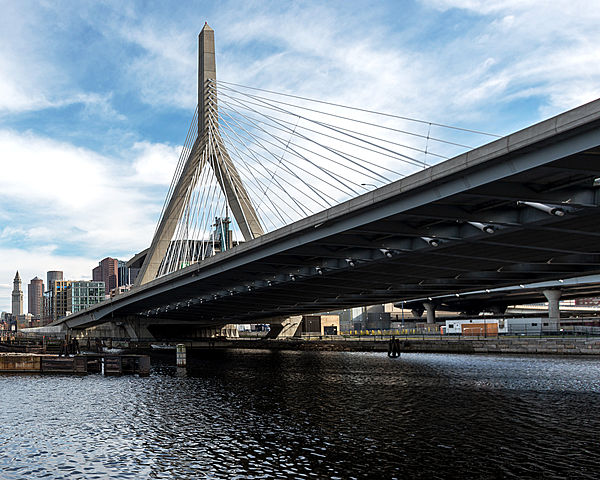
Menn, who was nearly retired, did the concept for the bridge, and Rosales, who had graduated only a couple of years earlier, headed the design. He still has an active office in Boston and has since built bridges all over the world. They replaced the spaghetti of elevated roads with a single immensely wide span, the now-famous Zakim-Bunker-Hill bridge:

Underside of Zakim-Bunker Hill bridge looking south, credit Mathew Miller

It has become an icon of the city!  It’s the only actually attractive feature of the roadworks themselves. It solved the tangle problem by having a lane cantilevered off of each side for entrances and exits, and then distributing the other ramps on both sides of the river. It’s named for Leonard P. Zakim, a Boston activist, civil rights leader, and friend of the Dukakis’s. Bruce Springsteen knew him too, and played “Thunder Road” at the bridge’s opening. The obelisk tower peaks resemble the Bunker Hill Monument in nearby Charlestown. It was actually the widest bridge in the country until the reconstruction of the eastern span of the Bay Bridge in San Francisco was finished in 2013.

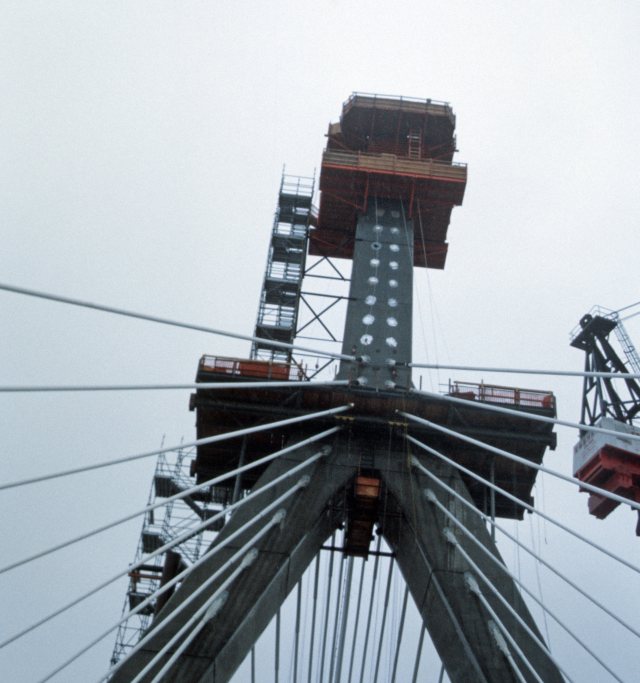
Here is that same south tower under construction during a tour that some friends and I got of the Dig in April 2000:

Peak of the South Tower while the cable stays are being strung, 4/22/2000

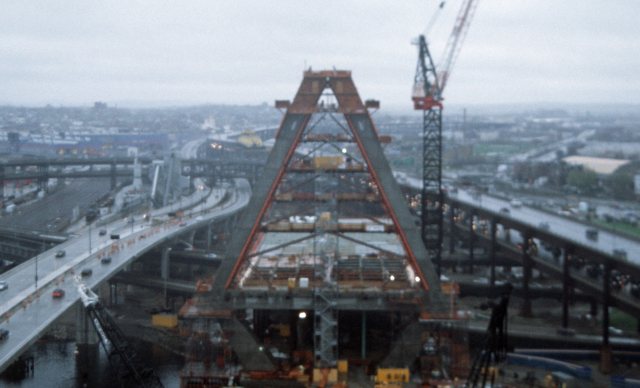
We got to climb up those scaffolds and look out over the city, something no one will ever be able to do again. Looking north from high in the tower:

The north tower of the Zakim bridge from the top of the south tower, 4/22/2000

Those elevated roads to the left and right are now gone. That’s the kind of mess that the Dig replaced.

It did have some glitches in its development. Menn was visiting it in 1999 as it was under construction and noticed that the cables weren’t properly attached to the support beams on the deck. ”Grrr”, said the project managers, and took two years to correct it. 

When it did open in 2003, people noticed that multi-colored lights had been installed on it. They’re normally set to make its white cables glow blue at night, but can be set to any color. ”Wasting taxpayer money!” many screamed, but everyone else loved it. They’ve been set to red-white-and-blue when the Patriots are in the playoffs, to all purple when Prince died, and all green for the death of honorary Irishman Mayor Tom Menino.

Overall, the Big Dig had a slew of problems. Corrupt contractors used sub-standard concrete in the slurry walls, the light fixtures corroded way too quickly, and there was unexpected flooding in the lowest roads. Worst of all, a too-heavy ceiling panel pulled out of its epoxy mounts and fell and killed someone. The general problem was too much cost-cutting. The project ran way over-schedule and over-budget, and some bad compromises were made. The ceiling panels, for instance, were supposed to be much lighter metal panels, but they saved some money by making them with concrete, and that turned out to not save money at all.

Yet the Dig overall saved the city in a quite direct way. The Artery was a nightmare, and has been replaced by the beautiful Rose Kennedy Greenway. The Seaport District, which used to be abandoned warehouses and parking lots, has had about $20 billion of investment in it since 2000. That’s more than the $15 billion Dig itself. It has now had about 70 major building projects, including the Boston Convention Center, the attractive Institute for Contemporary Art, and the best outdoor music venue in the area, the Leader Bank (formerly Harbor Lights) Pavilion. The fill from all the tunnels was used to cap the waste dumps on Spectacle Island out in the harbor, and it’s now a striking park.

The city became cleaner, greener, and more open. The result has been skyrocketing real estate prices! There’s a down side to making your area more attractive. Yet few would say that noisy and dirty highways should be kept in order to keep apartment rents low. Highways used to be Hallmarks of Progress, and now they’re eyesores in places too poor to get rid of them. The Dig showed one way to go forward, but it was such an expensive lesson that few other places can follow.

Posted in Uncategorized | Tagged , , | 2 Comments

Innovations of the Big Dig 2 – Slurry, Jacking, Freezing

Let me again recommend the WGBH podcast, The Big Dig, which was the inspiration for these posts. It’s full of great stories, but I’d like to concentrate on the innovations that made this vast project possible. Last time I talked about a key part of the concept, moving the ugly and filthy Central Artery into a tunnel. The tunnel had to be dug while the Artery was still active above it, but how? The key was:

Slurry Walls

This is a technique pioneered in Italy for the construction of the Milan Red Line in the 1950s. Its first use in the US was in Boston in the 1970s, where it was used for the Red Line extension in Cambridge from Harvard Square to Alewife The driver of the Big Dig, Fred Salvucci, was involved in that project, and learned about it there. It works like this:

Credit Sanjay Singh

A big claw excavates a slot in the ground, and as it works the open space is filled with a slurry of a clay material called bentonite. The slurry is semi-liquid, so the claw can drop down through it to get at the soil at the bottom. It holds the sides apart during the digging. Once the slot is done, a cage of reinforcing rods is put in, filled with concrete, and the slurry is pumped out. The result is a wall that extends down into the earth. 

The Big Dig was far and away the largest use of slurry walls in North America. 8000 meters were built, to a depth of about 40 meters. Two were built, one for each side of the tunnel. Beams to support the above-ground Central Artery were then laid across them. Then the space between was excavated, and more beams were put in to support the walls. The whole space down to the tunnel level was dug out, and then the tunnel was roofed and the space above filled in.

I actually got to see the tunnel being built on a tour in April 2000:

Inside the Central Artery Tunnel while it is roofed, April 2000

The slurry walls are on the sides. The space is held open by huge I-beams like the one in the middle. Here’s one being lowered in from way above us:

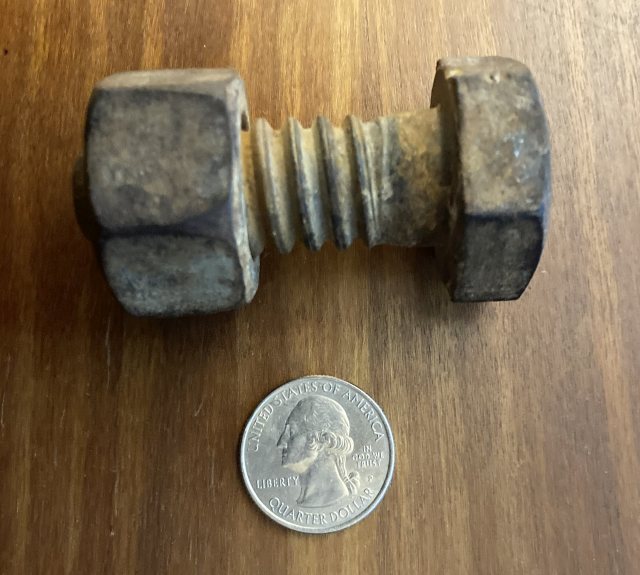
We were walking around amidst all this activity with people working high overhead. I was thinking “Civilians really shouldn’t be here,” but the Dig had remarkably few accidents for a project its size. I did pick up a big bolt as a souvenir:

So if it collapses, you’ll know why.

Tunnel Jacking and Ground Freezing

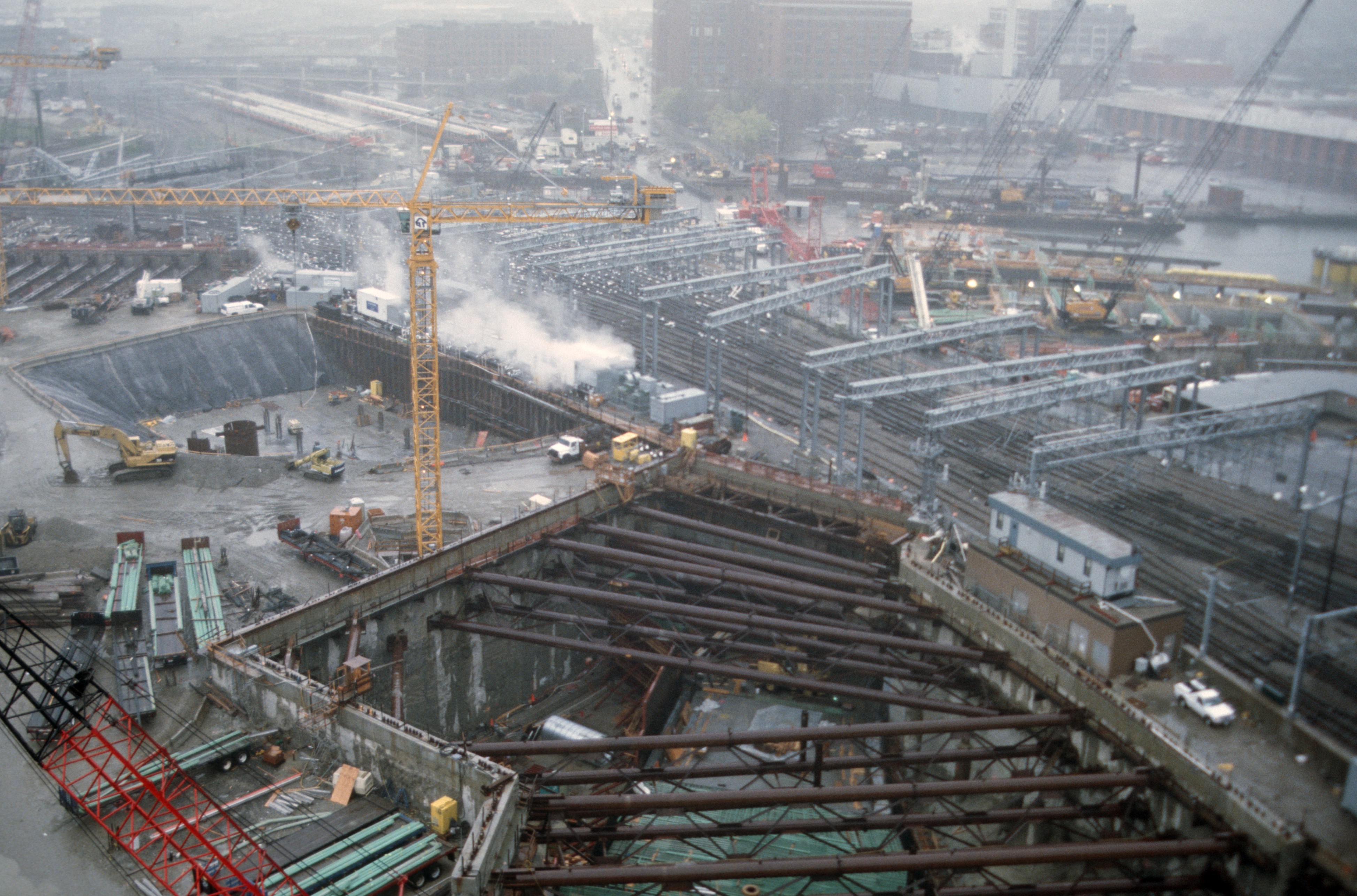
The slurry wall was fine for digging the main channel for the Artery, but wouldn’t do for the harbor tunnel. It had to cross beneath the dozen railroad tracks for the city’s main train station, and be dug while the trains were in operation. The ground beneath the tracks was just glop, so it couldn’t be excavated from underneath. The answer was to do enormous concrete castings of the tunnel sections and ram them through underneath the tracks. Here are giant hydraulic rams pushing a casting forward:

The huge brown steel cylinders are the rams. As they moved, those shorter cylinders would be put in as spacers. From above it looked like this:

This is looking south from South Station. The main tracks are in the center, and three tunnels (one on the bottom, one on the left, and one in the upper left) are converging to merge beneath the tracks before going under Fort Point Channel and then Boston harbor. The tunnels can be dug down from above and then the sections cast and rammed into place. 

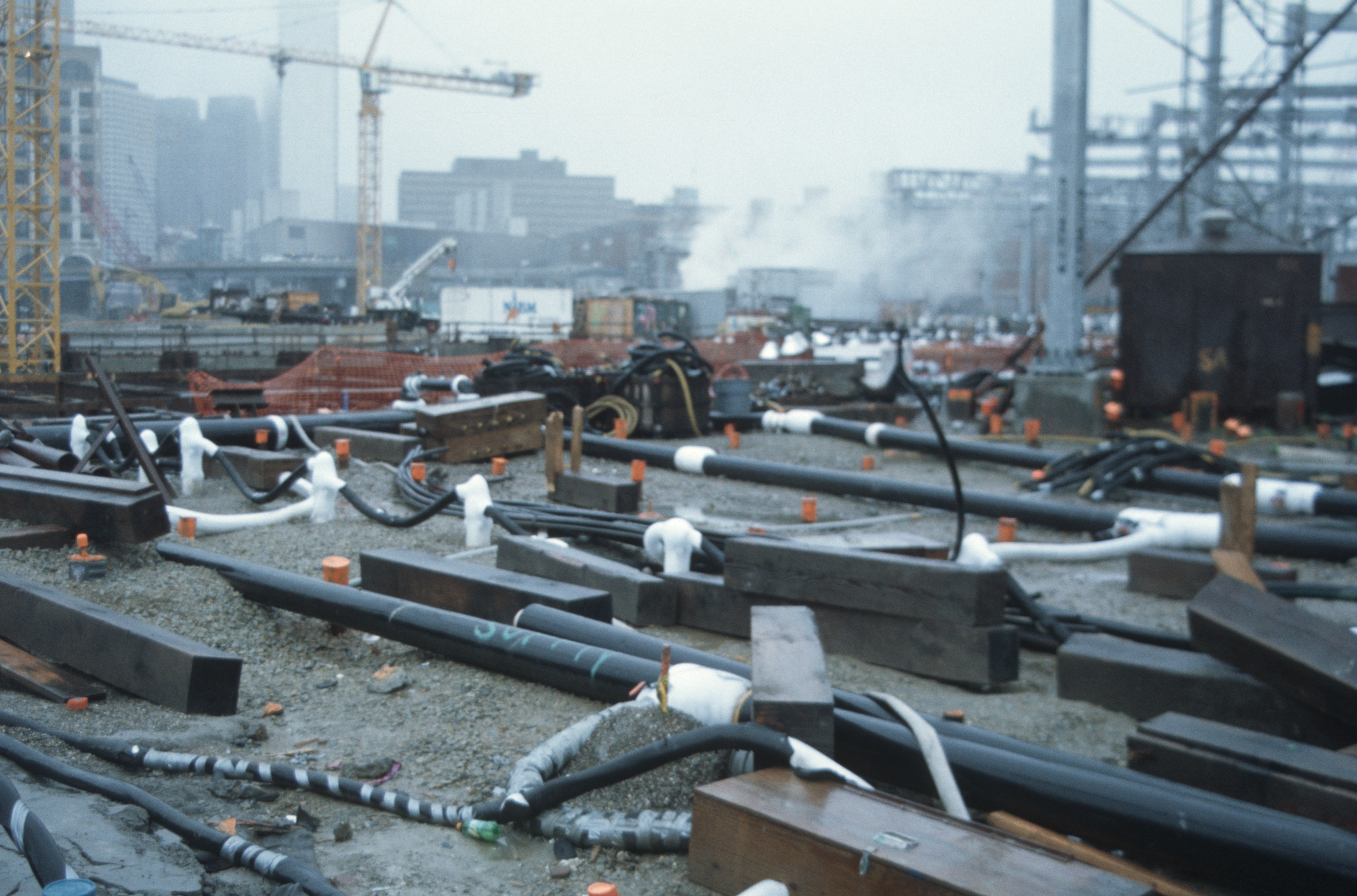
Yet there were some spots that could not be supported by big beams above, like right next to the tracks. That’s where ground freezing came in:

The black pipes are carrying a saline solution cooled to well below 0o C. They run through pipes underground and keep the soil frozen while tunnels are being rammed beneath them. They had to maintain this for a few months until the tunnels themselves could support the ground above them. It was artificial permafrost at latitude 42o . They timed it so this was done in the winter and spring! Summer heat would have screwed it up.

Fortunately, they did not have to do either of these for the water crossings. There they could excavate trenches at the bottom of Fort Point Channel and the Harbor, float the tunnel sections over them, and then sink them into place. The sinking took days, but they were placed to centimeter precision. The underwater parts of the Dig were actually relatively easy, exactly because they didn’t have to worry about existing structures.

Next up, fixing the worst design flaw in the whole project – Scheme Z.

Posted in Uncategorized | Tagged , , | 1 Comment

Innovations of The Big Dig 1 – the Concept

WGBH, the main Boston public radio station, has just done a great series on The Big Dig. You can find the podcast here: The Big Dig, and the start of the series on Youtube here: The Big Dig began with activists who hated highways. It’s written and narrated by Ian Coss, and goes over the full history of the massive project. His main interest in what it says about how we’ll deal with even bigger projects in the future, like protecting cities from sea level rise. It was vastly expensive, about $16B, but saved Boston in a direct way. The entire story is fascinating, but let me concentrate on one part of it, the brilliant innovations that made the whole thing possible. There’s a lot to cover, so let me do this in more than one part. Let’s start with the key concept:

Fred Salvucci in 1989, credit Framingham News, Paul Lehto

Combining the Artery and Harbor Tunnels – The entire Big Dig project was driven by one Fred Salvucci, a Boston-born MIT-trained civil engineer who was an anti-highway activist in the 1960s. His own grandmother’s house had been taken by one of the projects, leaving her with nothing. In the early 70s he was in charge of transportation for the city of Boston under Mayor Kevin White. He was at all the meetings arguing about what should be built, and his opponent was often a road guy named Bill Reynolds. In spite of their differences, they would go drinking together at Jacob Wirth’s, a downtown dive with sawdust on the floor. It’s now gone, displaced by the glossier Boston that the Dig helped create. As Salvucci recalls, Reynolds said to him:

“You know, I’ve been trying to figure out why you guys don’t like highways, cuz highways are beautiful things. They’ve built America, they’ve built a middle class. And I’ve come to the conclusion that the reason you don’t like highways is because the elevated Central Artery is such a big, ugly, dysfunctional thing. It’s like a giant neon sign flashing saying: highways are bad, highways are ugly, highways don’t work. So I’ve come to the conclusion that to get the root of the problem, we have to tear down the Central Artery and rebuild it underground.”

Salvucci replied “Gee Bill, that’s a wonderful image, but we’re gonna have to put a sign up at the Charles River: city closed for alterations, come back in 10 years. How the hell are we gonna do this thing without shutting the city down?”

Reynolds told him to just solve it, and that’s just what he did. Salvucci would walk under the Artery from City Hall for lunch, and the plan formed. There was nothing underneath the Artery. If the elevated highway supports could be held up by putting beams beneath them, the whole tunnel could be dug beneath it.

Yet that wasn’t enough. There was a competing massive infrastructure project, one to build a third tunnel under Boston harbor to connect the city with its airport. Business people desperately wanted the Tunnel because the existing tunnels were small and jammed. I remember one time when a truck lost its brakes in one of the tunnels and jammed itself between the roof and a BMW. That shut down the city for a day.

Transit people didn’t care about the Tunnel because there was already a good subway line to the airport, and they hated the Artery more. Worse, building a new Tunnel would destroy the neighborhoods of East Boston when it emerged from under the water. Tip O’Neill, the great congressman from North Cambridge and then Speaker of the House, would never agree to anything that harmed his constituents.

That’s when Reynolds re-appeared in the story. He called Salvucci from a pay phone by South Station and told him “You have to come down here.” They met and Reynolds showed him a Tunnel route that would come up on the airport itself, and not take a single East Boston property. It would be longer, and have to go under the South Station railroad tracks and under a waterway called Fort Point Channel, but it could be done.

The only way to resolve the conflict between the opponents of the Artery and the proponents of the Tunnel was to do both. It would cost an enormous amount, but Tip O’Neill would handle that part. They eventually named the new Artery for him! 

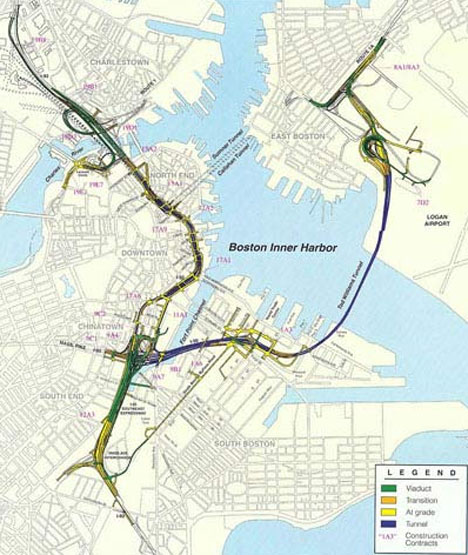
Here’s what the Central Artery and Tunnel (CAT) Project (its official name) ended up being:

The buried Artery goes just about where the elevated Artery used to run, right through the heart of downtown, and the Tunnel swings way around to avoid Eastie. 

This was all non-obvious. Depress this enormous highway while keeping it open? Double the cost by building a harbor tunnel too? Madness! Yet both had to be done, and the only way to get enough support was to do them both. Fortunately, Mike Dukakis was elected governor in 1974, and be brought in Salvucci as head of the Dept of Transportation. There he was, only 34, and about to start the most momentous reworking of this ancient city that it had ever seen. Yet how could it be done? That’s for next time.

Posted in Uncategorized | Tagged , | Leave a comment

Obscure Creators of the World #2: Robert Dennard

Many people have heard of Moore’s Law, that the number of transistors that can be put on a chip doubles every two years. Gordon Moore, a co-founder of Intel, noticed this in 1965, and it’s held true pretty much ever since. It has led to the fantastic improvement in the performance and cost of semiconductors, and has changed the world. I actually got to hear Moore give the keynote speech at a conference a few years ago, and he got a standing ovation! I have never seen that at any other technical talk.

Yet unless you’re in the chip game, you have almost certainly not heard of Robert Dennard. He’s the one who laid out just to accomplish that doubling, how to maintain that incredible rate of growth without having the chips melt. In a paper in 1974, Design of Ion-implanted MOSFET’s with very small physical dimensions, he and five other authors from IBM proposed what has since been called Dennard Scaling. After Moore’s paper itself, this is probably the most important paper ever published about chips.

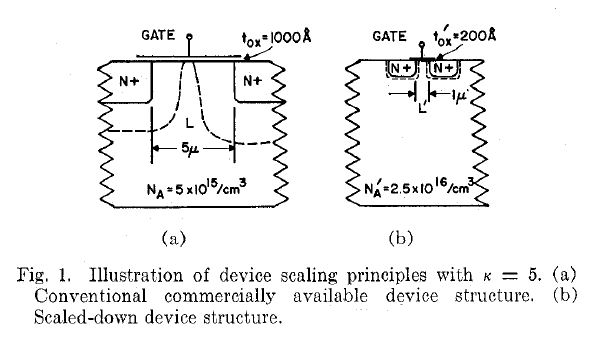
The above figure is taken from his paper. It shows how to go from a transistor with a gate length of 5 um down to one with a gate length of 1 um, a scaling of 5. The gate length is the distance from one terminal of the transistor to the other, and the smaller it is, the less time it takes to switch. Yet at the same time that the gate length is shrunk, the oxide that separates the gate terminal from the silicon must also be thinned or else the channel will not turn on. The density of doping in the two side terminals must also be increased, or else the junctions will overlap and again the transistor won’t work. In addition to all that, the voltage on the gate must be reduced or else the transistor will draw too much power. All of these constituted Dennard’s scaling rules, and they worked for the next 40 years.

Yet this wasn’t Dennard’s only big contribution. In 1967, when he was 35, he filed a patent (US3387286A) on the one-transistor-one-capacitor memory cell, a circuit that has since become known as Dynamic Random Access Memory, or DRAM. You’re using some right now as you’re reading this. It’s the answer to one of the primary problems in computers – how to store the data that the machine deals with in a way that is fast and cheap:

It consists of an array of tiny little capacitors, each of which can store a charge that can represent a one or a zero. One end of the capacitor is tied to a transistor, which can connect it to a “bit line” to be read or written. The gate control of the transistor is tied to a “word line” which turns it on, and enables a whole column of bits to be accessed at once. The transistors and capacitors can be arrayed as dense arrays called mats, and a lot of mats can be fitted on a chip. Current chips can fit 300 million bits onto one mm2 of silicon. That could hold about 40 novels on a dot the size of this: o.

The brilliant insight here was that the charges don’t have to be permanently stored. They tend to leak away over time, but the circuitry can refresh it every so often by doing a read and then a write back of the same data. That’s why this is called dynamic RAM. There’s another method called static RAM (SRAM) which does not need refreshing, but is nowhere near as dense. Here he is with one of the early DRAM chips, and with unfortunate 70s hair and tie:

Dennard with DRAM chip

DRAM is one of the five core circuits of all of semiconductors. The others are the 6-transistor SRAM, the CMOS static combinatorial gate, the differential sense amp, and the NAND flash memory cell. They account for practically all of the transistors ever made, even now.

Dennard is still around at age 91. He joined IBM in 1958 at age 26 after getting a PhD from CMU, and spent his entire career there. He holds about 80 US patents, with the latest (US9666267B2) filed in 2016. It describes a way to adjust a transistor threshold voltage by means of a buried device, an interesting and important technique. His first was in 1959, at age 23, and his peak patent creativity was from 2010-2013 when he was age 78 to 81. He had a patent dry spell from 1980 to 2000, when he was probably in management. He also worked on word-line and bit-line redundancy, and on eliminating latchup, a serious problem in early CMOS chips. He has won every award imaginable in the field, as one might expect. Here he is dancing with his wife Jane at the Imperial Palace in Tokyo after winning the Kyoto Prize in 2013:

Jane and Robert Dennard in Tokyo in 2013. Award speech here

Now there’s a life! He still loves to dance and to play in local musical groups.

So where did all this talent come from? Part of it was from the support of IBM, which has been a semiconductor leader from the beginning. They didn’t invent integrated circuits, but have made huge contributions to the field. They still do, even though they can’t afford their own fabs any more.

Yet Dennard’s own background must have helped. He grew up in a poor family of farmers in East Texas in the Depression-era 1930s. He went to a one-room schoolhouse for grades 1 to 3. He was the youngest of four children, and his three older sisters went off to work during WW II. They left their libraries, so he grew up reading H. G. Wells and Mark Twain. He was too small for sports in high school, but he had musical talent and joined the school band playing French horn. When it came time for college, all his parents could afford was the local junior college, but then Southern Methodist University offered him a band scholarship. That exposed him to the wider world, and he took off from there.

In 2014 he talked about his own process:

I often wake up in the middle of the night with a solution to a problem that I have been working on previously. Many inventors have described similar experiences to me, including getting out of bed to make notes or drawings before going back to sleep. Others have described significant inventions made while driving, which apparently leaves a lot of the mind free, at least before cell phones. My invention of the DRAM memory cell came early one evening after I came home stimulated and challenged from listening to a talk about a competing research project. The basic idea came in a moment, but there were a couple of months of perfecting it before the final simplification to a single transistor came in another flash of inspiration. At a National Inventors Hall of Fame event, while I was talking with four other inductees, I discovered that all five of us were raised in rural areas or small towns, and most started their education in one-room schoolhouses. We all were left on our own a lot with plenty of free time to develop our ideas about life. Now that may not be the key to our subsequent successes, but it surely is a counter argument to many of the things that are considered necessary for the younger generation today. I developed a very slow thinking process in my early days, and I believe that is why I am able to bring great concentration to a problem and engage my whole brain in finding a creative solution.

You might think that a tough childhood in a remote area would leave a person uncurious and ignorant, but not if they have a stable family and good access to books. The lack of distraction gave him unusual powers of concentration. Then he got into a field with massive opportunities for people who could think deeply about the subject, and away he went. Semiconductors have been so worked over in the last 70 years that those opportunities are probably no longer there, but the world is full of new challenges for young people with the same ability to focus. Find an institution that supports intense work, and dig in!

Posted in Uncategorized | Tagged , , | Leave a comment

The Invention of Lawn Inflatables

So it’s getting dark, it’s getting cold, and it’s getting wet. It’s a dreary time of year, so it’s just the right time to put something cheerfully garish out on your lawn:

On Brantwood Ave, Arlington
Sandworm from Beetlejuice, carnivorous flytrap Seymour from Little Shop of Horrors, and Frances

These are ideal lawn decorations! They’re big and bright, and yet pack down into small boxes for storage. They set up in minutes and come in a thousand different styles from tame to wild. They move – the dragon’s wings flap and the sandworm’s tongue rotates. They can have simple lights, or flashers, or even projectors inside for patterns.

What’s surprising is that they were invented quite recently, in the early 2000s. The initial versions were made of plastic and inflated with a hair dryer, and those flopped, literally. The earliest successful one I could find was an eight-foot snowman from 2001:

Credit GemmyInflatablesfan98, Gemmy 2001 8ft Ghost Inflatable Review

This was an early testing of the market. It shows all the key features: a built-in fan on legs, internal lights, and a nylon body with loose seams. The seams and the nylon are critical – they let the air out of every part of the structure, which keeps it fully inflated. They may have been inspired by the dancing inflatable advertising figures called Tube Men that you see by car lots. Those were invented in LA a few years earlier.

A key part of the design was getting a reliable fan that would work outdoors in any weather, and that took a while to get right. The fan on this one was really loud. They tuned it up over the next several years with better graphic designs, and had a big hit in 2004 when they made an inflatable snow globe with styrofoam snowflakes flying around inside. They trademarked the term Airblown Inflatables, and were off. You now see them everywhere around Halloween and Christmas, and there are a dozen fan clubs on Facebook. There are fanatic collectors who have thousands of them, since one of the bugs in human cognition is obsessing about gathering stuff.

So who invented all this? The main maker is Gemmy Industries of Coppel Texas, a suburb of Dallas. Non-Gemmy versions appear to be private labels done by them for the likes of Home Depot and Walmart. It’s privately held and pretty secretive. It was founded in the 1984 by one Dan Flaherty to make ballpoint pens and then novelty items like plush dolls. He has some design patents on things like picture holders in aquariums and water guns. Their first big hit was Big Mouth Billy Bass in 1999, a rubber fish on a plaque that would sing “Don’t Worry Be Happy” and “Take Me to the River” while mouthing along and wagging its tail. They sold millions of those, and I actually got a singing lobster version.

Figure in original Inflatables patent

Their earliest US patent on inflatables is US6,644,843, “Inflatable figure assembly”, filed in Jan 2002 and granted in Nov 2003. It only expired last year, so that’s why no one else can make these, at least not yet. The inventor was Tsai Chen-Chang of Taiwan. He only had one other similar patent, and it was assigned to Gemmy at about the same time. There’s also a Tsai Chen-Chang who patented a lot of circuits for driving LCD displays, but that’s a very different skill set and he doesn’t appear to live in the same town, so it’s probably someone else.

Gemmy has lots of other patents by Taiwanese people, so the technical development appears to be done there. The actual manufacturing is in China, since it needs a lot of cutting and sewing. These are fun products, but have to be cheap to succeed. The graphic design is done in Texas, and often uses licensed images from the likes of Disney. Linked-in shows 126 people currently employed at Gemmy, with a mix of designers, marketeers, and product distribution specialists. That’s not that big for a firm that puts out millions of items a year in hundreds of styles.

So this is an interesting global collaboration: US media design and marketing, Taiwanese technical talent, and Chinese manufacturing. It took some high-tech in the form of neodymium permanent-magnet motors for the fans, which only came out in the 90s. It also took a lot of political maneuvering to open up China in the late 90s, and those conditions may not last. Yet while they do we can brighten up these darkening nights!

Posted in Uncategorized | Tagged | 1 Comment

Where is Nobel-Winning Science Done?

The 2023 Nobels were recently announced, marking 123 years of the most prestigious science prizes in the world. This is now a big enough dataset to do some statistics on. So let’s ask – what are the countries, institutions, and regions that win the science Nobels? That’s Physiology and Medicine, Chemistry, and Physics. The other three Nobel prizes are not nearly so well-regarded. In the span from 1901 to 2023 there have been 646 science prizes awarded to 642 people, with 4 people winning twice (Marie Curie, John Bardeen, K. Barry Sharpless and Frederick Sanger). Let’s first look at the coarsest division:

Countries Where Nobel Work Was Done

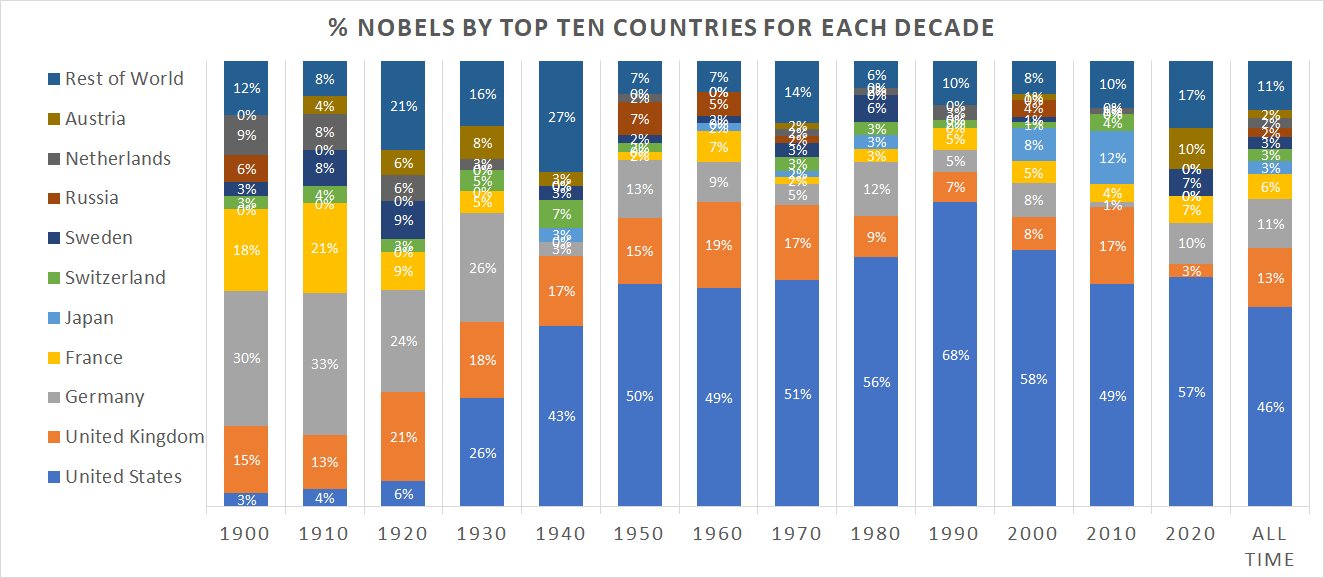
We can distinguish between where laureates are born, and where they did the work that wins them the prize. Laureates come from a wide range of the world – 51 countries in total, including ones as small as New Zealand and Slovenia. There are fewer places, though, where this level of work can be done – only 29 countries total. The top 10 account for >80% of the winners in each year:

Click to embiggen

The US (in blue) got huge after World War II in the 1940s and 50s, when refugees from all over the world came to the country. About 30% of US winners were not born there. The federal government also started putting serious money into Big Science in the 50s. Vannevar Bush had gone to Congress and said “You see this Bomb thing? There’s a lot more where that came from,” and he was right. The US was biggest in the 1990s, which was probably the peak of its world influence. The USSR had fallen, and the disgraceful Iraq War and Wall St Recession had yet to happen. About half of the total laureates did their work in the US, which isn’t too surprising given how big its population and resources are relative to the others.

Germany (in gray) dominated up until 1940, when they were distracted by other matters. The UK (in orange) has chugged along nicely throughout. France (in yellow) did well until the 1910s, when WW I wrecked the country. Japan (light blue) has done well recently. Switzerland probably gets the most per capita.

Now let’s look more closely at where this work was done:

Institutions Where Laureates Worked

Wikipedia has entries on all laureates, and in a nicely standardized format that lists all the institutions they have been associated with. When those pages are scraped, the top 20 institutions are these:

Number PeopleInstitutionCity
66U CambridgeCambridge UK
44UC BerkeleyBay Area
42U ChicagoChicago
41Columbia UNew York
35Stanford UBay Area
31Harvard UBoston
28CaltechLos Angeles
25MITBoston
23MRC Laboratory of Molecular BiologyCambridge UK
22Princeton UPrinceton
20Rockefeller UNew York
20Cornell UIthaca
20U OxfordOxford
19Yale UNew Haven
15Bell LabsPrinceton
15University College LondonLondon
15ETH ZürichZurich
15U BerlinBerlin
13U EdinburghEdinburgh
13U ManchesterManchester

Cambridge rules! And is far ahead of its rival Oxford. In both of those I grouped all of their colleges together although they’re listed separately. I did break up the University of California into its separate schools since they’re quite different and spread out. UC as a whole has 102 people, which is more Nobels than any country besides the US.

It’s interesting that the top two, Cambridge and Berkeley, are both public universities. Then there are 11 private schools, and the publics appear again with University College London. The first non-school is the MRC Laboratory at #9, which was involved in the revolution of molecular genetics in the 1950s and 60s, including the discovery of the DNA double helix. The first corporate operation is Bell Labs, and its heyday is sadly long past. The next corporate entries are IBM and BASF.

In terms of other competitions, Harvard is also far ahead of its rival Yale, and ahead of that trade school down the river, MIT. Of the eight Ivy League schools, six make the list, missing only Brown and Dartmouth. All of the Ivy-Plus schools – MIT, Stanford, Chicago, Caltech, Northwestern, Duke, Rice, and WashU – also figure. The other big state schools are Wisconsin, Michigan, Minnesota and Texas A&M.

Now let’s look at where this work is done geographically:

Cities

The Institution list can also be broken down by region, usually in terms of what the nearest major city is. The exception is the Bay Area, whose major city is San Francisco, but spreads widely beyond that. The institutions there are still close enough for synergy, which is what matters. The top 10 here are:

Laureates who worked thereCityTop 3 InstitutionsNumber Other
108Bay AreaUSB 44; Stanford 35; UCSF 1027
90New YorkColumbia 41; Rockefeller 20, Cold Spring Lab 524
89Cambridge UKU Cambridge 66; MRC Laboratory 230
80BostonHarvard 31; MIT 25; Harvard Med 519
61LondonU College 15; Imperial College 11; U London 629
52ChicagoU Chicago 42; Northwestern 4; Argonne 24
52Los AngelesCaltech 28; UCLA 8, USC 614
51Washington DCHoward Hughes Med Inst 12; Johns Hopkins 8; Johns Hopkins Med 724
50PrincetonPrinceton U 22; Bell Labs 15; Institute for Advanced Study 103
33BerlinU Berlin 15; Kaiser Wilhelm Inst 3; Max Planck Med 213

This is not surprising overall. The top three countries for Nobels – the US, UK and Germany – are also the sites of the leading research regions. It’s a bit surprising to see that the major financial centers of New York and London are up there, but those are the heart cities of their nations. Yet it’s nice to see that small cities like Cambridge and Princeton are well represented. Most think that this kind of advanced work is best done away from the bustle of political and commercial life, and their presence is evidence of that.

Overall

As one would expect, Nobel-caliber work is done in the leading economic and cultural nations of the world: the US, UK, Germany, France, and Japan. China is not contributing much yet, but will. There are seven Chinese-born laureates, although only one did their work there. Some small countries like Switzerland punch well above their weight. The same goes for leading institutions – the big ones are generally the old and famous ones like Cambridge and Harvard. Yet newer ones like Chicago and Caltech do well. The cities are also old and famous, but tiny Princeton sneaks in. Even the smaller countries and places can matter if they focus.

Posted in Uncategorized | Tagged , , | Leave a comment

Tech Crime Seems On the Rise

In the 2000s I was the CTO of a startup that quickly ran into trouble. Our CEO wildly over-promised in order to keep funding flowing, and he then got fired by the board. They appointed a new CEO, and he and I then went around to visit investors. One said “What we have here is a case of the F-word. I don’t mean that F-word. I mean the serious F-word, Fraud.” That was not a happy meeting! The company did actually run for another seven years, and the parts were good enough to be sold for another 15, but that was a low point.

I was reminded of this by a stream of recent reports on tech hype-frauds:

Lordstown Motors finally declared bankruptcy in June ’23 after failing to build electric pickup trucks. Their CEO, Steve Burns, was fired two years ago for claiming huge pre-orders that had no real money behind them. They got a lot of support from GM, including one of their closed plants, but couldn’t get the trucks working. They tried to sell themselves to Foxconn, which is desperate to improve US-China relations, but they couldn’t get them working either. They had gone public in 2020, albeit with a SPAC instead of a real IPO. Burns made $60M from that.

Lordstown demo truck fire Jan 2021, credit Farmington Hills Fire Dept, The Drive

The CEO of Nikola, Trevor Milton, went even further – he released a video of a truck powered by hydrogen fuel cells driving along a desert road:

A sharp-eyed investor found where the road was and discovered that it was actually coasting down a slight grade. They had tilted the camera. The truck had no engine. He was convicted of securities fraud in 2022. The company still exists, but their battery-powered versions have all been recalled and many have caught fire.

Jess Carpoff of DC Solar had a great idea in 2007 – put solar panels and batteries on a trailer and use them in place of diesel generators for movie location shoots. They would be clean and quiet enough to not interfere with the microphones. The panels folded up while on the highway, and tilted to catch maximum sun:

Movie studios loved this. Better still, you could buy them with 30% down and claim the whole 30% as a renewable tax credit. DC Solar would borrow the remaining 70% from you and pay it back to you in installments from income gained from leases. You put up no net money and got good lease income! Even Berkshire Hathaway bought in. Unfortunately, Carpoff was a garage mechanic with a troubled legal background, and had no idea how to make these work. No one was actually leasing them, and they built only a small fraction of what they claimed. It was a straight pyramid scheme, where the initial 30% down payment paid the lease outflow on everything thereafter. Carphoff bought himself mansions and collections of snazzy cars before the feds closed in. He went through a billion dollars, all covered by Uncle Sam’s tax credits. He was sentenced in 2022 and is serving 30 years. This all comes from a nice article in the May ’23 Atlantic: The Billion Dollar Ponzi Scheme That Hooked Warren Buffet and the US Treasury.

These are just the explicitly criminal cases. I would also call Tesla’s “Full Self Driving” a criminal promotion of dysfunctional software for the sake of stock promotion, and that has actually killed people. Those cases are in the courts right now. Outside of automotive tech, there’s the entire cryptocurrency sector, which creates literally nothing, and burns about 50 terawatt-hours per year to boot. That would power Massachusetts.

So what’s going on? It sure looks like too much money is chasing too few ideas. Now that it costs very little to actually make or grow anything, all the excess that people pay for has to go somewhere. The world is flooded with investments looking for returns. Much of it is Chinese and petro-state money looking for safety away from their unstable homes. A lot of it used to be Russian money doing the same, but those guys are falling out of windows these days.

When there’s this much money sloshing around, the unscrupulous are inevitably going to take advantage. In the grand scheme of things, though, the few billion lost in the above isn’t that big a deal. The risk is that the scamsters tarnish all new ventures. Self-driving cars, for instance, actually are getting better, but Tesla is doing its best to ruin the whole concept. The highly unstable venture capital market can easily turn against good concepts if enough fraudsters come in. My company was almost done in by that attitude, and many others actually have been.

Posted in Uncategorized | Tagged , | Leave a comment

“Oppenheimer” and the Limits of Scientific Influence

One of the favorite tropes of SF is the mad scientist. He (always he) represents the disruptive power of modern science to old beliefs, and of modern technology to old ways of life. He becomes crazed with this power, and wreaks havoc with the terror of his discoveries. The very first SF novel, “Frankenstein”, is about him, and Jules Verne cemented the meme with the noble and tragic Captain Nemo. Half of SF movies play on this, whether it’s Dr Morbius in “Forbidden Planet” (1956) with the planet-sized engines of the Krell, or Tyrell in “Bladerunner” (1982) with his army of rebellious androids, or Tony Stark in “Avengers: Age of Ultron” (2015) with run-amok AI.

Yet the great recent movie “Oppenheimer” shows how ridiculous this is. J. Robert Oppenheimer was the most famous and influential scientist in the world in the late 1940s. He led the team that created the fission bomb, and so cut short the greatest war in human history. He himself was the very picture of a magus: vastly erudite, tall, skeletal, and with piercing, electric-blue eyes. He dominated every room he was in, and women took notice. His direct scientific contributions were minor, but he knew and had the respect of the greatest scientists of the age: Einstein, Bohr, Bethe, Rabi, Fermi, Lawrence, Szilard and von Neumann.

Yet the core story of the movie is how he came to ruin when he crossed the actual masters of the country. He knew that the nuclear arms race would be madness, but couldn’t prevent it. He argued for international control of nuclear weapons, and for not taking the vastly expensive and dangerous step towards fusion bombs, and they simply ignored him. When he kept protesting, they made a point of humiliating him. It was slyly done, through innuendo about his leftist connections and his adulterous affairs, and through a bureaucratic procedure that was turned into a kangaroo court, but everyone knew what had happened. In crude countries, they kill or imprison their opponents, but in more skilled ones, they de-honor them.

You don’t get to choose what’s done with your work – that’s for the people who pay for it. To be brutal about it, Oppenheimer was an employee. When the Army carted the Bombs away, they didn’t even tell the Los Alamos people what was going to be done with them. Their job was done. In the longer run, their expertise was displaced by that of people like Teller and von Neumann, people who hated communism as fiercely as the Establishment did and so were considered reliable.

You don’t choose the use. Your choice is whether to take part or not. The most sympathetic character in the movie, I. I. Rabi, chose not to join the Manhattan Project, even though he had as much reason to hate the Nazis as Oppenheimer. Instead he worked on radar, which really did shorten the War and has been immensely useful since then. Don’t think that you’ll get to fix things later as Oppenheimer did – work on what’s going to be positive for everyone. You won’t be called an American Prometheus, but you’ll avoid a world of hurt.

Posted in Uncategorized | Tagged , , , | Leave a comment