Toys As a Leading Wedge for World Domination

So I was with the kids in the toy aisle of a drugstore when I saw something that made my blood run cold:

Yes, that's a martial arts expert battle hamster

This Kung Zhu toy makes squeaky little Ai-ee karate noises, and runs around on a table avoiding edges.   There was a whole section of them.  There were pink ones for girls called Zhu Zhu Pets, and these violent ones for boys.  They come with battle tanks and armor and combat arenas, or in pink houses with habit trails.  They’ve got of all the sinister aspects of modern toys that make them addictive and obsession-inspiring: collectible variants, a massive array of accessories, online communities, video games, interactivity, and cute-cute-cute.  My kids wanted one immediately. And they’re less than $10, avoiding that dread extra digit.

“This is the end,” I thought.  “The Chinese have finally figured out that it’s better to own a toy franchise than to build for one.”  The profit margin on a brand is much higher than that on the toy itself, since any competitor willing to pay its workers 10 cents less per day (cough, Vietnam) can take the business away from you.  Martial arts have already penetrated the consciousness of children everywhere, and so that would be a natural avenue for the Chinese bid for world toy domination. Continue reading

Posted in Uncategorized | Tagged | Leave a comment

Seeing Your Work

On my first job out of school, I was told to design an instruction decoder for a microprocessor.   It was a complex block for the early 80s, taking all of 30,000 transistors, and it occupied one whole corner of the chip.  When people asked what I did, I would say “You see these little shiny squares in the upper corner of this fingernail-sized chip?  That’s mine.”  Not impressive.

But just today I read the obituary of Robert Daugherty, founder of Valmont Industries, which pioneered  center pivot irrigation.  Here’s what his handiwork looks like:

Kansas, June 2001, from the ASTER satellite. Green circles are corn, yellow wheat. Small circles are 800 m in diameter, large 1600 m.

Here’s some more info on this picture from NASA.  In the center pivot scheme, a 400 m long pipe sweeps out a slow circle around a field, dripping water as it goes.   The pipe is supported by towers, each of which has an electric motor to drive it:

Pivot irrigation on cottom

Each tower has angle sensors to keep the segments all in line.  The water comes from a well in the middle.

In the early 50s he bought the design from one Frank Zybach.  His people improved it and marketed it all over the world.  Now 42% of all irrigation in the US is done this way.  How can you tell?  Because, as the first picture shows, you can count these circles from space.

Center pivot irrigation replaces the traditional technique of flooding ditches with water.   It uses much less, because less is lost to evaporation.  Fields can get a regular drip instead of a one-time flood.  It also uses much less labor (no need to go around pulling up ditch sluice gates) and works on fields that aren’t flat.

Daugherty just died at age 88 in Omaha, leaving 3 sons and 9 grandchildren.  He put most of his fortune into the Daugherty Foundation, whose largest grant appears to be $50M to the University of Nebraska to study water issues in agriculture.  Those are crucial in all the western states, and will be crucial everywhere in the not distant future.

There’s an old line – “Real engineering is where if you fall off of it, you die.”  Daugherty could go one better – “Real engineering can be seen from space!”  There’s a boast few can make!

Posted in Uncategorized | Tagged | 2 Comments

The Education of Billionaires

Or rather, the lack thereof. The recent movie about Facebook, “The Social Network”, claimed that those guys became billionaires by abandoning their schooling and being as jerk-ish as possible.   Two of the four billionaires created by Facebook, Mark Zuckerberg and Dustin Moskovitz, have no degrees at all, while Eduardo Saverin (the main screwee) has a BA and Peter Thiel (probably the dark mastermind of the company) has a JD.

I’m not ordinarily into plutography, but this got me to wondering how common it is for tech billionaires to be dropouts.  Steve Jobs and Bill Gates are, and they’re the most well-known corporate execs in the country.   How about the rest of them?   I went through the Forbes 400 list of the wealthiest Americans and found the education levels of the 52 of them who made their money in some kind of technology.   Most of the rest were in finance, unsurprisingly.  I could have looked at them too, but it’s just too maddening in these days of widespread financial crime.   So here’s a list of the technologists sorted by number of years of college and then by wealth:

Lots of college is not required for success even at the highest levels of technology

About 60% have graduate degrees and 20% have PhDs.  That’s a high proportion compared to the general technology community, but not an overwhelming number.   The best-known doctorates are the Google leader Eric Schmidt and the Intel founder Gordon Moore.

One contrast between the dropouts and the PhDs is in whether their firms succeeded because of network effects or because of a specialized advance.  Microsoft is dominant because it’s only reasonable to write for one operating system.   The more there is on that OS, the more valuable it becomes.  Likewise Apple wins because of the synergy between the iPod and iTunes, and because of the iPhone app ecosystem.  On the other hand, Google does the same searching as everyone else, but does it better.  The PhDs at Google really figured out how to do search, while the dropouts at Microsoft and Apple realized how the whole system should work.

It should be noted that the dollar figures here are pretty soft.  Most of this money is in the form of stock, which is volatile and not that liquid.  If one of these guys did peel off a billion dollars to have his face added to Mount Rushmore, the value of the rest of his assets would plummet.  People on the non-tech part of the Forbes list probably have more stable and diverse assets.

Where did they get their educations?  Mainly at Stanford and Harvard, at 8 each, followed by UCLA (4) and USC (3).  The other big tech schools – MIT, Caltech, CMU, and UC Berkeley- only get one each.  Stanford is not surprising – it’s the spark plug for the engine of Silicon Valley.  The Valley exists because of the efforts of Stanford’s great engineering dean, Frederick Terman, in the 50s and 60s, and because it has better weather than Massachusetts.  Harvard is a little more surprising – it didn’t even have an engineering school until recently – but it is the world’s best university, much as it pains this MIT alum to say it.

Other notes:

This tech list includes only one woman, Meg Whitman of eBay.   The Forbes 400 does have a few others, but most inherited their money.  The self-made non-tech ones are Oprah Winfrey (TV), Doris Fisher (co-founder of The Gap), and Diane Hendricks (roofing supplies).

There are also no African-Americans and only one Hispanic, Eduardo Saverin of Facebook, who was born in Brazil.  There are five born in East Asia (Min Kao,   Patrick Soon-Shiong,   James Kim,   David Sun,   and John Tu) and three Indians (  Bharat Desai,  Vinod Khosla,   and Romesh T. Wadhwani).

About 80% of them made their money in some flavor of information technology, whether it was computer hardware, software, Internet, or telecom.   If you wonder why cars and planes and spacecraft look the same as they did 30 years ago, there’s one reason – IT has sucked the innovation out of every other field.   It’s just too easy to make more money with it.  There are no billionaire mechanical engineers here, although Sir James Dyson in the UK counts.

Anyway, one of the reasons cited for the growing inequality in America is the premium acquired by education.  I don’t see that in this list.  The people here are pretty educated, but not extraordinarily so.  They’ve made their fortunes by the usual methods of luck, cunning, and determination rather than any special schooling.

Now, of course no one deserves to have a billion dollars.   The people here are capable, but they are not thousands of times more capable than others.  It’s a sign of how broken the incentive system is in US-style capitalism.   A few take all the gains and the rest get out-sourced to Bangalore.  There are fewer and fewer prospects for having a middle-class career in technology.   No wonder students aren’t drawn to it, as I discussed here.  This winner-take-all approach has become the subject of a lot of discussion, but it’s clearly something that has to be fixed.

Min Kao
Posted in Uncategorized | Tagged | 1 Comment

Where Science and Religion Actually Do Mix

Site at Papal Summer Residence, 25 km SE of Rome

I wrote a while back about how the science-oriented movies “Creation” and “Agora” appear to have failed in the United States because of animosity from Christianists.  It was a pleasant surprise, then, to find a scientific institution that is entirely backed by a religious one: the Vatican Observatory (VO), or Specola Vaticana.  It was founded quite explicitly to counteract charges of anti-science bias on the part of the Catholic Church.  As far as I can tell, it’s the only scientific institution in the whole world that is supported entirely by a religious organization.

The Vatican became involved in astronomy quite early with the activities of the great Father Christoph Clavius, who in 1582 devised the Gregorian Calendar that is used to this day.  It had three previous observatories before the current one: the Observatory of the Roman College (1774-1878),  he Specula Vaticana (1789-1821), and the Observatory of the Capitol (1827-1870).  The VO was established in 1891 on the grounds of the Vatican itself, but with the growth of Rome, seeing became impossible.  The site shown above was established in the 1930s.   It was still too close to Rome, though, so in 1981 they established an office at the Seward Observatory at the University of Arizona in Tucson.

VATT in winter

In 1993 they finally got a world-class telescope with the Vatican Advanced Technology Telescope (VATT), a 1.8 m near-IR scope on Mount Graham in Arizona.   This was built with the new technique of spin-casting (spinning the glass blank to form a parabolic surface while molten) and has such a deeply dished surface that it has a focal length of f/1.0 – i.e. the focus is only as high above the mirror as the mirror is wide.  It was one of 80 telescopes featured in the International Year of Astronomy program in 2009.

The VO has a staff of 16 Jesuits and a budget of about $1.5M per year.  That’s a respectable size.    What’s probably the world’s largest purely astronomical institution is the Space Telescope Science Institute in Baltimore MD,  and it has a staff of 450.  The VO’s research activities look to be quite broad, but one thing they’re particularly interested in is long-term surveys.  Since they’re free from the usual funding cycles of foundations and governments, they can accumulate data over long periods.  They’re currently working on complete galactic surveys of the Local Group, of star clusters in the Milky Way, of “spectrally peculiar” stars, and of meterorite properties.

Their patient long-term outlook is a nice real-world fit to the theme of Neal Stephenson’s recent SF novel, “Anathem” (2008), where the technorati stuff  themselves into monasteries, away from the upheavals of the secular world, in order to pursue their interests in peace.   That’s also the theme of  the great SF classic “A Canticle of Leibowitz” by Walter Miller (1959), where monasteries become the last refuges of learning after the nuclear apocalypse.

Yet the VO is the only religious-scientific operation that I’ve found.  There are lots of religiously-oriented universities that do science, of course, and lots of governmental institutes in countries with a national religion, but no other institutions that are supported directly by the religious organization itself.  Science is overwhelmingly done at universities, not at monasteries.   It’s a nice vision to imagine monks laboring away over centuries on the greatest book of all, the Book of Nature, but that’s not the way science is actually done.

Posted in Uncategorized | Tagged , | Leave a comment

How Nice To Have a President Who Can Speak

Shellacking = "Protect an antique finish"?

So even when he’s had a pretty serious political defeat, even when he looks really depressed, Obama still has the presence of mind to use an obscure term like “shellacking” in his post-midterm-election press conference.

You know this is something that I think every president needs to go through, because the responsibilities of this office are so enormous and so many people are depending on what we do, and in the rush of activity sometimes we lose track of the ways that we connected with folks that got us here in the first place.

Now I’m not recommending for every future president that they take a shellacking like I did last night.  I’m sure there are easier ways to learn these lessons!  But I do think that this is a growth process and an evolution.  And the relationship that I have had with the American people is one that built slowly, peaked at this incredible high and then during the course of the last two years, as we’ve together gone through some very difficult times, has gotten rockier and rougher.

Shellacking sounds old-fashioned to me, and I’m older than the president (which is a first for me – GW Bush was quite a bit older).

Shellac is a wood coating made from a resin derived from insects from India that’s dissolved in alcohol.  How did it come to mean “get beaten up”?  No one apparently knows.  The BBC looked into it here, and found that it was used in tough-guy slang in the 30s and 40s, mainly in the US and Australia.   In the UK they would say “he got pasted”, which is also obscure.

The best origin story I found is from the commenter Rufus T Firefly here, who said:

My personal theory is that it derives from the word “shillelagh”. A shillelagh whacking could easily become a “shellacking” over a period of time.

Now that could do some damage

That would jibe with there being a lot of Irish gangsters and sports figures in the early 20th century.

Anyway, Obama’s going to need that presence of mind over the next two years!

Posted in Uncategorized | Tagged | Leave a comment

Lovecraft news

So Guillermo Del Toro is going to do a film version of  H. P. Lovecraft’s “At the Mountains of Madness”.   There’s been a steady stream of awful Lovecraft adaptations, but this will be the biggest version yet.  I’ve long been a fan of HPL, and even own a Miskatonic University Antarctic Expedition hoodie, courtesy of the otakus at the H. P. Lovecraft Historical Society.

"This stylish and comfortable garment may not keep you alive in gale-force Antarctic winds when Elder Things attack... but then, what will?"

I wrote them a thank-you note when I received it:

Dear Sirs,

Thank you for the Miskatonic University sweatshirt.  My grandfather was actually on that expedition in 1930, although he never spoke of it.  I remember being at the dinner table once as a child when the subject came up.  His face darkened and he changed the subject.  I gather that the expedition was a failure, although there seem to be no accounts of it except for a rather fantastic story by a writer in Providence.

My grandfather was a student at the time, and although he did graduate and actually joined the geology faculty at MU, his later career was not happy.  He was one of the planners of the International Geophysical Year in 1957, and returned to Antarctica then.  There was a scandal involving a stolen aircraft and missing explosives.  All he would say was “I had to seal it up.  Some things are not meant to be known.” That was a shocking attitude for a scientist, and they forced him into early retirement. I still remember him fondly, although he used to make strange carvings for us children, and had a horror of caves and basements.  He lived in a cottage by the sea in Innsmouth, and was unfortunately lost there in 1961 in a great storm.  The house was swept away, leaving only an odd, shining track leading down to the water.

Now that Antarctica is being fully explored, I hope that the early work by MU will at last be recognized.  I’m an alum myself (Go Squids!) and know that it can only bring credit to my alma mater.  Your sweatshirt will let me show that old MU spirit.

Sincerely yours,

To which they responded:

J.L.,

Thanks for sharing your grandfather’s furtive mumblings. There are so few who were witnesses and fewer still capable of rational speech.

It is in fact a high-quality sweatshirt, and is actually made in L.A..

And speaking of the HLPHS, there’s a trailer out now for their next production, “The Whisperer in the Darkness”:

Looks promising!  It’s astounding what amateurs (well, semi-pros) can do these days.  Their version of  “The Call of Cthuhlu” is one of the best HPL adaptations ever, up there with “Reanimator”.

The other great keeper of the Lovecraft flame is Charlie Stross, whose Laundry series (basically MI-6 vs the Elder Gods) has been great fun.  The latest one is “The Fuller Memorandum”, and finally answers the question about what the appeal of the Great Ones is to all these earth-bound cultists.  Here they are risking major jail time with all these sacrifices, and having to dress up in all these ridiculous outfits, and for what?  Well, they’ve seen the future, and they know they want to be on the winning side…  Stross also wrote the best Lovecraft pastiche ever, “A Colder War”, which manages to bring HPL up to date using a lot of actual Cold War efforts, like Project Pluto.  Your tax dollars actually paid for madness like this.

So anyway, there are still movies and novels being written based on HPL’s work.  That’s more than one can say for his much more popular contemporaries, Edmond Hamilton and E. E. Smith.  Something about his horror of immense gulfs of space and time still resonates when their wonder at the same infinities does not.

Posted in Uncategorized | Tagged | Leave a comment

Made in MA, Bought by CA (E.g. “Get Lamp”)

One of the depressing things about the Massachusetts economy is how many startups here get bought up by firms from other states, particularly California.  Lots of good ideas start here, but move elsewhere before they scale up to significant size, or disappear altogether.  The most egregious recent example is Facebook, which began at Harvard but whose founders were told to move to Palo Alto in order to be close to capital and programming talent.  Other examples are rife: Apollo Computer, which pioneered graphical workstations before being bought by HP in ’89 and dissolved; Unisphere Networks, builder of core routers, bought by Juniper in 2002; and the biggest of all, Digital Equipment, bought by Compaq in 1998 (then HP in 2002) with a big piece bought by Intel in ’97.   Of the three firms where I’ve spent most of my career, two have been bought by CA firms: the semiconductor group of DEC (bought by Intel as mentioned above), and Pixel Magic, which was bought by Oak Technology and then by Zoran, both of CA.

The lamp appears in every interview of this documentary

I recently came across a documentary about an interesting case of this, the text adventure game company Infocom.  The documentary is called “Get Lamp”, and mainly consists of interviews with people involved in this odd sub-genre of computer gaming.   The text adventure genre is now defunct (i.e. is still pursued by obsessive fans), but they were huge in the 80s with titles like “Zork” and “The Hitchhiker’s Guide to the Galaxy”.  I played that one myself and did in fact get the babel fish.  Zork and Visicalc were the reasons to buy a PC in 1980.

Infocom was founded by MIT people, and was remarkably sophisticated in both its software and its gaming style.  In those days there was not a single dominant type of PC, so they built an interpretive engine, the Z-machine, that let the same game run on almost any hardware.  They pioneered an object-oriented programming style with inherited classes because they wanted coders to be able to specify a set of actions that one could do with an object in the game (E.g. “get lamp”, “light lamp”, “throw lamp”) and then propagate them to lots of other objects.  This is all a decade before Java.

The games themselves were also great advances over the earlier Adventure and Colossal Caves games.    The puzzles were good, the descriptions of the settings were evocative, and some scenes even quite moving.   The scenario of the game “A Mind Forever Voyaging” (a reference to Newton) would have made a great SF novel.   “Leather Goddesses of Phobos” had levels of raciness for descriptions: “tame”, “suggestive”, and “lewd”.  The games also had cool packaging: a blank face for “Suspended: a Cryogenic Nightmare”, and a flying saucer for “Starcross”.   “Get Lamp” has its own nice “feelie” – a coin with the iconic lamp and the motto “Where do you want to go today?”

By the mid-80s, though, the graphical computer games were killing the text adventures.   These all came from California, unsurprisingly.  Infocom resisted the trend, believing that the player’s imagination would supply better visions than that of the crude displays of the day.   Images versus words is an old California versus Northeast struggle, and images win.  A CA firm, Activision, who was the leading maker of cartridge games, bought Infocom in 1986.  Relations between them soon soured, and Infocom closed up only three years later.  Activision itself ran into trouble soon after, and nearly went bankrupt.   They saved themselves by packaging up all the Infocom games into one big release, “The Lost Treasures of Infocom” 1991, and sold $10M of them, enough to restart.  They’re now one of the largest game operations in the world.

That must have been aggravating to the Infocom people, but I wonder if it really mattered.   Most of them went on to other good work.   Their VP of Marketing, Mike Dornbrook, is now COO at Harmonix, maker of “Rock Band”.  One founder, Marc Blank, later wrote the “Syphon Filter” series and an email reader for the Palm.   Another, Bruce Daniels, worked on the Lisa and on Mac database software.   The least satisfying outcome was for the writer of their most sophisticated games, Steve Meretsky, who seems to have mainly done consulting work since.

In the interviews they talk about what a great time they had at Infocom, but a lot of that sounds like it just came from being young and loose and smart.   Even though their work didn’t turn into lasting fame and fortune, they made a real mark at an early stage of their careers, and that’s more than most people get to do.

The same can be said of most purchased MA companies.  The people involved keep with it or go on.  With some exceptions, the technologies persist if they’re worthwhile, or decay if they aren’t.   Companies are only shells, after all.   If one fails you go to the next.  That’s hard to accept when you’re in the middle of a failure, as I’ve been, but you need to take the longer view.  What matters are the people involved and the work they do, not the name on the stock certificates, or the US state of the owners.

[PS A detailed description of the fall of Infocom can be found in a report prepared for an MIT class in 2000 on the Structure of Scientific Revolutions:  “Down From the Top of Its Game – the Story of Infocom”.  They made some other key mistakes, but it’s hard to succeed when your product is being superseded.]


Posted in Uncategorized | Tagged , , | 1 Comment

Russians Get It Done

The Argon-16 flight computer. Real computers will kill you if they fall on your head

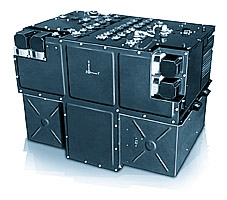
The Sep 2010 issue of IEEE Spectrum has a nice example of how  determination beats technology.  The article is  “A Digital Soyuz” by James Oberg, and discusses how the Russians have upgraded their main manned spacecraft.  They’ve replaced the main flight computer, the Argon-16, and  five analog monitoring and telemetry systems  with a single digital system, the TsVM-101.  The Argon-16 has been in use for over 35 years (!).   It contains  6 KB of RAM and can do 200 K adds/second.  That’s K, not M or G.  It weighs 70 kg, but oddly enough draws about as much power as a PC, 280 W.

“Backwards Russians,” you might think. “No wonder they lost their empire.”  I take away the opposite message.  They built something that worked and then stopped screwing with it.   This machine has triple redundancy – three copies of every subsystem that vote as to who’s correct.   It uses rad-hard TTL circuits.  It has never failed in flight.

As of March 2010, the Soyuz series has had 104 flights (compared to 114 for the Shuttle), and has lifted 276 people into space (723 for the Shuttle).  Its last failure was in 1971 on Soyuz-11 when the crew died on re-entry from loss of pressure.   The Shuttle’s last failure, of course, was when Columbia broke up on re-entry in 2003.   So that’s 39 years without a failure for Soyuz, and 7 for the Shuttle.  The Shuttle only has a couple of flights left, so Soyuz will be the only way to get to the International Space Station for some time.

So why are they upgrading Soyuz now?  Several reasons:

  • The new computer is lighter than the Argon-16 and the analog systems, increasing cargo capacity by 70 kg.
  • The analog systems were harder to calibrate and test, which made it take longer to prep the craft.  It’ll be flying more often when the Shuttle stops.
  • It only needs one pilot instead of two, so two non-pilot mission specialists can go up instead of one.

The only upcoming contender for US manned launches is the Dragon spacecraft from SpaceX Corp.  It’s due to have its first launch this year, but it’ll be unmanned.  SpaceX has had 3 failures in 6 launches total.  The parachutes did not open on reentry for first Falcon 9 launch, but they called it a success anyway.   That kind of spin is not encouraging.  Perhaps the hyper-tech founder of SpaceX, Elon Musk, could learn a thing about reliability from the stodgy Russians.

[Juicy gossip addendum – Musk divorced his wife Justine in 2008, leaving her with 5 kids.  He then married a much younger actress, Talulah Riley.  He’s 39 and she’s 25, which just fails under the XKCD creepiness rule – you shouldn’t date anyone younger than your age divided by 2 + 7.  He and Justine are wrangling in court, of course, but one thing she wants is a Tesla Roadster, glacier blue.]


Posted in Uncategorized | Tagged , | 12 Comments

More Making, Less Financeering

There’s a nice profile (abstract here)  of the British inventor James Dyson in the Sep 20, ’10 issue of the New Yorker.  His eponymous vacuum cleaner has made him vastly wealthy (~$1.5B) for a refreshing reason – it’s a better product.  Or at least that’s what people say; I haven’t used one myself.  I can testify that his new hand dryer system, the Dyson Air Blade, is an air dryer that is finally superior to paper towels.  It actually does dry your hands off without killing trees or burning much coal – it uses 1/5 of the energy of a hot air dryer.

In the profile Dyson talks a lot about getting back to actually making things.  He’s distressed at the sad state of tech in the UK, and particularly irked at the dominance of finance.  Yep, here too.  He recently wrote a lengthy report for the new Conservative government, Ingenious Britain, suggesting ways to re-invigorate  the high-tech sector.   It’s pretty boilerplate stuff: R&D tax credits for small firms, more attention to technical education, better transitions from university research to products.   It’s about what Democrats would talk about in the US,  even down to stressing things like high-speed rail and off-shore wind.   He does conclude his introduction with some extremely British phrasing: “We have brilliant, brilliant minds and a good dose of obstinacy. Ideal really.”

But the Brits already pioneered a better way to get people into tech: “Scrapyard Challenge”, known in the US as Junkyard Wars, and first aired in ’98.   Cool projects are much more engaging than prettified science textbooks, especially when there’s competition and dangerous stuff like welding involved.  The US version of people-hacking-stuff-together is, of course, MythBusters, now in its well-deserved 8th season.  Make magazine is doing its part, along with the inspirational Maker Faires.   There are even maker celebrities like Dean Kamen, who has parlayed his fortune and the attention he gets into the FIRST robotics competitions, where high school teams compete to build machines to accomplish some task like sinking basketballs.  The showdowns are huge fun, with big crowds from the schools coming out to cheer on their classmates.

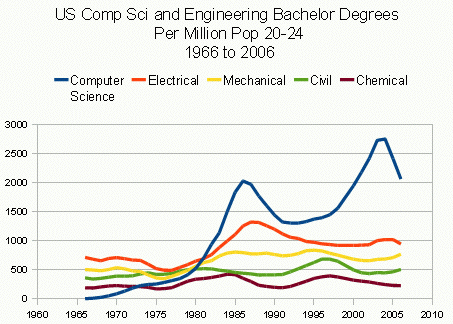
Is any of this working?  It may be too soon to tell, but it doesn’t look like it.  The NSF tracks the number of degrees granted in science and engineering, and here they are as a fraction of the number of people in that age range:

Interest in engineering seems flat in the 2000s

Computer science is bopping around, but the proportion of young people who are interested in engineering hasn’t changed much for 20 years.   The data only goes up to 2006, since that’s all the NSF has.  The next report is due next year, but will probably only take it up to 2008.

Now, the big push to get young people interested in tech may be more recent than 2006, and so won’t be reflected in these stats.  The slight uptick in interest in mechanical engineering is encouraging.  On the other hand, these are terrible times for engineering careers, what with the Great Recession, the loss of manufacturing to the Far East, and the corporate pressure to reduce salaries by out-sourcing and H1-B visas.  Nor is the number of degrees necessarily a good indicator of interest, since Dean Kamen himself never got one, and nor did Bill Gates, Steve Jobs, or Mark Zuckerberg.

Still, you would expect the trend in engineering degrees to be steadily upwards in a country that prides itself on innovation.   The fact that it’s flat means that Dyson and Kamen are right to worry.

Posted in Uncategorized | Tagged | 1 Comment

Asimov Called It

Cover of 1962 edition

So I happened to be leafing through Fact and Fancy, a collection of Isaac Asimov’s science columns from 1958 to 1961, when I came across one called “No More Ice Ages?”.    With his usual brio he elucidates an arcane subject – the flow of carbon dioxide in and out of the atmosphere.  When I saw that in the first paragraph, my heart sank.  This is no longer arcane.

He wrote about how CO2 is emitted by volcanoes, sequestered by the formation of coal, rapidly cycled by biological growth and decay, and slowly cycled by absorption and emission in sea water.   Now homo sapiens is putting 6 billion tons a year of CO2 into the air.  At that rate, the amount could double in 350 years!  That would be catastrophic, causing maybe a 4º C temperature rise, melting the ice caps and flooding all the world’s coasts.

The current rate is 30 billions tons a year.  When Asimov wrote that fifty years ago, there were 315 ppm of CO2 in the air; now there’s 385 ppm, 25% more.

Last Monday, 9/27, Los Angeles hit a record high temperature of 113° F.  This in what’s officially autumn.    Hurricanes are now making it up to Newfoundland -Tropical Storm Igor dumped 10″ of rain there on 9/21, the worst storm people there had ever seen.   All summer people were dying of heat stroke in Moscow.

So 50 years ago a popular science writer could see the dangers of anthropogenic global warming, and now here we are.   Fifty years of warnings, and now you can literally feel it in the air.

Posted in Uncategorized | Tagged | Leave a comment