A Wasted Genius: Nigel Richards

Word Wars TitleI recently saw a nice documentary, “Word Wars”, on an odd subject,  professional Scrabble players.   It followed four of them as they made their way around the circuit, aiming for the national tournament in 2002.  The first prize there was $25,000, which may not sound like much in the context of other sports, but was something these guys could really use.    The four were engaging characters, and it was hard to pick who to root for.  The sane family man?  The manic former screenwriter?  The black guy up from the projects?   The ultra-nerd with constant stomach problems who turns out to have a sweet and clear singing voice?

Yet there was another, much more mysterious figure who appeared briefly in the movie,  the New Zealander Nigel Richards.  This was his first appearance in a US tournament, which meant he had to abide by the official US Scrabble word list.   This differs significantly from the British list used everywhere else in the world.    While flicking through the thousands of possibilities for each play, he had to remember which were valid and invalid words.

PHOTO: K. GOPINATHAN

PHOTO: K. GOPINATHAN

He came in second that time, behind Joel Sherman, but he has since won the US title 5 times and the world title 3 times.  He has utterly dominated the game for the last ten years.  When you look at his tournament games you can see why.  He plays ZIBELINE (the fur of the sable) across two triple-word squares for 230 points on one play.   With a rack of CDHLNR<blank> he played CHLORODyNE  (a 19th century patent medicine) across three disconnected letters: the two Os and the E, and using the blank for y.  Notice that this has 10 letters, which means it’s not in any Scrabble word list.  They only go up to 9, for the 7 letters on a rack plus two on the board.

I submit that this is superhuman.   He has in fact memorized the Chambers dictionary, and can bring it to mind in the roughly three minutes one gets per turn.  He says he can visualize the page for each word.  Mere eidetic memory, though, doesn’t allow one to manipulate letters this way.

He’s not an idiot savant.  Nor is he an effortless super-genius like the ludicrous Matt Damon character in “Good Will Hunting”.  He has studied systematically and hard to absorb the 140,000 or so words of Scrabble.  By all accounts he’s a calm, articulate guy who holds a day job (as a CCTV installer in Kuala Lumpur) and loves to bicycle.   He never gets flustered (he does occasionally lose), and never gets excited – he just sits motionless in front of the board for 50 minutes in total concentration.   He didn’t even come to Scrabble until his later 20s.  He wasn’t exceptional at school in Christchurch, and won a scholarship to college but never went.   He just found something that clicked with his extraordinary mental abilities.

While people in the small world of Scrabble are completely in awe of him, his powers seem to me to be wasted.   Surely there is something better that he could do with this.   If he can match the 7 letters in front of him to the 140,000 valid words, he could visualize the protein folding that will block cancer receptors.    Or find the orbital path that takes one from Earth to Jupiter in a dozen slingshot manuevers.   Or distinguish the fakes from the masters in oil paintings.   Or trace the tenuous chain of evidence of the whereabouts of Osama bin Laden or Whitey Bulger.

Maybe he was never exposed to real problems.  He seems to have grown up in a lower class household.  He didn’t have a G. H. Hardy to pull him from obscurity like Hardy did with the Indian math prodigy Ramanujan.    His mother noticed his abilities, but no else probably spared two minutes for this quiet boy.

Or maybe he was overwhelmed by his abilities, as Funes the Memorius was in Borges’ famous story.  Every single thing that Funes ever saw was as vivid to him as what was in front of his eyes at the moment.   He could not generalize anything; all was individually distinct.  There’s no need for abstraction when all can be recalled.   Even time changes meaning when you can cycle through a day of memory in a day of real time.

Richards can’t be that extreme, of course, but I wonder if his odd occupation and demeanour is a sign of how different his mental world really is from yours or mine.    All the top Scrabble players have powers of memory and concentration far beyond those of ordinary people, but he seems to be in another class altogether.   How sad that a guy with such superpowers uses them to make $25,000 a year playing an obscure game.


Posted in Uncategorized | 6 Comments

Corrupting Science – Hayes, Syngenta and Atrazine

deformed_frog_1In the last Gilded Age, the railroad baron Jay Gould is supposed to have said about union sympathizers “I can hire one-half of the working class to kill the other half”.   In the current age, the same can be said of scientists.  That’s the conclusion one draws from a depressing article in this week’s New Yorker by Rachel Aviv: A Valuable Reputation.  It describes the travails of Tyrone Hayes, a biology professor at UC Berkeley, who has been trying to raise the alarm about an herbicide in extremely wide use, atrazine.  His specialty is amphibians, and he has found that exposure to very low levels of this chemical can cause genital defects.   The chemical’s maker, Syngenta, has been hounding him for the last 15 years with a smear campaign.   If you hit this Google link, Tyrone Hayes, the first thing you’ll see today is a sponsored ad, “Tyrone Hayes Not Credible”.

This may seem familiar from the last 20 years of climate change denial, but the difference here is that there are actual documents describing their plan of attack against him.  They came out in the discovery process of a class-action lawsuit against Syngenta.  The company agreed to settle in July 2013 for $105M, most of which is to go to water treatment plants in communities affected.  They are still selling the chemical, and will bear no further liability.  Syngenta has annual sales of $14.5B, so this is a less than 1% hit to them.

The documents detail how the company hired several different PR firms to attack Hayes, and commissioned many other studies that showed no health effects.  They had people follow him from conference to conference, and ask heckling questions at the end of his talks.  They bought an economist to say that banning atrazine would be a catastrophe for corn growers.

This all began in 1997 when they commissioned Hayes to look at atrazine’s effects on frogs.   He was a rising star in the field at the time.   Frog populations all across North America have been in decline, so this was an important question.  Hayes found quite strong effects, and quit accepting their money.  They then looked for more friendly researchers, and found many.

They were also able to derail EPA efforts to examine the chemical by means of a Bush-era (2003) law that said that all regulations must pass a cost-benefit analysis.   An unsurprising thing about such analyses is that the company reaps the benefits while the public bears the cost.     Control the process and you control the conclusion.

Now, from a straight scientific point of view, there may actually be some doubt about the danger of atrazine.    From a public policy point of view, though, there is none.   Syngenta’s actions have guilt all over them.  The EU has already banned this poison.   The US should too, not only to protect public health, but to protect the very processes of science.   They can’t get away this behavior.

Posted in Uncategorized | Tagged | 1 Comment

Pete Seeger, Almost Entirely Right

Pete Seeger’s recent death reminded me of the only time I got to hear him.  I happened to be walking through MIT one afternoon in 2000 when I saw a poster advertising a concert of his.   It was over at the Sloan School of business, so I strolled in.  There he was, the American Bard,  in a small auditorium playing for a couple dozen people with a children’s choir behind him.    He would have been 78 at the time.   He had been performing for 60 years, and this was a terrible venue with terrible turnout, but he still had tremendous verve.   He did “If I Had a Hammer” with the choir, and then swung into a great kid’s song, “English Is Cuh-ray-zey”:

Lyrics here.

“There’s no egg in eggplant, no pine or apple in pineapple.
Quicksand works slowly; boxing rings are square.
A writer writes, but do fingers fing?
Hammers don’t ham, grocers don’t groce. Haberdashers don’t haberdash.
English is cuh-ray-zee!”

He was there as part of a day-long program on “Community, Culture, Spirituality and Technology”, probably because he knew the organizer, Jane Sapp.   Article on it here.  When sitting at a panel talking about this serious stuff, his first act was to lead the audience in a song.

Maybe that’s how you get to be right about so many things – stay enthusiastic, stay funny, and help your friends.  He was wrong about Stalin in the 40s, but he was right about civil rights in the 50s, about the Vietnam War in the 60s, and about pollution in the 70s.   Here he is in the 2010s at Occupy Wall Street, still in the forefront:

Marcus Yam for the New York Times, Oct-22-2011

Marcus Yam for the New York Times, Oct-22-2011, click for story

He’s freezing, he has to walk with two canes, but he’s still out there at age 92.  In 2009 he got to perform at the inauguration of the president in front of a million people on the Mall.   Take that, House Un-American Activities Committee!

Posted in Uncategorized | Leave a comment

The Future Is Living Around You

A while ago the SF site io9.com asked What’s the Most Futuristic Thing About You?.    They were wondering if their readership was part of that unequally distributed future that William Gibson writes so memorably about.   The replies described the amazing technology in people’s pockets, the jobs that would have been hard to imagine even ten years ago, the people who should have been killed by what used to be called natural causes, but are now alive because those flaws can be fixed.

I have no such stories.  I’m a straight white male, the Lowest Difficulty Setting, live in a hundred-year-old house, and have had pretty much the same job for thirty years.

What is astonishing are the people around me.  I work with women who used to be men, with people born in vanished dictatorships on the other side of the world, with people who have machines keeping them alive, with people conceived inside machines, and with people who would be insane without drugs. I feel pretty dull, actually, compared to all the futuristic people who comprise more and more of the world.

It used to be that it was mainly the machines that changed.  We’ve been having that kind of future shock for the last 200 years.   Every decade some new and wonderful (and sometimes horrific) way to do something would come along.   Purely technical progress hit peaks in the 1890s and 1960s, and we’re not close to that rate of mechanical change today.   Yet people themselves are changing in profound ways.  That matters more than the GPU gigaflops in your cellphone.

Gibson himself recognized this long ago.   His early stories of flashy technology look rather dated today, while his recent novels are set only minutes in the future.   Yet they seem to have more of that dissociated SF feel, that sense of being elsewhere, of unfamiliarity.  It’s the contrast of mundane details of today with spooky intrusions from the future.   We’re used to having flashy new gadgets, but it’s the new people that tell us we’ve entered someplace we’ve never been before.

Posted in Uncategorized | Tagged | Leave a comment

Criminal Inventors

walter_white

Dangerous gangster is a sadly uncommon career path for technicals

So the “Breaking Bad” TV series has ended, and with it the career of the chemist and criminal mastermind Walter White.   It was nice in a macabre way to see a technical person portrayed as dangerous and alluring, rather than the usual hapless nerd.   So it caused me to wonder: are there any actual criminals with some kind of technical background?   How often do fine, upstanding scientists and engineers break to the bad side?   Unlike the people I described in Beautiful Inventors and Political Inventors, they are NOT going to get patents on their nefarious schemes, but perhaps they have more lucrative ways to display their ingenuity.

Let me first exclude evil but legal inventors such as Hiram Maxim, of the eponymous machine gun of the 1890s.   When he was being feted in 1900 at a banquet of the British Empire League, the prime minister, Lord Salisbury, rose to give him a toast:

Well, gentleman do you know, I consider Mr. Maxim to be one of the greatest benefactors the world has ever known.  I should say that you have prevented more men from dying of old age than any other man was has ever lived.

He beats out even Fritz Haber, of mustard gas, and Robert Oppenheimer, of fission bombs, in terms of number killed by his handiwork.   Yet all three did their work with the blessing and encouragement of their societies, and were given medals instead of prison sentences.

So let me list a few interesting cases of actual technical crime below:

The High Temperature Accelerant (HTA) Arsonist (Seattle 1980s)

This is either the perfect crime, or a case of seeing a pattern where none exists.  There was a series of unusual fires in industrial buildings around Seattle in the 1980s.  People reported seeing a bright white light and then copious smoke, and the building would then burn in minutes.   They would find melted steel girders in the wreckage, implying temperatures above 2500 F, and concrete would be turned a blue-green color and become brittle.   The buildings would go into “flashover”, where the air temperature exceeds 1000 F and all combustible material ignites.  However, no evidence of accelerants, such as containers or igniters, were ever found, perhaps because they were destroyed by the heat. There were five such fires between 1984 and 1989, and in the last a Seattle fire lieutenant was killed.  That’s when things got serious, and the Seattle FD called in the ATF and national labs like Sandia and Livermore.

There was a separate motivation for the work because of the attack on the warship USS Stark in 1987.  An Iraqi warplane hit it with two Exocet missiles while it was patrolling off the coast of Saudi Arabia.  37 people were killed, largely by a fire caused the solid fuel propellant of the missiles.

So the labs tested the fire effects of various high temperature fuels.  They tried thermite (aluminum + iron oxide), but couldn’t get the observed effects.  Then they tried solid rocket fuel, a mixture of powdered aluminum and ammonium perchlorate, which provides the oxygen.   It produced the white light and heavy smoke that had been seen at the fires.

Word went out to fire departments all across the country to be on the lookout for such fires.  Dozens of possible cases were found.  An ATF agent, Steve Carman, did a detailed report on them, “High Temperature Accelerant Fires”, that was able to dismiss most of them.   Only the original Seattle fires look to have been done this way.  (Carman, by the way, now has his own fire investigation firm.   His job cries out for being made into a TV series.)  No other fires since then seem to have used HTA, though some allege that it was involved in bringing down the World Trade Center.

It would be rare in the annals of crime for someone to find a successful scheme and then stop using it.  It would be especially rare in arson, since fire can literally drive people crazy.  It’s our oldest tool, one we have co-evolved with for two million years, and is so deep in our psyche that it has its own DSM entry.  Still, maybe this is one case where the criminal gave it up, either because the cops got wise, or because someone died.  Or maybe these fires had nothing to do with one another, or the reports were inaccurate, or they were caused by electrical shorts.  It’s now been long enough that we’ll likely never know.

A cargo submersible.  Click for source link

A cargo submersible. Click for source link

Miguel Angel Montoya – Narco Torpedoes (2000)

With great profits come great ingenuity, and that’s been copiously demonstrated in drug smuggling.   One of the few schemes there that has a specific person identified with it are towed submersibles for moving cocaine, narco torpedoes.  Smuggling by plane from Columbia to Mexico or the US became harder and harder in the 90s, so they turned to this.  Dr Montoya managed the initial design and construction in the late 90s.   He had somehow gotten involved in drugs ten years earlier in the reign of Pablo Escobar, but left it in 2004 and wrote a book about his experience, “”Ayer Médico, Hoy Narco – El Mexicano que Quizo ser Pablo Escobar“.

The concept was to load up the sub with three tons of cocaine (worth $24M in Mexico), and tow it behind a fishing boat.  It would travel at a depth of 100 feet and be impossible to spot by sea or air.  If the boat was stopped (and about 10% were), the tow line would be cut.  After some time the torpedo would release a radio buoy with a GPS  that would transmit its coordinates so that it could be recovered.   Quick, cheap, safe, profitable: everything you want in an engineering project except for the massively illegal part.

But this was just the beginning.  They’re now building actual manned submarines in jungle-hidden coves of the Columbian coast.  They’re up to 90 feet long, with diesel engines and snorkels, and are built out of Kevlar and fiberglass to fool radar, and probably for easy-to-conceal construction. The police have found documents in Russian and French around them, so they’re getting help from somewhere.  They’ve corrupted some Columbian naval officers too, another source of expertise.  They must be wildly unsafe, and so are crewed by people either desperate or threatened.   They don’t strike me as being as good as the unmanned submersibles, since they’re harder to hide, more expensive, and easier to track at sea.  There’s lots of work these days on autonomous underwater vehicles for tasks like oceanographic sensing or mine sweeping. If the people at Bluefin Robotics ever lose their AUV contracts for the US Navy, there might be a more lucrative use of their skills.

Victor Lustig – money-printing boxes (1920s)

lustig money printing boxThis king of con men had a particularly nice scam – he would befriend people on trans-Atlantic cruises, and when they wondered about his obvious wealth, confide in  them about his money box.  It could copy $100 bills, but took six hours to do so. He showed off its complex clockwork mechanisms, and demonstrated it for them by putting one bill in and getting two out.  When they wondered if they could get one, he would demur and say that several other parties were interested.   A bidding war would ensue, which would run up into tens of thousands of dollars.   After a couple of more bills were printed, the machine would only print blank slips, having run out of the bills it was seeded with.   By that time the ship had docked and Lustig was long gone.

"The Smoothest Con Man Who Ever Lived", click for link

“The Smoothest Con Man Who Ever Lived”, click for link

This was beautiful in several ways – it needed little capital to start, it was easy to make the getaway, and the mark couldn’t  complain to the police.  “Officer, I tried to use this counterfeiting machine and it didn’t work!”    He did it a number of times, but then pulled off an even more astonishing con – he sold the Eiffel Tower.  In 1925 it was rusting away because of the expense of painting it.   He posed as a government minister in charge of organizing its demolition and met with six Parisian scrap metal dealers.  One of them, one Andres Poussin, was interested, but his wife was suspicious.  Shouldn’t there be more press about this?  Lustig then revealed that he was doing this on the sly because of his meager government salary.  Poussin understood perfectly, and added a $20,000 bribe on top of the $50,000 fee.

Lustig was ultimately caught in the United States on a real counterfeiting charge.  He had teamed up with a chemist to get the right inks and papers, and had put out millions in fake bills.  They got him in 1935 when his mistress ratted him out after he had had an affair with his partner’s mistress.  Can’t fool all of the people all of the time.  He did manage to escape the day before his trial by tying some bedsheets together and going out the prison window in Manhattan.   He pretended to be a window washer, and swiped at a few as he made his way down to the ground in broad daylight, and none of the passing pedestrians thought anything of it. That’s getting up to Jedi mind power levels. They caught him again, though, and he spent the rest of his days in Alcatraz, dying there in 1947.  His is another story that cries out for a bio-pic.

Still, it appears overall as though very few criminals do anything ingenious.  Despite being a staple of pulp fiction, mad scientists and inventors are pretty rare.  Crime doesn’t actually pay, of course, and it’s hard to recruit staff when the penalty for failure is jail instead of lost stock options.   Walter White found more satisfaction in a life of crime than he did as a high school chemistry teacher, but few others appear to.

Posted in Uncategorized | Tagged , | 3 Comments

Antarctica Will Save Us All, Maybe

View towards Dome A. Photo: Robin E. Bell/Lamont-Doherty Earth Observatory

View towards Dome Argus
Photo: Robin E. Bell/Lamont-Doherty Earth Observatory

Just in time for the start of winter, NASA scientists have identified the coldest place on Earth: -93.2 C (-136 F) on a high ridge in Antarctica.  Full story here.  That beats the previous record of -89.2 C (-128.6 F) set in the Russian Vostok station in 1983.   They used thermal imaging on the new Landsat 8 satellite to find the coldest spot in hollows near Dome Argus on the East Antarctic Ice Sheet.   Except for the inside of volcanoes, this has to be the most inhospitable spot on earth.

Carbon dioxide freezes at -78 C, which is 15 degrees warmer.   Does this mean that Antarctica gets CO2 snow, like the Martian polar ice caps?  Sadly, no.   The -78 C is at 1 atmosphere of partial pressure, and CO2 in the air is only at 0.0004 atmospheres.   At that pressure its freezing point is -140 C, another 50 degrees down.

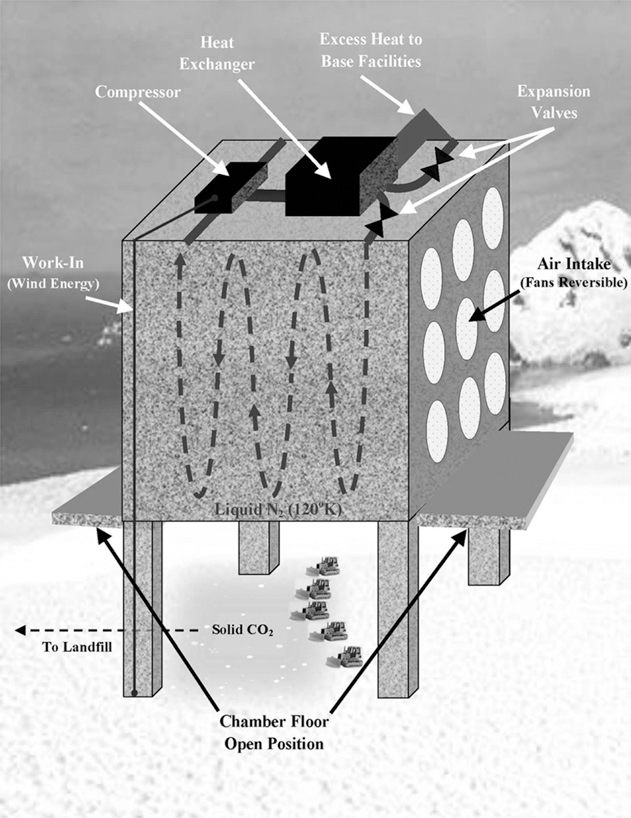
But searching for this led me to a truly maniacal idea for carbon sequestration: “CO2 Snow Deposition in Antarctica to Curtail Anthropogenic Global Warming” by Ernest Agee, Andrea Orton, and John Rogers of Purdue University (published Feb 2013, Journal of Applied Meteorology and Climatology).   The idea is to freeze CO2 into enormous landfills in Antarctica in order to counteract global warming.   Humanity is adding a net of about 4 billion tons of CO2 a year to the atmosphere.  At a density of 1.5, that’s about 2.5 cubic kilometers of solid CO2 a year.   If the landfill is 100 m deep, that’s an area of 25 km2 a year, or about 10 square miles.

The energy needed to chill it down to freeze it would come from big wind farms.    There are constant katabatic winds that flow off the cold, high ice sheets down to the warmer ocean, so site the windmills there.  You would need about 80 GW of windmills to freeze out all the CO2.   That sounds like a lot, but the US had about 60 GW of wind installed as of 2012, and it’s growing at 30% per year.   Worldwide there was about 280 GW installed, growing at 25% per year.  Using that wind power to freeze CO2 would remove a lot more CO2 than using it to displace coal.

CO2 Freezer

“FIG. 6. The proposed CO2 deposition plant. The chamber box for
terrestrial air intake is 100 m 3 100 m 3 100 m. The bottom floor
opens for solidCO2 excavation to nearby insulated landfills. Liquid
nitrogen is the coolant for the front and back side refrigeration
coils.”

The authors envision giant freezers 100 m on a side and standing on stilts.  They would have hatches on the bottom.  They would freeze a foot or two of CO2, then open the hatches and dump it down.  Bulldozers would then push it into the landfills.  I think a better scheme would be to put the freezer on caterpillar treads and have it drive very slowly along a landfill trench.  Maybe it could be staffed by Jawas. A crane ahead of it would be excavating the trench as the freezer moved.   Where all that ice would go is left as an exercise for the reader.

The sides of the landfills are to be insulated to keep the cold in.  The average year-round temperature up on the Sheet is -57 C, so continuous cooling would be needed.  If the partial pressure of the CO2 inside the landfill could rise to 1 atmosphere (perhaps by building a big tank), then the landfill could be maintained at -78 C, which would take much less energy.

All this would be a pretty major industrial operation.   It would be a reverse oil boom – putting the carbon back underground instead of taking it out.    It would be the Wild South, with rednecks driving bulldozers and cranes amidst the howling storms, and then going for tension relief in the hot nightclubs of McMurdo Station.

The landfills would have to be maintained indefinitely, or at least until some better solution comes along.   Maybe it can ultimately be injected deep into the earth where it can then turn back into oil, or maybe fusion will finally work and it can be turned back into coal.

Yet if the refrigeration ever failed, the results would be unpleasant.  A blast of CO2 would asphyxiate everyone around them.   You might get a local super-greenhouse effect, and turn the Sheet to slush.  That might cause more landfills to fail, and then the whole thing boils away in a chain reaction.

OK, so maybe this is not the total answer to climate change.   Maybe it’s enough to contend for  Richard Branson’s Virgin Earth Challenge ($25M for the best idea to sequester a billion tons of CO2 a year), but apparently it missed the entry window.   Still, as warming gets worse and worse, more and more desperate geo-engineering solutions like this will look better.   Even if it cost $100 billion a year (Iraq war levels of funding), that’s chump change compared to losing all the farmland on the planet.

Posted in Uncategorized | Tagged | Leave a comment

The Lost Engineering Paradise of DEC

I was saddened to hear the recent news that Intel is closing its Hudson MA semiconductor fab.  It’s 35 years old, and couldn’t be upgraded to the latest process nodes.  It’s still using 200 mm diameter wafers and a 130 nm feature size, whereas the latest is 450 mm and 22 nm.  Intel likes to make all their fabs identical, right down to the color of the paint, so that they can easily transition products from one to the other, but they didn’t actually build this one.   Digital Equipment Corp did, in 1979, and gave it a big upgrade in 1994.   It was sold to Intel in 1997 as part of then-CEO Robert Palmer’s break-up of the company, and also as part of a patent settlement suit.

I had my first real job there.  When I first arrived there fresh out of school in 1981, I thought I was Entering the Future.   The plant had its own helicopter service that shuttled people among DEC’s plants and to the airport.  It’s up on a hilltop, with a view of hundreds of square miles of rolling forest.  The hill was an old apple orchard, and the remaining trees would still blaze with flowers in the springtime.    DEC’s founding CEO Ken Olsen got then Governor Mike Dukakis to give it its own exit off of I-495, the outer ring road around Boston.   All through the 1980s it built the most sophisticated microprocessors in the world, and in the 1990s, with the Alpha line, it built the fastest. This was how high-tech was supposed to revive even this old, gray state.

Intel Hudson Fab17

Intel Fab 17, Hudson MA, ~2011 source: Intel

I was on the design side instead of the fab.  I worked in Building 2,  there in the back left, until 1992.   At that time I had a desktop workstation that was fully networked to server farms and laser printers, with a bitmap display and a real OS, VMS.  It was pretty much what I’m typing on now, except much more reliable and twenty times as expensive.

That cost is what did DEC in.   They knew how to build far better computers than the PC makers could, and they knew how to build them cheaply, but they didn’t know how to get the company to do it.    DEC did actually come out with its own PC line in the early 80s, the DEC Rainbow, which ran both CP/M and MS-DOS, but it wasn’t quite compatible with IBM PCs.  The DEC engineers didn’t realize that naive DOS programmers would access the x86 hardware directly instead of going through the OS, and so their code ran only on specifically IBM hardware.  Maybe people hated DOS even then, and trusted IBM more.

So the Rainbow didn’t make much money compared to the VAX lines, and was abandoned early.   Even the workstation market, which had machines in the $10K to $20K range, wasn’t that lucrative for DEC.  They liked big machines with big markups, and customers who cared about reliability and service.  They also liked to do things right, instead of quickly and cheaply, and that wasn’t the PC way.

However, DEC did tremendously well in the late 80s.  It peaked at 100,000 employees and $14B in sales ($25B today), but the writing was on the wall.  A disastrous project, the VAX 9000 ECL mainframe, and the looming threat of PCs caused Ken Olsen to resign in 1992.  He was replaced by the aforementioned Palmer, who had been head of the Semiconductor Engineering Group in Hudson, and had previously founded Mostek.   The engineers in Hudson mocked him for his thousand-dollar suits and blow-dried hair.  “Doesn’t he realize we have a dress code?” we wondered.  He also drove a Porsche, but with an automatic transmission.   He quickly started layoffs and sales of divisions, and finally sold the whole company to Compaq in 1998, with a $20M golden parachute for himself.   I don’t think he lives in Massachusetts any more.

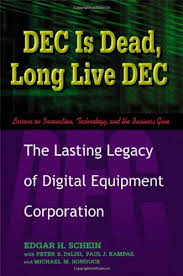
DEC Is Dead cover

Click for Google preview

Ed Schein and others talk about what went wrong in “DEC is Dead, Long Live DEC”.  He reviews the company history and interviewed a lot of alumni.  He thinks the core reason for both DEC’s success and its failure was Olsen’s management philosophy – set people going and then get out of their way.  Trust them to do the right thing.  They who propose, dispose. This was liberating in the 60s and 70s.  People were treated as grown-ups instead of pieces of equipment.  They explored a huge range of product ideas and were able to innovate everywhere.  It was engineering heaven.

But as the company grew larger, it was no longer possible to manage by personal contact.  No one at the top knew who was doing what, and whether they were any good.   They needed more formal mechanisms to prevent people from simply protecting loyal underlings and pet ideas.  They got hung up on their one great business, minicomputers, rather than shifting to networking, or servers, or small machines, any one of which would have been a good business.  When the board of directors insisted that the company change focus and seriously downsize, Olsen quit.   That felt like betraying his people.

He was a paternalist, but he treated people far better than companies do today.   DEC actually did hire ignorant young grads like me and teach them to be useful.  They didn’t expect hires to have already invested their own time in learning a technology, as companies do today.  As a result, Schein found that a remarkable range of people had fond memories of their time at DEC.   The company pioneered a wide range of technologies, but more importantly it trained a generation of people in IT.

That sounds rather vague, so let me be more specific.  If you’ll pardon a shout-out to old colleagues, let me list the people I knew from the Semiconductor Engineering Group and what their highest positions since DEC have been.  Links are to their Wikipedia entries:

  • Intel Fellows: Bill Grundman, Joel Emer, Matt Adiletta
  • Intel: Jim Pappas, driver of USB and Infiniband, and Bill Herrick, Itanium leader, Bill Bowhill, processor design leader
  • Xilinx: Moshe Gavirelov CEO, Victor Peng CEO (and then a President at AMD), Hugh Durdan VP, Liam Madden VP
  • AMD: Dirk Meyer CEO, Rich Heye VP Microprocessors, Rich Witek Fellow, Norm Rubin Fellow, Jim Montonaro Fellow (also Alchemy founder), Ray Stephany Fellow
  • Apple: Pete Bannon and Jim Keller, Ax processor architects
  • Google Fellow Dick Sites
  • Analog Devices VP Dan Leibholz
  • Analog Devices Fellow Chris Mayer
  • AMD Fellow, Tilera VP John Brown
  • Cavium VP and founder, and Marvell VP Anil Jain
  • Rambus VP Mike Uhler
  • C-port founder Larry Walker
  • Oasis Semi founder John Koger
  • Sand Video and Immedia founder John Iler
  • Nvidia VP Frank Fox
  • SiCortex founder Matt Reilly
  • Stargen founder Todd Comins
  • Princeton prof Doug Clark
  • Brown prof Iris Bahar
  • Nvidia VP Dina McKinney
  • Unisys VP  Bob Supnik (also creator of the great computer history site SIMH)

That’s a fair fraction of the modern chip industry!  Special mention should be made of Dan Dobberpuhl, now passed, but the ninja master of microprocessor design.  He led the designs of one of the smallest processors (the T-11, a PDP-11 in only 12K transistors), one of the fastest (the Alpha 21064), and one of the most power-efficient (the StrongARM series).   He left DEC to found SiByte in ’98, which was later sold to Broadcom for $2B, then founded PA Semi, which was bought by Apple in 2008 for $275M.  It’s now the core of their processor group, and at the heart of the iPhone and iPad.   He was IEEE Solid State Circuits Engineer of the Year in 2003, and elected to the NAE in 2006.   He had a sensei’s calm in the midst of chaos and cancellation, and the ability to ask the important question.

So DEC was a net generator of talent and technology.  Most firms are net consumers.   They aren’t missed when they go under.  I hope that people at, say, Google will have similarly fond memories of their firm when it gets inevitably displaced!

Posted in Uncategorized | Tagged , , | 18 Comments

“Gravity” and Retreating From Space

I was once surfing around the cable channels when I came upon a screen that was almost completely white. Almost, but not quite – slight ripples and whorls were moving slowly across it. There was hardly any sound, just a hiss and occasional beep. It was hypnotic. The patterns were subtle but somehow familiar. I watched for five minutes before a voice came on. “Houston, we’ve finished the check of the unit.” It was a live feed from the Shuttle as it flew over a cloud-covered Earth!

In the spectacular new movie “Gravity”, the Earth is very much a character. There are only two people in it, Sandra Bullock and George Clooney, playing astronauts stranded when a disaster destroys their Shuttle, but behind them and always beckoning to them is Earth’s huge and beautiful disk.

Bullock and Clooney repairing the Hubble

It’s home, it’s safety, and it’s other people. The horror in the movie is to be floating in free space, helpless and alone. Beneath you, though, are millions of people. Look, there’s Cairo and the Nile valley. There’s the boot of Italy.  At one point Clooney says “You should see the sun on the Ganges; it’s amazing!”, even though he’s in the most dire of circumstances.

Space, though, is lethal. All of Low Earth Orbit becomes uninhabitable when a cloud of debris from an exploding Russian satellite starts destroying everything else in orbit. This has long been an actual concern. In 1978 NASA scientist Donald Kessler noted that debris from one satellite could create more debris when it hit another, causing a runaway cascade now known as the Kessler Syndrome. Small incidents have already happened. In 2007 the Chinese tested an anti-satellite missile on one of their own satellites, and created 2300 pieces of debris more than an inch across. It damaged the Russian BLITS satellite in 2013. The ISS regularly moves to avoid debris, and its occupants have had to retreat to a relatively safe part of the station, the Soyuz capsule, three times.

So in this movie, the prospect of space is gone.  Nothing can survive up there, manned or not.   There won’t be any more space stations.  The only hope is to get back to Earth as soon as possible.  But that’s OK!  Every frame of this movie says that Earth is where we belong.

That’s not exactly the final frontier!  The moviemakers could have made a point of showing the cleanup, the new missions, the refusal to be beaten by a mere accident.  Not in the 2010s.   People here are retreating from space and not going back, because they don’t belong there.

Now, don’t let this dissuade you from seeing the movie.  It’s gripping and gorgeous, and Bullock turns in the performance of her career.   It was also nice to see people getting a grip and solving problems.  So this parachute harness is stuck?  We’re going out there with a wrench to undo it, in spite of the debris flying by.  It’s also finally a justification for 3D – the way things are floating around immerses you totally in the story.

Yet I found its underlying theme dismaying.   Earth is not our only home, any more than the savanna was.   Most of the Earth is pretty lethal to us naked apes, but that hasn’t stopped us.   I regret seeing this much skill and art devoted to a story of retreat.


Posted in Uncategorized | Tagged , | Leave a comment

Where Are Movies Made?

Mainly the US, as one would expect.  As in the post What Are Movies About, I looked at the IMDB databases to find out in what countries movies get made.  I took their list of titles and removed works marked as Adult, Documentary, News, Game, and TV.  I also removed titles with less than 5 ratings votes, since there’s a lot of unwatched stuff in there, especially in recent years with the rise of cheap digital cameras.

That left me with 139,200 movies from 174 countries.   The US accounts for 44,704 of them, about 1/3, while only 1 movie has ever been made in Guyana, Antigua, Faroe Islands, Maldives, Belize, Libya, Samoa, Macao, Suriname, Oman, Guadeloupe, Central African Republic, El Salvador, United States Minor Outlying Islands, Brunei, Fiji, Yemen, Liberia, Reunion, and Burma.  Lichenstein and Vatican City don’t ever seem to have had a movie made in them.  Here’s how the top countries look:

Movies_top_50_countries

Click for spreadsheet

I hope you’ll pardon the log scale, but the range here is so wide that it’s the only way to fit everyone in.  The top few here are the usual suspects – the leading cultural producers of the world.   It’s odd that China is so far down, just below Iran, but Hong Kong makes up for them in cinematic industriousness.  It’s small surprise that the US is so high; it started first, and has about 1/3 of the population of the developed world.    Let’s derate by population to see who is really into films:

Movies_made_per_million_inhabitantsThe Scandinavians seem to really like to make movies!  Iceland, Denmark, Finland, Sweden and Norway are all way up there.  Long winter nights resemble sitting in a dark theater, I suppose.

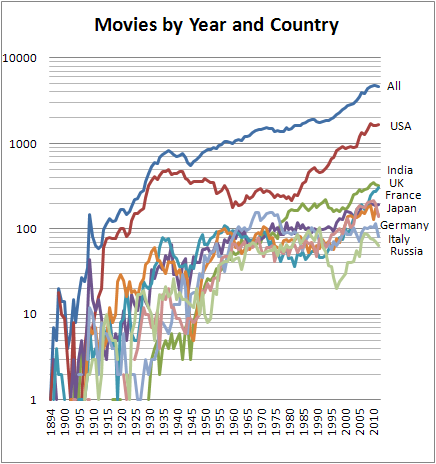
Finally, how has the number of movies made changed through the years?

Movies_by_year_and_country

The US movie industry really slumped in the mid-50s when television came in.  The Russians got hammered when they lost their empire in the 90s.  It’s a bit hard to see, but France actually made more movies than the US before WW I, when they became otherwise occupied.  Ditto Germany and Japan in the 1940s.

Today about 4500 movies get made world-wide each year, about 12 a day.   Here – Movie_titles_2012 – is a list of all the titles for 2012, sorted by the number of IMDB votes for each.  At 1.5 hours each, you could just barely see them all if you spent every waking hour watching and only got 6 hours of sleep.  That’s pretty infeasible, but it would be possible to see all of the 1600 US movies made each year.  That’s about 4.5 a day, but that would be a severe test of sanity!

Posted in Uncategorized | Tagged | 10 Comments

Adding Glitz to NASA: the Interstellar Probe

Hmm, what should NASA do next after the spectacular Curiosity mission?  A solar observer?  Seen that.  A lunar orbiter?  Like the ones China and India already did?  A Mars orbiter?  Like the several that are already there?    Even I hadn’t heard of  these probes – IRIS, LADEE, and MAVEN – and I actually like this stuff.  It’s kind of nice that these missions are becoming routine, but they aren’t contributing to one of NASA’s main purposes, which is technical spectacle.

But I recently came across an old proposed mission that really would get the reporters out – the Interstellar Probe.

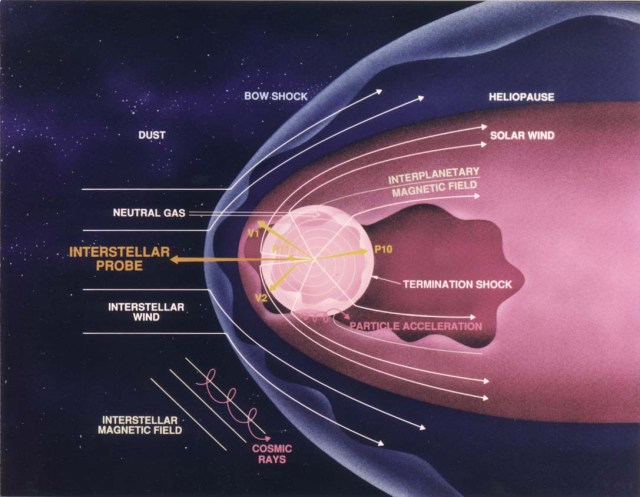
Interstellar Probe Mission

“An Interstellar Probe Mission to the Boundaries of the Heliosphere and Nearby Interstellar Space” by R. A. Mewaldt and P. C. Liewer of Caltech and JPL.

This was a plan to send a probe into true interstellar space, beyond the shell of plasma emitted by the sun called the heliosphere. That’s amazingly far out, about 20 billion miles, 7 times the distance to Pluto. Rockets would take forever to get there. Even Voyager 1 is only 12 billion miles out, and it was launched 35 years ago. So instead they planned to use a solar sail 400 m in diameter:

20SolarSail_Sun_black_lg

After launch from the earth, it would be deployed at an angle to the sun. Photons bouncing off it would slow it down so that it fell inward.  The sail is deployed by spinning, and steered by shifting the mass of the main probe in the center:

“Spacecraft in sailing configuration. The spacecraft is supported by three struts in an 11-m hole inthe center of the solar sail. A gold sun-shield covers the hole. Sail control is achieved by moving the spacecraft with respect to the center of mass of the sail by changing the length of the three struts. The gold is a sun-shield covering the hole.”

It would fall to inside the orbit of Mercury, about 20 million miles out, where the intensity of sunlight is 16 times what it is at earth. Then it would turn face-on to the sun and get blasted outward.

Probe Trajectory.  Ticks are at one-month intervals.

Probe Trajectory. Ticks are at one-month intervals.

It’ll take almost a year to fall into the sun, but then only four months to blast past Jupiter. At that point it’ll be moving at 70 km/s, the fastest probe ever.  That’s four times faster than the current record-holder, the New Horizons probe to Pluto.   It would jettison the sail near the orbit of Jupiter to make sure it didn’t interfere with the instruments.   It would reach the orbit of Pluto (32 AU)  in a bit over two years, and the heliopause (200 AU) in 15.

They wanted a mission lifetime of 30 years, so the probe would be 400 AU out at that point.     The probe would be powered by radio-isotope generators, which have a limited life.  The Voyager ones will run out by 2025.  It would have a 2.7m main antenna, which would still be able to deliver 350 bits/sec even at 200 AU.  The whole probe would weigh about 250 kg, of which 100 kg would be the sail.

The key technology limit is the areal density of the sail.  They need to get it down to 1 gm/m2, even though sail materials as of 2000 were at about 10.   In 2010 the Japanese launched a solar sail probe, IKAROS,  to Venus.  It had a 20 m sail made of 7.5 um polyimide, which would come in at about 7 gm/m2.   They’re planning a 50m sail + ion propulsion mission to Jupiter in the late 2010s.

The other limit is the max temperature that the sail can withstand.  This mission would get it up to 550 C at perihelion.    An even deeper dive would be even hotter, but would get even more speed.  In “The Starflight Handbook”, Eugene Mallove and Gregory Matloff calculate that a dive to within 0.01 AU with a sail that only weighed 0.02 gm/m2 would heat up to 1500 C.  It would blast away from the sun at 440 Gs, and hit a terminal speed of 3400 km/s, about 1.2% of c. Then it’s only 350 years to Alpha Centauri!  Space is just really, really big.

Unfortunately for all these plans, the Interstellar Probe mission appears to have been shelved by about 2002.   NASA does have a sail project in the works:  the Sunjammer, with a 40 m sail weighing only 30 kg.  If all goes well, it should launch in 2014.   If they scaled that up by a factor of 10, then threw it at the sun while aiming at the stars, they would get some press!

Posted in Uncategorized | Tagged , | Leave a comment