Microsoft Buys the Brains of Boys Everywhere

So Microsoft just bought Mojang, the studio that produces Minecraft, for $2.5B. That sounds like a ridiculous amount for a video game, particularly one that looks so crude, unless you happen to know some boys.

Minecraft Steve with his friends and diamond pickaxe

Minecraft Steve with his animal friends and his diamond pickaxe

His world

His world

For my 10-year-old son and his friends, Minecraft is mesmerizing.  They’ve been through Angry Birds and Skylanders, but Minecraft is sticking.  They play it on their game consoles, they play it on their tablets or phones, and they play it in the car when going someplace, connecting together to share a world through a local wireless link.  They play in Creative Mode, where you just build things, and they play in Survival Mode, where you defend yourself against the monsters that come out every ten-minute-long night.  They excavate huge caverns, looking for algorithmically placed gold and diamonds, craft weapons and tools, and build vast gravity-defying structures.

At 54 million copies sold, it’s the third best-selling game of all time, after Tetris and Wii Sports, and it sells for a lot more than they do.  Mojang was privately held, but was said to be making upwards of $200 million a year.  Merchandise is everywhere: T-shirts, cardboard Steve heads, guides, and even novels.  There’s even a nice papercraft version that turns the virtual world into a physical one – it lets you fold together actual blocks printed to look like the virtual ones, and assemble the animals and monsters to populate its world.

Its success is dismaying if you’re into computer graphics; it looks like renders from the 80s.  That’s a feature, actually; the simple graphics let it run fast on a huge range of platforms.  There has been an enormous improvement in graphics hardware and software over the last 20 years, all driven by the perceived need for most realistic imagery, and all ignored by this game’s fans.   The kids don’t need landscapes to look like landscapes; they need them to look like blocks that they can move around.   Real worlds wouldn’t look like they could be manipulated.

Scott McCloud talked about this in his seminal 1993 book “Understanding Comics”:

pg 31, click for link to site

pg 31, click for link to site

Abstracting away detail makes images more universal.  It lets people project more onto them.   If they become too abstract, one’s imagination can’t get started, and the image is boring.  If they are too specific, their interest becomes too narrow.

I’ve seen this go both ways with actual building block toys.   There’s a toy called Kapla Blocks that consists of nothing but identical wooden pieces that are about 5 x 15 x 75 mm.   It’s a completely minimal building set.  Adults love them, and you see them in science museums, because they’re utterly open-ended.

kapla block shipKids, though, tend to be baffled.  They don’t know where to start.   Mine at least are happier with kits that are already customized towards being castles or spaceships.  This is the guilty secret behind LEGO – they promise the parents that they are a completely universal building kit that will spark their children’s creativity, but the kids actually only ever build the X-wing fighter.

Minecraft is also playing towards parents’ desires.   The last thing they want is for their kids to be playing the #6 best-selling game, Grand Theft Auto.  It’s bad enough that they’re staring at screens instead of running around with each other, but at least here there’s some social interaction in the shared worlds, and some scope for imagination.

So $2.5B was not actually a lot for Minecraft.   At the current run rate, that’s about a 10% yearly return on the money.   If they put some effort into it, it could get bigger still.  I expect that they’ll do a Kinect version soon, where you can dig, craft, and fight by moving in front of the 3D camera.   It could ultimately become a Microsoft-controlled Second Life.  Have your users build wonderful, share-able worlds, then sit back and let money roll in.  Maybe the original Evil Empire of software still has some diabolical schemes left in it.

Posted in Uncategorized | Tagged | Leave a comment

Paying for Bad News: Funding the Keeling Curve

Here’s one of the most frightening charts in all of science:

keeling_curveCO2 has risen by a quarter just in my lifetime, and we all know the consequences.

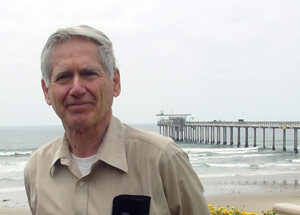
The chart comes from a remarkably sustained effort by Charles David Keeling: Keeling-pier-web-body_0and his son Ralph:

keeling, ralph

who were/are professors  at UCSD.  The elder Keeling was experimenting with measuring CO2 in the 1950s, and found that he couldn’t get consistent results when he took measurements around California.   He needed to get someplace where the natural greenery didn’t vary randomly.   A friend at the US Weather Service suggested the slopes of the massive volcano on Hawaii’s Big Island, where they had just put a new weather station.   The high winds there mean that the CO2 is nicely mixed from all of the Pacific.   Keeling set up his instruments during IGY in 1958, and tended them until his death in 2005.  His son took over early on, and has kept the series going.   It’s unheard of to run a single experiment for almost 60 years.  Here’s what it actually looks like:

CO2 Extraction rack.  CO2 level is measured by shining an IR light through a tube of test gas and a reference tube, and measuring the difference in absorption

CO2 Extraction rack. CO2 level is measured by shining an IR light through a tube of test gas and a reference tube, and measuring the difference in absorption

The whole Scripps CO2 Program is measuring levels at 11 other places besides Mauna Loa, and is also measuring atmospheric O2 levels, and seawater CO2 levels.

So you’d think that a program that is giving such an important data for so long would be securely funded.  Ha.  The Keelings have always had trouble maintaining the grants for the work.  In the 1980s it almost shut down as part of a bureaucratic squabble between NOAA, the NSF, and the DOE.  Everyone thought this was naturally under NOAA’s purview, but they didn’t have the money.   In the larger view, it has had problems because it’s not providing new results; it’s  just tracking the oncoming disaster.

Yet they have recently had a much worse time of it.  Several grants had ended.  The GOP has gotten much more rigid in opposing climate change.  In North Carolina the legislature actually passed a law forbidding the use of climate science in estimating sea level rise, since it gave an answer, a 1 meter rise by 2100, that coastal developers didn’t like.  The GOP also insisted on 8% cuts across all federal agencies as part of their Budget Sequestration bill of 2013.

So in December 2013, Ralph Keeling sent out a general appeal for public funding.   He hoped that interested citizens could do what the paralyzed federal government could not.   Here’s the actual appeal page:

Keeling Curve Button

Please press

I chipped in $500.  Unfortunately, UCSD isn’t really up on this whole crowd-sourcing thing.   They refuse to install a PayPal button, saying that it’s not secure enough.    They don’t offer any tchotchkes for supporters, unlike Kickstarter.   I decided to remedy that, and made up my own coffee mug on Zazzle:

Keeling Curve Coffee MugIf you email me a proof of donation, I’ll send one to you!  They’re handsome 11 oz mugs.

The campaign has gone both badly and well.  Badly, because they’ve only raised about $20,000 from small donations.   The ALS Ice Bucket challenge raised that much every ten minutes last August.  It’s gone well because they recently landed a big fish: the Wendy and Eric Schmidt Foundation.   That’s Schmidt as in Google.   They agreed to give $500,000 over five years.  The total burn rate of the Scripps CO2 Center is about $1M per year, so this helps a lot, but cannot be the only funding.

How crazy is it that key science has to be supported by such a volatile method as public funding appeals?  Sure, you’re paying for bad news, but that’s the kind you should most want to hear.  It’s the kind that should get general social support in the form of government funding.   James Conant and Vannevar Bush, founders of the NSF and of Big Science in general, would be spinning in their graves.

Posted in Uncategorized | Tagged , | 6 Comments

Phineas and Ferb Go To MIT

Because of course they would.   This is what they built over summer vacation:

Pic by Rachel Davis, '15, click for link to blog

Pic by Rachel Davis, ’15, click for link to blog

It’s a 130-foot-long roller coaster!   Students at the East Campus dorm built it for a freshman introduction activity.   The above is one end, and here’s the other, where you actually climb up to the top:

Entry end of coaster

Entry end of coaster

Once up there, you ride one of these:

mit_rollercoaster_3

The red chair is a one person ride

It zooms down the plywood track, goes up and down over two bumps, zooms up the other side, and then rolls back again.  The chair has wheels on the top and bottom of the track to hold it on, and all riders wear motorcycle helmets.  Here’s a ride:

My friend Paul pointed me to this story about it in Boston magazine.  I got to see it in person last Friday, just when they were taking it apart.   Sadly, I didn’t get to ride, but a guy there said that about 400 people had.  Some quite obscene things had been painted on it, though, so these Millenial-generation students are not all about good clean fun.

A much smaller one was built in 2010, but the city of Cambridge shut it down for safety violations as soon as they heard about it.  This time the builders were careful to get permits and an inspection by a structural engineering firm.

One of the designers, Ben Katz, built a 1:60 scale 3D model of it during a summer job at a 3D printer startup, Formlab:

Photo by Formlabs' Zach Booth

Photo by Formlabs’ Zach Booth

This is way cooler than the things undergrads did in my day!   Why is that?  Maybe:

  • MIT has a much more diverse student body today.  There are a lot more women, naturally, but maybe more art people than straight-up technicals.
  • Students are probably richer, and so can afford $10,000 of material for a hack like this
  • There are better design techniques, like the 3D printing above
  • There’s a lot more DIY art out there now, like Burning Man and Makerfests.   Students grow up with that instead of Heathkits.

I wonder, though, if something bigger isn’t happening.  A project like this would take at least a dozen people to design and build, and would take months.   You couldn’t have gotten a dozen of us to agree on doing anything.   We were solitaries, not solidaries, and still are.   As in Milorad Pavic’s novel of 1990, “Landscape Painted With Tea”, we were much more like the self-directed idiorhythmic monks on Mount Athos rather than the communal cenobites.  Students these days already know about working in teams, know that cooperation is critical to accomplishment.  We had to learn that in course of our careers.   Yet if learning cooperation early lets young people build stuff like this, I’m all for it!

Posted in Uncategorized | Tagged , | Leave a comment

The Fun Economy Displaces the Stuff Economy

The other day I took my 9-year-old son to gymnastics class.  The gym is in an industrial neighborhood of Waltham, Massachusetts, which was pretty much the original industrial town of America.   The Industrial Revolution in the US started here when Francis Cabot Lowell and Paul Moody built the country’s first major textile mill in 1814.  You can visit it today as the Charles River Museum of Industry.   Every year they hold fun steampunk festivals.    So what is the town like now?

The gym is on Clematis Ave, which is lined with 1970s-era industrial buildings.   At first glance it looks like a thousand other anonymous places in the country, a mix of old and new manufacturing operations.

A view down Clematis Ave, Waltham

A view down Clematis Ave, Waltham

Here’s an old operation, a machine shop.  There’s an electro-plating plant, and here’s a heavy equipment parts warehouse.  Then there’s a new firm doing water-purification tech, and a distribution center for a solar panel installer.

Yet they’re now the minority of the storefronts.   What you also see are the Boston Fencing Club and a Planet Fitness.  Here’s a tennis and badminton center.   Here’s a place that does “Canine Aquatic Fitness and Rehabilitation”:

A happy customer at FlowDog

A happy customer at FlowDog

The Farm Baseball Academy.   Champion Physical Therapy and Performance.  Ah, and at last we come to the Massachusetts Gymnastics Academy:

A dismal old factory, now filled with bouncing children.  Leo is in the center in the black and orange shirt

A dismal former factory, now filled with bouncing children. Leo is in the center in the black and orange shirt

This used to be a big space for shelves or machinery. It’s still got the standard steel-truss roof and cinderblock walls: cheap, durable, and ugly.  Yet now it’s all primary colors and soft floor mats.   Instead of a wall of tools on the left, there’s a wall of trophies.  Instead of grim middle-aged guys tending to their jobs and watching the clock, it’s full of buff young people and excited kids.

The young people are undoubtedly paid less and have no benefits.    The space no longer makes things that are exported from Boston to bring other goods in.  Instead, there’s a money transfer from harried parents to anonymous owners.

It’s now making fun instead of stuff.   That’s what has taken over even a drab industrial area like this.   The fun businesses have moved in because the stuff businesses are so unprofitable that the area is cheap.    All they need is a large uncluttered volume of climate-controlled space.   They need room to bounce around, or to lunge and parry, or to hit shuttlecocks, or to set up tanks for dogs to swim in.  An art gallery needs a much more finished space, but these firms don’t.

Is it wrong to make fun instead of stuff?   It does seem frivolous, and unserious.   Compare carving an engine piston out of a cylinder of steel at a machine shop to mopping up after a swimming dog.  The latter seems, well, unmanly, sad to say.

But there are machines in Michigan that carve millions of engine pistons a year.   Those machines get better all the time.  We just don’t need as many small machine shops scattered around the country as we used to.   More automation and better transportation has undercut them.  We also don’t need constantly greater amounts of stuff in our lives.  At some point the stuff needs annoying amounts of our attention, and we throw it away.

Still, there’s also only so much fun we can have in our lives.  The fun economy will also stall out at some point.  Then it’ll be replaced by, I don’t know, spiritual yearning centers, or something else that satisfies other human needs.   Yet for now even an old stuff-based town like Waltham seems to be shifting over to fun.

Posted in Uncategorized | Tagged | Leave a comment

Solectria – Achieving Goals By Lowering Them

A few days ago some good news finally came to a guy who has been trying to save the world for a very long time.   James Worden is the founder of the Massachusetts company Solectria Renewables, and it just got  bought by  Yaskawa Industries of Kitakyushu, Japan.  SE makes a key component of solar cell arrays, a box called an inverter.   This converts the DC power from the solar panels to the AC power of the grid.  They’re being built here in Mass, and so are a good fit for Green Economy initiatives.   Here’s Worden standing next to Governor Deval Patrick in 2012 at the opening of a 240 kW array on top of the Cummings Center, an old shoe factory now converted to office space:

James Worden, CEO of SE, and Deval Patrick at ribbon cutting of a solar array

Worden is at the front left; Patrick has the green tie.   The inverter is that white box behind them on the right.  They’re tricky to build, since they have to be totally reliable, highly efficient (any power lost in the inverter can heat it up enough to set it on fire), and safe in case of accidents.   Current models have 600 volts DC going into them – enough to kill you instantly – and they’re scaling up to 1000V to save on copper.

Yaskawa also builds inverters, but they’re smaller ones for the residential Japanese market.    They’re almost a century old, and their main business is motors and robots.    The term Mechatronics – electronically controlled mechanical parts – was actually coined by one of their engineers in 1971.  They want to expand into North America, so this is a good fit for them.   Inverters are a busy area in general – Google recently announced a $1M prize for a design that can handle 2 kW in a box the size of a laptop.

Still, they’re not that sexy a product.  They don’t cover a landscape, like the panels themselves, or tower over the world like windmills, looking like Martian death-machines.   They’re mainly boxes that live in basements, although they do occasionally explode.

So Worden didn’t start out working on them.   He knew as far back as high school how he was going to save the world – by finally making electric cars a reality.    While studying mechanical engineering at MIT, he built the first ever solar-powered car at an American university. the Solectria 3, in 1986.  He  went on to build  a series of subsequent cars like the Solectria 4B:

Solectria 4B

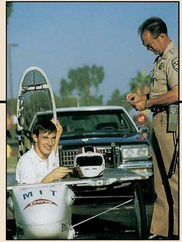
and the Solectria 5, 5B and MIT 5X.   He took them to solar races all over the world.   Here he is getting pulled over by a state trooper for breaking the speed limit:

James Worden getting pulled over for speeding in his MIT electric car

When he graduated in 1989 he founded Solectria to make an actual commercial electric car.   He started out small, by converting an existing car to electric drive.  Unfortunately, he picked one of the most boring cars ever built, the Geo Metro.

Solectria Force owned by Will Beckett of Palo Alto

Solectria Force owned by Will Beckett of Palo Alto

He needed something small and something that had otherwise standard components.   The  lead-acid batteries of the time only gave one 40 miles of range.  The converted car sold for $29,000 in 1991, which would be about $50,000 today.  That’s a lot for a slow, dull car.   The company only sold 400 of them.

So by the mid-90s he came up with something much flashier, the Solectria Sunrise:

solectric_sunrise_staylor01It still wasn’t fast, but it could go 300 miles on a single charge, thanks to nickel metal-hydride batteries from Ovonics and a 1500 lb weight due to a composite monocoque body.  Solectria built it on a contract from Boston Edison.   It had the interior space of a Taurus, and was supposed to sell for $20,000 in mass production.   It looks a lot like GM’s EV-1, which came out around the same time, but the EV-1 wasn’t as aggressive a design.  The Sunrise story is described in Joe Sherman’s 1998 book “Charging Ahead”.

Solectria hoped to ride the California Zero Emissions Vehicle mandate of 1990, which was to require 2% of the cars sold in the state in 1998 to be either electric or hydrogen-powered.  The car companies sued to block the law, and managed to push it off and complicate it wildly.   There is still such a law on the books, and companies do have to build a few electric models a year (called compliance cars), but its delaying squelched EVs for a decade.  The EV-1s were seized by GM and sent to the compactors.   A few protos of the Sunrise were built and shopped around, but no one picked it up.

It looked grim for Solectria.  They survived on research contracts, but had no products.  By 2005 they threw in the towel.    They sold all the tech to an Alberta company, Azure Dynamics.   They tried to build electrified Ford vans with it, but in turn filed for bankruptcy in 2012.

Still, Worden had learned something important in his long, painful quest for EVs – how to build reliable and efficient power electronics for inverters.  Cars have the same problem as solar arrays – they have to match a power source (a battery or a panel) to a load (a motor or the grid).  They have to be cheap, efficient, and reliable.   Cars have some extra requirements on them like weight and volume, and the need to support regenerative braking, but that just made the solar inverters look easier by comparison.   Worden started Solectria Renewables with his wife Anita in 2005, and has been going strong ever since.

Maybe it was always a fantasy to do big manufacturing like cars in a state like Massachusetts.    Cars were built in Mass up until 1989,  when the GM plant in Framingham closed, but first IT and then finance and pharma made it much too expensive for older industries.   Still, it’s surprising that Tesla is successful at building cars in California, and right next to Silicon Valley at that, across the Bay in Fremont.

I wonder what he thinks of the current success of EVs.   There are now three major ones: the Tesla Model S, the Nissan Leaf, and the BMW i3, and a number of plug-in hybrids.  It’s a lot easier to build them now with lithium-ion batteries than it was in Solectria’s heyday.   There’s also far more money available for development.  Is he glad that the dream is finally coming true, or irked that it’s not him?

So here’s hoping that he made some real money in the sale to Yaskawa.   And here’s hoping that he tries for something big again!


Posted in Uncategorized | Tagged , , , , , | Leave a comment

First Steps in Japan and Antarctica

I happen to be in Japan on business, and the office I’m visiting is on the pleasant Sumida River where it empties into Tokyo Bay

Looking west towards the Rainbow Bridge

Looking west towards the Rainbow Bridge

It’s right next to the Takeshiba Passenger Terminal, which takes people on sea trips to the Tokyo Islands, about 100 km out in the Pacific.   But what’s this in the middle of the plaza outside the terminal?

IMG_1952

Mast monument in Takashiba Passenger Terminal

A sailing ship mast?   With a white dude halfway up it?

sailor on recreated mast of the whaling ship Manhattan

Could this have something to do with Admiral Perry, and his Black Ships that forced Japan to open to the world?

No, it turns out to be a much nicer story.  In 1845, the American whaling ship Manhattan rescued 22 Japanese sailors from those same Tokyo Islands.  Some had been stranded on an island, while others were picked up from a sinking junk.  The commander, Captain Mercator Cooper, then took five weeks out of his voyage to return them to Japan.   He sailed over to this very stretch of Tokyo Bay, and lowered a boat with four of the sailors and a note describing the situation.

At that time Japan was strictly closed to the outside world by order of the Shogun, a policy known as sakoku, “chained country”.  This was instituted in the 1630s, largely as a response to unrest caused by Jesuit missionary work.   Catholicism had hit Japan like a bomb.  Their native religions hadn’t been competing ferociously the way creeds had been in the West.   It was an invasive species to which the native-born memes had little resistance.   They must have seemed like pretty thin gruel compared to what the Jesuits offered.   Forgiveness of sins!  Life everlasting!   A saint for every occasion!  An immense theology backed up by a wildly diverse sacred text, with a story in it for everyone.  The shogun’s response was to take a flamethrower to these invasive weeds, and he ordered the execution of all Christians, usually in as gruesome a manner as possible.  He then closed the country to limit future contact.  That had the other salutary effect of cutting off trade and therefore wealth for provincial barons who might turn out to be competitors.

thousand-autumnsThe only source of contact with the outside world was a small Dutch trading post on the island of Dejima near Nagasaki.  Interestingly enough, the main impact of the Dutch on the Japanese was through medical textbooks, which were furtively passed from hand to hand like samizdat.  This was indeed secret and powerful knowledge. For a brilliant fictional version of life in Dejima in the early 1800s, see the David Mitchell novel “The Thousand Autumns of Jacob De Zoet”.   It’s got romance, intrigue, sea battles, ninjas, and one honest man trying to make his way through a corrupt world.    When Napoleon conquered Holland in 1806, Dejima was the last outpost in the world of the Free Dutch Republic.  Its residents came home to a hero’s welcome when their country was finally freed in 1813.

Anyway, when the governor of Edo received Captain Cooper’s note, he allowed him to land.  His party were the first Americans to ever visit the mainland.   The lost sailors were received with much rejoicing.   Cooper stayed for four days, visited the governor himself, and was much impressed.   His ship was re-provisioned, and when Cooper offered to pay, the governor waved him off.  However, the shogun’s Imperial officers were less hospitable.   They thanked him for rescuing their people, and told him never to return.

His story made its way back to Washington.  The US had long wanted Japan to open, mainly as a coaling station for trade with China, which was flourishing.  Officers in the US Navy argued that the people of Japan were much more open to trade than the Imperial government was, and would welcome an opening.   That led to the Perry expedition of 1853, which had almost as dramatic an effect on the country as the Jesuits.

Captain Cooper himself seemed to have a taste for exploration.   How could you not with a name like Mercator?   In January 1853 he was commanding a whaling and sealing voyage in the Ross Sea near Antarctica.  They spotted an ice shelf backed by a high mountain.  He ordered a boat lowered, which landed on the shelf.  This was the first reliably documented landing on the continent of Antarctica.  He stayed in the area for several days, but found only penguins, rather than something valuable to hunt.

His trip seems to be remembered fondly in Japan.   They built the huge plaza above with a recreation of his ship mast.  The Tokyo Rotary Club also put up a monument to the occasion:

English side of Manhattan monument

English side of Manhattan monument

A century later, in 1945, US-Japan interactions were less pleasant.   Still, how nice to see this in the middle of this huge, bustling city!


Posted in Uncategorized | Leave a comment

The One Useful X-Power Is the Main One We Have: Telepathy

So I saw the new movie “X-Men: Days of Future Past” this last weekend, and was struck by how odd and useless most of their superpowers are. They look great, but what would you do with them? The ability to shoot ice blasts from one’s palms? Cool! But you’d use it for, ah, re-surfacing skating rinks? The ability to phase through walls? Handy for escaping from prison, but that’s something I’ve never actually needed to do.   Have 10″ claws come out of your knuckles? Then how could you bend your wrists when they were inside your hands? Heal quickly from bullet wounds? Can’t say I’ve been shot recently. If the fast cellular growth needed for quick healing also meant a constant risk of cancer, then I’ll pass.

Patrick Stewart

You can tell how highly evolved he is by his lack of hair

But even within the fantastical world of comic-dom, the writers of the X-Men knew who had the greatest power – the telepath Professor X. Being able to read minds is more important than being able to lift heavy metal objects. If you want to lift something heavy, rent a crane. If you want to do serious work, read people’s minds to figure out what they want and then get them to direct their efforts towards your goals.

After all, if you were ten times stronger than an ordinary person, and could kill with a single blow, you’d have the superpowers of a tiger.  Yet people have been hunting down tigers for hundreds of thousands of years. Five people with spears can take down a tiger, if they work together. A person who can understand four others enough to convince them to go on a hunt is effectively stronger than a tiger.

That must have been the scary thing about hominids when they first appeared. They were so weak and slow, but they moved with eerie coordination. They had these secret communication powers. They could act in concert even when widely separated. They could specialize on tasks. Wolves could cooperate too, but you wouldn’t have one wolf making extra sharp teeth while another lay in wait for prey, and a third drove the prey towards the ambush.

Soon they were able to project their thoughts into their children’s brains, and pass them on even after their own deaths. They got slowly better at that until about 50,000 years ago, when a Great Leap Forward happened. They were suddenly able to project their thoughts onto inanimate objects, creating art. Now they could cooperate in groups of hundreds. Agriculture needs groups of thousands, and industrialization needs millions. Keeping that many people from dissolving into vicious factions needs vast networks of persuasion and coordination.

In fact, intuiting what millions of people will pay money to watch is exactly what movie people do.   They use the Cerebros of market research and focus audience testing to carefully tune every word and image to match people’s desires.  Thousands of people work on a movie like X-Men, and tens of millions will see it.   Strange mental powers must be at work!    If Professor Xavier ever got tired of teaching wild and dangerous children, he would make a hell of a producer.

Posted in Uncategorized | Tagged | 1 Comment

The Glass Empire Strikes Back

Sergey Brin is recording you all the time

Sergey Brin has been watching you constantly online, but now he’s recording you in the real world too.

Google Glass has gotten enormous grief in the last few months.  Places are banning it, and people have gotten into fights over it.  Even the tech journalist David Pogue finds it creepy:

You no longer know if you’re being filmed by your conversation partner. An unspoken social rule is being violated. I didn’t like it. I wanted her to take the damn thing off.

So their first counter to that was a video about avoiding being a Glasshole.   Now the next phase kicks in – showing that cool people use it to do important things.   The first release of the campaign was a recent front-page story in the Boston Globe – Google Glass now standard in Beth Israel Deaconess emergency room. This is an interview with Dr Stephen Horng, who has been finding uses for it in the ER.  He can access a patient’s records and immediately find out about history and allergies.   I doubt that the Glasses really are standard equipment at Beth Israel, since they don’t mention anyone else but Horng.  Since he also has degrees in CS and bio-informatics, he’s likely to be a first adopter.

His system was developed by Wearable Intelligence, a startup in San Francisco that’s backed by Google.   They’ve also just out come with a staged video showing a doctor using it to deal with a stroke admission.   It shows an elderly man slurring his words and unable to keep his hands lifted, while his frantic wife is with him.   An older doc in a white coat and tie (i.e. not a hipster dude) uses his Glasses to capture a video, order a CAT scan, and contact a specialist.   The grateful couple look on, saved by this miraculous tech.

Well, it so happens that my sister is a physician’s assistant.   She says that one of the docs in her ER tried one in San Francisco and thought it was great.   However, they do already have rolling computers that give them immediate access to patient info, and it would be hard to convince providers to adopt yet another tech.   She also worries that patients would be made uneasy if they thought they were being recorded.

I suppose that lots of people in ERs really don’t want to be on video.   It smacks of police and interrogation.  Hospitals might insist that all the video is private, but  thanks to the NSA we now know that those promises are meaningless.  If the FBI or DEA wants it, they can get it. If fears like that deter people from coming into the ER, that would wipe out any medical gain that the Glasses might bring.

The long-term vision (so to speak) of things like Glass is to be an aid to our fallible memories.  So little of our lives actually sticks.  We lose so much.   We would all love to hold onto the good parts, ones that would comfort us in dark times.  Yet the unblinking eye of the camera also captures the bad parts, and captures things that can be used against us.   That’s what has people worried about Glass, and what may ultimately sink the product.

Posted in Uncategorized | Tagged | Leave a comment

“The Wind Rises”, As Did Japan

Jiro and his A5M

Jiro and his A5M

So why would Hayao Miyazaki, one of Japan’s greatest directors, chose to make his final movie about an obscure aircraft designer?  He has said that “The Wind Rises” will be his last, and he’s already 73.   None of his other movies have been based on real people, so why make one about Jiro Horikoshi, the designer of the Zero fighter plane of WW 2?   There are very few movies of any kind about engineers, and this animated one is unique.

It might be just because Miyazaki loves flying. It features in a lot of his movies, especially “Laputa, Castle in the Sky”, which has air pirates and an entire flying island. Flying is an inherently beautiful thing, and his style of cel animation is wonderful at portraying it on film.

But I think something else is going on here.   The Zero was the first Japanese industrial product that was clearly competitive with the West.   In the air battles of 1941 and 1942, it shot down everything that the US and British could put against it.   Compared to the standard US Navy fighter of 1941, the Brewster Buffalo, it was faster (330 mph vs 320), more maneuverable (a rate of climb of 3100 ft/min vs 2440) and had longer range (1900 miles vs 965).

Japan had been trying to catch up ever since the Meiji Restoration.   Once they were forced by Admiral Perry to look beyond their shores, they could see how far behind they had gotten.  Even by the time of this movie, the 1930s, the country still looked pre-industrial.  The movie is filled with pretty scenes of fields and small villages.   At the Mitsubishi aircraft factory where Horikoshi is working, they still haul the planes out to grassy runways with teams of oxen.

But things are changing.   The men are now wearing suits and ties.   Rackety cars are moving down the streets.  The air itself is in trouble – Horikoshi’s wife Naoko suffers from TB, and cannot stand the polluted air of the cities.  Flying itself gives a freedom to the Japanese that they had never known before.  Horikoshi exemplifies what it took to catch up – he’s a person of Zen-like concentration and utter determination.

It all ends badly, of course.   Naoko risks her health to be near him when he’s doing the flight trials of his first masterpiece, the A5M, but realizes that she is keeping him from work critical to the nation.   She flees back to a sanitarium in the mountains.  Just as the plane has its first spectacular flight, he feels a puff of wind and knows she is gone.  The movie ends at the end of WW 2, with Horikoshi looking out over vast fields of wrecked aircraft and saying “Not one of them came back.”  And it’s true – of the 11,000 Zeros built, only 1 flyable one remains.  His boyhood dreams of freedom and flight ended in ruin for him and his nation.

So this isn’t just a story of an artist who worked in metal and engines instead of animation cels.  It’s not just a tragic love story.  I think it’s also a story of the country itself.   No wonder it was the highest grossing movie in Japan in 2013!


Posted in Uncategorized | Tagged , | Leave a comment

“The Martian”: Really Mundane SF

A few years ago Geoff Ryman, the renowned author of “Was” and “The Unconquered Country”, got sick of the tropes of science fiction.   Faster-than-light interstellar travel, aliens, and alternate realities were cheap devices that encouraged boring and lazy writing.   While we may someday send devices to other stars, we certainly won’t go in our present bodies, nor will aliens visit us in anything even vaguely like human form or technological level.   FTL violates causality anyway.  Those ideas are exhausted!   Get over them!   Don’t think that you can burn up this planet and then find another!   He argued for Mundane SF, one that has some vague relation to reality, unlike the wish-fulfillment of pulp concepts from the 1930s.

He came in for much grief and mockery, of course, partly from people who really believe in Star-Trek-ish futures, and partly from those who thought he was being too restrictive.   They’re just stories after all.  His manifesto has had some effect, though.  Big names of today like Charlie Stross, Alastair Reynolds and Karl Schroeder have actually given up on FTL, and find ways to tell interstellar stories with mildly plausible slower-than-light travel.    Stross has been particularly dismissive of the old ideas.   He notes that it probably takes at least 100 million people to maintain even the current state of technology, so thinking that a tiny space colony is going to ride out the destruction of the Earth is ludicrous.  Note that North Korea can’t support modern tech with even 20 million people, and that the whole Soviet Union really couldn’t either.

Cover of hardback edition of "The Martian"

Click for author site

Now a new author, Andy Weir, has come out with an SF novel so Mundane that it practically needs its own category – “The Martian”.   It’s about the third manned expedition to Mars, the one that goes horribly wrong.    A huge dust storm blows up, and forces the crew to blast off early.   Just as they are making their way to the ascender rocket, the storm knocks over their communication dishes, and an antenna spears one of them.   The life support readings in his spacesuit go to zero.  The storm is about to tip over the ascender too, so they abandon his body and take off.  The antenna just destroyed his electronics, though, and he survives.  Now he has to make it to the next expedition in four years time with just the stuff abandoned at the base, and completely cut off from the earth.

Weir has great fun working out how this could be done.   Not enough food?  Create soil out of Martian sand and compost, including his own waste, and spread it over every inch of floor space in his habitats.   Seed it with potato eyes from supplies meant for a Thanksgiving dinner, and use the hab solar panels to power grow lights.  Get water from left-over hydrazine fuel in the descent vehicle and react it with oxygen broken out from the CO2 in the Martian atmosphere.    He actually puts numbers to all this, something you never see in novels.  Things continue to go wrong, of course, but the protagonist is an astronaut after all, and so is determined, smart, and unflappable.   Maybe implausible as well, since the things that happen to him would leave any actual person gibbering in panic, but  he keeps a cocky sense of humor as well.

Weir says that he has long been a space fan, and an amateur writer.   He grew up in California and now works in Palo Alto as a programmer.   He got to working out the details of a manned Mars trip and then wondered what would happen in various disaster scenarios.  When that gelled into a story, he started posting chapters of it for free on his website .   There’s also a lot of fanfic there, and a nice piece of philo-fic, “The Egg”.   The story started getting a lot of attention, so he assembled it into a Kindle eBook.  Then Crown came along with a publishing contract (six figures for a first novel!)  and it came out this month in hardback, which is how I read it.  At the moment it’s 15th on Amazon’s SF & Fantasy best sellers list.  Someone has even bought the movie rights!  Rising from the sea of freefic to a published novel is a rare story of survival in itself.

So the book is fun and engaging, especially to technicals.   What it doesn’t have is any sense of transcendance, a key aspect of SF.   Mars is portrayed as dead, and as deadly.   It’s like a particularly boring stretch of Antarctica, but even more ready to kill you.    There are no aliens or mysterious artifacts, and not even any Martian bacteria.

It’s as realistic a portrayal of an expedition to Mars as can be devised, and it leaves this fan unsatisfied.   I contrast it with Kim Stanley Robinson’s Red/Green/Blue Mars novels.   Those too gave a Mundane picture of Martian exploration, with no fantastic elements allowed.  Yet Robinson loved the wild planet itself and luxuriated in descriptions of it.    He’s a mountain climber and so is attracted to barren, open places.   He was also attracted to the idea of rebuilding society in a better way, the old Pilgrim dream.   All three books formed the best SF novel ofthe 90s.

All-is-Lost-Photo2

Redford in a non-Martian wilderness in “All Is Lost”, click for Amazon page

But maybe these are just times for stories of desperate survival.   This novel is a close parallel to the recent Robert Redford movie “All is Lost”.  That too is an account of one man surviving when everything fails, this time on a yacht in the Indian Ocean.  He too is cut off from the rest of humanity when a storm shorts out his radio, and must improvise his way past one challenge after another.  That too kept me engaged throughout.   Yet it had a sense of the beauty of the world that I didn’t get in “The Martian”, and is also in RGB Mars.  It also had a rather spiritual ending, which can be interpreted however you like.  That too isn’t in Weir’s book.  Still, I look forward to his next!

Update 10/22/14: A movie version of “The Martian” is underway!  Starring Matt Damon, no less, and directed by Ridley Scott.  This sort of ultra-realistic SF is the exact opposite style of Scott’s disastrous film “Prometheus”, so it will hopefully improve his reputation.


Posted in Uncategorized | Tagged , | Leave a comment