“The Wright Brothers” and Thinking Straight

the-wright-brothers-9781476728742_lg

Click for site

There are lots of reasons to love the story of the Wright brothers.  They came from nowhere to solve the great problem of flight, one that had defeated so many others.  They showed straight-up physical courage when flying these dangerous machines, and would do it wearing suits and ties.  They built a secret base in the wilderness of Kitty Hawk for their amazing experiments.   They’re like Jules Verne characters come to life, but without the whole conquer-the-world thing.

Yet one thing that David McCullough’s new biography makes clear is that they succeeded when so many others failed because they had a better approach to invention: systematic and incremental development instead of the flash of genius.

The flash story is how invention is almost always described.   An apple falls on Newton’s head and he wonders if the Moon is falling around the Earth.  Edison thinks “What if you put so much current in a wire that it glowed white-hot, but kept it from burning up by putting a glass envelope around it?”  Tim Berners-Lee gets annoyed that all these connected computers have all these incompatible file formats, and adds a few text markers to them so that a single browser program can display them all.

It’s a good way to tell the story to children, because it makes invention seem like much less work.   Come up with the good idea, patent it, and fame and wealth are yours!

It’s nonsense, of course.  To start with, creative people have ideas all the time.    David E. H. Jones, author of the wonderful old Daedalus columns in Nature and New Scientist, describes the process in his book “The Aha! Moment: A Scientist’s Take On Creativity”.   He calls it the Random Idea Generator, or RIG,  a subconscious process that is constantly throwing up combinations of things.  The trick is not to get ideas; it’s to winnow them.  You have to filter the ideas down to get the ones that are useful, feasible, and doable by you.   Useful means something that a few people want a whole lot, or a lot of people want a little.  Feasible means that it can be done in a reasonable time frame, like a year for a nice idea, and a few years for a great one.   Doable by you means that you have some means of actually making it work.  Patenting ideas that you can’t implement is trolling.

So in the case of the Wrights, it was NOT that they had one great idea that made flight possible.  They had a whole set of them, each related to the problem they faced at the time.  They started by writing to the Smithsonian in 1899 to get any literature on the then-current state of aeronautics.   They then carefully studied what Lilienthal and Chanute had discovered.  They realized that control was as important as mere lift, and studied the flight of birds to come up with their famous wing-warping method.  They knew that Lilienthal himself had been killed while flying a glider, so they had to do unmanned trials first.   Then they needed an open place to practice, one with steady winds, so they wrote to the US Weather Bureau to find the best such place, and so came to Kitty Hawk.  It had long stretches of soft sand to crash into.  Better still, it was away from prying eyes – their only neighbors were a Coast Guard station a couple of miles away.  They needed a place to stay while there, so they built their own cabin and workshop.  They practiced with gliders, and found that the existing equations and tables for lift were wrong.  They invented the wind tunnel to measure it themselves.  They then needed a light, powerful engine, so they had a colleague cast and machine one out of an aluminum block.   The plane then needed a push to get it going, so they devised a rope catapult driven by a falling weight.

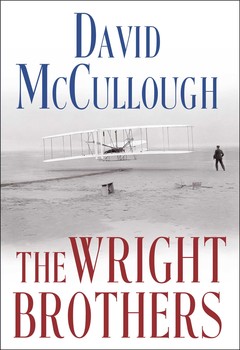
This then gets them to one of the most iconic pictures in American history, the one McCullough uses for his book cover:
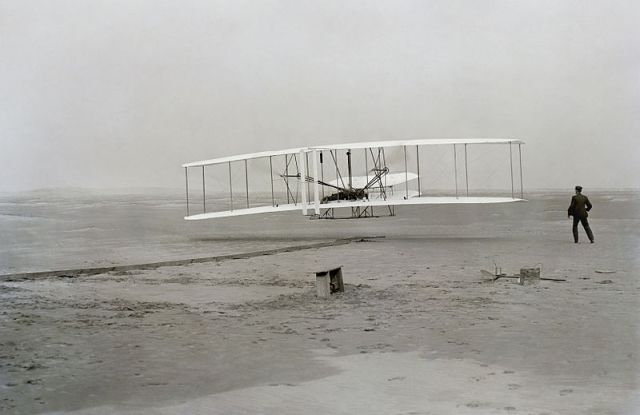
Orville at controls, Wilbur running along beside

First powered flight in history.  Orville at controls, Wilbur running along beside.

There they are, cooperating and focused on something ingenious and wonderful.   This is how Americans like to see themselves!   It’s the animating story of every startup.

Once they flew for the first time in December 1903, they gave up on Kitty Hawk.  It was too remote, the biting flies were hideous, and they had almost been swept away in a hurricane.  They returned home to Dayton Ohio and practiced in a nearby field, constantly improving their machine, until the 1905 Flyer could stay up for up to 40 minutes.

Having solved the main technical problems, they then turned to sales.  They pitched it to the US Army, who wasn’t all that interested.   The US military didn’t get concerned about air power until much later, December 7th, 1941, to be exact.   The Wrights were already getting feelers from European officers, though, so they packed up a machine and went to France in 1908.   It was a sensation.   Thousands turned out to see every flight, including royalty.   The Euros had been trying for flight for the previous few years, and were abashed that these outsiders had gotten it first, but also tremendously excited.

In November 1908 the Aero-Club de France threw a huge banquet in their honor and awarded them gold medals and a $1000 prize.   At the banquet Wilbur gave a particularly gracious and eloquent speech.   Let me copy it here just to show that he was not the stern, taciturn mechanic that he’s usually portrayed as:

For myself and my brother I thank you for the honor you are doing us and for the cordial reception you have tendered us this evening.

If I had been born in your beautiful country and had grown up among you, I could not have expected a warmer welcome than has been given me.  When we did not know each other, we had no confidence in each other; today, when we are acquainted, it is otherwise: we believe each other, and we are friends.  I thank you for this.

In the enthusiasm being shown around me, I see not merely an outburst intended to glorify a person, but a tribute to an idea that has always impassioned mankind.   I sometimes think that the desire to fly after the fashion of birds is an ideal handed down to us by our ancestors who, in their grueling travels across trackless lands in prehistoric times, looked enviously on the birds soaring freely through space, at full speed, above all obstacles, on the infinite highway of the air.

Scarcely ten years ago, all hope of flying had almost been abandoned: even the most convinced had become doubtful, and I confess that, in 1901, I said to my brother Orville that men would not fly for fifty years.  Two years later, we ourselves were making flights.  This demonstration of my inability as a prophet gave me such a shock that I have ever since distrusted myself and have refrained from all prediction – as my friends of the press, especially, well know.   But it is not really necessary to look too far into the future; we see enough already to be certain that it will be magnificent.  Only let us hurry and open the roads.

Once again, I thank you with all my heart, and in thanking you I should like it understood that I am thanking all of France.

That got a standing ovation!   And he had to autograph over two hundred menus.

But Orville didn’t see this triumph.  Two months earlier he had been in a terrible crash while showing the plane to the Army in Fort Myers, Virginia.  A propeller had cracked, which caused so much vibration that a guy wire snapped, wrapped around it, and shattered it, sending the plane straight down into the ground. It killed his passenger, an Army Lieutenant, and broke Orville’s leg and four ribs.   His passenger could have been Theodore Roosevelt!   Their sister Katherine immediately rushed to his side, and nursed him through months of recovery.

They both made it over to Europe by early 1909, with Katherine drawing as much interest as her brothers.   Orville did get back up in the air six months after his accident, and was able to train both French and Italian pilots.   Then they all returned to the US to more acclaim, and a spectacular flight up and down the Hudson and around the Statue of Liberty.  A million New Yorkers came out to see them.

But after that their lives got darker.  Everyone with technical talent got into aviation, and their records were soon surpassed.   Wilbur spent a lot of time defending their patents, and trying to get a proper business set up for building aircraft. That seemed to be where their enormous ingenuity reached its limits – they didn’t have the heart or skills for scaling up their inventions.   It’s a well-known problem among startups to this day, and venture capitalists will often replace the founder as CEO when things get serious.

The strain killed Wilbur.  He was traveling incessantly to raise money and sell product, and it wore him out.   He caught typhoid fever in Boston in 1912, and died six weeks later at age 45.

Orville had neither the interest or energy, given his injuries, to expand the company, and sold it in 1915.  By the time of the US entry into World War I in 1917, the Feds were sick of the patent feuding among the inventors, and forced them to all to enter a common pool for a payoff of $2 million each.  Orville last piloted a plane in 1918, but was involved with NACA, the predecessor of NASA, almost until his death in 1948 at age 77.

Their ultimate tribute came much later.  When Neil Armstrong stepped on the Moon in 1969, he was carrying a piece of muslin from the 1903 Flyer.

But, yes, they stopped contributing to aviation by about 1910.   They were surpassed, as everyone is in the end, and got too involved with growing their business and maintaining their IP to keep up.  But they showed everyone else the method of success – identify each issue as it comes up and knock it down.  It’s not so much a stream of brilliant insights – it’s insights focused on what prevents progress right now.   Don’t Think Different, Think Straight.
 

Posted in Uncategorized | Tagged | Leave a comment

The Singularity Will Be Built Out of the Same Old Stuff

I work in a field, semiconductors, that is the paradigmatic example of the Singularity.  When people talk about technology zooming up the exponential growth curve, they’re talking about what I do.  Since the field began in the early 1960s, there has been more improvement in integrated circuits than in any other technology except magnetic storage.  Each transistor has not only gotten cheaper by many orders of magnitude, but they’re faster, more reliable, and use less power.  Yet in spite of all this, there’s been a lot less change in the underlying ideas than you would think.

I’ve seen the progress part directly.  The first chip I worked on, the V-11 microprocessor at DEC in the early 80s, had 110,000 transistors with a gate length of 3 µm and ran at 5 Mhz.   My latest has 130,000,000 transistors with a gate length of 28 nm, and runs at 750 Mhz.   That’s not actually a big chip by today’s standards!  Yet it’s a factor of 1200 in density and 250 in raw speed.  Overall it’s about 2000 times faster, and 20 times cheaper to boot.

It’s a story of terrific technological success, which naturally leads to vast hype.  People have compared the invention of semiconductors to that of printing, writing, and even fire.  Some writers – most notably the SF author and CS professor Vernor Vinge, and the inventor Ray Kurzweil – go farther still and claim that they will bring about the transcendence of humanity, what they call the Singularity.   Things will move so far that no one today will be able to comprehend the people (or their uploaded avatars) of that era.   We’ll either be amoebas crushed by battling AIs, or we’ll all be as gods.

Yeah right.  I’ve actually been in this field for over 30 years, and what strikes me  is NOT how unfathomably different it has become, but how constant the underlying technologies have actually remained.     Let me start at the lowest level and work up:

  1. The base material of chips is still silicon, as it was in the early 60s.   People tried other compounds like gallium-arsenide and silicon-germanium alloys, and they’re only used for niche products, and fewer and fewer of those.
  2. The base device is the MOSFET transistor, invented in the 1960s.  They look a little different today – they’re built out of etched fins on the chip surface instead of lying flat along it, and use hafnium oxide instead of silicon dioxide for the dielectric, but it’s the same basic device that Noyce and Moore worked on. There are no more bipolar transistors, no tunnel diodes, no magnetic bubble memories, and no exotic non-volatile devices like MRAM.    Maybe the last will happen at some point, but people have been trying new schemes for decades.
  3. The base circuits are the CMOS static combinatorial gate, the 6-transistor SRAM cell, the DRAM capacitive storage bit cell, and the floating gate flash memory cell, all from the 70s.   These account for practically all of the 10^21 (billion trillion) transistors made per year.   Dozens of other circuit styles have been tried, and all have failed because of excess power or poor noise resistance.  I’ve worked in some of these styles, such as boot-strapped NMOS, pre-charged dynamic, and cross-coupled cascode, and they’re all gone.   Few people even design at the circuit level any more, except for those doing standard cell libraries (and most of those are auto-generated) or analog circuits.
  4. The base data types are character, integer, fixed point, and floating point, all known to Mauchley and Wilkes in the late 1940s.  Characters, at least, have expanded from the  5-bit Baudot code to the 8 to 32-bit UTF-8 Unicode.    There are no logarithmic number systems (which make divide and square root easy), or redundant binary (which avoid carries), and hardly even any support for 128-bit floating point, which we built in the 80s.
  5. The base processor architecture techniques were all discovered by the 1970s.  Pipelining, caching, branch prediction, vector instructions, and out-of-order execution were all known by then.   They used to be only available in supercomputers, and now every widget that goes for more than $30 can afford an ARM Cortex-A9 processor, which uses all of them.   Even the newer multi-core processors use ideas like write-back cache coherence, multi-threading, and distributed cache directories from the 80s.  Massive SIMD and dataflow never made it.
  6. The base processor language is still C from the 70s.  Lots of code won’t even rely on the enhancements in the 1999 update, C99.   People code today in a huge range of languages, but somewhere underneath them is usually an interpreter written in C, and C is in all the libraries and the OS.  It’s about the only binary compiler that most machines support.  That and FORTRAN, which is even older.  The object-oriented enhancements of C++ and Java are from the 80s. Lisp is still considered exotic, and it’s from the 60s.

Overall, it’s gratifying that the basic concepts of the field have persisted for so long.  It means that one’s initial education has not become irrelevant.  Learn the fundamental concepts and you can work for a long time in a wide set of sub-fields of the chip world.

But I don’t mean to say that there haven’t been any advances.  Chips are now in every corner of the manufactured world.  There have just been less underlying changes than what the breathless promoters of futurity would have you believe.  And I don’t mean that there won’t be significant consequences of further work.   Twenty years from now we may be living in clouds of smart dust that support terabit links to our augmented-reality sensoria.  But it’s very likely that that smart dust will be made of silicon, use standard gates and arithmetic, run code on standard processors, and that that code eventually will depend on C.   Any smart kid of the last 30 years can understand all of it.

Posted in Uncategorized | Tagged | Leave a comment

Lead in Flint and RoHS

The scandal about lead in the Flint Michigan water supply reminded me of my own brush with lead issues.  In the 2000s a program started up in electronics called the Reduction of Hazardous Substances, RoHS.   It was intended to get lead out of the solder used to attach chips to boards, and also to get rid of a lot of other dangerous materials like cadmium, hexavalent chromium, and a lot of nasty organics used in plastics.

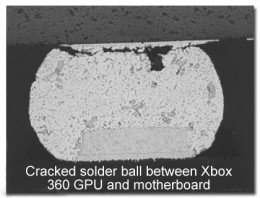
This was a royal pain for chip makers like my company.   The lead-free solders are more expensive and don’t work as well.  They can form tiny whiskers of tin that short out adjacent wires. Worse, they don’t have as much give when the chips and boards expand and contract during temperature changes.  When a chip heats up under heavy usage, it can easily pop right off the board.  Going to lead-free solder almost brought down Nvidia when their latest graphic processor chips started losing connections on customers’ boards, and also almost did in the Xbox 360.

Cracked solder ball Xbox 360 GPU

This is also the reason why lead paint is better.  Because it has some give, it can stay attached to surfaces through the cold of winter and the warmth of summer.   To this day lead paint is more durable than the alternatives, and is still providing good coverage decades after it was taken out of the paint supply.

In the electronics world we grumbled that no one should care if there was a little lead that was tightly encapsulated underneath the chips.  It’s not as if it was going to be eaten by children like the sweet-tasting chips of lead paint.   But Third Worlders care.  All this stuff eventually gets sent to desperately poor places for recycling.  When they grind up the boards to recover the gold that’s used in contacts and bond wires, they spread lead everywhere.  It’s a nightmare gift from the First World.  The EU was the first to actually care about this, and the US and Asia followed, reluctantly.  Now we’ve actually adapted to doing without lead, and don’t miss it.

Ultimately we have to get rid of it everywhere.   The managers of the Flint water supply thought that the old lead pipes there would be fine, even with the corrosive water from the Flint River going through them.  They were wrong, and have now harmed a generation of children there. Every poison is going to hurt somebody, somewhere and someday.

Posted in Uncategorized | Tagged | Leave a comment

A Plug for Doomed Engineers

In the early 90s I began collecting stories of engineers who came to bad ends.  That’s literally bad ends, as in executions and suicide, not just failed projects.    My own career was at a difficult phase at that time, and I found it cheering.  I posted them at an ISP called The World, which was based in Brookline MA, and one of the first anywhere.  Unfortunately, they were ultimately overwhelmed by spam and left behind by other providers, and I had to leave.    The site did stay up for over 20 years, which is an eternity in Internet time.

I’ve now re-formatted and updated the posts here – Doomed Engineers – Careers Even Worse Than Yours .   If you’re suffering from excess contentment and happiness, click over and have a look.   If you know of similar stories, email me!  I’m always interested in hearing more cautionary tales.

Posted in Uncategorized | Tagged | Leave a comment

When IP Escapes – the Sad Case of the Hoverboard

A few weeks ago my son was bothering me incessantly about hoverboards.   People in his class were talking about them, so he just had to get one.   The Amazon reviews were equally split between 5-star “This is the coolest toy ever!” and 1-star “This stopped working after 5 minutes and I can’t get my money back.”   I told my son that this was not a product ready for prime-time.  He was sad for about a minute and then asked for a Razor Crazy Cart, which turns out to be the same price but much safer and just as much fun.

Well, that was a narrow escape.  There are now reports of hoverboards actually catching fire.  Their cheapo lithium-ion  batteries often don’t have proper charging circuits, and go into thermal runaway.  That’s where a rise in temperature causes internal energy to be released, causing yet higher temperatures and releasing more heat until the hydrocarbon electrolyte catches fire.   Even well-designed cells can still burn if they get whacked hard enough, E.g. by rolling around and crashing into something.  Airlines have now banned them from luggage.   The fun-hating city of London bans them from sidewalks.

hoverboard-on-fire

Yet the design of these boards is really nice.  Someone managed to take the sophisticated self-balancing controls of the Segway and simplify them down to a much smaller and lighter form factor.  This stuff is non-trivial.  You have to use a motion sensor to drive each wheel separately to counteract the tilt of the weight of the driver, and do this with a fast response but no oscillation.   Who on earth did this?   Surely the knockoff factories in China didn’t come up with this on their own.

Yep, they didn’t – it was Shane Chen of the Inventist corporation in the US.

CRO_Electronics_CES_Inventist_Founder_Shane_ChenHe started a Kickstarter campaign in May 2013 for what he called the Hovertrax.  He raised $85,000 for it, and got them shipping by October 2014.  Backers got one for $695, and they sold for $1500 retail.   By early 2015 knockoffs were appearing in China.   They were heavier and larger, but much cheaper, down in the $300 range.  There are dozens of makes out there in a huge range of styles and colors, but they all seem to come from competing factories in Shenzhen.

There have now been teardowns of several different models.   The Planet Money radio show on NPR did one, and seem to have made a key mistake – they thought that the knockoffs had simplified the design by replacing the motion sensors with simple switches.  I think they just didn’t notice the small and inconspicuous accelerometer chips.   All of the teardowns look internally identical, right down to the aluminum casting for the central joint.  The most thorough disassembly I’ve seen is this one from a Norwegian EE who goes by IVC.   Here’s what the bottom of one side looks like, where the large blue lump is the lithium-ion battery:

800px-Hoverboard_right_platformThe motors are actually built into the wheels.

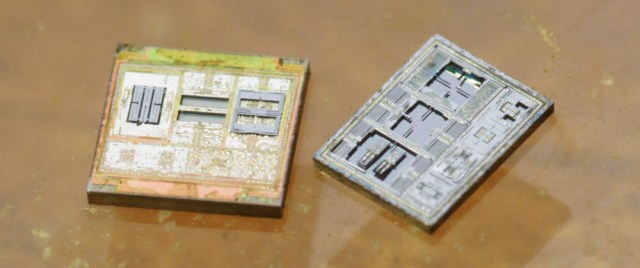
That green board holds the key component of the design, an astonishing piece of technology called a 6-axis Micro-Electro-Mechanical System (MEMS)  accelerometer. This can measure acceleration in the three linear directions – up/down, forward/back, and left/right – as well as rotation around each of these three axes.  There’s one in each side of the hoverboard, so it can tell which way the board is tilting and moving.  This particular device, the MPU-6050, comes from Invensense, a San Jose company that dominates the market for these chips.  Their main usage is in cellphones.   The chip consists of two pieces of silicon, one for the linear measurements and one for the rotations.   Each piece is heavily etched so that tiny silicon dioxide fingers lie along the surface of the chip.  As the chip gets moved, those fingers vibrate according to the direction and intensity of the acceleration.   Here are some some die photos:

Click for site

MPU-6050 die photos – Click for site

These come from a Russian site, Zeptobars, that has a great slogan: “We love microchips – that’s why we boil them in acid”.

These chips aren’t very big and are in an old process (250 nm), and so are dead cheap.   You can buy this one retail on Digikey for only $4.50, and much less than that if you have any volume.   It’s a typical example of modern high-tech – a device that takes immense research and engineering to design, but costs hardly anything to actually build.

So an ingenious piece of silicon gets paired with some ingenious mechanical engineering and software to build a nice walking assist.  And it then gets ripped off by hundreds of Chinese garage shops.   They cut down the design so much that it becomes wildly unsafe.   Then someone slaps the ridiculous name on it of “hoverboard”, probably because the movie “Back to the Future II” has its future set in October 2015, and features hoverboards that actually float, unlike these.

Now it gets widely mocked, and gets active hostility from some quarters.   It’s a good thing that Shane Chen got some licensing money from Razor for the design, or else it would have been a complete loss for him.  Someone needs to put some real safety engineering into this, but that will be tough given its poor reputation and the fact that the price has already been bombed.  He does seem to have a lot of other ideas, though, so maybe the next one will be the charm.

Posted in Uncategorized | Tagged | 2 Comments

The Force Puts Me to Sleep

Even thirty years ago when I saw “Return of the Jedi” I thought “This concept is played out”. Yet another Death Star? Yet more walker battles? Endless scenes of hapless guys in useless white armor getting zapped? Another light saber battle over an abyss? What’s with the Empire and safety railings anyway?

But Hollywood looked at that and thought “Let’s not mess with success.”  So now in “The Force Awakens” we have still another Death Star, another cantina, another young person with lost parents, another wizened old sage, lots more dogfights in space, another father-son conflict, and another dramatic climax over an abyss. Landspeeders! A cute robot! A hideous overlord! Desert dune scenes! It’s nearly a shot-for-shot remake.

A New Hope vs The Force Awakens

I can appreciate this.  Innovation is expensive, and prone to failure. Once you make something work, stop screwing with it. Look at Lucas’ own attempts to broaden the world of Star Wars in the prequels.  He tried to bring in actual politics, actual romance, and to show that Star Wars existed in a wider world. There were lots of other Jedi, of many races, and lots of planets that cared nothing for the trials of the Skywalker family.  He put in a huge amount of visual invention in the prequels too, much more than is seen in this movie.  The visual invention was mainly snazzy new spaceships, and his politics and romance weren’t all that good, but at least he was trying.

Well, forget that. After spending $4B for the rights to Star Wars, Disney wasn’t going to take any chances. They decided to give the fans exactly what they said they wanted. And they were right!    It looks like they’ll make half that on this first movie alone, and there are lots more to come.

They did make some cosmetic changes. In 2015 you can’t have all the characters be white, and almost all be male. Even the First Order now has female officers, although British accents are still signs of villainy. They’ll probably evolve things slowly over the next several movies. Even the die-hard fans won’t put up with too many more clones.

But it’s mainly the same old, same old. This has been an awful year for original science fiction and fantasy movies. “Tomorrowland” was a disaster in spite of having great people behind it.  I really didn’t care for “Ex Machina” as an AI story, especially compared to “Her”, but maybe it works as a parable of gender relations. A parable, perhaps, for someone who has been through a such bitter divorce that they think robots become real women when they learn how to lie.  “Jupiter Ascending”, “Vice” and “Chappie” got drubbed critically, and I passed too because life is short.  These failures and the huge financial success of this Star Wars reboot means that we’ll see even fewer original stories in the future.

Posted in Uncategorized | Tagged | 1 Comment

The Funniest Screenwriter of All Time

…  is Woody Allen, according to the Writer’s Guild of America.  They recently polled their members and came out with a list of the 101 Funniest Screenplays. Allen appears on it for 7 movies, more than any other person.  Sounds about right.

A lot of his movies, though, appeared at the end of the list, so maybe they shouldn’t count for as much.  How about if we give a writer a 102 points if they’re #1, 101 points if they’re #2, and all the way down to 1 point if they’re #101?  The spreadsheet is here.  The top writers then look like this:

Writer Number Written Points Screenplays, with the number as the overall rank
Woody Allen 7 257 1. Annie Hall
60. Sleeper
69. Bananas
76. Take the Money and Run
78. Love and Death
81. Manhattan
92. Broadway Danny Rose
Harold Ramis 5 370 3. Groundhog Day
10. National Lampoon’s Animal House
14. Ghostbusters
25. Caddyshack
88. Stripes
Preston Sturges 4 174 32. The Lady Eve
35. Sullivan’s Travels
72. The Palm Beach Story
95. The Miracle of Morgan’s Creek
Mel Brooks 3 280 6. Young Frankenstein
8. Blazing Saddles
12. The Producers
John Cleese 3 251 9. Monty Python and the Holy Grail
20. A Fish Called Wanda
26. Monty Python’s Life of Brian
Christopher Guest 3 192 11. This is Spinal Tap
40. Waiting for Guffman
63. Best in Show
John Hughes 3 192 33. Ferris Bueller’s Day Off
36. Planes, Trains and Automobiles
45. National Lampoon’s Vacation
Ethan Coen 3 184 13. The Big Lebowski
23. Raising Arizona
86. Fargo
Joel Coen 3 184 13. The Big Lebowski
23. Raising Arizona
86. Fargo
Marshall Brickman 3 164 1. Annie Hall
60. Sleeper
81. Manhattan
Charles Chaplin 3 40 82. Modern Times
90. City Lights
94. The Gold Rush

By this points standard, Harold Ramis is the funniest writer, since his 5 movies are closer to the top of the list.   Mel Brooks also beats out Woody Allen.  On the other hand, this gives John Hughes of “Ferris Bueller’s Day Off” 192 points, which is way ahead of Charlie Chaplin’s 40, and that’s totally wrong.

That shows one larger problem with the list – the movies are largely from recent decades.  Chaplin’s movies are from the 30s and Hughes’ from the 80s.   Here are the numbers and movies by decade:

Decade Number Movies Screenplays
1920s 2 57. The General, 94. The Gold Rush
1930s 6 17. Duck Soup, 24. Bringing Up Baby, 38. A Night at the Opera, 47. It Happened One Night, 82. Modern Times, 90. City Lights
1940s 7 21. His Girl Friday, 32. The Lady Eve, 35. Sullivan’s Travels, 37. The Philadelphia Story, 72. The Palm Beach Story, 95. The Miracle of Morgan’s Creek, 97. Arsenic and Old Lace
1950s 2 2. Some Like it Hot, 96. All About Eve
1960s 8 7. Dr. Strangelove or: How I Learned to Stop Worrying and Love the Bomb, 12. The Producers, 27. The Graduate, 28. The Apartment, 41. The Odd Couple, 62. It’s a Mad, Mad, Mad, Mad World, 73. The Pink Panther, 76. Take the Money and Run
1970s 15 1. Annie Hall, 6. Young Frankenstein, 8. Blazing Saddles, 9. Monty Python and the Holy Grail, 10. National Lampoon’s Animal House, 19. The Jerk, 26. Monty Python’s Life of Brian, 48. M*A*S*H, 49. Harold and Maude, 58. What’s Up, Doc?, 60. Sleeper, 66. Being There, 69. Bananas, 78. Love and Death, 81. Manhattan
1980s 29 4. Airplane!, 5. Tootsie, 11. This is Spinal Tap, 14. Ghostbusters, 15. When Harry Met Sally, 20. A Fish Called Wanda, 22. The Princess Bride, 23. Raising Arizona, 25. Caddyshack, 33. Ferris Bueller’s Day Off, 33. Trading Places, 36. Planes, Trains and Automobiles, 39. Rushmore, 42. The Naked Gun: From the Files of the Police Squad! , 44. Big, 45. National Lampoon’s Vacation, 46. Midnight Run, 51. Broadcast News, 52. Arthur, 67. Back to the Future, 70. Moonstruck, 74. The Blues Brothers, 75. Coming to America, 79. Dirty Rotten Scoundrels, 79. Lost in America, 87. My Favorite Year, 88. Stripes, 89. Beverly Hills Cop, 92. Broadway Danny Rose
1990s 18 3. Groundhog Day, 13. The Big Lebowski, 18. There’s Something About Mary, 40. Waiting for Guffman, 43. Office Space, 53. Four Weddings and a Funeral, 54. Dumb and Dumber, 56. Austin Powers: International Man of Mystery, 61. Galaxy Quest, 65. South Park: Bigger, Longer & Uncut, 71. Clueless, 77. Election, 83. My Cousin Vinny, 86. Fargo, 93. Swingers, 99. Mrs. Doutbtfire, 100. Flirting with Disaster, 101. Shakespeare in Love
2000s 13 29. Borat: Cultural Learnings of America for Make Benefit Glorious Nation of Kazakhstan, 30. The Hangover, 31. The 40-Year-Old Virgin, 50. Shaun of the Dead, 54. Anchorman: The Legend of Ron Burgundy, 59. Wedding Crashers, 63. Best in Show, 64. Little Miss Sunshine, 68. Superbad, 84. Mean Girls, 85. Meet the Parents, 91. Sideways, 98. The Royal Tenenbaums
2010s 1 16. Bridesmaids

The peak decade is the 80s, which may say more about Guild writers being middle-aged Boomers rather than that being a particularly funny time.   The 50s really were a grim era for Hollywood, though, so it’s not surprising that it had only 2.

The poll rules were that the films had to be not first shown on TV, had to be more than 60 minutes long, and had to be in English.  The voters are American writers, so 94 are from the US, and the other 7 from Britain.

There are only 7 women among the 152 writers total: Nora Ephron, Annie Mumolo, Kristen Wiig, Anne Spielberg, Tina Fey, Tania Rose, and Amy Heckerling.   Their movies tend to be more recent, unsurprisingly.  The only black writer appears to be Eddie Murphy.

About 10 of the writers are alumni of Saturday Night Live, and 6 are members of Monty Python.  Over 10% of the funniest screenwriters in English came out of those two operations.

Overall, there are a couple of obvious biases in this list.  Still, this is what the experts in the profession think are the best.  I’ve actually seen most of these, which is not surprising given their reputation, and I can attest that, yes, these are very funny movies.   Work your way through this list and you won’t be disappointed.

Posted in Uncategorized | Tagged | Leave a comment

The Human Population of Space

… is currently about six.   That is, if one adds up all the person-years spent in space by various crews, it comes to about six for recent years.  In a previous post from 2010, “The Population of Space”,  I had been wondering how much time people have actually spent in outer space.  I found that no one seems to have added it up.   So I put together a single list of all the manned space missions using the  Wikipedia article List of Human Spaceflights and merged it with Robert Braeunig’s page Manned Space Flights.  From that I was able to generate a list of all the people who have visited space and long they spent on each trip.  The results are in the tabs of this spreadsheet, Manned Spaceflight Statistics.  From there I was able to boil down the numbers to the charts below.

Here is the time spent in space by year and station:

manned_person_years The ISS dominates recent years, of course, but there was a surprising amount of time spent on Shuttle missions in the 1990s, largely because the Shuttle could carry so many people, 7, compared to any other craft.

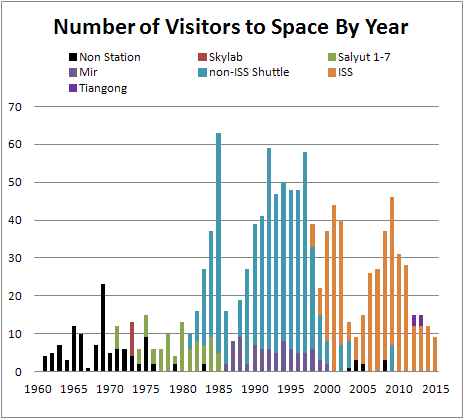
Here are the number of visitors each year:

manned_visitorsThe numbers have dropped a lot in recent years with the retirement of the Shuttle in 2011.  Only about 12 people are going up to the ISS every year, but they’re staying for a lot longer.

The stations are:

  • Skylab: a big station put up with the last flight of a Saturn 5
  • Salyut 1-7: a series of small stations put up by the Soviets
  • Mir: A large station put up by the Soviets and occupied for 14 years
  • non-ISS Shuttle: Missions by one of the 5 US Space Shuttles.  In the 2000s the Shuttle has been almost entirely used for building the ISS, so I’ve counted  those flights in the ISS category
  • ISS: The International Space Station, a gigantic station with contributions from the US, Russia, EU, Japan, and Canada.  It’s probably the most expensive single object ever built, with a total cost of somewhere near $160 billion.   That represents about $2 billion per person-year.
  • Tiangong 1: a small station launched by China in 2011, the first in a future series.
  • Other: all the other various launches, including the suborbital ones by the X-15 and SpaceshipOne, which qualify by getting above 100 km.

Here are some stats by station:

Station Mass (tonne) Pressurized Volume (m³) First occupied Last occupied Number Flights Number visitors Total Person-years
Non Station NA NA 1961 2008 61 117 2.97
Skylab 77 320 1973 1974 3 9 1.41
Salyut 1-7 20 (for 7) 90 (for 7) 1971 1986 37 84 9.76
Mir 130 350 1986 2000 30 80 30.56
non-ISS Shuttle 68 74 1981 2009 98 575 16.79
ISS 420 916 1998 2015 81 373 67.55
Tiangong 9 15 2012 2013 2 6 0.22
Total 724 1765 1961 2015 312 1244 129.26

The ISS has more mass, volume, and person-years than all the other stations combined.

Overall, there have been 312 manned space flights carrying 1244 visitors, of whom about 2/3 (817) flew on the Shuttle.    This represents 559 individuals.   The majority of them have flown more than once.   The number of flights per person looks like this:

Number of Flights 1 2 3 4 5 6 7
By This Number of People 212 153 95 65 25 7 2

The two people with 7 flights are Franklin Chang-Diaz and Jerry Ross.

32 people have spent more than a year in space.  The top five are:

Name Number of Flights Total years in space Last there
Gennadi Padalka 5 2.41 12-Sep-15
Sergei Krikalyov 6 2.20 11-Oct-05
Aleksandr Kaleri 5 2.11 16-Mar-11
Sergei Avdeyev 3 2.05 28-Aug-99
Valeri Polyakov 2 1.86 22-Mar-95

These 5 guys represent only 1% of all astronauts, but 8% of the total person-years in space.

There have been 7 space tourists, in the sense of people who paid personally for a trip, or 10 if you also count Senators Jake Garn (flew in 1985), Bill Nelson (1985) and John Glenn (1998), who finagled trips on the Shuttle.  Charles Simonyi, a Microsoft exec, went twice.   The last tourist was in 2009, so that era may be over.  Glenn was also the oldest person ever to visit space, at 77.   Gherman Titov was the youngest at 25 in Vostok 2 in 1961.

The overall total time spent in space has been declining slightly in recent years, and the number of visitors is way off.   This is again largely because of the retirement of the Shuttle.  Also, the only manned craft currently able to reach the ISS is the Soyuz, but others are under development.   Traffic may pick up if the Chinese ramp up their own stations.  The ISS is due to be maintained until at least 2020, and probably 2024.  After that pieces of it are likely to be used in the next station.   Maybe that will be the one used when assembling the Moon and Mars missions of the 2030s.

Posted in Uncategorized | Tagged , | 2 Comments

Ceres: the Best Place in Space?

We’ve recently learned something extraordinary about the dwarf planet Ceres, something that might make it the most habitable place in the solar system outside of the Earth:

Ceres from the NASA probe Dawn, 2/19/2015

Ceres from the NASA probe Dawn, 2/19/2015

It appears to have an icy mantle 100 km thick.  That would give it more fresh water than the Earth.   It rotates fast, in only 9 hours, but it bulges  at the equator, indicating that it’s made of squishy ice instead of rigid rock.  The Herschel IR telescope has detected water vapor jetting out of certain spots.   The space probe Dawn has seen lots of shiny spots on the planet:

Occator Crater with bright spots. Vertical relief exaggerated 5XOccator Crater with bright spots a few km across. Vertical relief exaggerated 5X

They could be salt, but they’re more likely to be ice.  If so, it’s being constantly replenished from beneath, since it would sublime away into space in the relatively warm asteroid belt.  They could be cryo-volcanoes, oozing ice instead of lava.  It may even have a liquid underground ocean, one that has been freezing slowly over the giga-years, but is sometimes squeezed up to the surface by pressure from an expanding ice shell.

So Ceres might have a lot of accessible water, which is the most basic requirement for life.   It’s also the most basic requirement for space travel, since with water and electricity you can make rocket fuel out of O2 and H2.    Ceres is still close enough to the sun that it has lots of solar power, although it’s 7X dimmer than in Earth orbit.   Yet that also means that it gets much less dangerous radiation from solar storms.   Its surface area is the same as the land area of India, so there’s lots of room.  The spectrum of its surface is like that of carbonaceous chondrite meteorites (which makes it a C-type asteroid), so it has lots of organic compounds.  With organics, water, and sunlight, it’s possible to actually grow things.

It has a low gravity, only 0.03 G.  That’s probably too low for long-term human health, but no one really knows how much we need.   It’s still better than the zero-gee that orbital stations like the ISS have to deal with.  Zero-gee is clearly bad for us, and is a nuisance in general, since plumbing doesn’t work and bits of gunk float into everything.   The Russian Mir space station  ultimately became uninhabitable due to mold, since it was impossible to clean everything.  The smell was apparently hideous.   Even a little gravity would make it much easier to wash things down.  If 0.03G really is too low, one could possibly build centrifuges, at least for sleeping in.

Yet the low gravity is a plus if you want to actually do things in space.  It makes it much easier to get on and off of Ceres compared to the Moon, Mars, or the moons of Jupiter.   The effort to get away from a body is defined by its escape velocity, or delta-vee, and the size of a rocket goes up exponentially with delta-vee.  [To be exact, the Tsiolkovsky ideal rocket equation says that mass_rocket = mass_payload * e ^ (delta-vee / exhaust_velocity).]  It takes gigantic multi-stage rockets to get away from the Earth, with its delta-vee of 11.2 km/sec.  It’s still huge for Mars at 5.0 km/sec.  For the Moon at 2.4 km/sec it took half the mass of the LEM to get away.  For Ceres it’s only 0.5 km/sec.   You could get into orbit around Ceres with only an 0.24 km/sec (540 mph) push, and thereafter use a tremendously efficient ion thruster in order to travel around the solar system.   This is what Dawn itself used.  It needed only 385 kg of xenon propellant to move the 1200 kg (initial) probe from Earth all the way to Vesta and then Ceres, although it did use a Mars gravity assist.

Ceres could be a base for asteroid mining.   X-type meteroids are solid metal, and have high proportions of valuable elements like platinum.  The company Planetary Resources is already working on this, although they’re targeting Earth-crossing asteroids.  Ceres itself might be able to export water and organics to LEO, the Moon, or Mars orbit.  It’s a lot easier to bring it down than to bring it up.

So let’s compare Ceres to various other places people might live in the solar system:

Low Earth Orbit Has no physical resources, no gravity, no radiation or meteoroid shielding.  Does have more solar power and is a lot closer.
Moon Has practically no water or organics and has a deeper gravity well.   Isn’t too far away.
Mars Deep gravity well, a long way away, and there’s a risk of contamination by Earth microbes. Does have more scientific interest because of the possibility of life
Venus Hellishly hot surface and an atmosphere of sulfuric acid makes it utterly uninhabitable.   Even probes only last for minutes. Does have good gravity.
Jovian Moons Really deep gravity well, no solar power, bad radiation levels.  Could be life on Europa.
Kuiper Belt Objects Several billion miles away. Are likely to have water and organics, and would have no radiation hazard. Karl Schroeder uses them as interstellar stepping stones in his striking novel “Lockstep”.

It’s not all that promising a list! Space colonization is a terrible idea in general, but if you’re going to have some self-sufficient manned space bases, Ceres might be one of the best places to go.

Posted in Uncategorized | Tagged | Leave a comment

SF Fail #1 – Bionics

Science fiction has failed in many ways, but I was reminded of one of its more egregious lapses, bionics, just the other day.   I was talking to a coworker who turned out to be an Extropian.  We don’t get many creationists in Massachusetts, but we do get their opposites like this guy.

We were talking about medical wearables, as one does these days.  The electronics for body sensors have gotten so cheap and low-power that they can be scattered about to track all kinds of health measures.  They’re pretty bad today, as witness the problems with smart watch heart rate monitors.   These attempt to measure your pulse by shining an LED through the skin to see blood flow.  Everything disrupts the signal: movements of muscles, perspiration, saturation of the sensor.  Plus the light won’t shine through dark skin, so it’s not just inaccurate – it can be racistly inaccurate.  Great.

Anyway, we were discussing all this when he said “You know, the real answer is to get rid of this meat altogether.”   He plucked at his forearm.   “We’ve got to get out of this weak stuff.”  Oh?  “Machines are obviously what we’ll be in the long run.  Maybe it won’t be in my lifetime, but it’s got to happen eventually.”

He’s thinking of pictures like this:

Model/athlete Aimee Mullins and MIT prof and climbing champion Hugh Herr

Model/athlete Aimee Mullins and MIT prof and climbing champion Hugh Herr

Superhumanly attractive people with superhuman physical abilities.  Mullins lost her legs due to a birth defect, and Herr lost them to frostbite while trapped during a mountain storm.  Both were competitive with able-bodied athletes, and Herr has been steadily improving prosthetics at the MIT Media Lab.  They sure look like the next generation.

But perhaps the obvious bears repeating:

No artificial replacement of a body part is as good as the healthy original, including teeth and hair.

Dentures stop fitting and wear out.   Toupees are causes of mockery.   Artificial hearts need horrific operations and only help until a transplant can be found.   Artificial limbs don’t join properly with the natural limb and are never as controllable.   They’re just about at the point where they can make a decent ankle.   They’re getting there with knees.    Hands?  Tongues?  Eyes? Nowhere near.

Your existing organs are almost certainly older than any machine you own.   They have a huge advantage over any artificial version – they can repair themselves.   No machine can reproduce itself – it takes an entire industrial system to do that.

That’s not going to change.   Forget about 3D printers that can reproduce themselves – they can’t even make their own motors, much less their chips.   Machines use a far wider range of the periodic table than any organic system, because organics have to rely on what can be eaten in the local environment.  Machines can use trade networks that span the planet.  It’s always going to be easier to make something with central, specialized equipment than it is to put some kind of universal fabricator into every widget.

The ultimate answer to replacing failing body parts is going to be regrowing them.  This is already getting huge attention.  People have used stem cells to regrow tracheas and livers.  The new parts will be bio-compatible with the old, and not instantly attacked by the immune system.   They’ll adapt as the body changes and keep themselves in good repair.

What they won’t be is superhuman.  They’ll be better than what you have, and maybe even as good as what you had at age 20.   But becoming superhuman through mechanical parts?   An illusion.   Yet it’s one that even people in high-tech hold, thanks to the dreams of science fiction.


Posted in Uncategorized | Tagged , | 1 Comment