
Several weeks ago my wife and I went out looking for autumn foliage. We went to one of the wildest places in Massachusetts, the great park that contains the Quabbin Reservoir. It was too late for leaves, but still had wonderful views:
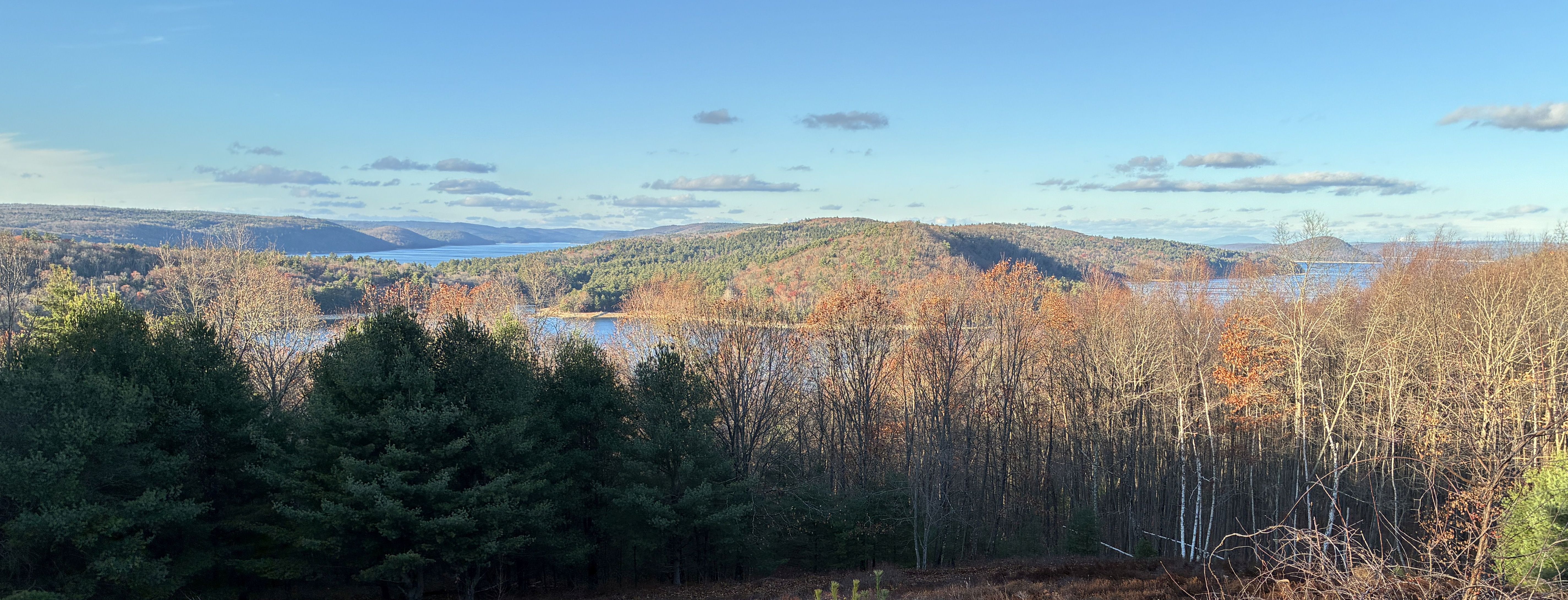
The Reservoir is gigantic – you can see how it disappears into the distance. It covers about 100 km2, contains 1.5 billion m3 of water, and delivers 8.7 m3/s of water to Boston. That’s more flow than the Charles River! It supplies several million people in eastern Massachusetts.
It took nine years from 1930 to 1939 to clear the basin of vegetation, move the main structures and the graves of the towns that were drowned, and build the dams that held in the Swift River. It took another eight years for the basin to fill. It feeds eastern MA through an underground aqueduct 40 km long, one of the longest in the world. The tunnel could take a train. The whole system is gravity-fed, since the Reservoir is about 120 m above sea level, and so needs no pumps. It needs no filtration plants because the drainage area around it is kept clean and free from development by the park.
It’s a great example of liberal engineering. That is, it was built for the benefit and enjoyment of citizens, and created by their representatives. It was designed and is operated by a state agency, the Metropolitan Water Resources Authority. No private firm was allowed to profit off this critical infrastructure. It was carefully planned over several decades to meet the needs of all the towns of the state, and has now for 80 years. It has excellent public access for hiking, biking and fishing, with no annoying fees or ads or retail. The built parts are nicely landscaped, and there is an interesting small museum by the main dam.
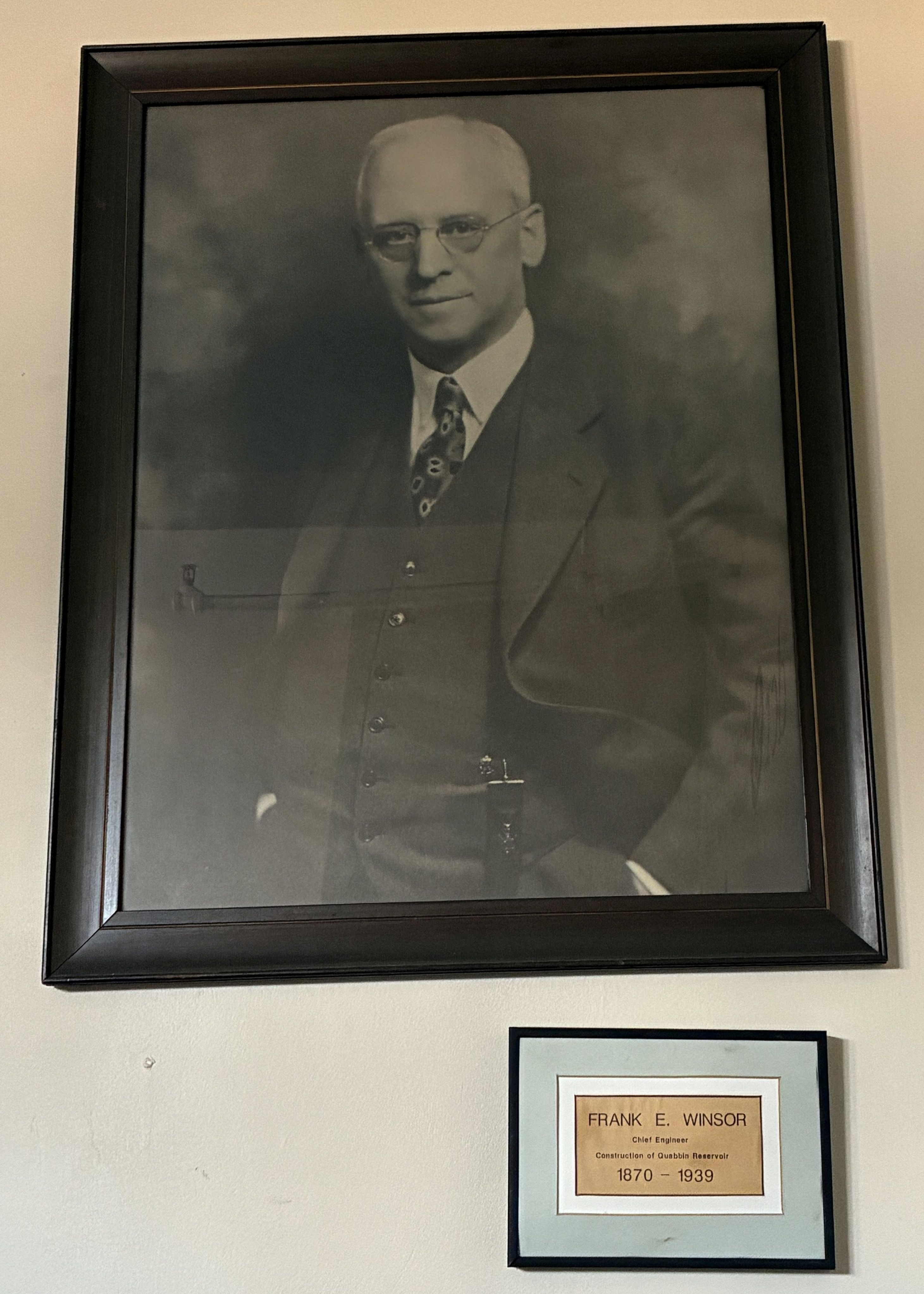
The head of the Authority at this time was one Frank Winsor. He also built much of Providence and New York City’s water supplies. This was his last project, and he died just before the main dam was completed. It’s now named for him. He was a public citizen as well, serving as head of the American Society of Civil Engineers, and a Fellow of the American Academy of Arts and Sciences. He wasn’t a technician or bureaucrat – he greatly enhanced the quality of life in the state.
The most controversial part of the project was the displacement of the 2500 people who lived in the basin. They were naturally unhappy at losing their towns. The state bought out some of the land and took the rest by eminent domain. This is a hilly, rocky area and could not have been good for farming anyway. Because it was all done under public supervision, the move of the people was done carefully. The major public buildings and churches were moved to nearby towns. People were particularly concerned about the graves of their ancestors, so they were moved too. Some people were able to move their houses, while others were just demolished. In 1939 the residents of Enfield, the largest of the towns, had a grand fair to say goodbye on the day before they had to evacuate. The memory of the lost towns was maintained by public memorials and archives, and there’s a lot about them in the museum. This is far from the bulldoze-everything-in-the-name-of-progress attitude that characterized Robert Moses, crucial though his projects were.
A project like this could almost certainly not be done today. Property owners are much more jealous of their rights, and would have sued endlessly to delay it. It’s hard today to even build transmission lines across remote woods to bring Quebec hydropower down to New England, although much of the opposition there is from gas companies. Waterfront owners have successfully blocked offshore wind projects because they did not like the change in their views. The builders would have put in more expensive filtration plants instead of buying up all the park land. It would likely be privatized, although that corrupt fad may be over.
It does have one odd memorial – it’s the site of one of H. P. Lovecraft’s most famous stories, “The Color Out of Space”. A meteor lands on a remote farm, and strange gases rise up out of the ground around it. The plants and animals of the farm become twisted and grotesque, and ultimately the farmer and his family go mad. The whole area is then flooded by the Reservoir, much to the relief of the narrator, although he worries what lies beneath these deep waters.
Yet today it looks anything but sinister! It’s grand views are a nice place to picnic. This is the way to show your tax dollars at work.

