
I recently learned about an extraordinary archeological discovery, that of an ancient high-tech culture that really was drowned in a cataclysm. It just didn’t happen to be the one Plato was thinking of when he described Atlantis. He was probably referring to the Minoan towns destroyed by the eruption of Thera (modern Santorini) in about 1600 BCE, but this was a place vastly older and farther away – the Neolithic Chinese town of Jiahu:
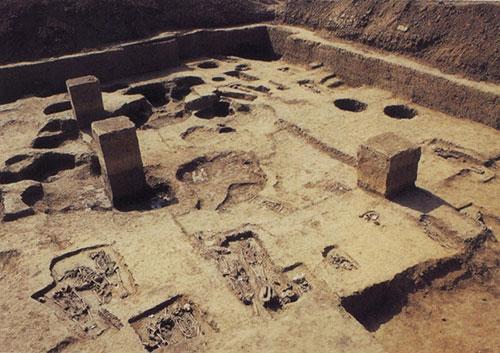
The site is in central China, Henan province, and is 9000 (!) years old. It’s on the plains between the Yellow and Yangtze rivers. It was discovered in the early 1960s, and has been under intermittent excavation ever since. It’s now a tourist attraction for the town of Wuyang.
So what makes this high-tech? At a time when almost all societies were still nomadic hunter-gatherers, this place had:
- Agriculture – the first evidence of rice cultivation in China, and also millet.
- Alcohol – pots were found with fermented rice, honey, grapes and hawthorn residues. Dr. Patrick McGovern at U Penn figured out the recipe and Dogfish Brewing in Delaware made it as Chateau Jiahu. This is the oldest alcohol recipe known.
- Music – About 30 bone flutes, generally in a pentatonic scale. They were made from the wing bones of the red crown crane, an Asian bird admired to this day for its elegance but now endangered. They’ve been able to date the flutes and see a progression in quality and tonality. Tech advanced even then. More here from a curator of their exhibit in the Henan Museum: Jiahu Bone Flute of Wuyang.
- Writing – There are tortoise shells with symbols carved on them. No one can read them, but they are grouped and the pictograms do recur. Understandable writing only came many millennia later.
- Domestic animals – pigs, poultry, dogs, and even some cattle. A pond was used to raise carp. Food was plentiful and good.
- Defense – the village was surrounded by a moat. The human skeletons found do not show signs of violence. They lived to a decent age too – maybe 40 on average. They appear to have been an egalitarian culture – there are not many differences in grave goods among them.
Just imagine being a primitive hunter slogging across the plains and coming upon a place like this. A place where people lived long and peaceably, ate well, and spent their time drinking, making music and crafting written prayers to the gods. They doubtless would not let you in, but it must have looked like paradise.

The village appears to have had between 250 and 800 people in it at a time. It lasted for 1300 years until a flood from a nearby river drowned it in 5700 BCE. It was evacuated in an orderly manner – no tools or household effects were left behind. The flood and its sediment is undoubtedly why it was preserved, rather than reworked by millennia of later settlement.
It didn’t have the trappings of the Tomb Raider Atlantis – lasers, god statues with glowing eyes, levitating pyramids – but it sure looked sophisticated. There is as much time between us and the Great Pyramid, 4500 years, as there is between the Great Pyramid and Jiahu. There was a lot going on very early that we know little about.
 A Niche in the Library of Babel