
Let me again recommend the WGBH podcast, The Big Dig, which was the inspiration for these posts. It’s full of great stories, but I’d like to concentrate on the innovations that made this vast project possible. Last time I talked about a key part of the concept, moving the ugly and filthy Central Artery into a tunnel. The tunnel had to be dug while the Artery was still active above it, but how? The key was:
Slurry Walls
This is a technique pioneered in Italy for the construction of the Milan Red Line in the 1950s. Its first use in the US was in Boston in the 1970s, where it was used for the Red Line extension in Cambridge from Harvard Square to Alewife The driver of the Big Dig, Fred Salvucci, was involved in that project, and learned about it there. It works like this:

A big claw excavates a slot in the ground, and as it works the open space is filled with a slurry of a clay material called bentonite. The slurry is semi-liquid, so the claw can drop down through it to get at the soil at the bottom. It holds the sides apart during the digging. Once the slot is done, a cage of reinforcing rods is put in, filled with concrete, and the slurry is pumped out. The result is a wall that extends down into the earth.
The Big Dig was far and away the largest use of slurry walls in North America. 8000 meters were built, to a depth of about 40 meters. Two were built, one for each side of the tunnel. Beams to support the above-ground Central Artery were then laid across them. Then the space between was excavated, and more beams were put in to support the walls. The whole space down to the tunnel level was dug out, and then the tunnel was roofed and the space above filled in.
I actually got to see the tunnel being built on a tour in April 2000:

The slurry walls are on the sides. The space is held open by huge I-beams like the one in the middle. Here’s one being lowered in from way above us:

We were walking around amidst all this activity with people working high overhead. I was thinking “Civilians really shouldn’t be here,” but the Dig had remarkably few accidents for a project its size. I did pick up a big bolt as a souvenir:
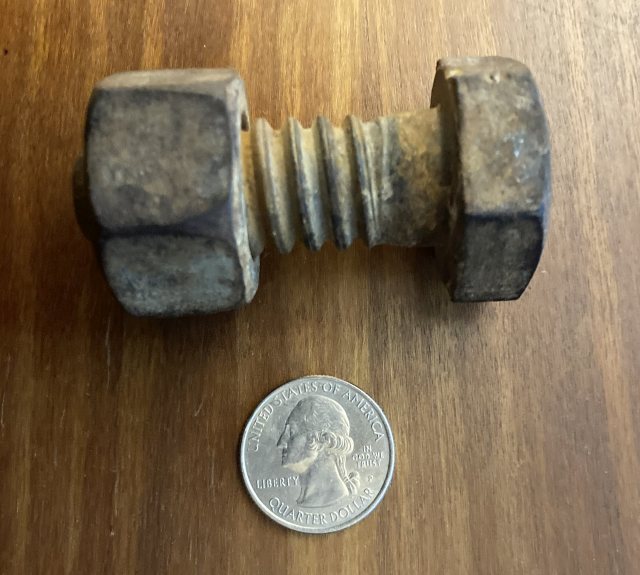
So if it collapses, you’ll know why.
Tunnel Jacking and Ground Freezing
The slurry wall was fine for digging the main channel for the Artery, but wouldn’t do for the harbor tunnel. It had to cross beneath the dozen railroad tracks for the city’s main train station, and be dug while the trains were in operation. The ground beneath the tracks was just glop, so it couldn’t be excavated from underneath. The answer was to do enormous concrete castings of the tunnel sections and ram them through underneath the tracks. Here are giant hydraulic rams pushing a casting forward:

The huge brown steel cylinders are the rams. As they moved, those shorter cylinders would be put in as spacers. From above it looked like this:
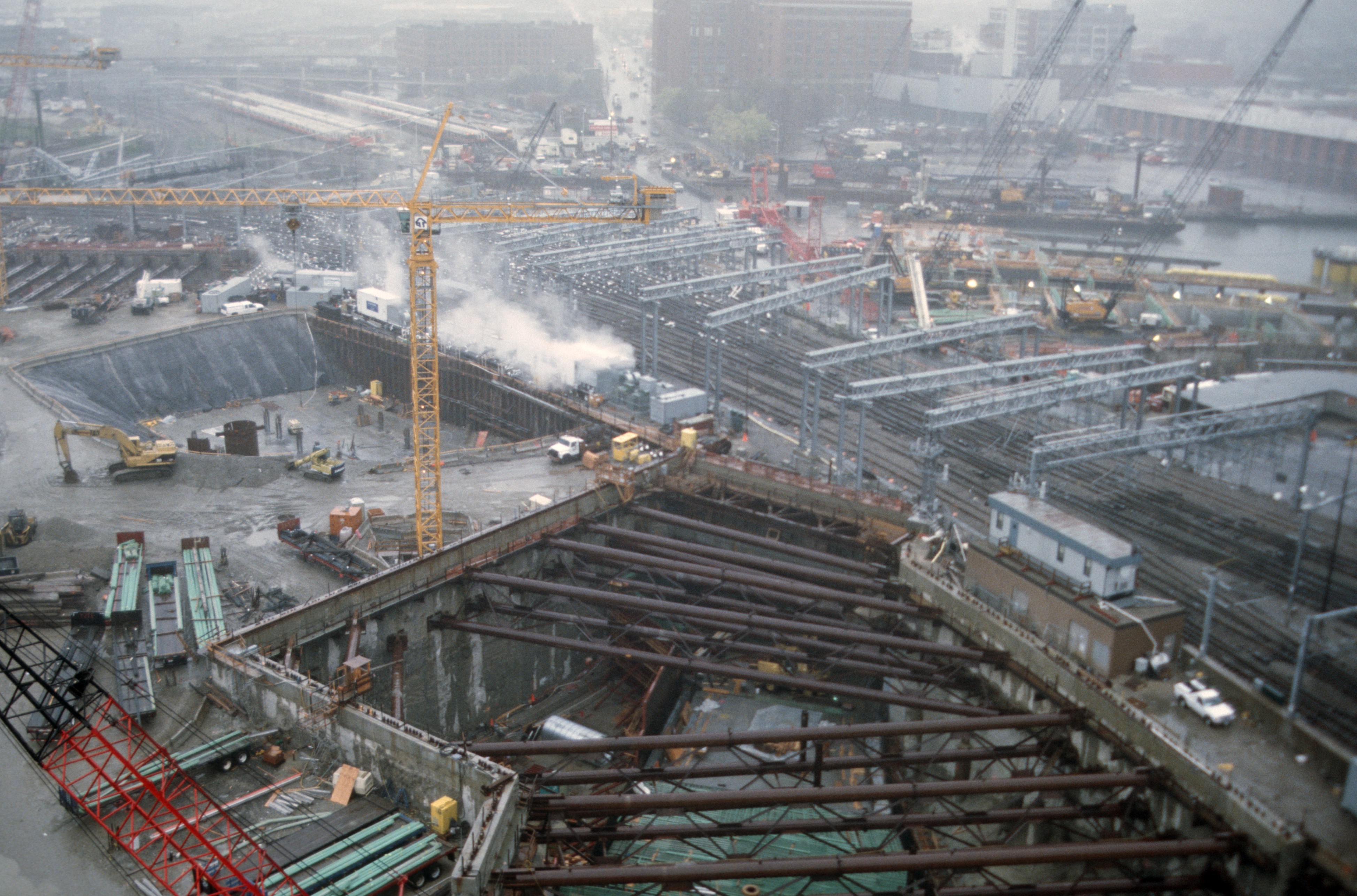
This is looking south from South Station. The main tracks are in the center, and three tunnels (one on the bottom, one on the left, and one in the upper left) are converging to merge beneath the tracks before going under Fort Point Channel and then Boston harbor. The tunnels can be dug down from above and then the sections cast and rammed into place.
Yet there were some spots that could not be supported by big beams above, like right next to the tracks. That’s where ground freezing came in:
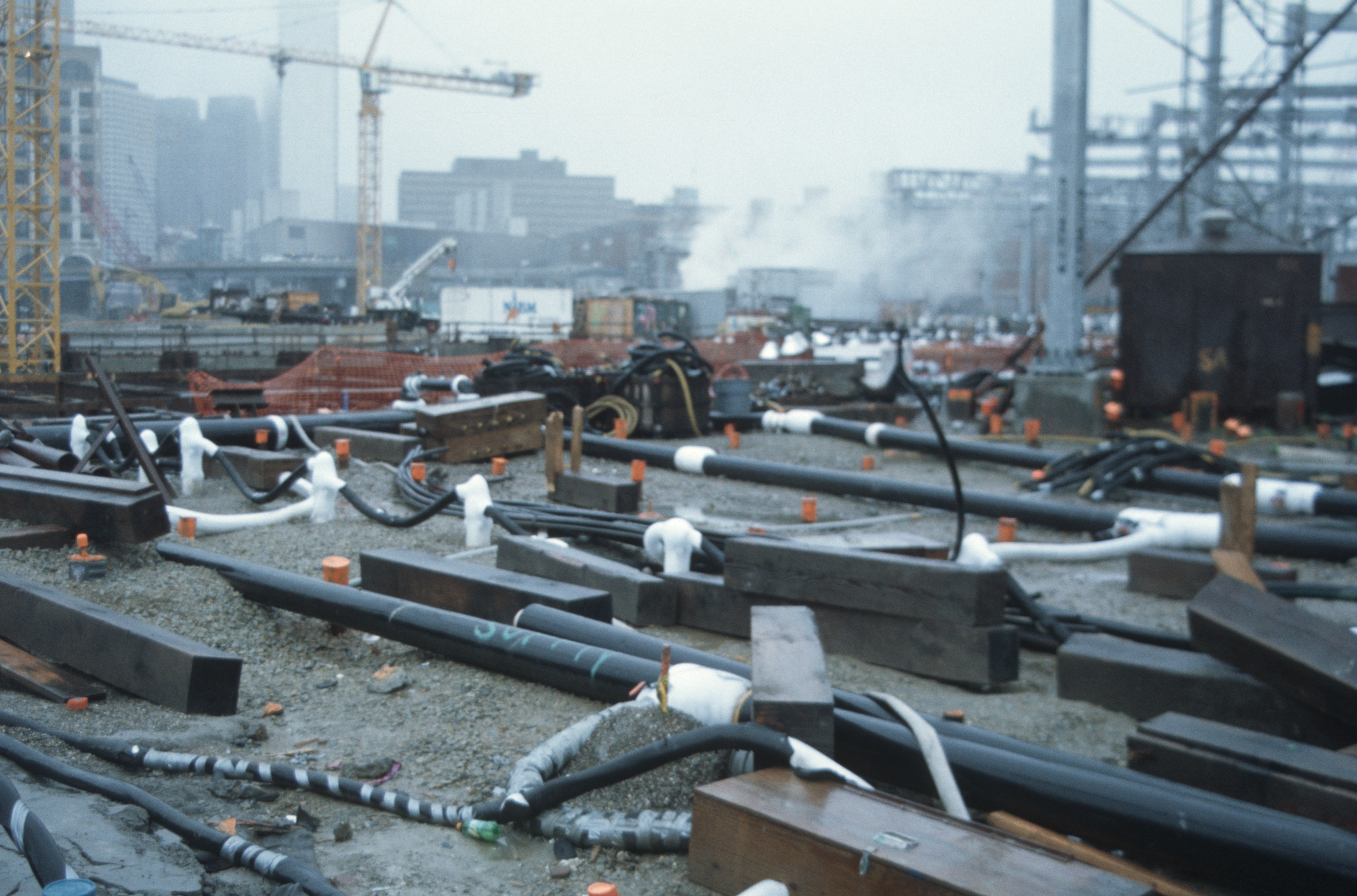
The black pipes are carrying a saline solution cooled to well below 0o C. They run through pipes underground and keep the soil frozen while tunnels are being rammed beneath them. They had to maintain this for a few months until the tunnels themselves could support the ground above them. It was artificial permafrost at latitude 42o . They timed it so this was done in the winter and spring! Summer heat would have screwed it up.
Fortunately, they did not have to do either of these for the water crossings. There they could excavate trenches at the bottom of Fort Point Channel and the Harbor, float the tunnel sections over them, and then sink them into place. The sinking took days, but they were placed to centimeter precision. The underwater parts of the Dig were actually relatively easy, exactly because they didn’t have to worry about existing structures.
Next up, fixing the worst design flaw in the whole project – Scheme Z.
 A Niche in the Library of Babel
Makes me want to listen to the podcast again!