Cool Space Stuff: VLEO and Electric Jets, Rocket Planes

Here’s a quick dump on some novel ideas: satellites in very low orbits so they can take better pictures, using electric jets to deorbit space junk, and a rocket plane with big ambitions from New Zealand!

Very Low Earth Orbit Satellites

Space officially begins at the Karman Line, 100 km, but all current satellites orbit a lot higher, above 350 km. The atmosphere up there thins out enough so there isn’t much drag. There’s still some – the ISS is at 400 km and needs to be reboosted about once a month. The range between 100 and 350 km is called Very Low Earth Orbit, VLEO. There’s a lot more drag there, and that’s actually an advantage since the satellites deorbit themselves and there’s no space debris to hit them. Being closer to the surface means it’s much better for optical imaging, and far better for radar and lidar imaging. It has just gotten its first commercial customer – the Clarity-1 satellite by Albedo Space:
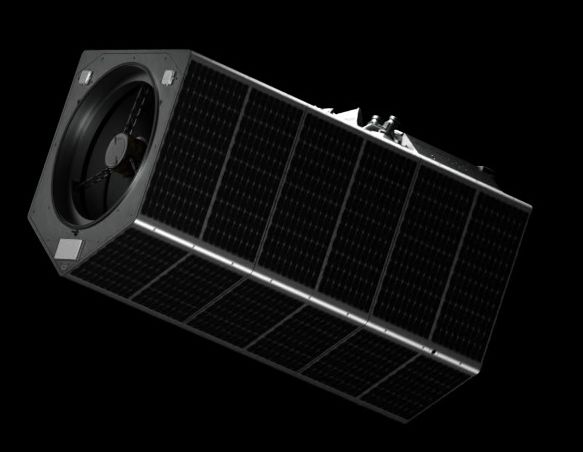
It’s about the size of a refrigerator, and will orbit at 275 km. That big aperture at the end is a telescope pointed at the ground. It can take pictures at 10 cm resolution, while typical satellite imagery is at 30 cm. You can get the picture 30 minutes later. It’ll fly over every spot on Earth every 15 days, which will drop to 2/3 of a day when the whole constellation of 25 satellites is up. Those solar panels drive a xenon-fueled ion thruster. There’s a phrase that tells you we’re living in the future! It ionizes xenon gas and accelerates it out the back. When the xenon runs out in about five years, the satellite burns up. It may burn up earlier because oxygen molecules that high up get turned into lone atoms that corrode everything they touch. This mission will see how bad that is.

10 cm is about enough to recognize the make of a car. Albedo touts it for us in agriculture to track field growth, in urban areas to track land use, in supply chains to monitor shipping, in climate research to verify models, and of course in the military to see where everyone is.

Electric Jet Propulsion in VLEO

275 km is still kind of high. How could we get more thrust to fly lower? By using the air itself as reaction mass. Instead of ionizing xenon, you ionize the air itself and accelerate it, just like a jet. There are several companies working on this. The one that appears to be furthest along is the general space tech company Redwire, which is pitching SabreSat for the US military:

Last year they got a DARPA contract to build this, using propulsion systems from either the Electric Propulsion Laboratory in Colorado, which got $5M, or from Phase Four in Los Angeles, which got $15M. No word on time frame, though. Like Albedo, they want to use it for imaging. They’ll get a lot lower, like 150 km. The satellite actually needs to be aerodynamic at that point, and thus the wings.

One positive aspect of this compared to normal reconnaissance satellites is that if it’s taken out by an anti-satellite weapon, the pieces will deorbit on their own. LEO is already full of junk from previous anti-satellite attacks by the Russians and Chinese. Recon sats are the natural targets, so this is bound to happen more. Space war will happen at some point, but it shouldn’t poison the environment in the way that, say, mine fields poison a landscape.

More ambitious but much smaller is Viridian Space, which wants to not just fly at a low orbit, but get enough thrust to get to LEO at 500 km. They want to build an air-refuelable satellite, able to change orbits at will. That would let them pop up, grab a piece of space debris, and bring it down to let it burn up. It might take a year to move up and down this way, but put enough of them up and then can do a lot of cleanup. They’re vague on the details, but I think this means that they actually want to capture air for use in the higher orbit. Collecting air at 8 km/sec will be … interesting.

Dawn Aerospace Rocket Planes

It’s obviously ridiculous to throw away a whole rocket after one launch, so people have always thought about adding wings so that it can fly back. That was the idea for the X-15, and for the Space Shuttle itself. In those cases the rocket plane was the last stage, but it’s the first stage that is actually the expensive part. It also turns out to be much harder to dump all the energy from orbital velocity than it is from relatively slow first stage. Thus SpaceX reuses the first stage of the Falcon9 almost all the time, and will reuse the first stage of Starship, the Super Heavy Booster, as well.

Yet developing those was horribly expensive – they crashed and blew up a lot. The Starship program has already spent at least $5B. That’s one reason why no one else has gotten reuse to work in the 10 years since SpaceX first did it – the R&D cost didn’t justify the return. Even SpaceX, the most successful launch company ever, only made $4.6B on launch in 2024. The smallest company on the Fortune 500 has sales of $7B, so it’s in the noise. The real value for SpaceX is in launching the Starlink Internet communication constellation, which is already making a lot more money than launch.

One answer to developing reuse is to find a much less expensive way to do it, and that’s where the plane comes in. It can be launched again and again, allowing all its systems to be tuned up. That’s just what Dawn Aerospace has done with their first craft, the 1/4 scale Mk IIA Aurora:

The spectacular scenery is from the South Island of New Zealand, where they have their runway. It doesn’t need an elaborate and expensive launch pad. They’ve already flown it to Mach 1.1 and 30 km. It’s not big: 4.8 m and 350 kg. It’s remotely piloted with steadily more autonomy. The rocket engine burns kerosene and 90% hydrogen peroxide, which does not need to be cooled like liquid oxygen, and so is much easier to handle.

The next generation is the Mk-IIB, which they hope to get to 110 km and Mach 3. It’ll have a 5 kg payload of a 3U cube-sat. It can deliver small packages to 300 km away in minutes, or provide 180 seconds of micro-gravity for experiments, or test hypersonic structures. The next step is the big one: the Mk III at 22 m, 23,500 kg, and capable of launching a second stage into orbit. It could deliver a quarter to a third of the delta-v needed to achieve orbit, which is a bit less than what the Falcon9 first stage does, and it would be for much smaller payloads.

Sadly, that might not be viable. Falcon9 launches so often that it’s easy to get ride-share cube-sats on it, which cuts into the market for smaller launchers. Rocketlab does all right in that niche, but they’re building a much larger rocket, Neutron, to compete directly. Still, there’s a high coolness factor for this Dawn approach, and launching with them would mean you get to visit New Zealand. Here’s wishing them luck!
Posted in Uncategorized | Tagged | Leave a comment

“Sapiens” and the Fifth Order of Being

Click for publisher site

Yuval Harari’s “Sapiens: A Brief History of Humankind” (2011) is a Big Think book, attempting to cover a vast range of subjects in a way that non-specialist readers can follow. In this case it’s the development of our species over the last 100,000 years, which means summarizing paleo-anthropology, archaeology, history, and sociology. It’s very easy to get key things wrong in such a broad survey, and scholars of these fields were unimpressed.

Nevertheless, there is an idea in the book that I have long agreed with, and so would like to say a bit more about – that humanity has brought a fifth order of being into the world.

Every child knows the first four orders:

  • People – who can speak, and move, and grow
  • Animals – who can move and grow
  • Plants – who can grow
  • Stuff – which just sits there.

This covers about all that you see in daily life.

So what would the next order up be? People have thought about this forever. There must be orders beyond us. Those are spirits and gods. They can do things that we long to do but can’t – read one another’s hearts, live forever, fly. Just as we make things, they must have made the world itself.

Yet there really are intangible beings in the world, and they really do dominate it. They are social organizations. They come in many flavors: governments, companies, schools, guilds and professional associations, clubs. They really can (theoretically) live forever, and some are millennia old. That’s far longer than any animal, and nearly up to extreme plant lifetimes. They do most of the work of the world.

An individual human being is a weak creature. A dog can live on its own in the woods for years, while a naked person wouldn’t last a month. Even hominids always lived in groups, as do the great apes. Hominid skills with fire and rocks were enough to let them spread out across Eurasia, but they still didn’t have the success of, say, bears.

It was only about ten to twenty thousand years ago that homo sapiens really started to rise. That happened with the domestication of dogs, and the rise of agriculture, and of metal working, and of stone structures. All of those need cooperation and education. One person might entice a wolf to sit by a campfire, but it’s only when the whole clan adopts them and uses them that dogs join human packs. You need a lot of people to clear and tend a field, and store its produce. No individual could figure out that green-ish rocks could turn into beautiful copper when melted, and was really handy for trading with other tribes. Having a big visible site like Göbekli Tepe full of stone monoliths was worth building if a lot of people could rendezvous there, and if a lot of people could help raise its huge weights.

By five thousand years ago most humans lived in riverine societies in China, India, Mesopotamia, Egypt, and Peru. They had become part of social groupings much larger and more powerful than, say, beehives or even termite mounds. Writing was then used to transfer information far more widely than speech could, and over far more time. It was then possible to organize hundreds of thousands of individuals to irrigate with the Euphrates or raise pyramids.

Today hardly any humans still live in simple hunter-gatherer bands. Only those in remote parts of the Amazon, Java, or the Kalahari still persist. Everyone else is in some social organization or other, and usually many. You personally are likely to have the natural mammal relationships of family, but also to work somewhere, and vote somewhere else, and be involved in some other social groups. Because they can draw upon thousands or even millions of human minds, they can handle tasks far beyond any single brain, and that has let them remake the planet. People are like the leaves of a tree in these organizations, growing on their own, but contributing to the whole.

These new beings are tough. Take one like the Humboldt University of Berlin. It was founded in 1809 and so is 216 years old. It was the leading scientific operation of the 19th century, boasting faculty of Schopenhauer, Planck, and Einstein. Then a third of its staff was purged by Nazi anti-semites, and it was bombed flat by the Allies. After the War it was split in half by the Berlin Wall. It came together again 45 years later in the German Reunification. Even a tree couldn’t survive such trauma, but it now has 40,000 students. 57 Nobelists have worked there. This is all pretty good, but not even all that old or large compared to political organizations.

Getting back to Harari, he has a dim view of the future of humanity. If we don’t extinguish ourselves, we’re likely to be replaced by robots and AI. Yet it seems to me that the future lies in this new class of being. I have no idea what will happen to homo sapiens, but we can see that social organizations are only gaining in power and sophistication. New organizational forms like parliaments and limited-liability corporations have proven to be far more effective than the older feudal courts and merchant guilds. Insights from sociology will tune them up even more. People will undoubtedly be changing too, but they will still need to operate inside organizations of some kind. If we ever leave the planet, it will be as part of great cooperating groups of people, not as individual hunters.

Posted in Uncategorized | Tagged , , , , , , | Leave a comment

The Discrete and the Flashy at CES

I was just at the 2025 Consumer Electronics Show in Las Vegas. It’s the biggest tech show in the world these days, with 140,000 attendees and occupying a lot of the city. It fills the gigantic Las Vegas Convention Center, which is about a mile across on the diagonal, and also occupied the spectacular Venetian Hotel. It’s a firehose of new products, and is so big that it’s difficult to absorb.

It reminded me of the funny SF novel “First Contract” by Greg Costikyan (2001). The Galactic Federation finally contacts Earth, and everyone is overjoyed, until they realize that they have to pay for the anti-grav cars and the immortality drugs, and Earth has nothing to sell. A desperate human entrepreneur talks his way out to a galactic trade show, one that occupies a whole planet. Large companies have continents for booths, while smalls settle for islands like Britain. He actually interests someone in a product idea, a squeeze bulb with a suction cup to keep it from floating around in zero-gee. The buyer says “OK, let’s start with a minimum order, say, two trillion?” Hey, it’s a big galaxy! Humanity has to level up. All of Earth’s industries become devoted to making squeeze bulbs, because you gotta do what you gotta do.

Anyway, the big new products at CES this year were robots. They had ones the size and shape of dogs, even though Boston Dynamics never did find a use for their Spot robot. They had humanoid ones, which are mainly a play by the tech-feudalist overlords to scare workers into not unionizing. There were some actually useful ones like drones (the reason why Ukraine is still free) and package delivery bots that could carry your luggage around an airport. Then there was the massive attention on self-driving cars, with robo-vans that you could walk into, and lots of new sensing schemes.

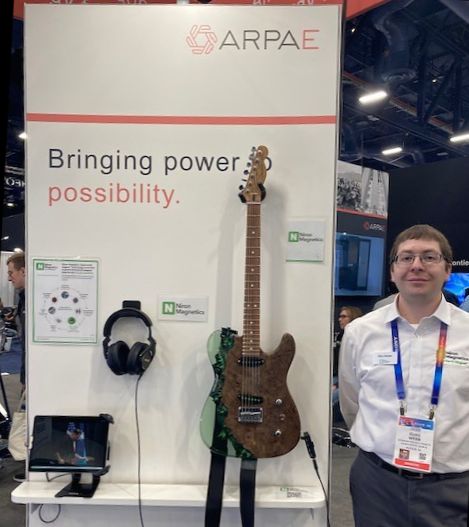
Niron poster session at CES 2025

Sure, something will come of all of these. Yet I was more impressed by a little company called Niron Magnetics. They didn’t even have their own booth – they occupied a corner of a booth sponsored by ARPA-E. This is the research arm of the US Department of Energy, and is directly modeled on the Pentagon’s DARPA. They gave Niron startup money to commercialize a profound idea – building strong magnets out of iron and nitrogen. A professor at U. Minnesota, Jian-Ping Wang, has been working for 20 years on how to make Fe16N2 thermally stable. This is a particular crystalline form of iron with a few nitrogen atoms inserted in the lattice. It can deliver 30% stronger fields for a given weight than current rare-earth magnets! And it doesn’t need the neodymium or dysprosium that come from hellishly polluted mines in Mongolia. Refining a kg of Nd creates 200 kg of toxic waste. That’s why there are no mines of it outside of China these days.

Stronger magnets are useful everywhere. Have you ever noticed how cars suddenly got power windows and power seats in the 90s? That was because rare-earth magnets made the motors small and cheap enough that they could be used everywhere. GM actually pioneered them. A typical car cabin now has 21 motors: 8 for the windows and locks, 6 for the seats, 4 for windshield, cabin, and footwell fans, and 3 for the rear hatch and wipers. They used to have 2 – the fan and front wiper. All modern advances – EVs, robots, hard drives, and even inflatable lawn decor – have benefited from strong magnets.

Niron picked a cool application for their first samples – an electric guitar. The steel strings give a signal when they vibrate in a magnetic field. On their site you can see someone playing! They’re building their first factory now in Minnesota, and plan to scale up to thousands of tons as yield improves. Here’s wishing them luck! They only had one guy and a discrete poster at this show, as compared to all the flashy robots, but they could be a big deal.

Posted in Uncategorized | Tagged , | Leave a comment

Trump Will Be a Disaster for High Tech

Trump will be a disaster for the entire country, of course, but let me concentrate on his effect on my own area, that of high-tech. I see the following places where he’s most likely to damage the field: curtailing the flow of talent to the US by immigration restrictions, and encouraging financial crime in the high-tech sector.

First up: immigration and talent. The CEOs of Microsoft, Alphabet, IBM, Tesla, AMD, Broadcom, Nvidia, Adobe, Micron, and Zoom are all foreign-born. I actually work for an Irish CEO at a semiconductor company. Forbes estimates that about half of the high-tech firms in the Fortune 500 were founded by immigrants or their children. The American Immigration Council estimates that of the 10 million STEM workers in the US as of 2019, about a quarter are immigrants. I once found that 30% of the Nobel Science Prize winners who did their main work in the US were not born here, the highest proportion of all the countries who had won a significant number of Nobels.

Of those 2.5M immigrants, maybe a third, 750K, are here on H1-B visas, an oppressive company-controlled system. The tech-bro faction of Trumpism loves H1-Bs because they’re forced to work hard and work cheaply, since the visa is held by the company, not the individual. That fits with their feudalist attitudes. They’re trying to replace low-level workers with AI anyway, although that’s likely to go as badly as their attempts to robot-ize.

Regardless, a lot of the rest are on green cards, general work visas. They’re all at risk under Trump. I work with many people in this situation, as does all of high tech. They’ve come here to contribute their talents to US operations in return for pay, experience, and opportunity, and they are a major national asset. A lot of them find that they prefer the relatively open and tolerant US, since home may be Russia, or Iran, or China. If you were an enemy of the US, one of the best ways to destroy its international dominance would be to keep this talent out.

You might think that MAGA-ist hatred is directed mainly at lower-class immigrants, at the Central Americans and Caribbeans whose desperation keeps all the low-end wages low. That ignores the jealousy component of hate. East Asians and South Asians do very well in America, with much higher incomes and educations than MAGA whites. Hatred of them is the latest version of anti-Semitism, and has the same sources. They’re not taking the crummy jobs – they’re the doctors, lawyers, and engineers. They’re going to be particularly targeted, regardless of what the tech-bros want.

Second – Trump will enhance crime. There are several kinds of high-tech crime. The most obvious is crypto-currency, a tech that has found no legitimate uses, but is great for moving illegal money around. It is especially good for moving money out of China, which its government otherwise restricts, and that’s where most of the crypto mining happens. The crypto-crats were all in on Trump, since they fear the restrictions that decent regulation would bring. They also hope that the federal government will bless their field, perhaps by using crypto for government transactions, and so prop up their various frauds.

Another major type of high-tech crime is stock manipulation, something that Elon Musk is expert in. He was convicted of it by the SEC after he claimed that Tesla was going private, and settled for $40M and stepping down as chair in 2018. He has hated them ever since, and will do his best to defang them. Yet the problem is widespread in the Valley, ranging from the outright fraud of Theranos, to the eye-watering valuation of Nvidia today. It briefly eclipsed Apple as the most valuable company in the world at $3.4T, although it only has a quarter of Apple’s revenue. It alone accounts for much of the rise in the S&P 500 this year, and it’s all based on over-hyping AI. Trump will basically disable financial regulation, allowing scamsters to loot other investors.

The third major type is monopoly. Google is particularly guilty of this, what with controlling about half of the world’s advertising. They control the market for it, being both a buyer and seller. Amazon likewise has a lock on company exposure, what with requiring firms that sell on Amazon to not undercut its prices elsewhere, and to pay exorbitant fees. Both of them were about to lose to Lina Khan, the current head of the FTC appointed by Biden, and both of them will get away when she is replaced.

The hyping and the monopolies are why high tech has not delivered much recent years. They are driven to pump up each new idea to ludicrous levels: Large Language Models (AI), virtual reality (the Metaverse), and self-driving cars. There is value in each of these, but nowhere near as much as they claim. Ed Zitron has a nice term for it – the rot-com economy. They pretend to be innovators while their actual revenue comes from attention theft and vicious business practices.

Grifts are what has defined Trump’s career. He has operated entirely on hype his whole life. His only mode is bluster. The tech people around him operate the same way. They’ll use lax regulation and disinformation for their own wealth and power. High tech already has a lousy reputation, what with the harm caused by social media and the gross scandals that that have been perpetrated under its banner. Signing on with an obvious fool and criminal like Trump will harm it even more.

Posted in Uncategorized | Tagged , | Leave a comment

“Orbital” – A Hymn to Earth That Puts SF to Shame

Click for author website

Everyone is raving about this sort-of novel, and it’s clear why – it’s a stunning meditation on the beauty of the Earth, as seen by six astronauts on the International Space Station. Not much happens. It just follows them across 16 orbits, a single day, as they see sunrises, noons, sunsets, and tapestries of city lights or great black spaces at midnight. The language is lush, almost overwhelming. It’s the most lyrical writing set in space that I’ve ever read, beating even Kim Stanley Robinson’s “Red/Green/Blue Mars”.

So SF writers – up your game! This is what you need to win the Booker Prize as she did. Harvey doesn’t use any genre tropes, but she is writing about the urge to explore, to get out of the mundane, to find the wonderful, and that’s what SF is about. That’s what drove all the characters here.

Yet she also writes about how routine their lives are on the station. The people there are kept constantly busy with experiments or repairs, but it looks like make-work. The ISS has now become a backwater as far as programs go. It has aged badly, and only has a couple of years left. During this one day, the next phase of space exploration begins as a crew is launched for the next Moon landing.

Still, between the workouts on the stationary bike and the replacing of filters and the worry about loved ones down below and the constant background noise of fans, there’s the magnificent view of the Earth out of every porthole:

In the new morning of today’s fourth earth orbit the Saharan dust sweeps to the sea in hundred-mile ribbons. Hazy pale green shimmering sea, hazy tangerine land. This is Africa chiming with light. You can almost hear it, this light, from inside the craft. Gran Canaria’s steep radial gorges pile the island up like a sandcastle hastily built, and when the Atlas Mountains announce the end of the desert, clouds appear in the shape of a shark whose tail flips at the southern coat of Spain, whose fin-tip nudges the southern Alps, whose nose will dive any moment into the Mediterranean. Albania and Montenegro are velvet soft with mountain.

It all reminds me of a new UU hymn by Peter Mayer. The tune comes from an old Welsh hymn, but Mayer updated it to our current out-looking age. It’s called “Blue Boat Home”:

The Earth is our mother, our oasis, our ship in the endless sea. That’s what every single astronaut has noted, and it’s what this novel and song evokes.

Posted in Uncategorized | Tagged , , , , | Leave a comment

What Should the “2001” Aliens Have Given Us?

I recently saw “2001: A Space Odyssey” for the umpteenth time, and I have to agree with this old line:

There are those who say that “2001” is the greatest SF movie ever made, and there are others who are wrong.

This was an actual 35 mm print, and was so full of scratches and blotches that I was reminded anew of what an awful tech that was. It’s yet another thing we don’t miss from the 20th century. Actual celluloid only looks good for the first few showings, while digital laser projection looks good indefinitely.

An ape guy realizing that he really likes smashing stuff

Anyway, the movie was as grand as ever, but the opening bothers me more and more. In “The Dawn of Man” segment, a hapless band of hominids are preyed upon by great cats, and bullied by a neighboring tribe. Then the Monolith appears. It starts playing “Also Sprach Zarathustra”, which understandably freaks out the hominids, and inspires them to start using bones as clubs. They attack their neighbors, and beat one to death, thus starting humanity on its rise. That was the true original sin.

Yet that’s just not right. Tool use is actually fairly common among higher animals, and hominids are not particularly violent, especially compared to chimpanzees. They’re actually intensely social, far more than other great apes, and now live in vast herds. Since both Kubrick and Clarke had lived through World War II, the worst war in human history, it’s not surprising that they would have a dark view of human nature.

So that got me wondering – what should the aliens have done to level up humanity? Can we point to single things that would have set us on our current path? If it wasn’t weapons, what was it? It should be something that appeared in one place instead of many, something that was a distinct inflection point. Things like agriculture or metal-working were invented in many places and times, and so were inevitable. They would also have needed a heck of a lot of monoliths!

So here are a couple of candidates in reverse chronological order:

The Upper Paleolithic Revolution

Ochre hand stencil in El Castillo Cave, Spain, ~40Ky old

At some point between 50 and 100 thousand years ago, hominids woke up. They started burying their dead, they started making wonderfully elaborate stone tools, and they started making art, like this hand stencil. Both homo sapiens and homo neanderthalensis were doing it, and perhaps we’ll find that the other lost homo species did it too. There is no sudden change in the genetic record in this time frame, and both species are hundreds of thousands of years older than this. We just don’t see as sophisticated stuff at earlier sites. The whole set of traits is called Behavioral Modernity.

Some argue that this is when speech arose, and point to slight anatomical changes in the throat. Others dismiss the whole idea, saying that the changes happened far more incrementally and over longer periods.

Me, I vote for a strangely rectangular black rock appearing in Olduvai Gorge and teaching the locals to say “These berries are good and these bad.” That lets them communicate abstract concepts. They then teach that to their kids and start their march to world domination.

Fire

MIT Press, 2016

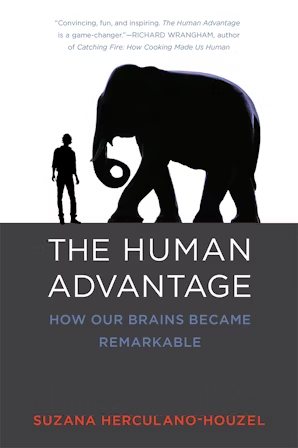
Humans do not have the biggest brains – elephants and whales do. They’re smart, but not all that smart compared to people. So the neuro-scientist Suzana Herculano-Houzel wanted to estimate brain complexity in a more rigorous way than just weight. She devised a way to actually count the neurons in the cortex, a macabre process she calls “brain soup”. She dissolved all the neural tissue with detergent, leaving just the nuclei. She stained them blue and could then count them under a microscope. This let her estimate just how many neurons there were in the brains of various species. She described it all in “The Human Advantage“, which is well-written and funny.

She found that humans have about three times the number of neurons in their cerebral cortices (16B) as the next most complex brains, those of elephants (5.8B) and chimpanzees (6B). This makes human brains really expensive in metabolic terms. It’s estimated that it would take 9 hours of foraging a day to keep a human fed.

Fortunately, we have another metabolic trick – fire. Cooking breaks down food, making it easier to get more calories out of the same material. The first evidence of fire is from 1.0 to 1.5 million years ago, and that’s when hominid brains started to expand. It looks like there was a positive feedback loop between using fire and expanding brains. They went from the size of chimp brains, about 500 cc’s to their present 1400 cc’s.

No other animal uses fire. We have co-evolved with it for so long that we find it inherently fascinating, so much so that pyromania is a common neural failure mode. Did the big black rectangle have some slow-burning piles of logs around it? With tasty yams and rabbits roasting in the coals? One gang figures this out in East Africa and suddenly they can live in any climate and eat almost anything.

Bipedalism

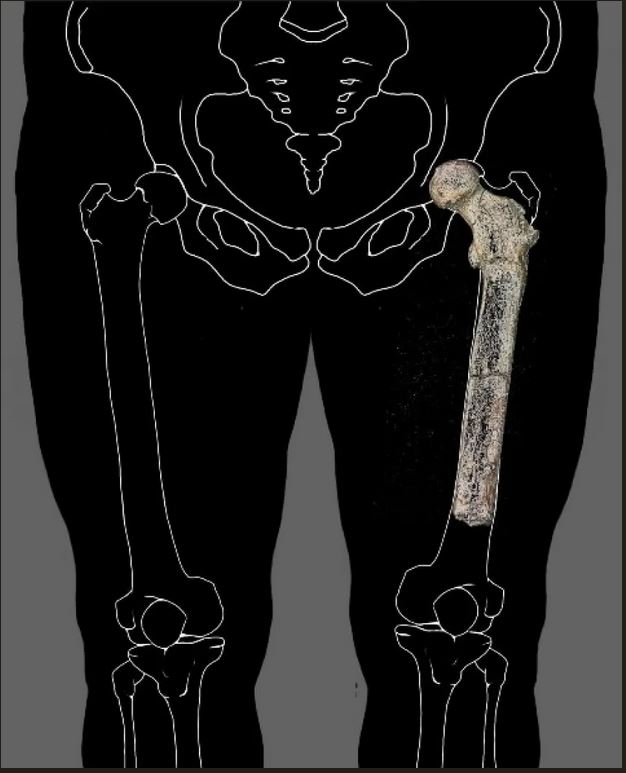
Silhouette of a 6 My old hominid (called Orrorin tugenensis) femur found in Kenya (courtesy Karen Carr Studio, © Smithsonian Institution)

Another distinctive thing about hominids is how they stand upright. This has lots of advantages for sentience: it lets the hands become more dexterous by taking weight off of them, it puts the eyes up higher for spotting prey or danger, it allows the shoulder to adapt to throwing objects for hunting, and it permits long-distance running for chasing prey to exhaustion. It also ruins the back and makes one far vulnerable to head injuries, especially with large, heavy brains. The other great apes can stand up, but not for long.

The earliest evidence for it is a change in the femur to hip connection in the leg of about six million years ago, as seen in the image. This one tweak to the hip joint allows a lot more weight to be put on the leg. The other adaptations were to strengthen the knee (4 My ago), add an extra curve to the spine (2.5 My ago), and make the femur longer for longer strides (2 My ago).

That’s a lot of adaptations! The monoliths would have to tinker with the genes that controlled skeletal growth for a while. Or maybe they made the original hip joint change and let Darwin do the rest. This weird kid is born that can see farther and move faster than its peers, and that’s a big survival advantage. Its descendants start reaching up for stuff, start grabbing rocks and doing things with them, and start getting a bigger view of the world. In a couple of million years they’re more successful than even rats.

Anyway, there do seem to be a lot of mysterious changes that were all necessary for us to be able to sit here and discuss all this history. It took a long time to get from standing upright to manipulating fire, and a long time again from fire to art. There was little that was necessary about it. We may think that the universe should be full of vastly powerful and ancient aliens, ones that can uplift even apes on the savanna, but this whole process seems unlikely and improbable.

Posted in Uncategorized | Tagged , | Leave a comment

Execs Erasing Techs

The executives of companies often take credit for the innovations that their lead technicals actually created, and erase them from company history. This is hardly surprising! It seems common enough that I’ve come across it in a number of previous posts:

Unfortunately, there are some much more famous cases of this. Let me start with a widely respected figure, Steve Jobs, and then talk about one whose reputation has cratered, Elon Musk:

Steve Jobs erases Steve Wozniak, Jef Raskin, and Tony Fadell

Wozniak and Jobs in 1976 with the Apple I

You may have heard of Wozniak, since he was the co-founder of Apple and has become a beloved elder statesman of tech. He did the hardware design for Apple’s first two computers, the Apple I and Apple II, and also designed the floppy disk interface for the II and the Mac. The disk interface alone may have saved the company, since it was much simpler than other controllers and therefore let disks be sold for far less. The II was a massive hit, and they both made a pile when Apple went public. Jobs kept all his, but Woz gave away a lot of his stock to other deserving employees. Just as he got going on next big thing, the Macintosh, he was in a serious plane crash and had to drop out of it. Jobs took it over, and re-directed the entire company towards it. Wozniak and the entire II design team were shut out of further developments. He quit Apple in 1985 in protest. He did join again later, but has been mainly a representative than a contributor. He has been in a lot of interesting companies since then, but nothing has connected. He did help found major tech institutions like the Electronic Freedom Foundation and the Computer History Museum.

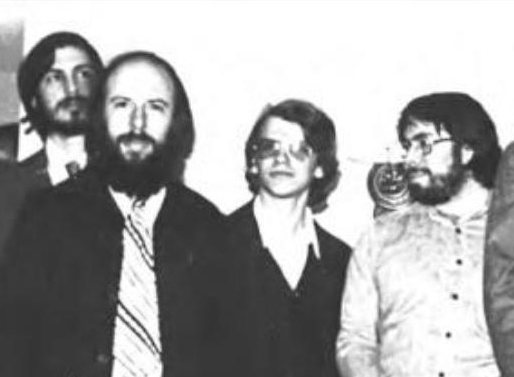
Jobs, Jef Raskin, Chris Spinoza, Woz, 1978

Jef Raskin wasn’t nearly as important figure at Apple, but he did run the Macintosh development for the first year, and did drive towards the idea of the PC as an appliance that anyone could use, and did introduce Jobs to the Alto GUI at Xerox PARC. That was the single most revolutionary idea ever in personal computing. Jobs then took over the project and shoved him aside. He left Apple in 1984, but did receive the millionth Mac built with his name on a gold plaque on it. He had a vast range of interests, but didn’t contribute much later, and died young in 2005.

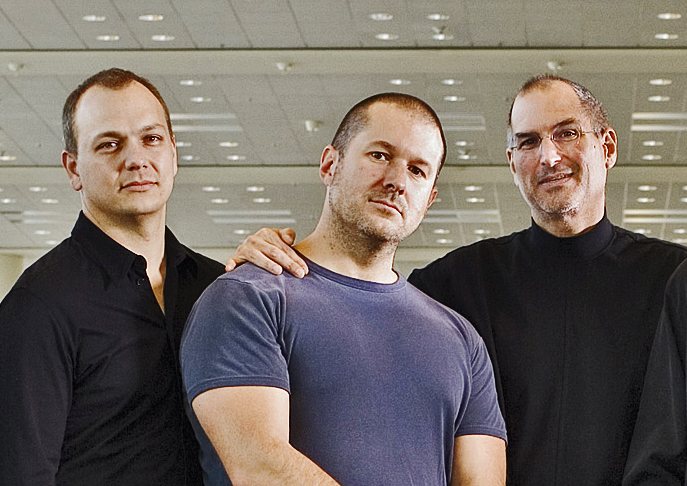
Tony Fadell, Jonny Ive (main Apple industrial designer), Jobs, 2007. I have to say I prefer the shaggy Apple look to this stormtrooper look.

After the Mac the next big innovation at Apple was the iPod, and that was the creation of Tony Fadell. He had been at General Magic, a spinoff run by Macintosh designers, and then at Phillips. He quit there when he got a seriously great idea – build a portable music player with a tiny hard disk that could hold a thousand songs, and have an online library to get them from. He started a company for it, Fuse, but couldn’t quite get funding. Jobs heard about it in 2001, and contracted him to build it. He got it going in just 11 months, and it was an immediate hit. He became a VP in 2004, and made major contributions to the iPhone as well. He quit not long after that in 2008, perhaps due to burnout. He started a new company in 2010, Nest, which made creepy home thermostats that would monitor the house for when people were actually there. Google bought it for $3.2B in 2014, and has expanded the line hugely in its effort to make money off of everything they can conceivably learn about you. Fadell left in 2016.

I did actually meet Fadell once in 2002. I pitched a video processing chip that my startup had just developed for use in a video iPod. The meeting was crisply efficient! In fifteen minutes he told us what the chip’s performance, schedule, power, and price had to be. Sadly, we couldn’t meet any of it at our size. We did almost get into the company that built the main chip in the iPod, Portal Player. That deal failed due to our CEO’s ego, but that’s another story.

Now, it’s not too surprising that Jobs eclipsed all these other people. He was actor-level handsome, he was an expert showman, and he was utterly ruthless. He cheated Woz on their very first job together on a contract at HP. He drove people mercilessly, and treated them badly, but appears to have mellowed in his later years. Oddly enough, most of his fortune came from his investment in Pixar rather than all he did at Apple.

Elon Musk erases Martin Eberhard and Marc Tappening, and Peter Rawlinson

Given his recent behavior, it’s no surprise that Musk has bullied people throughout his career. Two early targets were the actual founders of Tesla, Martin Eberhard and Marc Tappening:

Eberhard left, Tappening right, both with the first Tesla model, the Roadster (2008)

They came up with the core ideas of Tesla: to build a stylish and zippy but green car by exploiting the power of thousands of standard lithium-ion batteries and the great torque of electric motors. They had a novel strategy for EVs – start at the high end to develop the tech and then work down, instead of trying to produce the Model T right at the start. Musk led their first round of investment about a year later, and put in about a third of the funding before the first product, the Roadster, was released in 2008. Unfortunately, that give him license to meddle endlessly in the design. He tweaked the dashboard, the head and taillights, the seats, and worst of all, demanded that this electric car have a transmission. He thought a sports car should be able to do 125 mph vs the 110 that it could do with a single fixed gear. This was stupid, and cost them a year of schedule, an expensive extra component, and a loss of reliability and range. No other EV ever did this.

Nonetheless, the car was a hit when it was first unveiled. No one else was close to a car this cool. The press fawned over Eberhard and Tappening, and that made Musk’s head explode. He forced the ouster of both of them a year later, and proclaimed that he was the founder. Eberhard sued over that, and finally settled for an undisclosed sum. The two of them have since been shoved aside in the EV space, but made a fair amount off their Tesla stock.

A two-seater like the Roadster had limited appeal, though, and the design wasn’t suitable for mass production. Tesla’s next product, the Model S, was what really broke the market open:

Peter Rawlinson in front of the Model S chassis, 2011

They needed a real car guy for the Model S, and they found one in Peter Rawlinson, who had introduced CAD to Jaguar, had headed engineering at Lotus, and was at the last remnants of British Steel, Corus Automotive. He joined Telsa in 2009 at Musk’s personal invitation. Most of the previous team had left, unsurprisingly, which left him free to hire whoever he wanted. He used massive simulation techniques to get the Model S done in only 3 years. A key aspect of it was system-level design, of getting features in one part to make use of optimizations in another part. For example, the car needed strong anchor points for the seat belts on the bottom of the chassis, so they made them part of the battery pack partitions that underlaid the entire floor. In the picture above he’s explaining how the car front trunk acts as a crumple zone for head-on accidents.

Yet he was nowhere to be found at the Model S introduction in June 2012. He had actually quit a few months before. He said he needed to take care of his ailing mother back in England. He denied that it was due to pressure from Musk, since he felt enormous pressure from himself to really make an EV work. His mother passed away not long after, and Musk asked him to return, but he was already interested in doing something on his own. Musk then denied that he had done much on the S. Yet the S is what really saved Tesla and established that EVs could be way better than internal combustion cars.

Rawlinson then went on to found Lucid Motors in 2016, which has concentrated far more on the straight car aspects of an EV than Tesla has, which has been distracted by very-much-unready self-driving features. Lucids look great, and apparently have a genuine luxury feel, and have dramatically improved the miles/kWh, the internal networking, and the over-the-air updates. They’ve had a slow start, and still only ship about 10,000 cars a year, but get a lot respect, unlike Tesla.

Jobs and Musk, as well as the other execs mentioned above, really were good businessmen. This is not a common skill! You would think that the enormous amount of money they all made would be enough, but the true currency of America is celebrity, and that’s what they all craved. They have to be the people on stage. Jobs could hold the audience spell-bound, while Musk has gotten more and more cringey, but they couldn’t share the spotlight with anyone, especially those who contributed as much or more than they did.

Posted in Uncategorized | Tagged , , | Leave a comment

Libraries – Old and Grand, or New and Bland

Last summer I tried to visit every local library that I could get to by bicycle. It was an excuse to exercise, but I had also just read “The Library Book” by Susan Orlean (2018). It’s a history of the Los Angeles Public Library, and a description of what an amazing resource it is for the city. It’s a genuine Third Place, a separate space besides home and work. A huge range of people use it, especially those who are new to the country. Did all this apply to suburban Boston libraries too?

I managed to get to ten local libraries, but still have a few to go. You can’t go more than a mile away from one around here, unless you’re in the golf course and parks districts. None of these are as grand as the Riordan Building of the LA Central Library, although the Boston Central Library certainly is.

They come in a wide range of sizes and styles, but I can report that they all stress resources for immigrants, teens, and kids. They all now have a lot more to offer than books, including items for loan (the cutely named “Library of Things”), PC stations along with scanners and printers, and scads of DVDs, just as you can no longer buy or play them. They all have a common catalog called the Minuteman Library Network, and so can get titles from anywhere in eastern Massachusetts.

The saddest one I visited was in Belmont MA, and that’s because they had to demolish it. The old library was a low, dull Federalist structure from 1965 that was outgrown by 2000 and falling apart by the 2020s. They knocked it down in Dec ’23 and nothing has yet gone up in its place. They moved some of the holdings to a senior center a half mile away, but no one was there. They hope to have a new building in place by the end of 2025, but it’s not looking promising. The renders for it look dull too.

That ties into the main problem that I saw with most of these buildings – they have striking original structures coupled with boring modern extensions. The worst was the main Cambridge Library:

Main Library, Cambridge MA, with 1888 original on the left and 2009 extension on the right

The original building is in the style of H. H. Richardson (1838-1886), and you see it all over New England. It struck a chord in the heart of stolid 19th century Yankees. It’s not the soaring, airy Gothic of medieval cathedrals. That would be too frivolous for them, and too Catholic. It’s also not the plain white clapboard of Puritan churches. That looks too cheap. They had money by then, and Italian stone mason talent. This style is solid and lasting. It can withstand whatever the world throws at it. Yet it also gets floral capitals and even gargoyles. The burghers of Cambridge wanted a Temple of Knowledge, and were willing to spend to show how much they valued it.

The new building, well, not so much. It could be an office for some tech-ish business like pharma. It looks flimsy and transient. The glass curtain walls are only 15 years old, and not looking that good. Notice that it doesn’t even have steps. For the old building, you literally ascended to enter it, and here the entrance is on the flats with the lawn. That does make ADA compliance easier. All that glass actually makes it hard to read since it lets in direct sunlight. Maybe the translucent awnings help, but they’ll get filthy over time. There is a modernist architecture philosophy that thinks that glass walls display the open and democratic qualities that public institutions should embody, but because they also happen to be cheap, they look that way. At least it’s not the fetish for raw concrete that they inflicted on us in the 60s and 70s.

Modern librarians probably aren’t that comfortable anyway with the cult of books. It smacks too much of worshiping dead white men. They may secretly be biblio-maniacs, as I am, but have to declare that the library is about Information and Universal Access, not dead trees and elite education. Buildings that actually look nice are classist and don’t show their solidarity with the People.

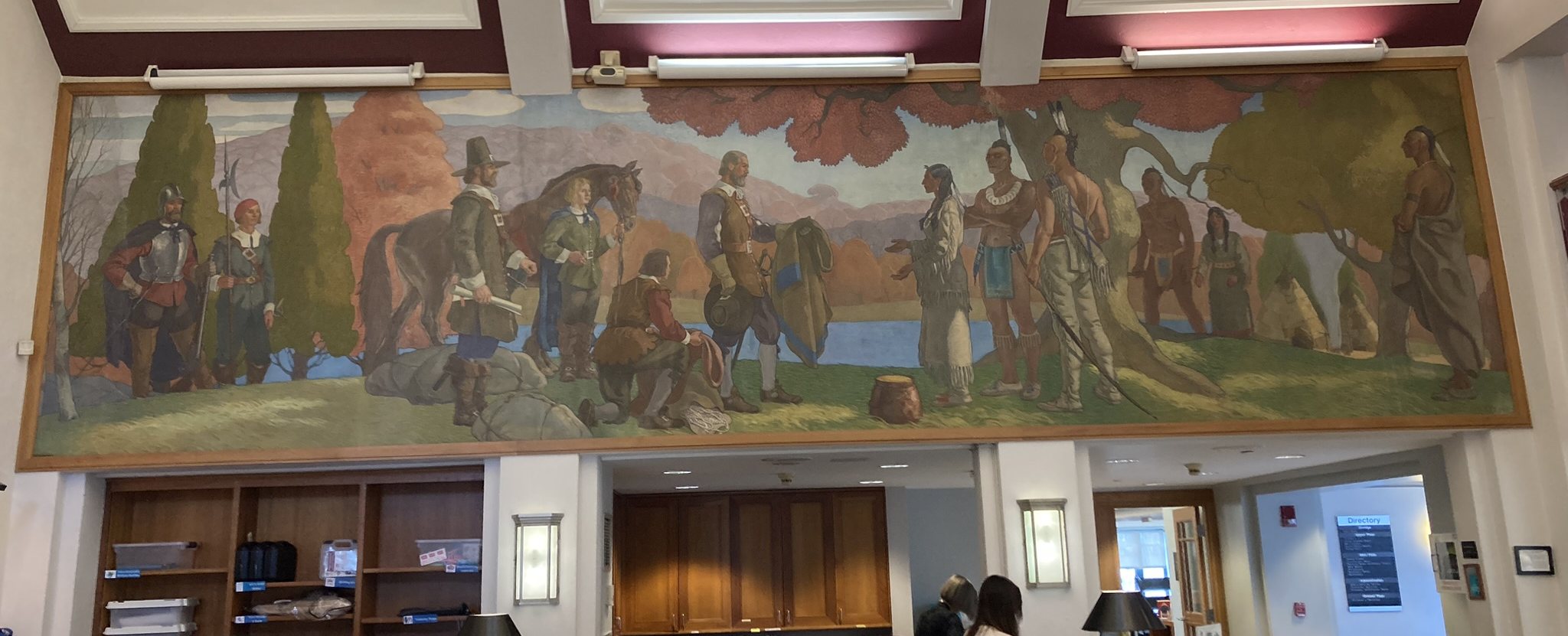
Another thing that struck me in visiting all these places is how they really are the memory of their towns. Here for instance is a WPA mural of the purchase of the land for the town of Winchester from the Squaw Sachem:

“Purchase of Land from the Indians”, 1934, by Aiden Lassall Ripley (1896-1969), Winchester Library, above registration desk.

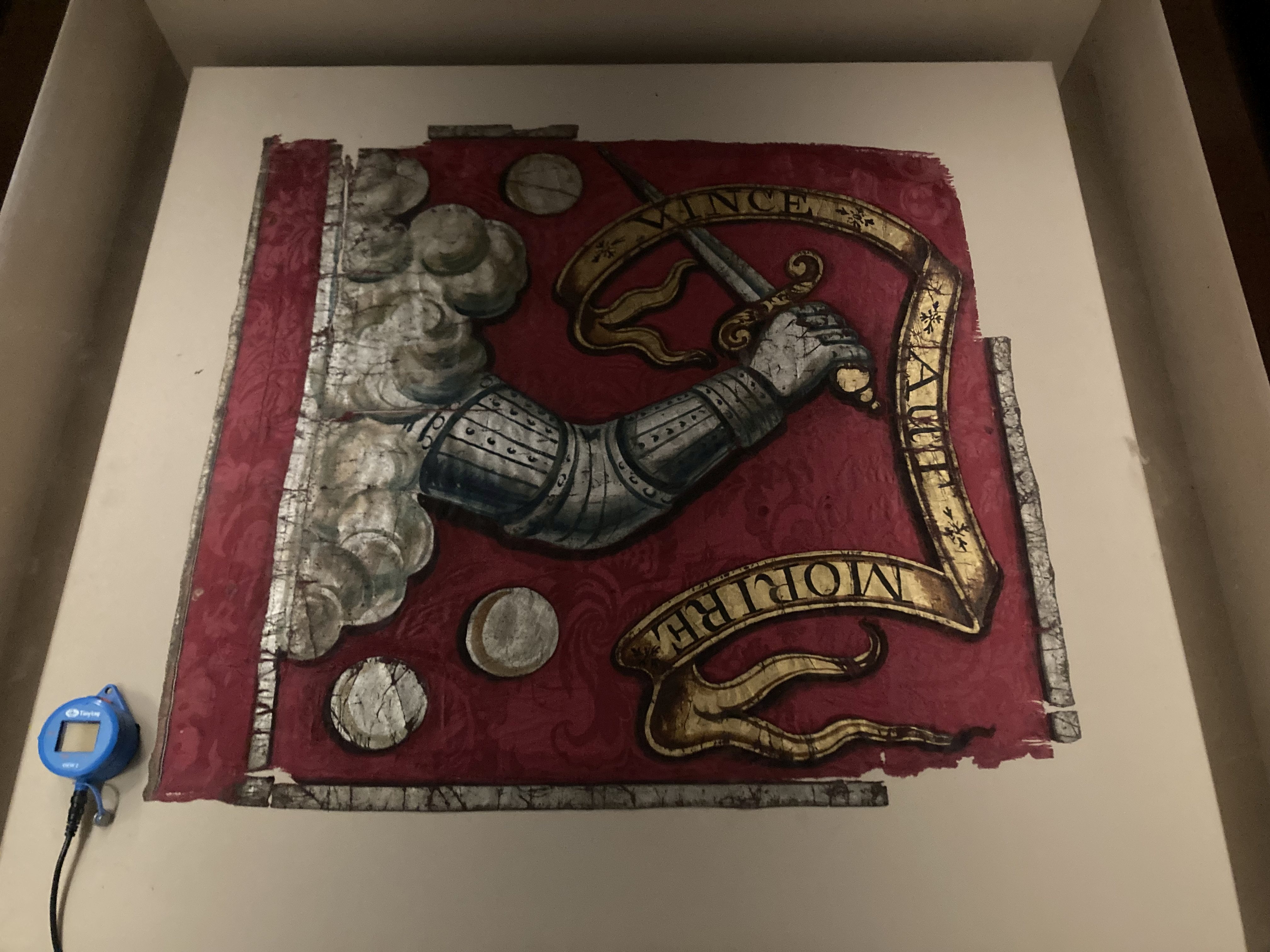
They all have portraits of distinguished citizens, works by local artists, and a local history room. Those are full of volumes like town meeting records for the last 150 years, and lists of residents who fought in the country’s many wars. The most impressive such artifact is the Bedford Flag:

This is an actual banner carried in the Battle of Lexington and Concord in 1775, the first of the American Revolution. It’s the oldest flag in the country, made in the 1730s of painted silk. The motto is Vince Aut Morire, Win Or Die. The design was popular in the English Civil War of a hundred years earlier, and shows the mighty arm of God on one’s side. This is as heavy metal as flags get! The librarian who showed it to me said that a previous visitor had it tattooed on his arm. The three silver dots distinguish this particular flag from similar ones of other regiments. It was restored in the 2000s and is now kept in a climate-controlled room. Not bad for a town of only 14,000!

The most gratifying thing, though, was to see how busy all of these libraries were. All the computer workstations tended to be in use, and the children’s areas were full of kids. There appear to be many events held in each per week. They are always short of funding, and frequently scapegoats for the political crisis of the moment, but they are also wonderful resources for their communities.

Posted in Uncategorized | Tagged , | 1 Comment

Serious Tech Tourism – the Niagara Parks Power Station

My wife and I recently went to the Shaw Festival at Niagara-on-the-Lake Ontario. This has been presenting plays by George Barnard Shaw and other 20th century playwrights every summer for the last 60 years. It’s held in a perfect little town full of flower baskets. The whole area is the Riviera of eastern Canada, with mild winters, orchards and wineries everywhere, and lots of views over the grand Niagara River.

Yet maybe you’re not all in on witty old comedies and quaint shops. Maybe you’re into Big Iron, or at least your wife thinks so. She found the awesome Niagara Parks Power Station just a few miles up the River:

Its main hall here is a thousand feet long and a hundred high. It contains 11 of those huge blue alternators 1 . Each one sits on top of a shaft that drops 130 feet down to a water turbine at the bottom. It’s located right beside the top of the Horseshoe Falls on the Canadian side, and diverted water from it. It was one of the first power stations built to harness the Falls in 1905, and it ran until 2006 (!).

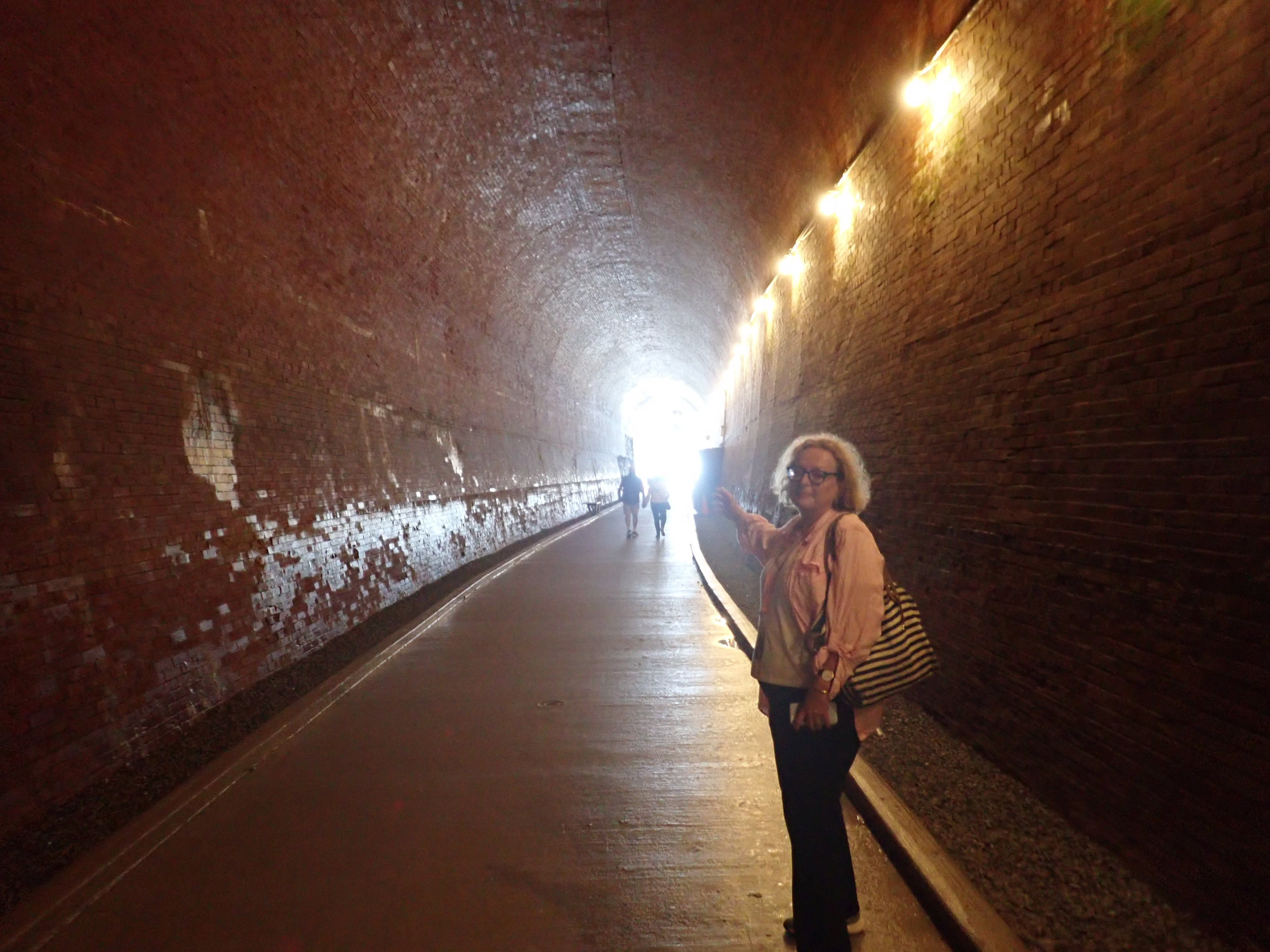
Once the water falls down the shafts and through the turbines, it flows down an enormous outfall tunnel out to the base of the Falls. You can now take an elevator down to the tunnel and walk out:

Outfall Tunnel and Curtis

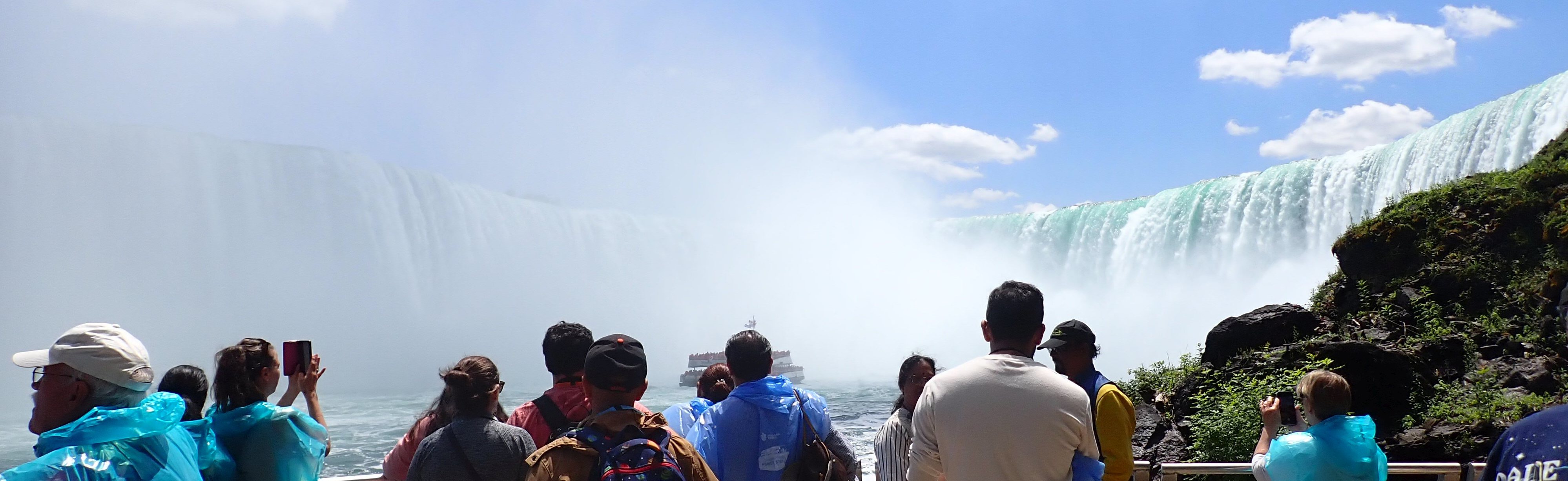
It’s about a half mile long and 40 feet high. It needed that enormous volume to hold the flow of water coming out. At the end you see:

That’s a hundred thousand cubic feet of water a second falling down in front of you. You can just make out a tourist boat going around the base. The American ones had everyone in blue ponchos while the Canadian ones were all red.

How is it that a huge installation like this could operate for over a century? One reason has to be that it produced dead cheap power. Once something like this is built it runs on its own. The main maintenance is to keep stuff in the water from damaging the turbines, so someone has to keep all the logs and branches and canoeists having a really bad day from actually going into the flumes. Otherwise the water flows in, the turbines go round, the alternator magnets spin, and the power goes off into Ontario.

Yet there’s another, odder reason. The entire power grid of North America has been set to run at 60 Hz for the last hundred years. That number was picked somewhat randomly early in the 20th century. It’s high enough that the flicker in incandescent light bulbs isn’t visible to the human eye, but otherwise there’s no special reason for it. Europe randomly picked 50 Hz, maybe to give local electrical manufacturers an edge over American ones.

This plant generated 25 Hz. It predated the standardization on 60 Hz. It could not be connected to the grid! It had to go to specific users, ones that could handle the weird frequency. There appear to have been two main kinds of customers – electric trains and aluminum smelters. The street cars of Toronto could use the 25 Hz directly in their motors. It was much more efficient than 60 Hz because of losses in the iron poles of their electromagnets whenever the magnetic direction switched. Amtrak uses 25 Hz to this day in lines in New York and Pennsylvania and has its own hydropower stations to generate it. Aluminum smelters need DC, and lots of it, and it’s easier to convert from 25 Hz to DC than it is from 60 Hz. Most of the cost of aluminum is in the electricity used to smelt it, so this really mattered to them.

All of their customers loved the low cost power, but ended up locked into them because of the non-standard frequency. That really lengthened the plant’s lifetime! But by the early 2000s everyone had to bow to using standards. In the latter part of its operation, the main income was selling the water flow rights to other, more modern plants down stream. The main one is the Adam Beck Station. It’s fed by a canal from the top of the Falls and is far larger: 2000 MW vs the 80 MW here.

So it had to be closed eventually. It ran for so long that seismic shifts in the bedrock were throwing the turbines and alternators out of alignment. They converted it into this museum and re-opened it in 2021.

I should mention one other aspect of this that impressed this electrical engineer – this enormous plant contains no electronics at all. It predates even vacuum tubes! All the control of these enormous machines is done mechanically. The alternators all need to run in exact sync at exactly 250 rpm, and that was done with ball governors much like Watt’s steam engines of a hundred years earlier. There were huge banks of switches next to them that were immersed in oil to keep from arcing, and variable resistors the size of cars to control the voltage. We can put tens of billions of transistors on a chip these days, and this whole plant wouldn’t have used one.

Anyway, the old line is that real engineering is where if you fall off of it, you die. Here’s one piece of engineering that qualifies!

  1. In alternators the power coils are stationary while the magnets turn, while in generators it’s the reverse. The electromagnets can be inside the power coils, like here, or outside fixed coils. Fixed power coils let alternators have fixed power wires while generators have to take the power off of slip rings on the moving power coils. This gives alternators a big advantage for high-power systems like this, since the brushes on the slip rings spark and wear out, but it does mean that they can only produce alternating current (AC). Generators can produce AC or DC depending on how the slip rings are connected. Electromagnets inside the alternator still need power as well, but far less, so they’re fed from slip rings. The alternators start from big battery banks and can then power their own electromagnets. ↩︎
Posted in Uncategorized | Tagged , , | 1 Comment

A Golden Age for Chemists – MIT on Climate Change

The physicists used to have all the fun, what with building species-ending weapons and ominously declaring that I Am Become Death. Yet nukes turned out to be useless for actual military purposes, as Putin has discovered to his dismay, and nuclear power is moribund.

So now it’s the chemists’ turn! Climate change is largely a problem of chemistry, of the infrared absorption of CO2 and CH4 to be exact, and now they get to step up to the plate. Money is being thrown at them to develop batteries that are denser or safer or longer-lasting or cheaper, and to remove emissions from every manufacturing process.

I saw this quite directly at the MIT 2024 Technology Day on June 1st. Every year they invite alumni to listen to various professors talk on a common topic, and this year that was climate change. Apparently some 20% of the faculty are working on it in some way. MIT’s official charter from the State of Massachusetts in 1861 is to do exactly things like this:

….Are hereby made a body corporate by the name of the Massachusetts Institute of Technology, for the purpose of instituting and maintaining a society of arts, a museum of arts, and a school of industrial science, and aiding generally, by suitable means, the advancement, development and practical application of science in connection with arts, agriculture, manufactures, and commerce.

So that’s no surprise. The whole program can be found here, of which this is the first part:

Watching video is slow, though, so let me summarize a few of the talks:

Yellow Hot Graphite Thermal Batteries – Prof Asegun Henry, Mechanical Engineering, founder of Fourth Power

Batteries need to be an order of magnitude cheaper per kilowatt-hour, and we’re not going to get that through lithium-ion. Instead let’s store the energy as heat in something cheap, like blocks of pure carbon. The energy density goes up as the fourth power of temperature, so it needs to run as hot as possible. This is what distinguishes this work from other efforts like Antora Energy – they run at 2400 C while Antora is at 1500 C. Instead of using simple resistive heating, FP uses ceramic pipes full of molten tin, moved by pumps with graphite components. Electricity is drawn out through thermo-photo-voltaic panels, which are solar cells that are tuned for infrared and can have efficiencies as high as 50%. The rest of the energy is used as process heat in industries. The blocks are kept in sealed, insulated shipping containers filled with argon so they don’t catch fire. They’re aiming for $25/MWh, 10X less than Li-ion. They’ve got a great name for it – “Sun In a Box”.

CGI render of the thermal batteries, with a plant view in the top left

Breaking Down Methane – Prof Desirée Plata, Civil and Environmental Engineering, founder of Moxair

Methane is a far worse greenhouse gas than carbon dioxide, and its level is rising too from industrial emissions. Even though its concentration is > 200X less than CO2, it accounts for about 30% of global warming so far. The biggest emissions are from leaks from natural gas distribution, but those are too diffuse to do much about. The best opportunity to reduce it is at point sources. There are two big ones there: dairy barns and coal mines. These both have powerful ventilation systems to maintain air quality, so those vents a great place to break down methane. Moxair has found a catalyst that combines methane and oxygen, and put it into clay pellets like cat litter that can be used as a filter in the ventilation. The reaction runs hot, but it’s being blown outside anyway.

Prototype thermal catalysis reactor being tested in a dairy barn (D. Plata)

Green Cement – Prof Yet-Ming Chiang, Dept of Materials Science, founder of Sublime Systems

Concrete is far and away the most common construction material, and making the Ordinary Portland Cement (OPC) that holds it together accounts for >7% of worldwide CO2 emissions. These come from two sources: the heat used in the cement kilns, and the CO2 from the limestone itself as it is cooked with sand and water into OPC. The final product is various combinations of calcium, oxygen, silicon, aluminum, and iron. Prof Chiang starts with a non-carbonate mineral (which they don’t mention), grinds it up, and extracts the calcium via electrolysis. It ends up being just as strong and tough as OPC, and compatible with concrete mixing and handling.

Comparing standard cement production with Sublime’s

They have a 250 ton/year plant in Somerville MA now, and will have a 1000 ton/year plant out in Holyoke MA in 2026. Holyoke has a large dam on the Connecticut River for supplying clean power. The Mass Green High Performance Computing Center is sited there for the same reason.

However, the US produces 90 Mtonnes of OPC a year and China produces far more, so this has to scale by five to six orders of magnitude. Cement is such an enormous business that the recent crash in Chinese construction caused a visible decrease in worldwide emissions all by itself.

Sure hope this matters!

All of these ideas are still at the laboratory stage. That’s OK – it’s what MIT is for, and tech has to start somewhere. Yet it’ll take decades for them to make a difference. It’s too bad that this work didn’t start in 1997 after the Kyoto Protocol made it an international issue, but here we are. The warming used to be slow but is now quicker every year. We’re now getting to the steep part of the S curve. It’s like the famous Hemingway quote from “The Sun Also Rises”:

“How did you go bankrupt?” Bill asked.
“Two ways,” Mike said. “Gradually and then suddenly.”

The bill for fossil fuel usage is now coming due! These ideas are now not just interesting experiments but crucial.

Posted in Uncategorized | Tagged , , , | 1 Comment