A Catastrophic Failure of Verification

So your competitor has come out with a new product.  It beats yours hands down.  You’ve been working away on a similar thing, but your engineers are arrogant and uninterested in the ideas of others.  You’re now hopelessly behind.  You panic.  An outsider comes to you with a new design that’s much flashier than what your team has been doing.   A sharp salesmen shows you impressive demos.  The first reports from the field are good.  You rush it through testing, skipping a lot of the normal steps, and not testing the configuration that will actually ship.    You build a pile of them and get them out into the field as fast as possible.  Unfortunately,  it’s not as reliable as your competitor’s, and your users get killed.
A history of automatic weapons, particularly the AK-47

That’s literally killed.  The users were US Marines in Vietnam in 1967.  What you shipped too soon was the M-16 assault rifle.  It’s 3/4 the weight of its competitor, the Soviet AK-47, holds more rounds, and has greater range.  It looked great during the demo, but has this problem – it rusts out and jams.  The Marines found themselves surrounded by NVA with non-working guns.   It’s hard to know just how many US troops were lost, but it’s probably at least in the hundreds.

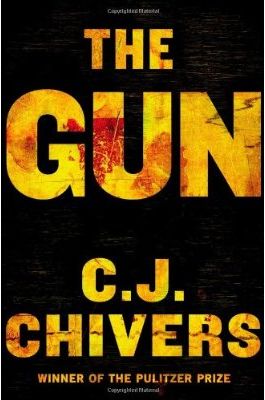
A full account of this disaster is given in “The Gun”, by the New York Times correspondent C. J. Chivers.  He served as a Marine in the Gulf War, leaving as a captain, and has since reported from half the world’s military hellholes.   He won a National Magazine award for his Esquire story on a Chechen siege of a Russian school in 2004, and shared a Pulitzer Prize in 2009 for coverage of Afghanistan.  He’s seen more havoc in his time than a hundred guys like you or I.

As he reports, the M-16 disaster unfolded under Robert MacNamara, who was Secretary of Defense for Kennedy and Johnson.    When he came into office, he was astonished at how far behind the US was on basic equipment like rifles.   The Army’s standard weapon, the M-14, was much heavier than the AK-47 and had so much recoil that one person had trouble firing it when it was set to automatic.   Its successor was supposed to be the Special Purpose Individual Weapon (SPIW), which fired flechettes, bullets with vanes.  That gave them flat trajectories and large ranges for a light bullet, permitting many more rounds for a given weight.  Unfortunately, they also had less piercing power and the weapon was nowhere near ready for use.   30 more years of research still couldn’t make it work – it was cancelled in the 90s.

Faced with a choice between the obsolete M-14 and the impractical SPIW, MacNamara’s whiz kids desperately reached out to a third design, the Armalite AR-15.   An Armalite salesman wormed his way into General Curtis LeMay’s heart by taking him out for a picnic and using the gun to explode watermelons at  100 yards.  Watermelons are nothing like human heads, but they make spectacular red splashes when hit.  Early reports from South Vietnam made it sound like it caused much more gruesome injuries than other guns, because its smaller bullets would tumble inside the body.

The AR-15 also looked good because it was lighter than the AK-47.   It used lighter ammo, and had a simpler method of re-cocking the gun.   In both rifles, the energy for re-cocking comes from the expanding gas behind the bullet, but in the AR-15 the gas was re-directed to push on the bolt directly, while in the AK-47 it pushed a piston that then pushed the bolt.  That turned out to be a fatal design flaw.   The gas is hot, which corrodes the bolt metal, and dirty, which fouls the mechanism.

But it worked in demos with clean guns and only a few rounds fired, and the DoD went for it.  They had to improve it, of course.   They renamed it the M-16 to make it part of standard Army terminology.  They thought it needed more range, so they put a more powerful kind of gunpowder into it.  Unfortunately, that powder left more residue when it burned, which made the fouling problems much worse.  They didn’t test it with the new powder, figuring that couldn’t make much difference.  Famous last words for verifiers.

They also saved weight and money by not putting chrome plating on the barrels, as the AK-47 did.   That threatens it with rust, but only if you test it in a wet environment, which they didn’t.   It was now the mid-60s, though, and Vietnam was getting hot.  They desperately needed something to counteract the North Vietnamese, so they built tens of thousands of these untried guns and rushed them off to the Marines.

Clearing a jammed M-16, just what you want to do when people are shooting at you (George Schneider, 1968). The white stuff is sand, not snow.

When the reports of rusting and jamming came back, they did the worst thing you can do during verification – they blamed the user.   The brass told the troops that they weren’t keeping their guns clean. They ordered more manuals and cleaning rod kits to be sent over.  When the soldiers started complaining directly to their hometown newspapers, the military shut them up.  When congressmen finally started asking them about problems with the M-16, they denied them in front of House committees.

That cost the DoD the trust of their troops.  The soldiers knew the guns were junk, so when their superiors denied it, they wondered what else they were lying about.  Quite a bit, it turned out.   When the Tet Offensive came in early 1968, it was clear that the military didn’t know what was going on, in spite of all their confident predictions.    The skepticism spread to Congress and the general public, and probably helped put the odious Richard Nixon into office.

They eventually did fix the problems of the M-16, and it’s still in use.    Its reputation was shot, though, as was that of the whole Army Ordnance division.  This small failure of testing rippled up through the whole military.  Did it contribute to the US losing the Vietnam War?  Chivers doesn’t say so, and I certainly don’t know enough about it to comment.   Once you let bad stuff through, though, it can take decades to get your reputation back.

Posted in Uncategorized | 1 Comment

A Small Eco-Doom

So your family has been farming a particular spot of North Dakota for the last 130 years. When you were a kid, there was a lake off in the distance, Devil’s Lake, that was good for perch fishing, but horrible for drinking because of high salt and sulfate levels. Over the last few years you’ve watched as the lake rose and rose.  The rise sped up in the last 20 years as global warming increased rainfall.   Since 1993 it has come up 11 meters. Now your farm is lost:

The Storsteen farm in northeastern North Dakota, abandoned in 2010 after flooding by Devil’s Lake. Credit Huck Krueger

You can’t get to it any more. Hundreds of square miles have been flooded around you. Nearby villages have been lost, and the town of Devil’s Lake (pop 7000) has only been saved by a levee built by the Army Corps of Engineers. The roads around the lake have been washed out, and the rail lines are about to go too.

The lake sits in a closed basin, and so collects all the rain that falls.  The high levels of salt and sulfates are because there’s no place for them to go.  The lake is now at its highest level in recorded history.    About a billion dollars has already been spent trying to stop it.  The projects started in the 70s and have gotten more and more desperate since then.   The lake’s rise has exceeded all predictions.  If it goes up another 1 or 2 meters, it’ll break through to the Sheyenne River and dump its nasty, polluted gunk into the water supplies of Minnesota and Manitoba.  If it happens suddenly, it could cut a channel and send a wall  of bad water downstream.  The Corps is trying to stop that by releasing it gradually, but nobody wants that stuff near their reservoirs.

It’s a vicious story, and is told well in the latest issue of American Scientist: “Runaway Devil’s Lake” by Douglas Larsen.  He’s a limnologist who first saw the lake in 1964, when it was 1/32 of its current volume.  It had an area of 80 km² then and it’s at 815 now.

So it takes a billion dollars to save the land of a few thousand people, and it’s not even clear it’ll work.  What will it take as the entire ocean rises?


Posted in Uncategorized | 1 Comment

The Oldest Active Computer

ENIAC (1946) - The first true computer

Digital computers are a fairly old technology at this point.  The first ones date from the mid-1940s, which makes them older than nuclear reactors, integrated circuits, polypropylene, and orbital satellites.

What they aren’t is a durable technology.  Computers age fast, both because they’re easily superseded by later models, and because their components wear out quickly.   The early machines failed more than once an hour because of bad vacuum tubes, while current ones fail because of heating of their boards and aging in the wiring and transistors of their chips, and because of shifts in software environments that render old programs useless (“bit-rot”).

It’s not uncommon for jet aircraft to fly for 40 years, and there are still nuclear reactors running from the 1950s.  Can any computers claim similar longevity?   That is, are there any machines that are still performing something like their original function?  Let’s exclude museum exhibits or hobbyist re-creations of old machines, because anything can be kept working if people love it enough.   People love the USS Constitution enough to keep it an active warship of the US Navy at age 214, but it’s not keeping the British out of US waters any more.  I’ll also exclude calculators because they’re not quite in the category even though the programmable ones might be Turing-complete.

I describe a few candidates below, and would love to hear of any other machines that people know of, but first let me describe a few machines that didn’t make the cut:

  • The Space Shuttle flight computers – These were IBM AP-101 machines, which are compatible with the 360 series.  The original machines in the 5 Shuttles were AP-101b’s, built in 1971, but they were replaced with the AP-101s line in 1992.  The biggest change was to go from core memory to 64Kx1 SRAM chips.  The Russians did use the Argon-16 flight computer in their Soyuz spacecraft from 1975 to 2010, but it wasn’t literally the same machine throughout.
  • Air Traffic Control Machines – The automation of the US air traffic control system was started by Burroughs Corp in the 1960s, and originally ran on their machines.   However, all the hardware was converted over to Motorola 68000 microprocessors in the 1980s, and to IBM and Motorola PowerPC microprocessors in the 1990s.  The system is called Common ARTS, and is now in turn being replaced by one called STARs.
  • BART Station Signage – The San Francisco subway system used DEC PDP-8e minicomputers to control the signs indicating when the next trains would arrive.  They were installed in 1971, and there were rumors that they were still in use, but Gary Messenbrink (who wrote the PALBart PDP-8 assembler for use on those systems) reports that they were all replaced in the early 2000s by x86 systems.  30 years is a really good run for a computer, but not quite as good as the ones below.

So what are some genuinely old systems?  I’ll describe a few in youngest to oldest order:

1978 – the Cadillac Seville Trip Computer

Trip computer to right of steering wheel and above the radio; LED display on dash

This was the first use of a microprocessor in a car.  It used the Motorola 6802 microprocessor, a chip that used 8 bit data with a 16 bit address, and had 128 bytes of on-chip RAM.   It was a $920 option, and could calculate miles per gallon, miles to empty, and time of arrival.  About 57,000 of these cars were built, but it’s not clear how many had the option.   The cars themselves are still readily available.

1977 Bridgeport Series 1 numerically-controlled milling machine

Series 1 CNC mill - Controller in cabinet to right

The Series 1 is a famous line of mills, with some 370,000 built over the last 70 years.  They added computer control in the 70s, driven by a DEC LSI-11 board, which is part of the 16-bit PDP-11 family.   The LSI-11 used a set of four VLSI chips from Western Digital called the MCP-1600, which was a microcoded general purpose CPU.   The mill could be programmed to cut slots and circles using something called the BOSS software, which evolved through the late 70s and early 80s.  The machines are still widely available, although the LSI-11s are often replaced by PCs.

1977 Voyager 1 flight computers

Voyager Computer Command System, now in the Smithsonian

The two Voyager probes are still active after almost 35 years.  They contain 3 computers each according to this FAQ:

Computer Command System (CCS) – 18-bit word, interrupt type processors (2) with 4096 words each of plated wire, non-volatile memory.

Flight Data System (FDS) – 16-bit word machine (2) with modular memories and 8198 words each

Attitude and Articulation Control System (AACS) – 18-bit word machines (2) with 4096 words each.

They are not microprocessors – they were built out of small-scale-integration (SSI) RCA CMOS chips by General Electric according to JPL’s specs.   When the Voyagers were specified in the early 70s, there were no rad-hard micros available.   The RCA 1802 came out in 1976, and would have served, but it was too late.  Each machine had a backup for redundancy, and some of those have failed.  A lot of the memory bits have gone bad as well, so JPL has programmed around them.

Being able to upload commands to the probes made a big difference.  For instance, when Voyager 1 went past Saturn, it was able to rotate itself to keep the planet centered on the camera, and so avoid motion blur.  It was a better probe then than when it went past Jupiter!

The probes are powered by radio-isotope generators, and they’re steadily losing power.   JPL has already had to turn off most of the instruments.  By about 2025 there won’t be enough power for even one instrument, and that’ll be it.   At that point the probes will be almost 50 years old, and will almost certainly be the oldest operating computers.   Given what a grand success the Voyagers have been, that will be a noble legacy.


Posted in Uncategorized | Tagged | 4 Comments

The Farewell Dossier and CIA Cyber-Sabotage

I recently came across an extraordinary story of Soviet industrial espionage and subsequent CIA wrong-doing – the Farewell Dossier.    I heard about it through the French movie “Farewell” (2009), which is a fictionalized version of it.  “Farewell” is a rather drab title, but the French title was worse – “The Farewell Affair” – since this is definitely not a romance.  A full account was given in “Adieu Farewell – The Greatest Spy Story of the Twentieth Century” by Sergei Kostin, which has just been translated into English.  The link includes the first 80 pages.

Farewell was the code name for Vladimir Vetrov, a Soviet KGB agent and engineer.  During the 1960s and 70’s he had been evaluating technological secrets stolen from the West by a KGB office called Directorate T and its operational divsion Line X.   They had planted agents in embassies all over the world, and had exploited the openings of Kissinger’s détente policy to visit Western factories and institutes.

By 1980 Vetrov had become disillusioned with the Soviet system.  He unburdened himself to a French businessman friend, Jacques Prevot, whom he had met while working as a spy in France in the 1960s.   He handed him ~4000 documents, including a list of all 250 Line X agents.   He took no money for it.  Prevot gave them to French intelligence, who verified that they were genuine.  The French president, Francois Mitterand, then gave it directly to Ronald Reagan at a summit in July 1981.

From there it wound up in the hands of a CIA analyst named Gus Weiss.  He had been worried about Soviet technical espionage for decades, and here was proof.  They had stolen large chunks of their technology in radar, machine tools, computers, and semiconductors.

VAX Microprocessor logo - "CVAX...When you care enough to steal the very best"

I actually had some  contact with the last two.  In the 80s I worked at DEC-Hudson, the microprocessor design center for Digital Equipment Corp.   In 1983 US Customs seized a shipment of computer parts for a DEC machine, the VAX 11/782, that was destined for the USSR.  They may well have learned about the plan from the Farewell Dossier.  The 11/782 was one of the first multiprocessors, and we were rather flattered that it was a target.  That prompted my colleagues to put some Russian text in the logo of VAX microprocessor that they were designing, as seen in the picture above.

Anyway, Weiss wanted to do more than just stop IP theft, and that’s where this story gets interesting.   He wanted to turn the tables on  Line X:

I met with Director of Central Intelligence William Casey on an afternoon in January 1982. I proposed using the Farewell material to feed or play back the products sought by Line X, but these would come from our own sources and would have been ”improved,” that is, designed so that on arrival in the Soviet Union they would appear genuine but would later fail. US intelligence would match Line X requirements supplied through Vetrov with our version of those items, ones that would hardly meet the expectations of that vast Soviet apparatus deployed to collect them.

If some double agent told the KGB the Americans were alert to Line X and were interfering with their collection by subverting, if not sabotaging, the effort, I believed the United States still could not lose. The Soviets, being a suspicious lot, would be likely to question and reject everything Line X collected. If so, this would be a rarity in the world of espionage, an operation that would succeed even if compromised. Casey liked the proposal.

The CIA met with various American companies and persuaded them to give bad plans and software to people connected with Line X:

Contrived computer chips found their way into Soviet military equipment, flawed turbines were installed on a gas pipeline, and defective plans disrupted the output of chemical plants and a tractor factory. The Pentagon introduced misleading information pertinent to stealth aircraft, space defense, and tactical aircraft.(4) The Soviet Space Shuttle was a rejected NASA design.

In the case of the pipeline turbines, it appears as though the bad designs led to an 3 kiloton explosion in the Trans-Siberian natural gas pipeline in 1982.  That would make it one of the largest non-nuclear explosions ever.  That’s a charge leveled by Thomas C. Reed in his 2004 book “At the Abyss – An Insider’s History of the Cold War”.  Reed was Secretary of the Air Force under Ford and Carter, and an organizer for Ronald Reagan.  Others dispute the claim, saying that it was caused by bad construction, that there was little automation in use at that time, and that an open-air gas explosion couldn’t be that big.

Yet it’s an appalling story if true.   The explosion was seen from space, but happened in a remote area, and it’s not known how many were killed by it.   If it had happened in a densely populated area, thousands could have been killed, all over some random CIA machinations.   People are killed all the time in gas explosions; it’s not something to fool with.

Weiss and the CIA were being too clever by half.  As they suspected, all they had to do was let the Soviets know that the Line X material was compromised, and the whole operation would have been destroyed.   They didn’t have to actually put out dangerously flawed tech.  When the Soviets did find out about Farewell (they executed Vetrov in 1985), they were thrown in disarray.  They no longer knew what to believe.   In particular, they fell for Reagan’s Star Wars anti-ballistic-missile program, which was absurd on its face.  The open US scientific community dismissed it out of hand, but Gorbachev couldn’t be sure that there wasn’t some secret tech behind it.

The CIA appears to be still be up to cyber-sabotage, if the reports about the Stuxnet and Conficker worms can be believed.   Stuxnet was the worm that disabled a few Iranian uranium centrifuges in 2010, and a recent report by John Bumgarner, CTO for the  US Cyber Consequences Unit think-tank,  says that the immensely annoying Conficker worm of 2008 was a dry run for it.

If the CIA (and probably the Israelis) are running around smashing random computers, they’re in dire need of adult supervision.   Not only are they failing to genuinely harm Iranian nuclear progress, not only are they causing huge aggravation for the general public, but they’re also inventing dangerous malware that can be used by non-state-sponsored criminals.  Ask Eric Holder how Operation Fast and Furious turned out, where the ATF actually sold guns to Mexican drug cartels.  If you give script kiddies the ability to actually damage industrial hardware, you could be looking at a lot more gas pipeline explosions.

Posted in Uncategorized | 5 Comments

The Moon Is Dull

If they had found monsters on the Moon in 1973, we’d still be there now

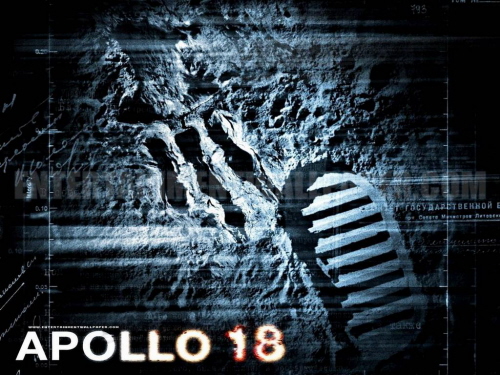
Last summer there were two movies partially set on the Moon: “Transformers: the Dark of the Moon” and “Apollo 18”.  In the first, the Apollo program has a secret agenda to explore alien robots that are discovered there.  In the second, a secret final Apollo mission is launched to investigate Soviet reports of monstrous vacuum spiders living in craters.

It’s not uncommon for movies released at similar times to have similar plots, so this probably doesn’t mean much.  Still, maybe there was something in the air when these movies were being planned.  The 40th anniversary of Apollo 11 was just two years ago, so perhaps writers were thinking about what could possibly have justified that enormous effort.  It seems unbelievable today.  We couldn’t actually do it now, even with all the real progress that has happened in space exploration. The last humans left the Moon 39 years ago, and no one is really thinking about going back.   Bush II made a big deal about returning to the Moon on the way to Mars, but only aerospace lobbyists took him seriously.

I was reminded of this by the recent launch of the Mars Curiosity Rover.  When it lands in August 2012 it’ll join four other active robots at Mars: the MER-B (Opportunity) Rover, and the Mars Express, Mars Reconaissance, and Mars Odyssey orbiters.  It’s getting crowded out there!  There’ll be five robots at Mars just as there are about five people in low earth orbit on the ISS.

In contrast, there have been no soft landings on the Moon since Luna 24 in 1976.  There have only been 9 missions there since then:

  • Hiten – 1990 (Japan) – orbited for 18 months then crashed into surface.
  • Clementine – 1994 (US) – orbited for 2 months and then was lost while en route to an asteroid
  • Lunar Prospector – 1998 (US) – orbited for 19 months then crashed into surface.
  • SMART-1 – 2003 (ESA) – took 17 months to reach Moon with an ion thruster, then orbited for 19 until it was crashed into surface
  • Chang’e 1 – 2007 (China) – orbited for 16 months then crashed into surface
  • SELENE – 2007 (Japan) – orbited for 20 months then crashed into surface
  • Chandraayan 1 – 2008 (India) – released impactor, then orbited for 10 months before losing contact
  • Lunar Reconaissance Orbiter – 2009 (US) – released Centaur/LCROSS impactor, and is still in orbit.  Its camera is of high-enough resolution to actually see the Apollo LEMs.
  • Chang’e 2 – 2010 (China) – orbited for 9 months then left for L2, where it is today.

Space agencies seem to really like to crash things into the Moon!  Maybe George Melies was on to something.

Compare these 9 missions to the 15 to Mars, with 5 soft landers.  You would think that the relative ease of getting to the Moon would make it more popular, but no.  It actually seems like just a practice destination for new space powers like China and India.

The reason for the relative lack of interest in the Moon is obvious – there’s no prospect of life there.  The major scientific interest there is in its geology, and that was fairly well covered by Apollo.  There’s still a lot to learn, of course, especially in terms of resources like water that might make a base more feasible, but Mars has a lot more to teach.

In the two movies above, the Moon’s terrible secrets cause people to abandon its exploration in fear.  In reality such discoveries would have justified the Apollo program all by themselves.    Discovering life?  Really?  In a vacuum?  It would have been the find of the century.  There would have been a mad rush to get there by any means available.  Sure, the creatures there were dangerous, but so are tigers and Ebola, and we deal with them all the time.

Taken July ’09 by the LRO

The writers had to add this kind of color as a secret justification for Apollo. The reality is that there’s not much of interest there, as seen by the relatively few missions since. Now if only the recent pictures of the Apollo debris on the surface had shown that some of it had been moved!

Posted in Uncategorized | Tagged , | 1 Comment

Beautiful Inventors

So I see that Richard Rhodes is coming out with a new book about Hedy Lamarr and the invention of spread spectrum communications: Hedy’s Folly: The Life and Breakthrough Inventions of Hedy Lamarr, the Most Beautiful Woman in the World.  Rhodes is known for his magisterial series on nuclear weapons – “The Making of the Atomic Bomb”, “Dark Sun”, “Arsenals of Folly” and “Twilight of the Bomb” – but this story is much juicier.

It describes how the über-glamorous actress fled her munitions-maker husband in Vienna in 1937, made a huge splash in Hollywood, and collaborated with an avant-garde composer, George Anthiel, on a jam-proof way of communicating by radio with torpedoes in 1941.   They did it by constantly changing the frequency of the transmitter and receiver, with each one having the pattern of changes on a player piano roll.  It was a paper-based ROM!  This kind of frequency hopping  is the kernel of Code Division Multiple Access (CDMA), an elegant method of allowing multiple transmitters to share the same frequency band without interference that’s now in quite wide use.

This story is hard to resist, and has gotten a lot of play since the Lamarr and Antheil patent was discovered in the 90s.  Lamarr was honored by the Electronic Freedom Foundation with an award for it in 1997, but Antheil died in 1959.

From the accounts I’ve read, though, Lamarr’s technical talents have been exaggerated.  She doesn’t seem to have ever done anything else.  The bulk of the idea has to do with the player piano rolls, which was a specialty of Antheil’s; he had used a set of synchronized player pianos in a composition of the 1920s.  Lamarr’s own memoir “Ecstasy and Me: My Life as a Woman” (1966) doesn’t mention anything about torpedoes or radio.  It’s possible that it was classified, but there’s also no mention of Antheil.  It could be that Antheil added her to the patent in order to get attention.

The idea itself was also described in an earlier patent, 1598673 “Secrecy Communication System”, from 1926.   That patent was already being referenced by 1945, while Lamarr’s wasn’t referenced until 1989, long after spread-spectrum was in regular use.  Also, the key to the later success of spread-spectrum was in the method by which a receiver can synchronize with the transmitter’s pattern without a common time base, and that wasn’t covered by this patent.

So there may less here than meets the eye.  If anyone can fill out the story, though, it’s Rhodes, so the book is likely to be fun regardless.

This got me to wondering about other celebrity inventors.   Have others taken time out from their busy schedules of public adoration to do something technical?   A few others are listed below, in chronological order:

Florence Lawrence (silent film actress) – Car turn signals (1913)

Circa 1910

Lawrence hit it big early, with roles in 1906.  She was a star at several studios, and was known as the Biograph Girl in the days before they promoted actresses, but was badly burned in a set fire in 1915.  She recovered, but her career didn’t, and after going through several husbands she committed suicide in 1938.

She got one of the early cars in 1913, and came up with a turn signal for it consisting of a lever attached to the rear bumper that would rise when a button was pressed on the dashboard.  She also devised a brake signal that would raise a STOP sign when the brake pedal was pressed.  She didn’t patent them, though, and her versions didn’t get adopted.

Julie Newmar (dancer, actress) – Shaping panty hose ( 4,003,094, 1977) and bra (3,935,865, 1976)

Newmar is best known for playing Catwoman in the 1960s Batman TV series, as well as other hot babe roles such as Stupefying Jones in “Lil Abner” and Rhoda the Robot in “My Living Doll”.  At 5’11” she could hardly play ingenues!

By the time she turned 40 in 1973, such roles were gone, so she turned to other interests.  She invested successfully in LA real estate, had a six-year marriage to a lawyer, and bore a son.

She invented this pantyhose and bra scheme, and marketed them in the 70s and 80s as Nudemar.  There’s a spectacular picture of her modeling them in an ad in People magazine, but I’ll let Google find it for you.

Of all the inventions described here, this was the only one that actually went anywhere, since they sold for a number of years.   Her patents expired long ago, so they may be standard lingerie features by now.

Jamie Lee Curtis (actress, author) – Disposable diaper with built-in pocket for wipes (4,753,647, 1987)

Curtis debuted as the heroine of “Halloween” in 1978, and then had a series of roles in horror movies as the final girl.  Her peak parts were in “A Fish Called Wanda” (1988) and “True Lies” (1994), but she has had a steady series of good roles in movies and TV right up to the present.

She and her husband, the comic and British lord Christopher Guest, adopted their first child in 1986 and their second in 1996.  She had her patent idea when her kid was one, and a very sensible idea it is too.  Having a wipe always available with the diaper would be hugely convenient on trips.

She refused to license it, though, until diaper makers started making biodegradable disposable diapers, and that hasn’t happened yet.  There may be a conflict between safely containing the ‘insults’ (as the biz calls them), and having them later break down in landfills.  Malcolm Gladwell wrote a typically engaging piece about disposables in the 2001 New Yorker, here, where he notes that their key feature is how much shelf space they take up. Stores have to move a certain dollar volume per shelf foot, and the diapers are bulky, so more absorbent polymers mean thinner diapers and therefore more successful brands.  Degradability probably has to take a back seat.

Curtis also started writing children’s books along with illustrator Laura Cornell when her daughter was about seven.   They’re entirely charming, and my own kids love them, especially “Where Do Balloons Go? – An Uplifting Mystery”.

Hannah Reimann (musician, actress) – Narrowing piano keyboard (6,020,549, 2000)

Reimann is a classical and jazz pianist and singer in New York.  She has a striking voice and a sort of Windham Hill sound overall.  She’s been in a couple of indie movies, but little yet of note.

Her invention is a way to replace a standard piano keyboard with one that has narrower keys, permitting people with smaller hands to reach a wider range of notes.  It involves a minimum of modification to the piano itself; just the keyboard needs to be swapped out.   The ultimate hope, I suppose, is that the keyboard can be a modular unit on a standard piano, and each player can have one that fits their hands.  Her patent was referenced by another from Yamaha, so it may go somewhere.  It sounds like a great thing for musicians with tendonitis, but is probably as doomed as Dvorak keyboards.

Of all the inventions described above, only spread-spectrum is a big deal, and the Lamarr/Antheil contribution wasn’t significant.  That’s OK – hardly any patents ever amount to anything.  What’s more interesting to me is what a range of inventors there can be.  They aren’t all pasty guys in basements.  These women all had pretty non-technical day jobs, and yet they still had worthwhile ideas.   Anyone can contribute, if you see something that needs fixing.

Posted in Uncategorized | Tagged | 3 Comments

Boston Power becomes Beijing Power

Well here’s a depressing story – a local lithium-ion battery startup, Boston Power, has recently been bought out by Chinese investors and the Chinese government, and will be moving most of its R&D operations to Beijing.  The American execs are being replaced by Chinese ones, and even the founder will only be staying on for a year.  1/3 of the local staff of 90 will be laid off.  They had tried to get $100M from the US Dept of Energy to build a factory in western Massachusetts, but failed.  A lot of venture capital has already gone into them, $192M, but they needed more to scale up production.  Their original US investors appear to be long gone, although their current investors chipped into this $125M round.  They already have a factory in Shenzhen, and this acquisition will move most of the technology to an office in Beijing.  They may actually keep the Boston name – maybe it has some cachet – but probably not.  So much for the neoliberal idea that the US will be the high-margin innovator and China the low-margin manufacturer.

Andy Grove, the former CEO of Intel, worried about exactly this in this widely-discussed Business Week article “How America Can Create Jobs”.  He sees lots of innovation coming out of Silicon Valley, but little of it scales up to big volume, as Intel did in the 70s.   They falter exactly when they need to shift over into manufacturing.  The founders might score if there’s an acquisition or an IPO, but they don’t make it into the big time.  They don’t have the manufacturing experience just when they need it.

Boston Power looks like one of his examples.  The company was founded in 2005 by  Christina Lampe-Onnerud.  There’s a profile of her in a 2008 issue of IEEE Spectrum here, and she was interviewed on the Boston radio station WBUR here.  She started the firm after doing battery consulting for 10 years at Arthur D. Little.   She got a doctorate in materials science in 1995 in Sweden, and did some post-doctoral work at MIT.  She’s Swedish, 43, and has young children.  Her husband is CTO, which is a big red flag to investors, and might have been part of the problem.   They’re both still with the company while the other execs are gone.

Their angle on batteries was to improve safety and durability.  Li-ion batteries tend to leak more as they get warmer, which warms them up more, which makes them leak more, and soon they catch fire.   They also tend to build up lithium metal on the electrodes and so lose capacity.  After a couple of years and a few hundred cycles of charge, their capacity is way down.  That’s not so bad in a phone, where it’ll be thrown away by then, but terrible in a car.  Boston Power combined a lot of incremental improvements in the cell geometry, the configuration, the electrode chemistry, and the battery management system to get a better overall system.  They’re now shipping in ASUS and HP laptops, and got into Saab’s electric vehicle program.

That’s too bad, since Saab is not now and never was going to be an EV leader.  They should have been in a US car maker, but they didn’t have batteries ready until 2008, and that was already too late.  The DoE awarded its funds in 2009, during the one big flush of stimulus spending, and they just weren’t in position at that point.    After that the window of opportunity closed, when Obama himself pivoted towards deficit reduction.   Republican obstructionism now makes any such investments impossible.   They don’t even want to fund teachers and firefighters, much less startups that might threaten their fossil fuel patrons.  They savaged Obama over the failure of Solyndra, and are now going after quite reasonable companies like SunPower.

So the US government is paralyzed, and US investors seem uninterested in firms that actually make things.  Why bother when dot-coms, finance, and defense are so profitable?  That’s pretty bad news, but it gets worse – not only are the Chinese actively pursuing a technology that we’re dropping, but they’re going to be the actual market for it.   They have no oil and they have lethal pollution levels, so electric vehicles make all kinds of sense for them.    EVs can be cheaper than gas cars, once the battery cost comes down.   They’ve also cornered the supply of rare earth metals needed for the magnets in the EV’s motors.  They’ll build up their domestic market and then sell the cars everywhere.

They’re clearly maneuvering  to dominate the future world car market.  It’s as if they’re planning beyond the next election cycle and the next quarterly statement.    These communists just don’t play fair!

It could be that this is what scared US investors off – they thought that China was going to dominate the field anyway, and that US attempts to compete were doomed.  It could also be that this battery approach isn’t competitive with others, or that this group of execs couldn’t make it work, or any of the other usual reasons why startups fail.    It’s obviously an important technology, though, and it’s actually shipping.  Lampe-Onnerud may be happy that her ideas are going to have an impact, but the US tech community should be worried.

Posted in Uncategorized | Tagged , , | 1 Comment

Auto Automobiles

The consistently interesting Brian Hayes has a column in the latest issue of American Scientist speculating on the consequences of true self-driving automobiles.  He makes a number of valuable points:

  • For liability reasons, they’ll only be present in large numbers if they’re vastly safer than human-driven cars.
  • They’ll need much less roadway since they can travel 3X closer together (as can expert drivers such as racers)
  • They’ll be able to communicate globally with each other and so can optimize stops at intersections
  • They can park themselves more densely, freeing up more space in the city
  • They can come on command, increasing car-sharing
  • They’re bad news for truck and taxi drivers, who represent ~3% of the workforce
  • They’re likely to adopt an aircraft control model, where safety is ensured by constant inter-communication and regulation.
  • Similar software among vehicles could lead to common mode errors and mass accidents.

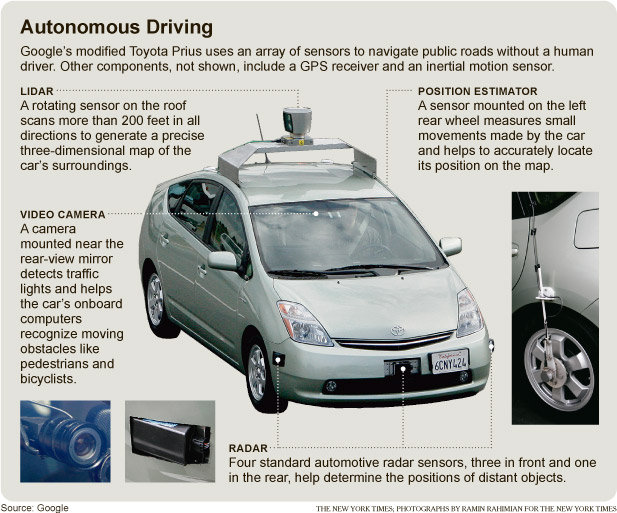
The present state of the art is probably the Google self-driving Prius, as described in this New York Times article:

It can handle urban and rural streets, and Google is pushing for it to be legalized in Nevada, but it still has a supervising driver.

Hayes is writing for a serious magazine and so needs to keep his speculation fairly grounded, but a blogger is under no such restriction.   What else might happen in the age of driver-less cars?

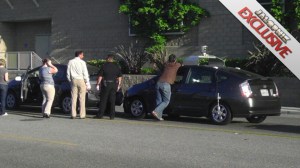
The first self-driving accident - a 4-car pileup with a Google car in Mountain View CA, Aug 2011

To start with, you have to wonder about his basic premise – that liability issues won’t kill this baby in the cradle.   It’s hard to imagine any kind of software getting to the necessary  level of reliability.   Space Shuttle software still failed, and it operated in a far more restricted domain than a car would.   All it had to do was fly through open air and empty space, rather than drive with rain and snow and squirrels and pedestrians.  It would be so easy for something to go wrong, and the consequences to the software provider would be so dire, that I can’t see how this would ever work legally.  An accidental death in the US gets priced out at a couple of million dollars, depending on the age, income, and number of dependents of the victim, so it doesn’t take many of those to bankrupt you.

But let’s grant for the sake of argument that these systems can be made ultra-safe.  We’ll wave hands and invoke Google-ish AI techniques where the car compares its current situation to billions of similar ones stored on the cloud.   People might not go for it even then for personal vehicles.   After all, cars are probably the most important status symbols that people own, after their clothing.   This is mainly due to massive investment by car company advertisers, but  there are a huge set of signifiers associated with them.   Are you a middle-aged guy in something low and sleek?  That tells people something.  How about a mom in a tank-like SUV?  A hybrid with a distinctive shape to let people know your greenitude?   A mud-stained pickup with a gun rack?   Look at someone’s car, and you’ll know their consumer segment immediately because of years of subliminal training.

Plus, lots of people like to drive, including me.  I don’t even like automatic transmissions, and get so annoyed by cruise control mistakes that I rarely use it.  Driving is one of those simple and pleasurable physical skills, like ice skating.   It’s not naturally that way, but it’s become it through millions of person-years of engineering.

So individuals may not give up their cars that easily, but commercial vehicles are under much less constraint.  Once safety is assured, robot trucks and delivery vans have lots of advantages.   A key one is being able to operate in the middle of the night, when labor is at its most expensive but the roads are the most open.   Darkness shouldn’t bother a vehicle with lidar and radar senses. Nighttime is when mail and packages should be delivered, assuming it’s done by quiet electric vans.    That’s when garbage should be picked up too.  Many towns are already requiring trash to be in standard bins that the truck itself can pick up, so removing the driver is the next step. And of course nighttime is the best time for long-haul trucking.  Shifting truck traffic to nighttime will lessen congestion everywhere.

Fast and cheap delivery, though, means trouble for retail.  Amazon is already breathing down the neck of every store in the country.   It already has advantages for distribution because of volume and automation.  On-line retailer warehouses are already getting roboticized, E.g. by Kiva Systems bots that move bins of products to tables where people can pack them.  Self-driving vans and trucks will take another whack out of distribution costs, making on-line retail even cheaper.

This could cause yet another rework of the urban landscape.  Pedestrian Main Streets were killed by strip malls once people could drive to them instead of walk.  Strip malls were killed by shopping malls, which offered a denser array of goods in a more pleasant environment.  Shopping malls are getting killed by Walmart and its ilk, which cut out sales staff and the overhead of separate stores.  But why even drive to Walmart if an electric robot van can deliver you something from a remote rural warehouse in an hour?  No going out in the rain, no fighting traffic and lack of parking, and no vast intimidating spaces filled with bad music.

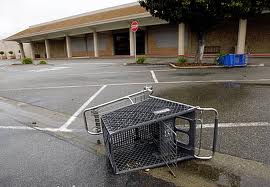
Abandoned Mervyn's dept store in Dublin CA (2009)

Every one of these shifts left debris across the land.  Small towns are full of derelict Main Streets, and have bathtub rings at their borders of failed strip malls.   A fading shopping mall is a scary place to be, with lots of blank fronts and gangs of restless teenagers.  Now the big-box stores are likely to go the same way, with vast acerages of parking lot going to weeds and birds nesting in their steel roof trusses, now exposed to the sky.

Even the largest artifact of the 20th century, the road system, could be overturned.   The CIA says that there are 4 million km of paved roads in the US, which must contain billions of tons of asphalt. They’re paved for the sake of safety, but if the robot can drive far better than you can, who needs them?   There’s no public money to maintain them anyway.  Use adaptive suspensions to handle rough surfaces and sell off the asphalt as hydrocarbon feedstock.  Great robot road-chewers could roam across the landscape, munching up the now-useless roads for their carbon, while burning some of it to power themselves.

So if cars can get to the intelligence level of horses, maybe we can go back to the minimal infrastructure needed by horses instead of the vast and ugly road systems needed by dumb cars.    We can go back to 19th century greenways instead of 20th century roadways.  Our towns can be social gathering places instead of  given half over to parking and retail.

And maybe we won’t have tens of thousands of people being killed by cars every year.   Cars killed 37,000 people in the US in 2008.  Compare that to 12,000 killed by guns in that year (not including suicides).    Cars are 3X more dangerous than machines deliberately designed to kill!  Maybe it would be worth a few software failures to get those numbers down.

Posted in Uncategorized | Tagged , | 1 Comment

SF Writers At War

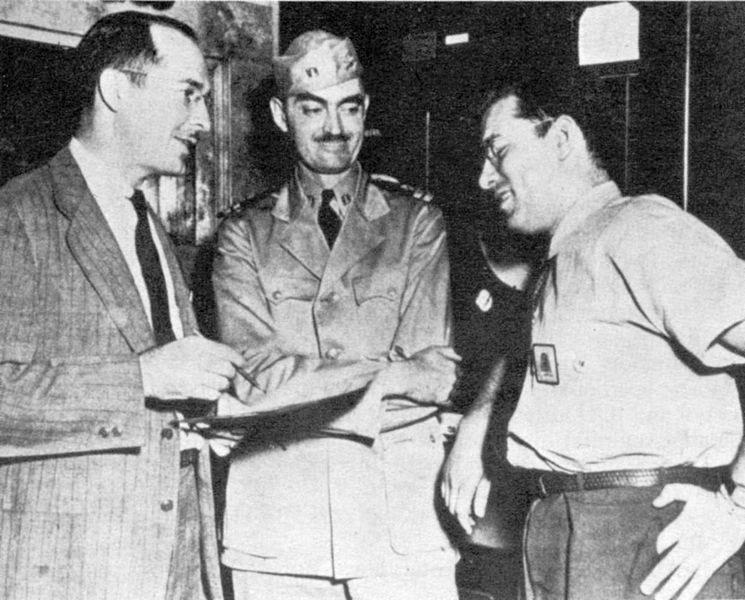
Heinlein, De Camp, and Asimov in 1944 at the Navy Yard

In 1942  three of the country’s leading SF writers – Robert Heinlein, Isaac Asimov, and L. Sprague De Camp – all started working together at the Philadelphia Navy Yard.    The US had just entered WW II, and everyone wanted to contribute.  Heinlein and De Camp were too old and too unfit to fight, and Asimov hated the getting-shot-and-dying part, but they still wanted to chip in.   They were three of the most imaginative people in the country, so what did the Navy actually have them doing?

Paul Malmont has just written a fun novel exploring just that question: “The Astounding, the Amazing, and the Unknown”.   It centers on these three, but throws in the unpleasant L. Ron Hubbard, the actively nasty John Whitesides Parsons (a rocket pioneer and satanist), the mysterious Walter Gibson (creator of The Shadow), and an extremely elderly Nikola Tesla.    There’s a secret that Tesla has been hiding for decades, a secret involving his last great effort,  the Wardenclyffe Tower, an aborted beam-energy system that he built at Shoreham, Long Island.  Our heroes will learn the truth of it, and get involved with the Philadelphia Experiment, the Japanese attack on the Aleutians, and the one Nazi landing in the US.  It’s a ripping yarn, and nicely blends together most of what’s known about these people and their time.

But what did these three actually do during the war?  I couldn’t find anything about this on-line, and so looked at the autobiographies of Asimov (“In Memory Yet Green”) and De Camp (“Time and Chance”), and a detailed bio “Robert A. Heinlein” by William Patterson.   The reality of their activities is pretty mundane, of course.  The only one who got close to adventure was Asimov, and he managed to wriggle out of it in time.  As best as I can tell, here’s what they each did during the war:

Heinlein – had graduated from Annapolis and been an officer, but was forced by tuberculosis to leave his beloved Navy in 1934.   He started writing SF in 1939, and by 1942 was the leading SF writer in the country, with stories like “Life-line”, “Requiem”, “Waldo” and “The Unpleasant Profession of Jonathan Hoag.”  Ignore his later odd and cranky novels – this was prime stuff.  He was desperate to get involved in the war, but couldn’t get back into the Navy.  He settled for managing a materials testing laboratory at the Naval Air Experimental Station at the Yard.  His most direct contribution was in discussions of how to merge data from sonar, radar, and visual sightings with his friend Cal Laning, who captained a destroyer in the Pacific and was later a rear admiral.  Laning used those ideas to good effect in the battle of Leyte Gulf in 1944, the largest naval battle ever fought.  As described in the novel, Heinlein did head something called the Kamikaze Group, but it was informal and didn’t get anywhere.  That’s not surprising – to this day no one knows how to stop guided missiles, be they human or robot-directed.   He did come out with a report on plexiglas radome covers (which tend to shatter when hit with bullets), but it was too late to affect production.  The war in the US only lasted for about 3 ½ years, which was hardly time to fix anything.  The biggest consequence to him of his war work was meeting the love of his life, Virgina Gerstenfeld, who was a rare female engineer at the lab.  He divorced his second wife, Leslyn MacDonald, in 1947, and married her a year later.

Asimov – was also already a significant author by 1942, even though he was only 22.  He had already published “Nightfall”, which the SFWA voted as the best short story published before the existence of the Nebulas in 1965.  He was doing graduate work in chemistry at Columbia when the war came to the US, and was dragooned into the Navy work by Heinlein.  That and a quick and unsuitable marriage were a good way to avoid the draft.   He was mainly involved in testing materials.  E.g. he would test how waterproof a plastic was by filling a bowl with a water-absorbing chemical like calcium carbonate, sealing the bowl with the plastic film to be tested, and then placing it in a heated, high-humidity oven.  He would then weigh it to see if any vapor had gotten through the film and been absorbed.    He also looked at sealants for aircraft joints, testing if they maintained elasticity under heat, cold, and sunlight, and at dye markers for airmen downed at sea.  These were tubes of fluorescent chemicals that would form a big green patch on the water around the guy in his life jacket.  The patch could be seen by searching aircraft.  He did actually go up in a plane to test their efficacy, which was one of  two times in his life that he ever flew.

He did finally get drafted in 1945.  He did the usual basic training, and then he and some other chemists were sent to the Pacific to take part in Operation Crossroads, the first post-war test of an atomic bomb.  This terrified him.  Even though tens of thousands of other people would also be observing the test, and they’d be watching from at least ten miles away, he wanted nothing to do with it.  He wrote a letter to the American Chemical Society and managed to get himself excused.  Myself, I would have wanted to see the device that was likely to destroy the world.   I’m rather disappointed that Asimov, a man who was interested in everything, wasn’t curious about this, dangerous though it might have been.   He returned to New York after that, and took up his dual career of writing and biochemistry.

De Camp – may not be as familiar a name as the other two, but he was a writer of great charm.   His best known work is “Lest Darkness Fall” (1939), where a 20th century man manages goes back in time to prevent the fall of Rome.  My favorite is “The Dragon of the Ishtar Gate” (1968) where a Persian warrior and a Greek philosopher attempt to find the heart of a dragon at the head of the Nile in the time of King Xerxes.

He actually got degrees in aeronautical engineering from Caltech and Stevens.   Of the three, he came closest to actually doing something useful.  He was ordered to find out why the trimtab controls on the new Grumman F6F Hellcat fighter planes tended to lock up at high altitude.   He found that the lubricant on the universal joints between the cockpit control and the trimtabs got sticky at low temperature.  The answer was to use a bigger handwheel with more mechanical advantage to drive the control.   It’s not clear, though, that this simple fix ever made it back to the factory – again, the war just wasn’t long enough.  In 1944 he was taken off of engineering and put on a committee that was supposed to act on employee suggestions.  It turned out to be a waste of time, and he managed to get it abolished.  He quite proud of that, since it’s a rare bureaucrat who organizes his own job out of existence.

Of the three of them, I think he had the best post-war life.   He maintained a steady output of fun novels and histories, traveled and socialized extensively, became an expert in interesting subjects like Greco-Roman technology, and had a successful family.  Much of the credit goes to his wife, Catherine Crook De Camp, who was also a collaborator on many of his books.   Heinlein and Asimov had better careers, but they both had bad divorces, and I doubt they were as happy.

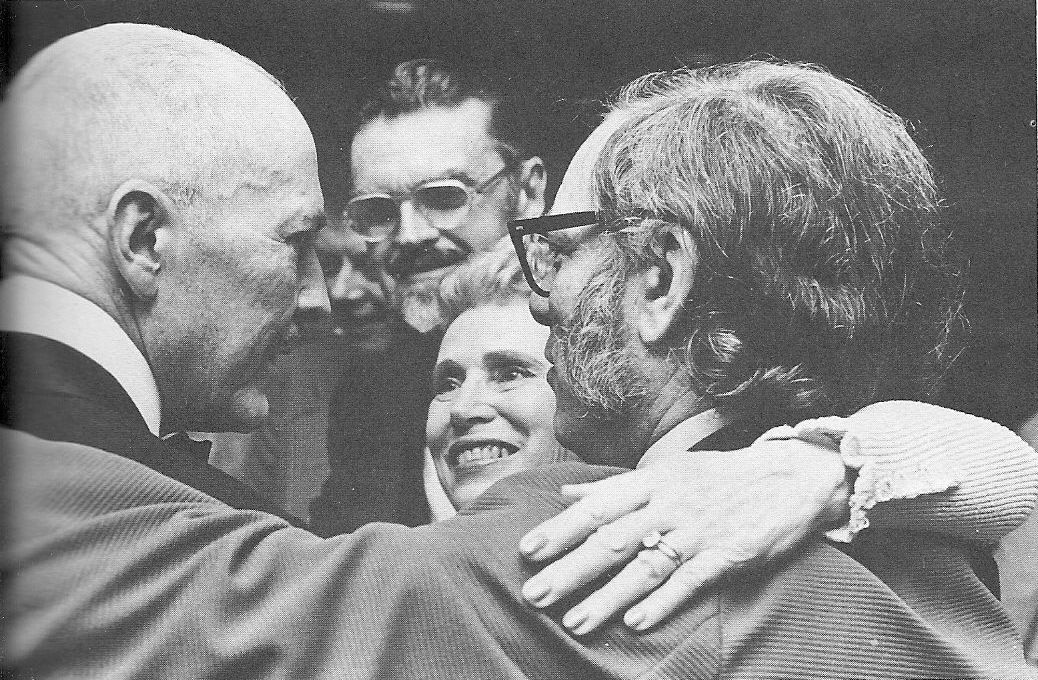
In any event, here they all are, including Catherine, 30 years later at a Nebula Awards banquet in 1975:

Heinlein, Sprague and Catherine De Camp, Asimov in 1975. Photo by Jay Klein

In spite of wildly different politics, styles, and careers, their war work together seems to have kept them on great terms.  Maybe they didn’t make destroyers disappear or recreate the Tunguska Event, as in Malmont’s novel, but they did some good stuff.

Posted in Uncategorized | Tagged | 12 Comments

“MIT Seeks to Flatter Wealthy Businessmen”

… is what the headline should have read on this Boston Globe article, “Stars of invention – Walk of Fame in Kendall Square celebrates technology and the entrepreneurial spirit”.  Apparently MIT and the city of Cambridge have set up a kind of Hollywood Stars walk in the square close to MIT:

Gates WoF star in Kendall Square, CC DanBricklin.  The quote reads “Never before in history has innovation offered the promise of so much to so many in so short a time”

They’ve put seven of these into the sidewalks, ones for Thomas Edison, Bill Hewlett and David Packard of HP, Bob Swanson of Genentech, Mitch Kapor of Lotus, and the inescapable Steve Jobs and Bill Gates.  The idea for it came from Bill Aulet, managing director of the MIT Entrepreneurship Center.   He says “We retire baseball players’ uniforms and have all kinds of celebrations for sports figures, but there’s no place to celebrate entrepreneurship.  These are the celebrities people will look up to.”  He continues “This is about honoring these people, yes, but it’s more about the stories about them to inspire young people. Children are great imitators, and we need to give them something great to imitate.’’

Ah, so it’s for the children, children who might not realize that making billions of dollars is something that American society values.  The athletes are well-known, as are the musicians, as are the actors, but who will speak up for the unknown plutocrats?  Don’t they deserve the kind of attention that all these other groups with their professional staffs of publicists receive?   Well, actually they also have professional publicists, but they still need more attention.  Maybe if MIT gives it to them, they’ll give a little attention back, attention with a lot of zeros after it.

Unfortunately for the plan, the plutocrats don’t seem all that interested.    Of the four living honorees, only one, Mitch Kapor, showed up, and I’m afraid he’s the most minor of the seven.   Although he has had a long and interesting career, he was only head of Lotus for four years, and Lotus itself had neither the first or the best spreadsheet.  The other honorees didn’t even send flacks.  Dan Bricklin, creator of the first spreadsheet program, spoke in honor of Bill Gates, even though he never worked for him or even with him.  His gracious and balanced speech about that controversial figure is here.

The other backer of this project is the city of Cambridge, which hopes that the Walk will make it better known as a center for startups.   If Grauman’s Chinese Theater can become famous for having a Walk of Fame, why can’t Kendall Square?  Unfortunately, the choices here don’t back up that hope.   Kapor’s Lotus started in Cambridge, but only lasted there for 14 years before IBM bought it, and its sad remnants are now in Westford MA.   All the others came out of  Silicon Valley, except for Edison.  Shouldn’t this Walk be in Menlo Park CA instead?  That’s where most of these people did their work, and it’s even named after the site of Edison’s lab in New Jersey.

The larger question, though, is why such a Walk is even needed.   All of these people are well known and rich.  Why do they need even more stroking?    MIT should be honoring people who have not made billions, and yet whose innovations have really made a difference.  People like Richard Stallman, who as the creator of Emacs, GNU, and the Free Software Foundation has done at least as much for computing as Bill Gates, and maybe more.   He’s also actually connected to MIT and Cambridge.   He’s a difficult character in person (I’ve had the honor of being insulted by him at dinner), but he’s the sort who should be a role model for students, and who deserves a star in a sidewalk.

Posted in Uncategorized | Tagged , , | 3 Comments