What Are Movies About?

IMDB has a nice feature whereby users can add keywords and genres to listed shows.  They have generously made these databases available here.   Can we use this to find out what movies are really about?

First off, I tried to restrict the data to movies instead of related video material.  I excluded every title marked with the genres Adult, News, Reality-TV, Game-Show, Talk-Show, and Short.  That leaves 409,048 shows, starting in 1894 (“Miss Jerry”, Romance) and going up to 2019 (“Timeliner”, Action, Sci-Fi).   Here are the proportion of movies in each genre:
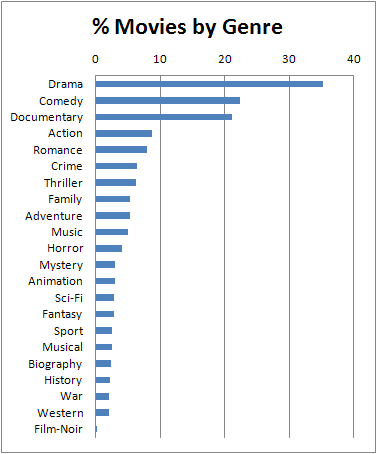
This seems to scale about with the size of display cases in the now extinct video stores, although it seems Sci-Fi ought to be bigger.

How has this changed over time?   Here are the top 10 genres by year, starting with the advent of talkies in 1930:
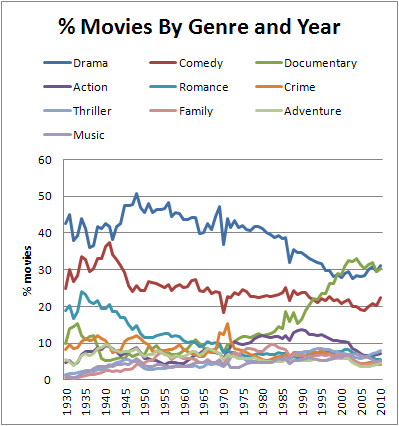
The data has been smoothed with a 3-year rolling average.  The 1930s were good for comedy and romance, suitable for dark economic times.  Documentaries have certainly surged in recent years, perhaps because of cheaper cameras, and they also appear to be displacing drama.  Action seems to have had its heyday in the 70s through 90s.

These genres cover most movies.  What keywords are popular for them?  I took all the titles in the keyword list that were marked with one of the above genres, and then stripped out the boring keywords like “name-in-title”.   Some really obsessive person entered tens of thousands of those.  Here are the remaining top 25:
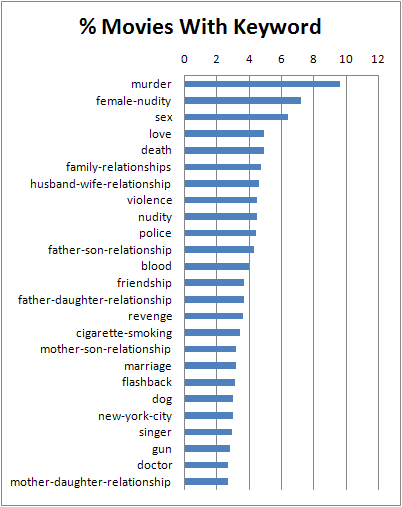
So movies are pretty much about biology: death, sex, and family relationships.   That does seem to cover a good chunk of existence.   But we also want to see police, cigarette-smoking, dogs, and new-york-city in the movies.  Hmmm.

How have these changed over time?  Looking at the top ten keywords:
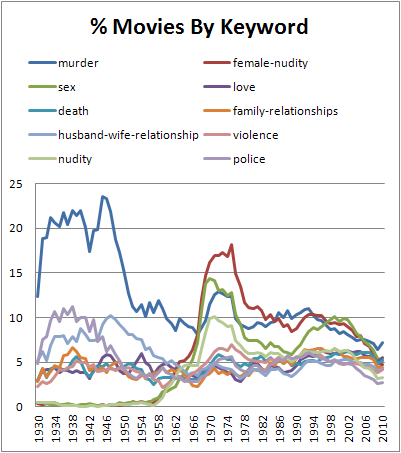
They sure liked them some murder in the 30s and 40s.  That was also the heyday of police and husband-wife-relationships.  Can’t imagine what the connection is.   Then it looks like censorship got loosened in the mid-60s, and female-nudity, sex, and nudity took over.   That lasted until about 1980, when I guess the Boomers started thinking about money instead.

What else can we compare?  New-york-city made it into the top 25 – what other cities rate?

New York is in a class by itself, especially in the 30s, when >10% of all movies were set there, and thus the log scale.  Then it’s Paris, London and LA,  then a cluster of SF, Chicago, Rome, Berlin, and Las Vegas.

The original inspiration for all this was a comment by Ken Restivo:  “Vampires were so 80s.  Aliens were very 90s.  Zombies are right now, but, I think, rapidly becoming passe.  What’s next, I asked a friend and his 10-year-old son?  “Dragons”, came the answer.  It could be. A trend is waiting to be set.  It just needs someone to set it.”  Dragons, sadly, didn’t make it into the top 1000 keywords, but here are some others:
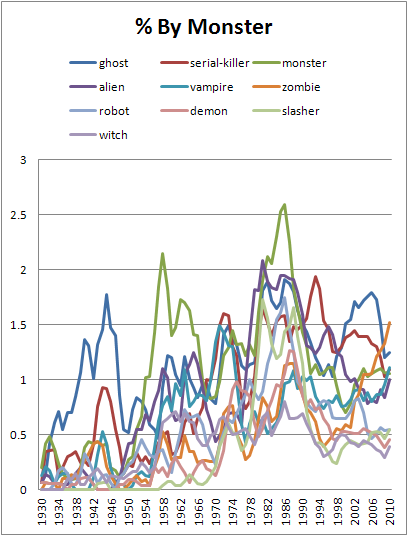
Zombies did trend up in the Zips, and are currently the leading form of monster.   Ghosts were the favorite in the 30s, and then straight-up monsters in the 50s and 80s, along with aliens.   If you find this graph too busy, Ken took some of this data and turned it into an interactive chart here .

OK, one could play with this all day.  I’ll try one more – what do people do in the movies?

Doctors were big in the 30s and Zips, spies in the 60s, and prostitutes in the 30s and 70s.   People seemed to do more in the 30s, but that’s perhaps an artifact of how those movies have been marked up with keywords.

Google should really do something like its N-gram engine for books for this stuff.  Maybe IMDB could license it from them!   People need more on-line time sinks.

Posted in Uncategorized | Tagged | 1 Comment

Tech Tourism Around Boston

Boston has been industrialized for 200 years, so there’s plenty to see around the city for the technically-minded traveler, or for the local looking for a family outing.   Since it’s hard to decide which are my favorites, I’ll just put them in alphabetic order.


Battleship Cove, Fall River, Collection of 20th C warships

Huge evil machines, remnants of the worst war in human history, and now a place for overnight camps by Boy Scouts. The battleship USS Massachusetts fought in WW II in the Mediterranean, South Pacific, and Japan. It carried hundreds of 2700-lb 16″ shells, enough to demolish cities. There are also the WW II submarine USS Lionfish, the Korean-era destroyer USS Joseph P. Kennedy, an East German missile cruiser from the 1970s, two PT boats, and several aircraft. The battleship still smells of oil after forty years of being berthed here.


Charles River Museum of Industry, Waltham, site of first MA textile mill, 1814

Start of the US Industrial Revolution with IP stolen from the UK. Lots of 19th and early 20th C tech. Some references here: Steampunk vs Apple-ism .

There are great restaurants and the Watch City Brew Pub nearby on Moody St, named for the mill’s chief engineer, Paul Moody.


The Great Refractor, Harvard/Smithsonian Astrophysical Center, Cambridge,

The world’s largest refracting telescope in 1847, still operational. Open to the public for star-gazing on rare occasions. The Center hosts meetings of the Amateur Telescope Makers of Boston on the second Thursday of each month, More here: The Persistence of Beautiful Things

Telscope and Leo


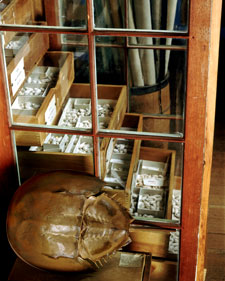
Harvard Museum of Comparative Zoology/Minerals/Glass Flowers

What natural history museums used to be like, full of actual specimens of nature, instead of models with primary colors for schoolchildren.


Higgins Armory Museum, Worcester, Collection of suits of armor and weapons

The personal collection of a local businessman, John Woodman Higgins, who snarfed up all he could he find in Europe in the 20s and 30s, then built a castle to display it all.   He once staged a banquet in its main hall, and had his sons hide out in the suits that were arrayed along the walls.  They came to life in the middle of the meal, yielding a highly satisfactory reaction from his dinner guests.   There are now local groups there giving classes on western martial arts based on medieval German fighting manuals.


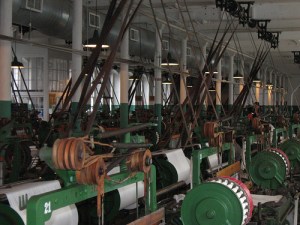
Lowell Mills National Historical Park, Lowell, Early textile mills

The original factory town, entirely built around hydro power from the Merrimack River, with dorm housing for young women from all over the New England.   Terrific folk festival in the summer.

1920’s weave room, credit JMaz Photo


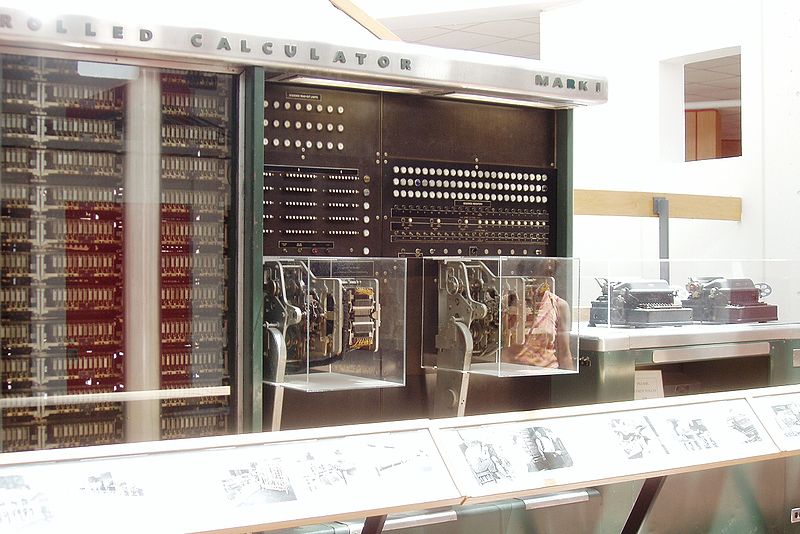
Mark I Computer, Harvard University Science Center, Cambridge

Built in 1944, this was one of the first true programmable computers.  It had 500 miles of wiring, weighed 5 tons, and could do about 4 72-bit adds per second.  It was too early for even vacuum tubes; it used  thousands of relays instead, and sounded like “a roomful of knitting needles” when working. Designed by Howard Aiken and programmed by Grace Hopper.

Right segment


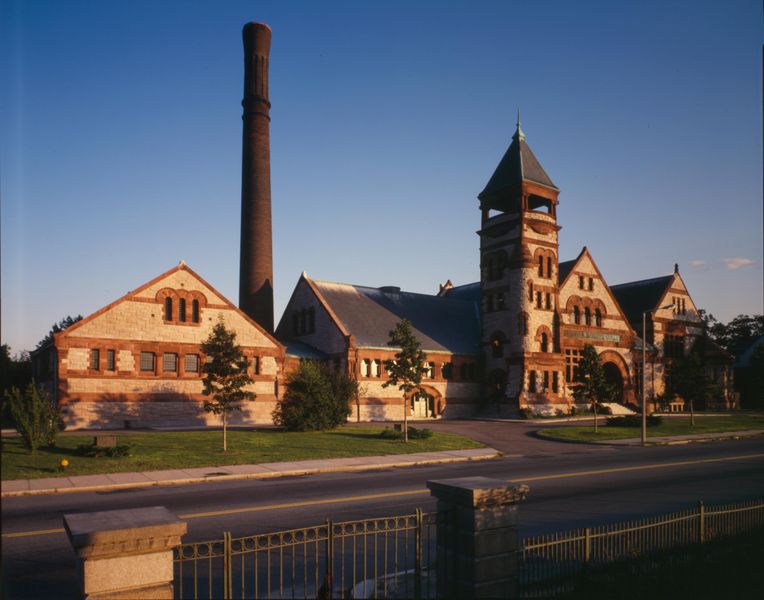
Metropolitan Waterworks Museum, Boston, Major pumping station

Gigantic gleaming steam engines that pumped tens of millions of water a day into the city up until the 1970s, and an exemplar of the nobility of public works engineering. More here: When People Were Proud of Their Government


MIT Museum, Cambridge, Early radar, Arthur Ganson sculpture

There isn’t much to see at MIT proper, although its vast interconnected complex of buildings is a strange and daunting labyrinth all by itself.  Its museum has lots of random stuff from the centuries of work at MIT, but my own favorite is the collection of Arthur Ganson‘s mechanical sculptures.

Each gear turns 60X slower than the one before it.  The first can be turned by hand,  and the last is embedded in concrete


Mount Auburn Cemetery, Cambridge, Graves of the greats

Final resting place for: Buckminster Fuller (geodesic dome), Henry Burkhardt III (Data General, Encore, KSR), William Barton Rogers (founder of MIT), Harold Doc Edgerton (strobe pioneer), Edwin Land (Polaroid), BF Skinner (behaviorist), Louis Agassiz (discover of the Ice Ages), Asa Gray (leading botanist), Katharine Burr Blodgett (anti-reflective coatings), Nathaniel Bowditch (marine navigation)

Grave of Fuller and his wife


Museum of Science, Boston, Gears, ships, dioramas

The best stuff here is in the neglected corners of the museum in the basement, like a display case that has every known form of gear, or the ship collections, or the dioramas of New England landscapes.  At one point they received an entire trophy room full of murdered animal heads as a bequest, and had to install it down there with a highly apologetic plaque.  Gotta do what donors want.

Colby Gun Room, credit Just Us 3


Musical Instrument Collection, Museum of Fine Arts, Boston

Weird and wonderful musical mechanisms from every era and place. No pictures, sadly, because the MFA charges for them all. Their new American wing is also spectacular.


Old Schwamb Mill, Arlington, 19th C wood-working factory

Intricate belt-driven lathes, still working after 150 years.  They had fixtures for cutting oval picture frames.  Their last main project was turning wood from the Washington Elm (where George mustered the troops on Cambridge Common) into frames for DC gifts.  More here:
The Last Factory

Clinton and Louis Schwamb at their Arlington Mill in 1905

Not open often, though, so check for times.


Saugus Iron Works, Saugus, First iron blast furnace in North America, 1648.

The core technology of 17th century industry, yet quite easy for modern eyes to follow. The highest tech of its day, and desperately needed by the young and vulnerable Massachusetts Bay colony, but a failure. More here: A Failed High-Tech Gamble

A pleasant picnic spot!


USS Constitution, Boston, World’s oldest warship still afloat (1797)

Active for almost 60 years, and never defeated, it’s still a registered ship in the US Navy.  On the Fourth of July it gets towed out into Boston Harbor and turned around so that the sides wear evenly.   We once happened to be on Spectacle Island on the Fourth, and saw the grand ship moving out, surrounded by hundreds of small craft.  Two fast corvettes then zoomed into the harbor, both flying the Canadian flag.  The Constitution let them have it with a broadside, and Boston was saved from invasion once again.

Posted in Uncategorized | Tagged , , | 2 Comments

Has Growth Stalled in Spite of Third Industrial Revolution Tech?

Paul Krugman and Business Week have recently referred to a grim new paper  – “Is US Economic Growth Over?” by Robert Gordon.  He’s an economics professor at Northwestern University, and notes that real growth peaked in the 1960s, and has been tailing off for some time now:

“British data for 1300-1870 come from Broadberry et al. (2010) and are ratio-linked to Maddison’s U.K. data through 1906. U.S. data are based on NIPA Table 1.1.6 back to 1929 and are ratio-linked to annual GDP from Balke-Gordon (1989)”

He doubts the reality of continuous economic progress, and instead says that there have been three distinct Industrial Revolutions:

  1. 1750 to 1830: E.g. steam, railroads
  2. 1870 to 1900: E.g. electricity, internal combustion engine, running water, indoor toilets, communications, entertainment, chemicals, petroleum
  3. 1960 to present: E.g. computers, the web, mobile phones

What looks like continuous progress is the working out of the inventions of each revolution.   They take some time to really kick in, and that’s when growth happens.  E.g. automobiles were invented in the late 19th century, but didn’t have a broad effect until the 1920s, and didn’t become universal (at least in the US) until the 1970s.  Now there are more cars in the US (250M) than people over 16 (~240M), so more big growth is impossible.

There was little growth before 1750, and there’s no guarantee that there will be any in the future.  It’s already declining in spite of the Third IR.  That hasn’t had nearly the effects on ordinary life as the Second.   Cellphones are nice, but the difference between a cellphone and a telephone is minor compared to the difference between a telephone and a letter.   The Third IR did cause a growth bump in the late 90s, when PCs and the rising Internet really did make a difference, but that seems to have played out already.

The reason he gives is that the benefits of the Second IR were fundamental improvements in human quality of life, and can only be achieved once.   People can take care of sewage disposal once, and it’s done.    They can acquire easy and clean transportation,  or the banishment of night, or relief from farm labor, or freedom from the heat and cold of the seasons only once.   All these gains can be improved upon, and can be more widely shared, but at some point future gains just aren’t as great.   Electric lights can become more efficient, and safer, and cheaper and have better color, but the big change was from candles.

The Third IR added freedom from repetitive mental tasks, and greater access to information, but those just aren’t as big a deal, according to Gordon.   I partly agree.  I’ve spent most of my career designing computers, but I’ll be the first to admit that they aren’t as important as indoor plumbing.    To drive this home Gordon proposes a thought experiment, which I’ll rephrase slightly. Which would you rather have:

  1. A PC, and an outhouse and outside well?
  2. Or books and a bathroom?

Fond as I am of reading and writing blogs, I prefer to go inside in the winter!

He also believes that even the present anemic rate of US growth is slowed by 6 factors:

  1. An aging population
  2. A stagnant educational system (i.e. graduation rates are no longer rising)
  3. Rising inequality (Note that the above chart is for average, not median, GDP per capita – median looks much worse)
  4. Global competition
  5. Bad energy and environmental prospects
  6. High consumer and government debt

Other countries may be affected less.  E.g. Canada is refreshing itself with lots of skilled immigrants, and Sweden suffers far less from inequality and debt.

It’s a bleak picture, but at least in my own field I don’t think it’s right.  Advances in electronics have NOT come in clumps; there has been something major in every decade.   Here’s a list off the top of my head for the last century, where I’ve assigned the decade to the time of wide use, and not just first invention:

  • 1900s – radio telegraphy, electric street cars, movies
  • 1910s – vacuum tubes, radio telephony, vinyl records
  • 1920s – radio broadcasting
  • 1930s – radar, movie sound
  • 1940s – digital computing, television
  • 1950s – transistors, tape recording
  • 1960s – communication satellites, integrated circuits
  • 1970s – microprocessors/DRAM/disks => PCs
  • 1980s – computer networking, CDs, VCRs
  • 1990s – Web, cellphones, GPS, digital cameras
  • 2000s – digital video (DVDs & streaming), smartphones, electric cars

Invention has been constant, and shows no signs of slowing.

But what of his larger point, that the Second IR satisfied human needs in a way that the Third has not?   I think there’s growth here that isn’t showing up in the statistics.   Most people have seen a great expansion in freedom in the last 50 years.  The 1960s may have been great for monetary gain for white straight males, but minorities, gays, and women would much rather live in the 2010s.    Even the elderly are far better off – they’re healthier, more mobile, and more engaged.  The metric of dollars per person is not capturing this.    It can capture the relief of physical discomfort that the Second brought on, but not the relief of mental discomfort that we’re seeing today.   It should matter that people feel less oppressed.

Has Third IR technology aided this expansion of freedom?  Perhaps, because people become more tolerant as they are exposed to a broader range of experience.   Recorded music, television, and now the Web have made all of the world’s culture available everywhere.    This can be overstated, as Wired-style cyber-vangelists tend to, but to the extent that the Third IR has been helping this process, it has been improving the quality of life as much as the Second.

Posted in Uncategorized | Tagged | Leave a comment

Enfolded in the Internet of Things

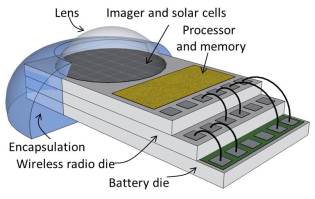
The Michigan Micro Mote – camera+computer+radio+power  in 1 mm3, introduced at ISSCC 2012

So I was at a conference the other day where the speakers were constantly using the buzz phrase “The Internet of Things”.   This is where pretty much everything will have a processor in it that’s connected to some kind of network.   This can be at a macro level, like having a car that knows who is driving it, or at a micro level, like having a set of strain sensors that can tell when a bridge needs maintenance.   I heard the phrase so often that I got irked, since I myself was not connected at that conference.  The wireless LAN was so overloaded that neither my phone or laptop could get a signal!

However, it’s something that’s clearly on its way, since it follows the great progression of computing:

  • 1950: One computer per country (UNIVAC, EDSAC)
  • 1960: One computer per company (mainframes)
  • 1970: One computer per office (minicomputers)
  • 1980: One computer per desk (PCs)
  • 1990: One computer per briefcase (laptops)
  • 2000: One computer per pocket (cellphones)
  • 2010: One computer per gadget (cameras, e-books, memory sticks, toys, etc)
  • 2020: One computer per dust mote!

The constant decline in the size of transistors has meant a constant decline in the minimum size of processors.  The older classes of machine don’t go away – there are still building-size computers like UNIVAC that still draw megawatts – but  smaller and cheaper classes of machines become possible in decade after decade.

The latest generation of tiny machines has crept up on me unawares.   I realized recently that I have 10 computer/radios either on me or close to me:

  1. a cellphone
  2. now with a Bluetooth headset link
  3. a FitBit wireless pedometer
  4. a keyless fob for my car
  5. a tollbooth transponder in the car (FastLane)
  6. a keyless fob for an office
  7. a wallet entry card for a different office
  8. yet another wallet card for yet another building
  9. an RFID chip in my passport
  10. an RFID card for the subway (a Charlie card)

How did this happen?  I used to sit down in front of a computer, and now I’m decorated with them.  Our stuff is surrounding us with signals.   We move in a field of radio waves,  invisibly interacting with machines around us.

Sound creepy?  It was when DARPA researched this in the late 90s with the Smart Dust project.  They wanted to know about every footstep on every path in a hostile area, the better to shoot them.  It also was in “Minority Report”, where every wall was a billboard trying to personalize itself to encourage you to buy.   That’s also available now, with cameras in displays that can classify faces by age, gender and ethnicity in order to target ads.

Yet look at the list above of things in my pockets – their purposes are so mundane.  They’re mainly to eliminate a few seconds of fumbling for a key or card.   The chips in them are so cheap that it’s worth having one to save those few seconds.   Soon they’ll be cheap enough to put in light bulbs so they can turn themselves off when no one needs light.  They’re already in toilets for people who forget to flush.   They’re going into streetlights (E.g. Enlight), so they can dim between midnight and five AM and report when they fail, and they’re in garbage cans (E.g. BigBelly) so they can report when they need to be emptied.

It’ll be a more responsive world than our current environment of stolid, unmoving artifacts.   Maybe it’ll be more like the pre-industrial world of plants and animals on the farm.   Our stuff is getting more life-like, more like what we evolved to interact with.   It’ll be nice when our stuff is simply less stupid!

Posted in Uncategorized | Tagged | Leave a comment

Building Good Stuff for the Wrong Reason

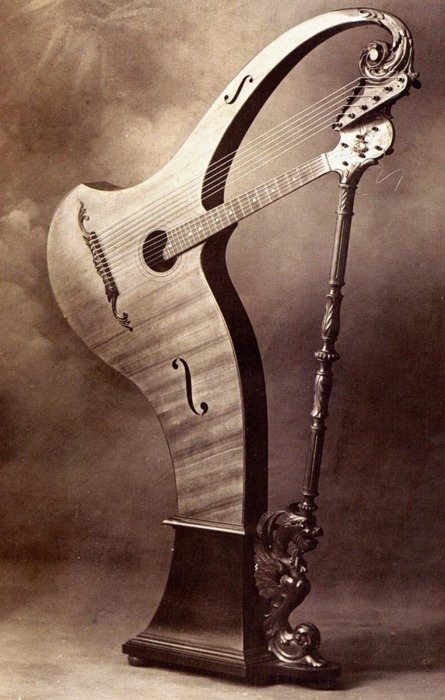
Cesare Candi harp guitar, ~1900. Yes, it can be built, but why?

Two years ago I was asked to look at the assets of a failed startup.    All its equipment and intellectual property were about to be sold for a pittance, so I was supposed to see what could be saved.  The startup had found a way to build a cheap  infrared camera, one that could see much deeper into the infrared than ordinary cameras.  A typical silicon sensor can see into the near infrared (a wavelength of about 1000 nm), whereas this could see down into short wavelength infrared (SWIR,  about 1600 nm).   There’s a lot of this kind of light around even on dark nights – it’s emitted constantly by a layer of the stratosphere.   They thought they could build a great surveillance camera, one that didn’t need any illumination at night.

It turned out that almost no one cared about that.   If you put a surveillance cam outside, you also put a light there.   The sort of places you really want to cover are truck yards, where it’s easy to steal a lot of stuff, and those always have lights.  The people who really care about covering dark areas are ones who don’t want to advertise their presence.  That’s basically military bases in hostile areas, and that’s not much of a market.

So they went under.  The technology was great – they had found a way to put a layer of germanium on a standard silicon sensor (germanium has a much lower bandgap than silicon, and so can sense lower-energy photons), so it was a simple add-on to existing tech.  The people had come out of Bell Labs, and one of them was an IEEE Fellow, which is a real honor.  I asked them what else you could do with such a sensor.  “Well,” said the former CTO, “it turns out that SWIR light goes right through healthy teeth, but is absorbed by the water in cavities or other damage.”

I almost fell over.  They had a way to do dental exams without X-rays, and they spent all their money on surveillance cams for Afghanistan.  What a waste!  “Wouldn’t that have been a better application?” I asked.  “Our CEO and VCs were committed to the surveillance idea, so we never pursued it,” said the CTO.  And now they can’t.

I’ve seen this happen lots of times.   Someone builds something really nice that really works, but its basic purpose was wrong-headed.   A few other examples:

  • A wireless link capable of gigabits per second that’s meant to replace a $5 HDMI cable.
  • A full custom chip for a proprietary disk interface (DSSI) that’s only going to be used on a few thousand workstations.  That’s about $1000 of design expense per chip for a chip that only costs $20.
  • A fully-programmable parallel image processor that spent all its cycles doing standard operations like video compression.   That stuff should have been done in a standard block, leaving the processor to do novel operations that would distinguish the product.
  • A chip that can do the latest and greatest video compression algorithm (H.264 SVC), one that’s so difficult that no one can actually decode it.  Well, they could if they had the same custom hardware, but no one will buy that until video is available in this format, and no one will do that until everyone can decode it.  Chicken, meet egg.

The engineers involved in all these projects did their jobs well.  These projects were completed, and worked.  It was the people at the top who screwed up.   They asked for the wrong thing to be built.

That’s not always fatal.  I once heard Wally Rhines speak about this.  He was the manager of the group at Texas Instruments that built the first major digital signal processor (DSP) chip, the TMS32010, in the early 80s.  He’s now the CEO of a large chip design software company called Mentor Graphics.  DSPs are now a $10B product segment and are used in a vast range of applications, from cellphones to disk drives to audio.    Even way back then TI knew they had a hot product on their hands.  It was obvious what DSPs would be used for – speech synthesis.   Everyone would love to have talking cars!   TI had actually had a big success with the Speak & Spell, a toy that let you type a word and then hear it, and so knew that this was the wave of the future.   Ten years later they looked back at the top 100 applications of DSPs, and speech didn’t even make the list.  They guessed completely wrong, but the design was so flexible that it could be used for lots of other things.  Few projects get to be so lucky!


Posted in Uncategorized | Tagged | 3 Comments

Bigger Is Greener

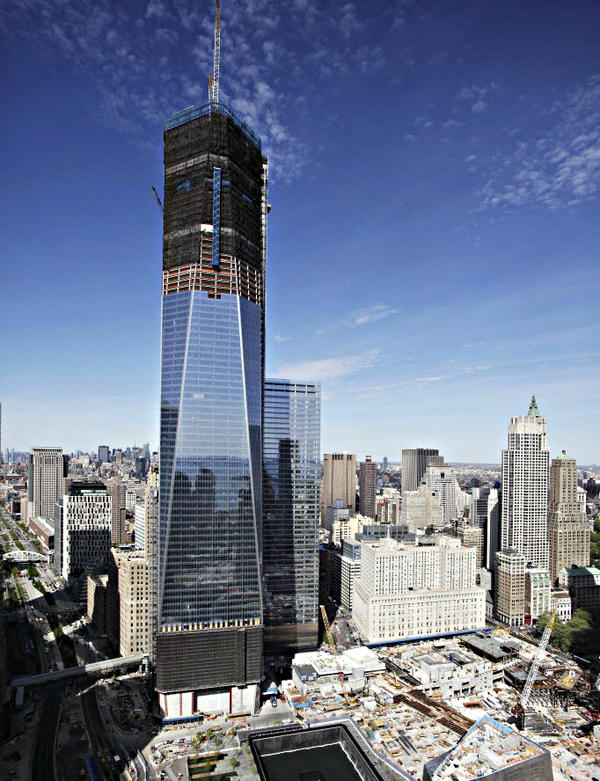
The fuel-cell-powered One WTC as of 4/30/12 when it topped the Empire State Building (Mark Lennihan/AP)

Here’s a promising trend – all the cool big guys are going green.    Google and Adobe are now powering their offices with Blo0m Boxes, a solid oxide fuel cell powered by natural gas that has 40% the CO2 emissions of a coal plant (773 lb/MW-hr vs ~1900), and vastly less sulfur and nitrogen oxide pollution.

The replacement for the World Trade Center, One World Trade Center (thankfully no longer called the Freedom Tower), is also putting in gas fuel cells – a 4.8 MW system from United Technology Power.  It’s built from 12  Purecell 400s  that can each output 400 kW at 42% thermal efficiency.  That’s not that good compared to combined-cycle turbines, which can get up to 61%, but the fuel cells are small, quiet, and low-maintenance.  They can also dump their waste heat into hot water for the building or into chillers for air conditioning, and so can get up to 80% total efficiency.  The building will be nearly self-powered, just like the Avengers Tower in the recent movie, although few would mistake its developer, Larry Silverstein, for Tony Stark.  The building is also much more attractive than the hideous WTC, although still not a patch on the elegant Burj Khalifa.

Even the ancient Empire State Building is getting upgraded.  The NY Times reports (“Green Power for the Empire State Building“) that they now get all their power from a wind supplier, NRG Systems.  They’re buying 55 million kWH a year, which works out to an average of 3.6 MW.   This is part of a general makeover which has replaced the windows, redone a lot of the floors, and kicked out a lot of small tenants that were paying ridiculously low rates.

All these developers know the score – they need to lock in their energy prices with their own supplies.   It may be more expensive up front, but it’s worth it to hedge against the future volatility of conventional sources.  Every disaster like Fukushima or the Kingston Coal Ash Spill makes the risks in nuclear and coal harder to quantify and so more expensive to insure against.  Sure, the energy companies will  sucker some congressmen into making the US take all the liability for their crummy old tech, but it will only take a couple more catastrophes before that gravy train ends.

Big guys can afford to build their own power generators because they can afford to have people to manage these kind of systems, and they have access to suitable financing.  Small businesses and residences are at the mercy of the now-privatized utilities.    They usually don’t have the energy (so to speak) to manage their own power.

There are schemes for generating your own power, mainly via solar panels, but the privateers are now pushing back on this too.   California just raised the caps on how many people can do this, and the investor-owned utilities screamed.   They claim that forcing the utilities to buy home-generated power at retail rates boosts the rates for everyone, since the home generators aren’t paying for the transmission infrastructure.  “You’re raising rates on the poor!” they say, hoping to get a good class war  going in the right-wing media.   This is discussed in this NY Times piece “Solar Payments Set Off a Fairness Debate”, where the Times gives the corporate shills a national platform for their PR, as is their wont.   The utilities didn’t mind if a few hackers put up solar panels, but once a lot of people try to emulate Google and Larry Silverstein, they’ll have to be stopped.

Posted in Uncategorized | Tagged | Leave a comment

Ray Bradbury, 1920-2012, RIP

The opening to “Something Wicked This Way Comes”, 1962:

The lightning rod salesman has come to Green Town, Illinois.  He is talking to two boys, Will Halloway and Jim Nightshade: neighbors, best of friends, closest of rivals, one born light and one born dark.   Halloween is coming, and something worse.    He has given them a rod and says that lightning will strike one of their two houses:

But Will was staring beyond the man now.

“Which,” he said.  “Which house will it strike?”

“Which?  Hold on.  Wait.”  The salesman searched deep in their faces.  “Some folks draw lightning, suck it like cats suck babies’ breath.  Some folks’ polarities are negative, some positive.  Some glow in the the dark.  Some snuff out.  You now, the two of you … I – ”

“What makes you so sure lightning will strike anywhere around here?” said Jim suddenly, his eyes bright.

The salesman almost flinched.  “Why, I got a nose, an eye, an ear.  Both those houses, their timbers!  Listen!”

They listened.  Maybe their houses leaned under the cool afternoon wind.  Maybe not.

“Lightning needs channels, like rivers, to run in.  One of those attics is a dry river bottom, itching to let lightning pour through!  Tonight!”

“Tonight?” Jim sat up, happily.

“No ordinary storm!” said the salesman.  “Tom Fury tells you.  Fury, ain’t that a fine name for one who sells lightning rods?  Did I take the name?  No?  Did the name fire me to my occupations?  Yes!  Grown up, I saw cloudy fires jumping the world, making men hop and hide.  Thought:  I’ll chart hurricanes, map storms, then run ahead shaking my iron cudgels, my miraculous defenders, in my fists!  I’ve shielded and made snug-safe one hundred thousand, count’em, God-fearing homes.  So when I tell you, boys, you’re in dire need, listen!  Climb that roof, nail this rod high, ground it in the good earth before nightfall!”

“But which house, which!” asked Will.

The salesman reared off, blew his noise in a great kerchief, then walked slowly across the lawn as if approaching a huge time bomb that ticked silently there.

He touched Will’s front porch newels, ran his hand over a post, a floorboard, then shut his eyes and leaned against the house to let its bones speak to him.

Then hesitant, he made his cautious way to Jim’s house next door.

Jim stood up to watch.

The salesman put his hand out to touch, to stroke, to quiver his fingertips on the old paint.

“This,” he said at last, “is the one.”

Jim looked proud.

Without looking back, the salesman said, “Jim Nightshade, this your place?”

“Mine,” said Jim.

“I should’ve known,” said the man.

“Hey, what about me?” said Will.

The salesman snuffed again at Will’s house.  “No, no.  Oh, a few sparks’ll jump on your rainspouts.  But the real show’s next door here, at the Nightshades’!  Well!”

The salesman hurried back across the lawn to seize his huge leather bag.

“I’m on my way.  Storm’s coming.  Don’t wait, Jim boy.  Otherwise – bamm!  You’ll be found, your nickels, dimes and Indian-heads, fused by electroplating.  Abe Lincolns melted into Miss Columbias, eagles plucked raw on the backs of quarters, all run to quicksilver in your jeans.  More!  Any boy hit by lightning, lift his lid and there on his eyeball, pretty as the Lord’s Prayer on a pin, find the last scene the boy ever saw!  A box-Brownie photo, by God, of that fire climbing down the sky to blow you like a penny whistle, suck your soul back up along the bright stair!  Git, boy!  Hammer it high or you’re dead come dawn!”

And jangling his case full of iron rods, the salesman wheeled about and charged down the walk, blinking wildly at the sky, the roof, the trees, at last closing his eyes, moving, sniffing, muttering.  “Yes, bad, here it comes, feel it, way off now, but running fast …”

And the man in the storm-dark clothes was gone, his cloud-colored hat pulled down over his eyes, and the trees rustled and the sky seemed very old suddenly and Jim and Will stood testing the wind to see if they could smell electricity, the lightning rod fallen between them.

“Jim,” said Will.  “Don’t stand there.  Your house, he said.  You going to nail up the rod or ain’t you?”

“No,” smiled Jim.  “Why spoil the fun?”

“Fun!  You crazy?  I’ll get the ladder!  You the hammer, some nails and wire!”

But Jim did not move.  Will broke and ran.  He came back with the ladder.

“Jim.  Think of your mom.  You want her burnt?”

Will climbed the side of the house, alone, and looked down.  Slowly, Jim moved to the ladder below and started up.

Thunder sounded far off in the cloud-shadowed hills.

The air smelled fresh and raw, on top of Jim Nightshade’s roof.

Even Jim admitted that.

Was a terrific movie too in 1983, with Jonathan Pryce in his first major role.

Posted in Uncategorized | Tagged | Leave a comment

Amusing Children With Supercomputers

Yesterday I saw the new animated movie “Madagascar 3” at a special preview with my son.  It doesn’t open for a week, but the studio, Dreamworks, held a preview for the staff of Red Hat, a Linux software services company who helped them greatly with the computer animation, mainly with task-dispatching software called MeshGrid.  My son has a friend whose dad works at Red Hat, and so we got in.

Before the movie started, a Dreamworks person came out to say a bit about it.  It was rendered on a farm of 24,000 processor cores.  Even that wasn’t enough – they had to rent cloud time as well.  Individual scenes took millions of CPU hours, and had tens of thousands of animated characters.  The whole movie probably took 50 million CPU hours.  That’s about 6 CPU-millenia!

So making a modern animated movie takes a supercomputer.   Pixar has a similar system of about 15K cores.   However, a 24K-core system isn’t all that big by supercomputer standards – it would be 27th of the list of the Top 500 Supercomputers.  The world’s largest is the 700K-core K Computer at the RIKEN Advanced Institute for Computational Science in Kobe, Japan.   Still, the Dreamworks system would be one of the largest non-military machines in the US.   That’s what we do in the US – movies and bomb simulations.

Dreamworks uses HP Proliant Blade servers, where each board holds one or two Xeon 2.0 GHz 6-core processor chips, 64 GB of RAM, and many 10 Gb network ports.   HP now builds these in shipping-container-sized units for cloud servers.    Oddly enough, Dreamworks does not appear to use GPUs at present.  Ten years ago they used ATI chips, but I suppose modern renderers are too complex to optimize for specialized hardware.

As for the movie, well, that poster is actually a pretty accurate summary of it – lots of colors and lots of yelling.   I’m afraid that even CPU-millenia can’t make up for over-frenzied scripts.   The kids liked it, though, so if you have to go, do what we did and have a high kid-to-parent ratio!

Posted in Uncategorized | Tagged | Leave a comment

The Machinery Beneath the World

My commute has recently changed, and much for the better. Instead of being stuck on the highway, I get to walk over the pleasant stream of Alewife Brook:

And then down a sandy path on the Greenway:

Birds have been singing all the spring long, and wildflowers are in bloom.    How nice to be out of the car, I think, and out in nature.  Then I noticed something by the side of the path:

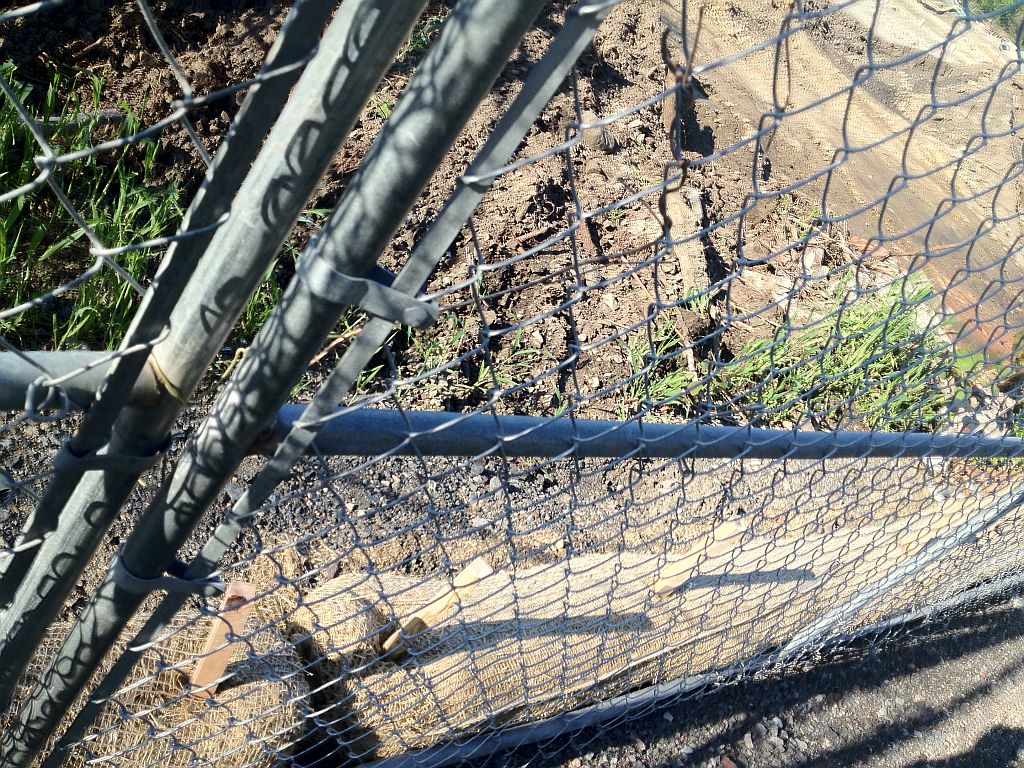
There’s a reason why this path is so smooth and dry – it’s underlain by plastic sheeting.   This whole area is actually a marsh.  The plastic keeps water from coming up, and weeds from sprouting up through the path.  On the far side of the brook is a fence:

And if you look beyond it:

You see what’s actually going on here.  This whole area was channeled and drained.   Underneath this park are pipes and dams.  It’s about as natural as the  shopping mall on the far side of the railroad.

Alewife Brook Reservation was actually laid out in 1909 by Charles Eliot, son of the great president of Harvard,  and the overall space was landscaped by the Olmstead brothers.  Before them it was a swamp.  The new construction here is for a storm water impound for  Cambridge and Belmont.  It’ll be a marsh, a bird migration and nesting site, and a functional part of the city’s infrastructure.

Some day all the green spaces of the world will look like this – a carefully crafted illusion of nature.  Everything will bear our touch.   Sometimes, like here, our touch will be light and crafted for pleasure.    In most places we’ll just dump the junk we don’t want.

I welcome this idea of nature as stage set.  Actual nature is overgrown and full of ticks bearing Lyme disease.  I’ll take a faux nature full of flowers and birds any time.    I’ll particularly prefer it over commuting in a sealed metal box!

Posted in Uncategorized | Leave a comment

“BLAST!” and Good, Cheap Science

“BLAST!” is a documentary about the Balloon-Borne Large Aperture Sub-millimeter Telescope, and it  opens with this teaser:

“Are you fucking kidding me?”, says the PI

The telescope is that huge instrument on the end of crane.   It’s supposed to measure light in the far infrared from the early universe.  Its builders had been down in Antarctica for months putting it together.  Just as the balloon lifts off and starts to pull it upwards, it swings back and crashes into the crane.  The principal investigator, Mark Devlin of U. Penn, was not a happy NASA customer, as expressed above.

And then they cut away!  You have to watch the rest of the movie to find out what happens.   You’re welcome to catch it on Netflix here, but I’ll spoil it for you.

The telescope did go up successfully and flew for 11 days in 2006 across Antarctica, and then came down as planned.  It captured data too quickly to radio it anywhere, and so it was all recorded on a hard drive in a sealed pod.  Unfortunately, the parachute didn’t release on landing.  It dragged the scope for 120 miles (!) across the ice in 24 hours.  There’s a sign of just how barren Antarctica is – you couldn’t drag something for 2 miles anywhere else without snagging on something.  The scope was smashed to bits.     The researchers flew out to the scope’s final resting site, desperately hoping to find the hard drive pod.  Unfortunately it was painted – white.  They had to search a 120 mile snowy track  for one white box.  Miraculously, they found it only 3 miles away and managed to recover the data.

The scope was made to image distant galaxies in the far infrared at wavelengths of 100, 250, and 500 um.  That kind of light never makes it to the Earth’s surface, so they lifted the scope to 120,000 feet with a helium balloon.  They did it in Antarctica because the sun never sets in the summer time, letting the scope’s solar cells power it continuously, and preventing the balloon from sagging in the cool of the night.

Every time astronomers look at a new spectral band they find something interesting, and that was true here too.  It turns out that light from early stars would get absorbed by dust clouds, re-radiated at 100 um, and then red-shifted to 200 to 500 um.  Redshifts of  1 to 4 correspond  to ages of 1.5 to 6 billion years after the formation of the universe.    There’s a huge amount of energy in this band, indicating that there was a lot more star formation going on at this period than we see today.  And a good thing that was too, since those early stars formed the heavy elements that we’re composed of.   Most of the far infrared light that we see today comes from those early stars.   Here’s the abstract for the Nature paper: “Over half of the far-infrared background light comes from galaxies at z ≥ 1.2″ .

The movie was made by Mark Devlin’s brother, Paul, who has done several other documentaries at Devlin Pix.   It centers on the first two flights of BLAST, one from Sweden and the one in Antarctica.  The Swedish flight was a bust.  They were held up by rain for weeks, and then the focus drifted so much that the data was unusable.  They rebuilt the scope so they could tune the focus in flight and had much more success the second time. It still meant being away from their families for months.  There’s a quite poignant scene where Devlin is calling home from McMurdo at Thanksgiving and his young son refuses to talk to him.  That’s the strain of long field work.

Yet this is kind of a beau ideal of science.  It doesn’t need massive semi-military expenditures, it takes people to exotic places, and it finds out interesting things.   When the movie came out, Devlin went on the Stephen Colbert show to promote it.  Devlin happens to be completely bald, so Colbert asked him “Now, you spend a lot of time in Antarctica, you send things up to the edge of space – you’re Lex Luthor, aren’t you?” What every kid geek aspires to!

It turns out that there’s a lot of this kind of balloon-borne astronomy.  It’s radically cheaper than satellites, but let’s you get to new wavelengths.  This list of stratospheric balloon launches shows dozens of new ones each year.  The flights are currently limited to only few days in length, and even that is only near the poles.  The reason is that current balloons cool down at night and lose too much altitude.  They have to drop ballast to stay up, and the amount of ballast limits the flight time.  However, there’s a new technology, Superpressure Balloons, that keep the same volume by over-pressuring the envelope during the day and relaxing it at night.  They have stayed up for 41 days, and NASA is aiming for 100.  They need envelopes twice as thick as zero-pressure balloons and so can’t lift as much payload, but they could take balloon astronomy to a whole new level.

The field even has its crackpot fringe in the form of operations like JP Aerospace.  They talk grandly of Airship To Orbit, building three lighter-than-air craft that will provide cheap access to space:

  1. A 1000 ft Ascender blimp which takes a crew to:
  2. Dark Sky Station (love that name), a permanent manned structure with 3-mile-long arms at 140,000 feet.  It  supports observatories and tourism, and is the construction platform for:
  3. A 6000 ft orbital vehicle driven by an ion engine.  It takes 5 days to accelerate to orbital speed, climbing all the while.

Orbiter, Dark Sky Station, Ascender

Hey, I’d visit!   Better that than the 15 minute ride on Spaceship Two.   Too bad it’s a do-it-yourself volunteer operation out near Sacramento.  So far they’ve built a 150 foot scale model of the Ascender, and have tried out a few of the technologies on weather balloons.

Still, the BLAST work is quite real, and they just flew another mission last year.   That’s the sort of project that gets grad students excited!

Posted in Uncategorized | Tagged , , | 1 Comment