
Most of the stuff in your daily life, of course, is made in the US. That’s groceries, and gasoline, gas and electricity, and construction materials like lumber, bricks, glass, and drywall.
Yet your clothing almost certainly isn’t, nor are most manufactured goods. Even for major goods like cars and planes, a big fraction is made elsewhere. E.g. for the Boeing 737 MAX, a bit under half is foreign-made, and that includes the engines from LEAP in France.
This is unsustainable. It’s been great for the 1%, but everyone else needs work. It’s going to be tough to bring it back, though, and I recently came across two examples of why:
American Roots
This is a clothing manufacturer near Portland Maine. I have one of their excellent hoodies:

It was founded by a couple, Ben and Whitney Waxman, who had been in politics. They made a point of sourcing every single component in the US: the fleece and cotton materials, the drawstrings, the thread, the zipper, and the printing. Most of the equipment for this is gone, as is the expertise in running it. They found a few old-timers to re-create it, but that was difficult and expensive.
They were also determined to do right by their workers, and they’re unionized. They have training programs to make people efficient, and offer flexible work hours. That turned out to be critical to hiring women.
The trouble is that they can’t find many native Americans to do this tedious work for $18 an hour. Their workers are almost entirely immigrants. They come from a wild range of places, from Turkey to Central Africa. It’s a good deal for them, as this is a lot of money compared to their home countries, and their bosses are not the usual crooks, but it’s not that great by US standards.
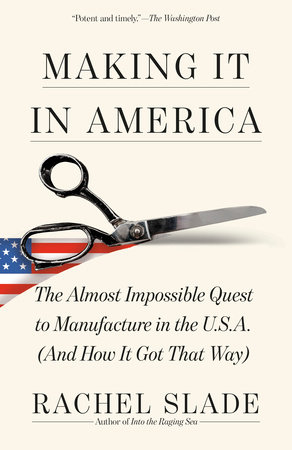
Their difficulties are well-described in “Making It In America” by Rachel Slade (2024). She follows the Waxmans from 2015 as they search for suppliers, battle anti-immigrant sentiment, and deal with many setbacks.They were hit hard in 2019 by bad quality inputs, and then by the pandemic. They switched to making masks, but got hit again when Chinese imports started up again.
Their saving grace was that they largely sold to unions and non-profits. Any time an organization needed logo-branded apparel for a convention or merch, they could supply it in bulk. They do now sell retail, and that’s where I got mine, and are thinking of opening their own stores. They currently have about 75 workers and have revenue in the low millions, although that’s hard to determine. That’s not that much after ten years, but I wish them all the luck.
The Smarter Scrubber
I came across this in a Youtube video on the excellent engineering channel SmarterEveryDay by Destin Sandlin:
A friend of his, John Youngblood, went through the common experience of inventors – he found a problem with the existing way things were done, and devised a better solution. In his case, the problem was with barbecue grill scrubbers. They’re made as wire brushes to scrape off the baked-on grease on a grill. Unfortunately, the steel bristles break off and can get in one’s food. If you swallow one, it’s bad news as it perforates your digestive tract.
So instead, he thought to make the scrubber with chain mail. Now the wires are tightly bound and won’t break. The head can also be run through a dishwasher to clean it. This is the kind of Aha! moment that every engineer hopes to feel. Sandlin loved the concept and thought to try an experiment – could this be made entirely in the US? He had been dismayed when his home state of Alabama was completely unable to make PPE during the pandemic, except for one old guy who knew how to make injection molds.
He also wanted to make it in the US because Amazon encourages Chinese manufacturers to rip off American products. They tell them exactly what is successful and put the knockoffs on the same search page. Because the quality is worse and they have no development expenses, they can undercut the inventors. Amazon then ignores patent infringement claims. Don’t ever buy anything from them.
Sandlin does a nice job describing the whole design process for the scrubber. He had to try a lot of different pads and schemes for attaching the mail to the head and patterns for the chain mail. Finding a US supplier was hard and they couldn’t get large quantities. The simplest and most standard part, a 1″ 1/4-20 stainless steel bolt, turned out to be the hardest of all. Chinese suppliers sell if for 9 cents, and the best he could do was a Massachusetts supplier for 35 cents.
What really depressed him was discovering that he couldn’t even make the molds for the head parts in the US. All that skilled work is now in China too. The US bosses fired the expensive mold makers in favor of cheaper Chinese ones just like they fired US workers. He ended up doing it himself, with a lot of help from old experts. That was enjoyable, but again not sustainable. One ray of light is that there are new ways to make smooth metal molds with 3D printing. Yet there’s still a lot of lost know-how in what the molds actually work.
So here’s the final product:
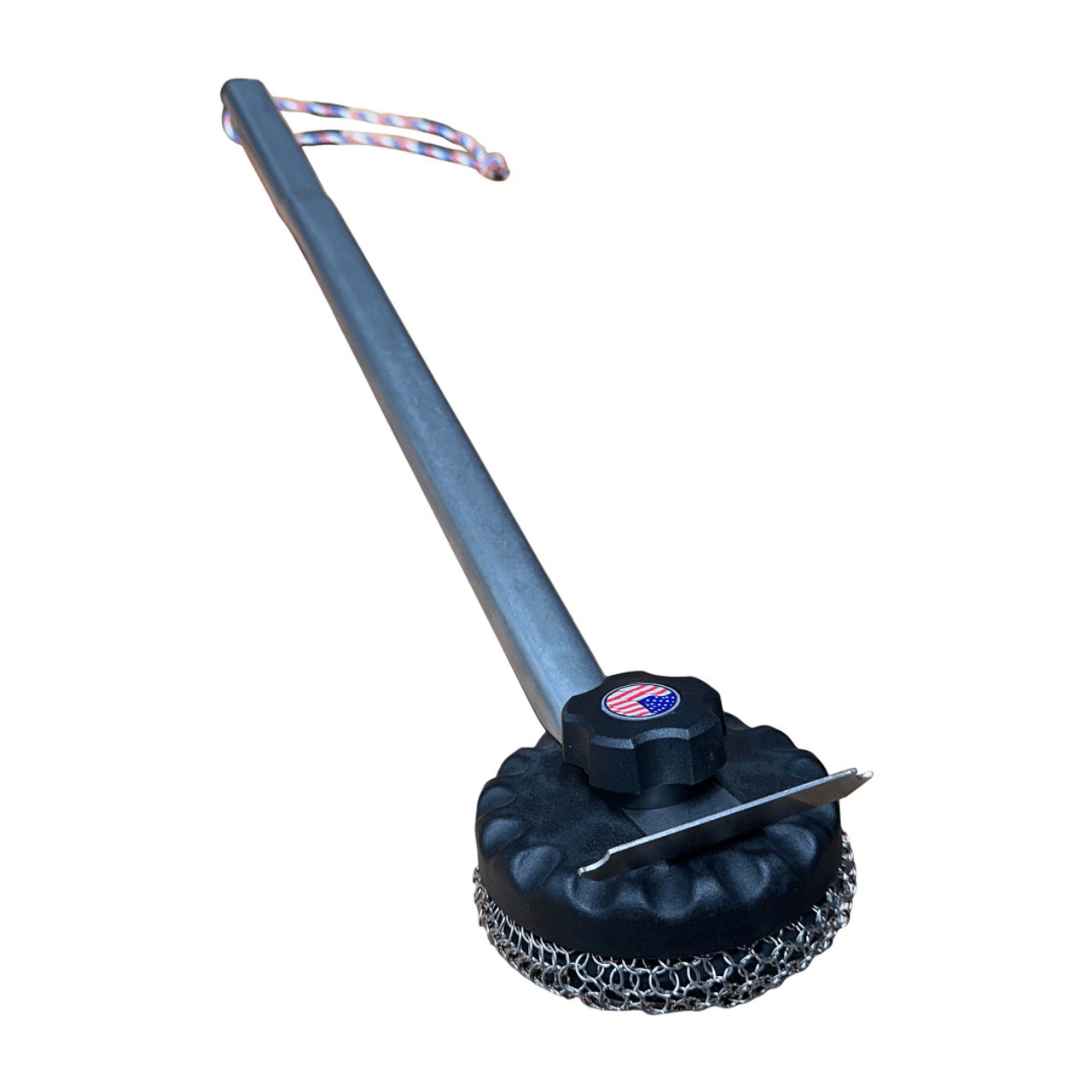
$75! And on back-order. That’s a lot compared to a standard brush, but it won’t, you know, kill you.
Sandlin put a lot of effort and money into this minor product, far more than any ordinary venture would. It would have been a lot easier and cheaper to do in a place with a working industrial infrastructure. He could do it because he has 12 million Youtube subscribers.
Yet he’s also doing it to make a point. It’s going to take a lot to undo the damage the oligarchs have done to the US economy. Trump blathers about bringing manufacturing back, but that’s all a pitch for the rubes – his actual actions have been entirely counter-productive. It’ll take clear and concrete actions like Sandlin’s and the Waxmans’, and therefore proof to politicians about how to really help.
 A Niche in the Library of Babel