
A New Zealand-based company, Whoosh Solutions, is building a new kind of urban transit system – a network of overhead fixed cables that are used by self-driving battery-powered gondolas to go from point to point. They can switch from one cable to another, unlike regular gondola systems, and so can take any route through a network to get around without having to change cars or stop. They let people on and off at stations every few blocks at ground level:
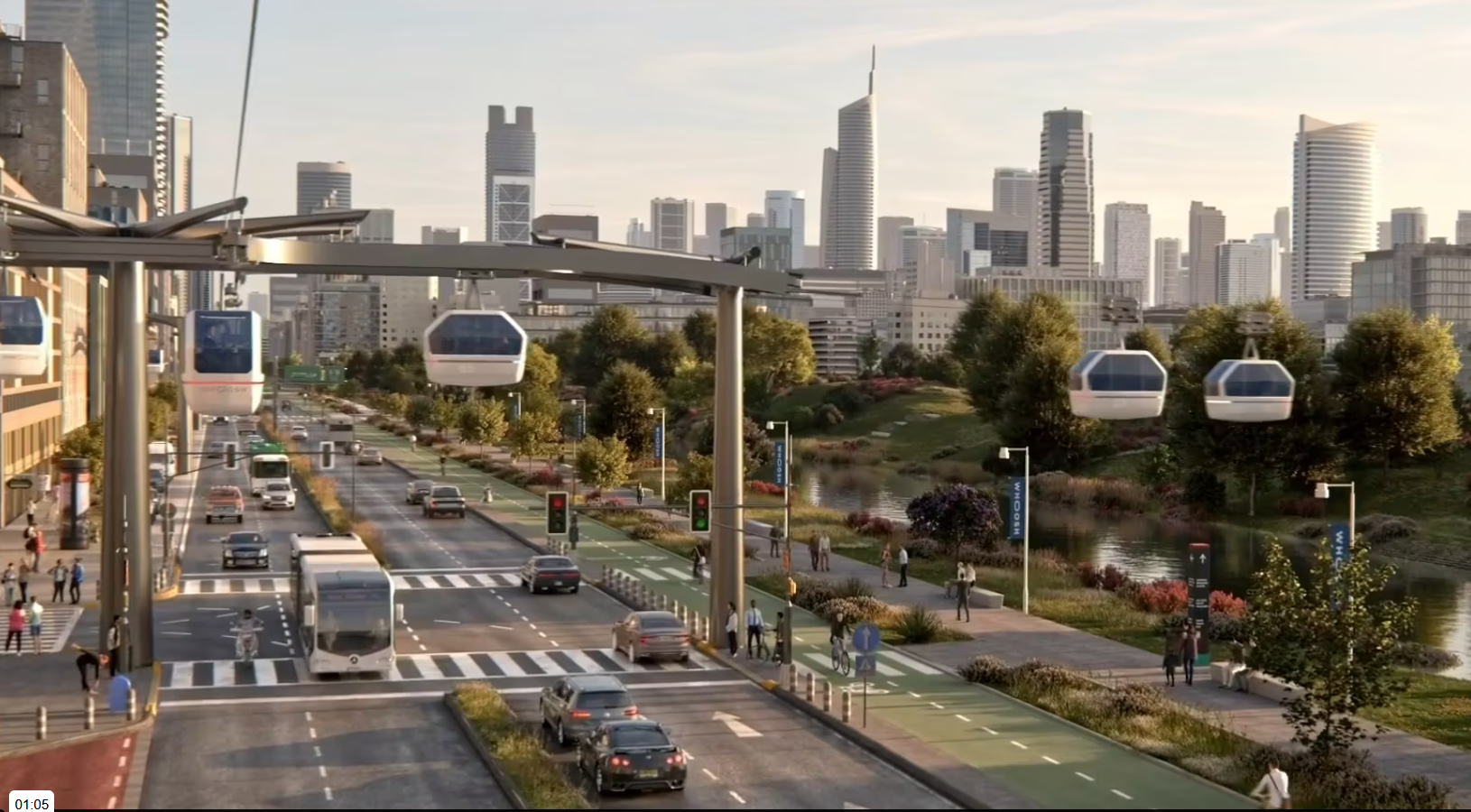
They’ve built a quarter-scale model in the resort town of Queensland NZ in the middle of the South Island, and are looking to build a full system there. They’re also looking to build a system in the Houston suburb of Sugarland. They were picked by the Google Transit team as a favored solution, which was then spun out as Swyft Cities. They’ll build the systems while Whoosh develops the tech.
The cars can hold up to 5 people, and so can take a family or someone with a lot of luggage or delivery packages. They’re a minimum of 9 meters above the ground, and so have lots of clearance over the streets. They run at up to 30 km/hr and go directly to a destination, so you can get there in a similar time to a car in a city. The cars are much safer than ground cars, which have to deal with drunken or distracted drivers, and kids running into the street, and the occasional animal.
So this has a lot of advantages over other mass-transit schemes:
- The cable towers and stations take hardly any land and far cheaper to build than light rail or even bus lanes. Whoosh estimates it at $5M / km vs $100M / km for rail. Boston would love to be able to build for $100M/km! Multiply that by 10 for New York. The towers are typically 150 m apart, and can be more in sparse areas. The cables can easily cross rivers and gorges.
- That also means they can be built quickly, like in years instead of decades. The system can grow to reach all kinds of areas now badly served by transit.
- Unlike a gondola on a fixed cable, the number of cars can vary with demand. A lot can be deployed at rush hour, and they can be taken offline at night for maintenance and recharging.
- They can come on call like a ride-share, instead of at fixed intervals like a bus or train, decreasing transit time and increasing utilization.
- The car entrances are at the same level as the platform, so there’s no step up or down. This is great for accessibility. This is a constant problem with buses, which have always had trouble with wheelchairs, and for regular cars for that matter.
- That also means that you can wheel hand trucks into them for deliveries.
- They can run in all weather, even when snow blocks roads. Queenstown is a big ski resort town. High winds are bad though.
- You get great views as you travel! Being in subway tunnels is always oppressive, and a bus is little better.
- It’s even more energy-efficient than an electric vehicle (EV) – the cars run continuously without many stops and starts for traffic, and the rolling resistance on the cable is low.
- Like gondolas, they can handle elevation changes easily, like mountains on a city’s edge. Trains can’t handle height changes at all, and even roads have problems. This is why many South American cities like Medellin, La Paz, Caracas, and Rio have already built big gondola systems.
- It’s riding the global trend towards EVs. All the same battery, inverter, and motor tech can be applied. The wheels are just on a cable instead of asphalt. The cars should ultimately cost only tens of thousands, and can be upgraded easily over time.
Yet there are disadvantages too:
- The capacity will be much lower than a train. A typical train can hold 200 people and arrive 10 times per hour for 2000 people per hour. Here there are only 5 people per car max, so at one minute per car that’s only 300 people per hour. That’s about like a bus. This was also the problem with the small tunnels of the Boring Company. Pods just can’t hold as many people as long cars.
- Many people don’t like heights and won’t go on something that swings in the air.
- This is new tech from a tiny company in a tiny country, and so lacks scale. Everybody builds buses and subway cars.
The biggest threat to it, though, is probably robo-taxis. Vast amounts are being invested in this by tech overlords who see automobiles as the next grand market to conquer, now that they’ve seized finance and advertising. A hundred million households in the US spending $500/month on their cars represents $600 billion. That’s why Waymo has put tens of billions into their autonomous system, and that’s what props up Tesla’s valuation at its ludicrous price-to-earnings ratio.
Yet Whoosh has some advantages here:
- They’re much safer. They don’t have to deal with all the random events of the street. Even the most highly tuned LIDAR/radar/V2V system is going to kill people who wander around. We only accept this now because there’s little other way to get around easily.
- They don’t need roads, which suck. They cut up neighborhoods, destroy green space, are noisy, and are hugely expensive to maintain. They’re constantly damaged by trucks and frost heaves and sewer/water work. Big fast roads like highways are a menace to humanity.
- They’re green from the start, without the legacy fossil fuel systems that have poisoned landscapes and now the atmosphere.
- They’re quiet! Even EVs make a lot of tire noise, while these have rubber wheels on cables high in the air.
So will this go anywhere? The Google interest is promising, but the hype around self-driving is overwhelming and the entrenched auto industry is hard to overcome. They killed street cars long ago, after all. This might be yet another tech that gets more traction (ha!) outside the US than in it.
 A Niche in the Library of Babel
Maybe this would be better for moving cargo than people? Then you might not need to worry about the low capacity or low speed, or the risk of people getting occasionally stuck in the air if the system breaks, or the complaints of residents along the route who don’t want people looking into their windows from the pods.. A cargo system might also be more easily built somewhere people wouldn’t complain about it being an eyesore, like over a highway corridor. Whereas putting a passenger gondola in a highway corridor might not be the ideal spot for transit. Of course, the trick would be automating the loading/unloading process so that goods could move back and forth easily between trucks and the gondola…