
I was just at the 2025 Consumer Electronics Show in Las Vegas. It’s the biggest tech show in the world these days, with 140,000 attendees and occupying a lot of the city. It fills the gigantic Las Vegas Convention Center, which is about a mile across on the diagonal, and also occupied the spectacular Venetian Hotel. It’s a firehose of new products, and is so big that it’s difficult to absorb.
It reminded me of the funny SF novel “First Contract” by Greg Costikyan (2001). The Galactic Federation finally contacts Earth, and everyone is overjoyed, until they realize that they have to pay for the anti-grav cars and the immortality drugs, and Earth has nothing to sell. A desperate human entrepreneur talks his way out to a galactic trade show, one that occupies a whole planet. Large companies have continents for booths, while smalls settle for islands like Britain. He actually interests someone in a product idea, a squeeze bulb with a suction cup to keep it from floating around in zero-gee. The buyer says “OK, let’s start with a minimum order, say, two trillion?” Hey, it’s a big galaxy! Humanity has to level up. All of Earth’s industries become devoted to making squeeze bulbs, because you gotta do what you gotta do.
Anyway, the big new products at CES this year were robots. They had ones the size and shape of dogs, even though Boston Dynamics never did find a use for their Spot robot. They had humanoid ones, which are mainly a play by the tech-feudalist overlords to scare workers into not unionizing. There were some actually useful ones like drones (the reason why Ukraine is still free) and package delivery bots that could carry your luggage around an airport. Then there was the massive attention on self-driving cars, with robo-vans that you could walk into, and lots of new sensing schemes.
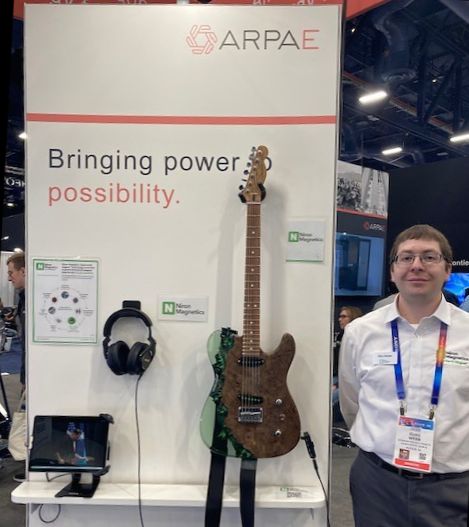
Sure, something will come of all of these. Yet I was more impressed by a little company called Niron Magnetics. They didn’t even have their own booth – they occupied a corner of a booth sponsored by ARPA-E. This is the research arm of the US Department of Energy, and is directly modeled on the Pentagon’s DARPA. They gave Niron startup money to commercialize a profound idea – building strong magnets out of iron and nitrogen. A professor at U. Minnesota, Jian-Ping Wang, has been working for 20 years on how to make Fe16N2 thermally stable. This is a particular crystalline form of iron with a few nitrogen atoms inserted in the lattice. It can deliver 30% stronger fields for a given weight than current rare-earth magnets! And it doesn’t need the neodymium or dysprosium that come from hellishly polluted mines in Mongolia. Refining a kg of Nd creates 200 kg of toxic waste. That’s why there are no mines of it outside of China these days.
Stronger magnets are useful everywhere. Have you ever noticed how cars suddenly got power windows and power seats in the 90s? That was because rare-earth magnets made the motors small and cheap enough that they could be used everywhere. GM actually pioneered them. A typical car cabin now has 21 motors: 8 for the windows and locks, 6 for the seats, 4 for windshield, cabin, and footwell fans, and 3 for the rear hatch and wipers. They used to have 2 – the fan and front wiper. All modern advances – EVs, robots, hard drives, and even inflatable lawn decor – have benefited from strong magnets.
Niron picked a cool application for their first samples – an electric guitar. The steel strings give a signal when they vibrate in a magnetic field. On their site you can see someone playing! They’re building their first factory now in Minnesota, and plan to scale up to thousands of tons as yield improves. Here’s wishing them luck! They only had one guy and a discrete poster at this show, as compared to all the flashy robots, but they could be a big deal.
 A Niche in the Library of Babel