
I recently saw “2001: A Space Odyssey” for the umpteenth time, and I have to agree with this old line:
There are those who say that “2001” is the greatest SF movie ever made, and there are others who are wrong.
This was an actual 35 mm print, and was so full of scratches and blotches that I was reminded anew of what an awful tech that was. It’s yet another thing we don’t miss from the 20th century. Actual celluloid only looks good for the first few showings, while digital laser projection looks good indefinitely.
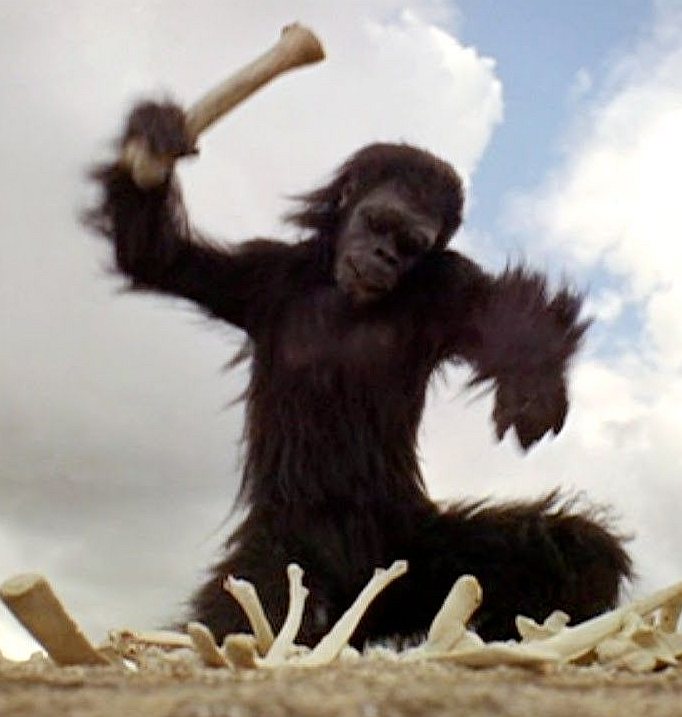
Anyway, the movie was as grand as ever, but the opening bothers me more and more. In “The Dawn of Man” segment, a hapless band of hominids are preyed upon by great cats, and bullied by a neighboring tribe. Then the Monolith appears. It starts playing “Also Sprach Zarathustra”, which understandably freaks out the hominids, and inspires them to start using bones as clubs. They attack their neighbors, and beat one to death, thus starting humanity on its rise. That was the true original sin.
Yet that’s just not right. Tool use is actually fairly common among higher animals, and hominids are not particularly violent, especially compared to chimpanzees. They’re actually intensely social, far more than other great apes, and now live in vast herds. Since both Kubrick and Clarke had lived through World War II, the worst war in human history, it’s not surprising that they would have a dark view of human nature.
So that got me wondering – what should the aliens have done to level up humanity? Can we point to single things that would have set us on our current path? If it wasn’t weapons, what was it? It should be something that appeared in one place instead of many, something that was a distinct inflection point. Things like agriculture or metal-working were invented in many places and times, and so were inevitable. They would also have needed a heck of a lot of monoliths!
So here are a couple of candidates in reverse chronological order:
The Upper Paleolithic Revolution

At some point between 50 and 100 thousand years ago, hominids woke up. They started burying their dead, they started making wonderfully elaborate stone tools, and they started making art, like this hand stencil. Both homo sapiens and homo neanderthalensis were doing it, and perhaps we’ll find that the other lost homo species did it too. There is no sudden change in the genetic record in this time frame, and both species are hundreds of thousands of years older than this. We just don’t see as sophisticated stuff at earlier sites. The whole set of traits is called Behavioral Modernity.
Some argue that this is when speech arose, and point to slight anatomical changes in the throat. Others dismiss the whole idea, saying that the changes happened far more incrementally and over longer periods.
Me, I vote for a strangely rectangular black rock appearing in Olduvai Gorge and teaching the locals to say “These berries are good and these bad.” That lets them communicate abstract concepts. They then teach that to their kids and start their march to world domination.
Fire
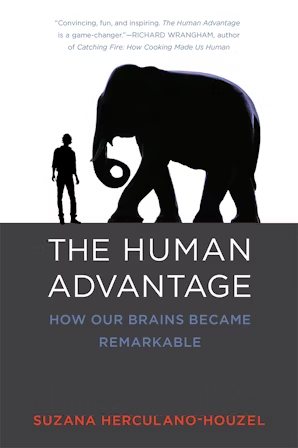
Humans do not have the biggest brains – elephants and whales do. They’re smart, but not all that smart compared to people. So the neuro-scientist Suzana Herculano-Houzel wanted to estimate brain complexity in a more rigorous way than just weight. She devised a way to actually count the neurons in the cortex, a macabre process she calls “brain soup”. She dissolved all the neural tissue with detergent, leaving just the nuclei. She stained them blue and could then count them under a microscope. This let her estimate just how many neurons there were in the brains of various species. She described it all in “The Human Advantage“, which is well-written and funny.
She found that humans have about three times the number of neurons in their cerebral cortices (16B) as the next most complex brains, those of elephants (5.8B) and chimpanzees (6B). This makes human brains really expensive in metabolic terms. It’s estimated that it would take 9 hours of foraging a day to keep a human fed.
Fortunately, we have another metabolic trick – fire. Cooking breaks down food, making it easier to get more calories out of the same material. The first evidence of fire is from 1.0 to 1.5 million years ago, and that’s when hominid brains started to expand. It looks like there was a positive feedback loop between using fire and expanding brains. They went from the size of chimp brains, about 500 cc’s to their present 1400 cc’s.
No other animal uses fire. We have co-evolved with it for so long that we find it inherently fascinating, so much so that pyromania is a common neural failure mode. Did the big black rectangle have some slow-burning piles of logs around it? With tasty yams and rabbits roasting in the coals? One gang figures this out in East Africa and suddenly they can live in any climate and eat almost anything.
Bipedalism
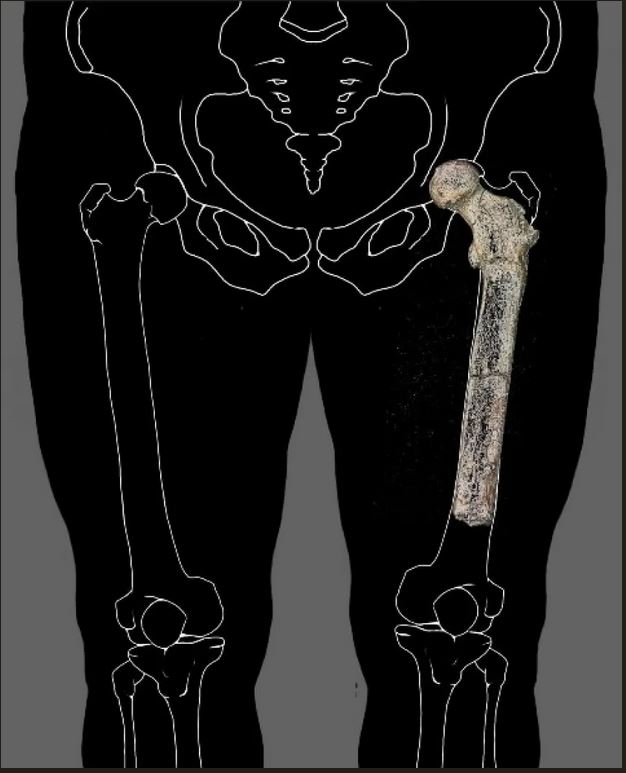
Another distinctive thing about hominids is how they stand upright. This has lots of advantages for sentience: it lets the hands become more dexterous by taking weight off of them, it puts the eyes up higher for spotting prey or danger, it allows the shoulder to adapt to throwing objects for hunting, and it permits long-distance running for chasing prey to exhaustion. It also ruins the back and makes one far vulnerable to head injuries, especially with large, heavy brains. The other great apes can stand up, but not for long.
The earliest evidence for it is a change in the femur to hip connection in the leg of about six million years ago, as seen in the image. This one tweak to the hip joint allows a lot more weight to be put on the leg. The other adaptations were to strengthen the knee (4 My ago), add an extra curve to the spine (2.5 My ago), and make the femur longer for longer strides (2 My ago).
That’s a lot of adaptations! The monoliths would have to tinker with the genes that controlled skeletal growth for a while. Or maybe they made the original hip joint change and let Darwin do the rest. This weird kid is born that can see farther and move faster than its peers, and that’s a big survival advantage. Its descendants start reaching up for stuff, start grabbing rocks and doing things with them, and start getting a bigger view of the world. In a couple of million years they’re more successful than even rats.
Anyway, there do seem to be a lot of mysterious changes that were all necessary for us to be able to sit here and discuss all this history. It took a long time to get from standing upright to manipulating fire, and a long time again from fire to art. There was little that was necessary about it. We may think that the universe should be full of vastly powerful and ancient aliens, ones that can uplift even apes on the savanna, but this whole process seems unlikely and improbable.
 A Niche in the Library of Babel